# Blocket.se Car Scraper: All Swedish listings (`memo23/blocket-scraper`) Actor
Scrape every car on Blocket.se — price with and without VAT, mileage in km, VIN, registration plate, battery kWh, equipment, all photos, plus seller phone, email, website and address. Splits past Blocket's 2,450-per-search limit to reach all ~144,000 listings. JSON or CSV.
- **URL**: https://apify.com/memo23/blocket-scraper.md
- **Developed by:** [Muhamed Didovic](https://apify.com/memo23) (community)
- **Categories:** E-commerce, Lead generation, Business
- **Stats:** 25 total users, 5 monthly users, 99.9% runs succeeded, 0 bookmarks
- **User rating**: No ratings yet
## Pricing
from $0.80 / 1,000 results
This Actor is paid per event. You are not charged for the Apify platform usage, but only a fixed price for specific events.
Learn more: https://docs.apify.com/actors/running/actors-in-store.md#pay-per-event
## What's an Apify Actor?
An Actor is a serverless cloud program that runs on the Apify platform. It has two run modes.
In Batch mode, an Actor accepts a well-defined JSON input, performs an action which can take anything from a few seconds to a few hours,
and optionally produces a well-defined JSON output, datasets with results, or files in key-value store.
In Standby mode, an Actor provides a web server which can be used as a website, API, or an MCP server.
Apify vocabulary and the platform model are defined once, in the agent quickstart at https://apify.com/agents.md.
## How to integrate an Actor?
If asked about integration, you help developers integrate Actors into their projects.
You adapt to their stack and deliver integrations that are safe, well-documented, and production-ready.
Do not guess an integration path. Every one of them is in the agent quickstart at https://apify.com/agents.md: the Apify MCP server, Agent Skills with the Apify CLI, the JavaScript and Python clients, the REST API, and the account-free path for an agent with no human to sign in. It also carries the rule on stating cost before the first paid run.
For examples already wired to this Actor's own input schema, see the [API](#api) section below.
Each client library has reference documentation the quickstart does not restate: [JavaScript/TypeScript](https://docs.apify.com/api/client/js/docs.md) (`npm install apify-client`) and [Python](https://docs.apify.com/api/client/python/docs.md) (`pip install apify-client`).
# README
## Blocket.se Scraper

**Every car on Blocket.se — not the first 2,450.** Paste any Blocket search URL and get one clean row per car: price with and without VAT, mileage in kilometres, VIN, registration plate, battery capacity, full equipment list, every photo at full resolution, and the seller's phone, email, website and postal address. Roughly 144,000 cars are listed at any moment, and this actor is built to reach all of them.
| Input you paste | What comes back |
|---|---|
| `blocket.se/mobility/search/car?...` — any search, any filter | One row per matching car, across the whole result set |
| `blocket.se/mobility/item/26253704` — a single ad | One row for that car |
| `blocket.se/mobility/dealer/9311124` — a dealer page | One row per car in that dealer's inventory |
| Nothing at all | Every car on Blocket |
> Pure HTTP. No browser, no headless Chrome, no third-party bypass service. Blocket ships its data inside its own server-rendered pages, and this actor reads it there.
***
### Why this is not a normal listing scraper
Blocket answers **any** single search with at most 50 pages of 49 ads. That is a hard ceiling of **2,450 rows per query**, and it arrives with no error, no warning, and no marker in the response. Point a conventional crawler at "all cars" and it returns 2,450 of 144,000 and reports success.
This actor measures the size of your query first, then splits it into price ranges — halving, and halving again — until every piece fits under the ceiling. On the full Swedish car market that currently means **127 partitions planned from 255 counting queries**, none of them touching the wall.
The split points are measured at run time, never hardcoded. A fixed ladder of price bands is only correct for the market it was measured against; the day the inventory shifts, one band crosses the ceiling and starts losing its tail with nothing in the log to say so.
Small runs skip all of that. Blocket lists newest first, so a run that wants 2,000 cars or fewer reads them straight off the first pages of your search: 60 cars from the whole market take two page loads and a few seconds.
***
### How it works
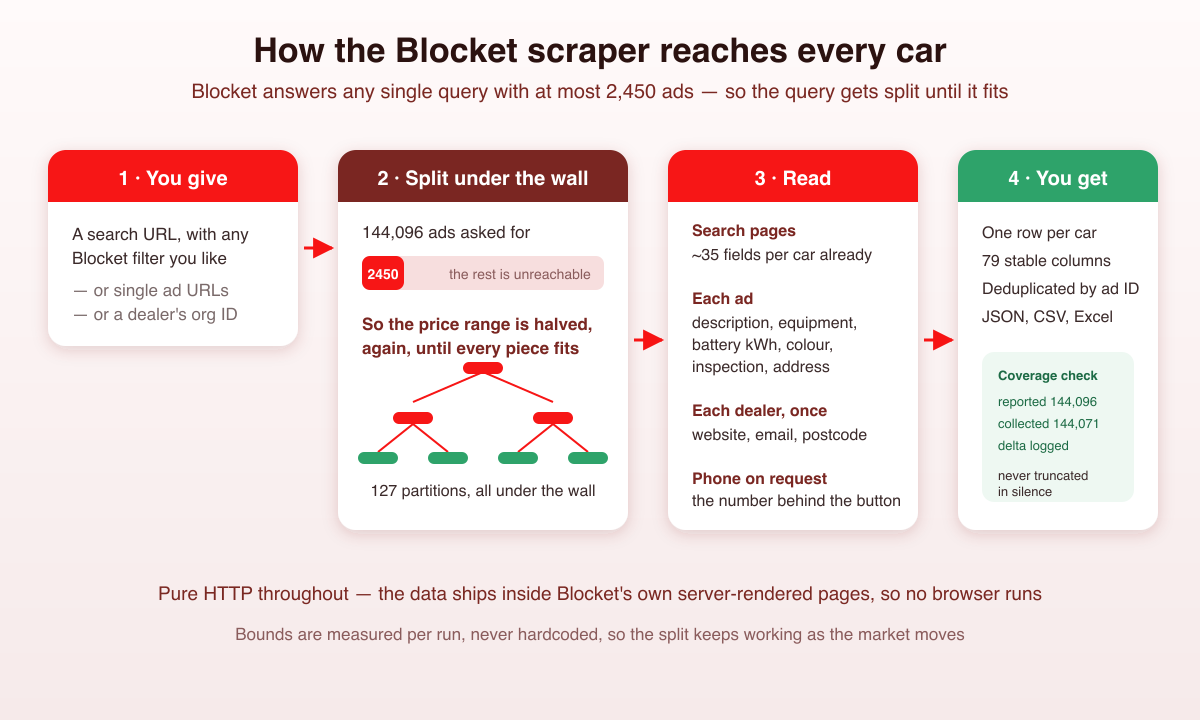
The run measures your query, plans the partitions, then walks each one. Ads seen while measuring are kept rather than re-fetched, and everything is deduplicated by ad ID, so a car that appears in two partitions is still one row.
At the end the actor compares what Blocket reported against what it actually collected and writes the difference into the log. Blocket's own count moves while a crawl runs — ads go up and come down by the minute — so a small delta is normal and the actor says so instead of pretending to a number it cannot guarantee.
***
### Input
| Field | Type | Required | Notes |
|---|---|---|---|
| `startUrls` | array | no | Search, ad or dealer URLs. Empty means every car on Blocket. |
| `dealerOrgIds` | array | no | Dealer org IDs; each expands to that dealer's whole inventory. |
| `detailLevel` | enum | no | `basic`, `full` (default) or `fullDealer`. See below. |
| `includePhone` | boolean | no | Resolve the number behind each ad's phone button. Default `false`. |
| `maxItems` | integer | no | Stop after this many cars. Default `1000`. Up to 2,000 come straight from the newest results. |
| `onlyNew` | boolean | no | Return only ads earlier runs did not return. For scheduled runs. Default `false`. |
| `monitorId` | string | no | Names the `onlyNew` memory. Empty means one memory per exact list of URLs. |
| `compareToMarket` | boolean | no | Add each car's market value from similar live listings. Default `false`. |
| `onlyBelowMarketBySek` | integer | no | Return only cars at least this many SEK below market, e.g. `10000`. |
| `onlyBelowMarketByPct` | integer | no | Return only cars at least this many percent below market, e.g. `10`. |
| `minDealConfidence` | enum | no | `medium` (default) or `high`: how sure a below-market match must be. |
| `includeRedFlagged` | boolean | no | Keep below-market cars whose ad mentions damage, defects or parts only. Default `false`. |
| `telegramBotToken` | string | no | Your bot's token (stored encrypted). Sends each returned car to Telegram. |
| `telegramChatId` | string | no | The chat, group or channel the alerts go to. |
| `maxTelegramAlerts` | integer | no | Alerts per run before the rest are summed up in one message. Default `50`. |
| `fullCoveragePass` | boolean | no | Second sweep to catch cars listed without a price. Default `false`. |
| `safePartitionCap` | integer | no | Split anything above this. Default `2000`. |
| `partitionConcurrency` | integer | no | Counting queries in flight while planning. Default `5`. |
| `maxConcurrency` | integer | no | Parallel requests while scraping. Default `10`. |
| `proxy` | object | no | Optional. Blocket serves this actor without one. |
#### Detail levels
| Level | Extra requests per car | What it adds |
|---|---|---|
| `basic` | none | ~35 fields straight from the search results: price, mileage, VIN, plate, coordinates, images, dealer name |
| `full` | 1 | Description, equipment list, battery capacity, colour, registration date, inspection dates, previous owners, seller's street address |
| `fullDealer` | 1 + one per dealer | Dealer website, email, switchboard number and postal address, fetched once per dealer and cached |
`basic` is dramatically cheaper and already carries most of what a pricing or inventory analysis needs. Reach for `full` when you want the description, the equipment or the EV fields.
#### Example input
```json
{
"startUrls": [
"https://www.blocket.se/mobility/search/car?fuel=4&dealer_segment=2&sales_form=1"
],
"detailLevel": "fullDealer",
"includePhone": true,
"maxItems": 5000
}
```
That reads every used electric car sold by a business. Any filter Blocket's own interface offers works in the URL — `price_from`, `price_to`, `year_from`, `mileage_to`, `body_type`, `transmission`, `wheel_drive`, `exterior_colour`, `location` and the rest are passed through untouched.
***
### Monitor new listings
Put the actor on a schedule with `onlyNew: true` and every run returns only the cars published since the previous one. On a Sunday evening Blocket gets about two new car ads a minute, so a run every few minutes usually reads one or two search pages.
```json
{
"startUrls": ["https://www.blocket.se/mobility/search/car?price_to=150000&dealer_segment=1"],
"onlyNew": true,
"detailLevel": "full",
"maxItems": 500
}
```
How it behaves:
- **The first run sets the starting point.** It returns the newest cars up to `maxItems`. From then on, a run returns only ads published after that.
- **Nothing is charged twice.** The actor remembers every ad it returned and skips it, including an old ad the seller bumps back to the top.
- **Runs stop early.** Paging stops as soon as the results are older than where the last finished run started, so a quiet interval costs one or two page loads. With `maxItems` above 2,000 the search is still split first, and each piece stops after its first page.
- **Nothing gets lost when a run is cut short.** If a run stops at `maxItems`, crashes or is aborted, the next run reads back down to the old starting point and returns what was missed. The log warns when runs keep hitting `maxItems`; raise it or run more often.
- **Results come newest first.** A `sort=` in your URL is replaced for monitoring runs, since the actor has to read newest first to know where to stop.
- **The memory lives in your account,** in a key-value store named `blocket-scraper-monitor`, one record per list of URLs. Editing the URL list starts a new baseline; set `monitorId` to keep one memory across edits, or to run two schedules over the same search. Ads are remembered for 90 days.
One limit: an older ad that starts matching your filters later, for example after a price cut brings it under your `price_to`, is not new and is not returned.
***
### Market comparison and below-market deals
Turn on `compareToMarket` and every car gets a market value: what similar cars on Blocket are asking right now.
- **Comparables come from Blocket's own make and model list,** not a text search, so a V60 is compared with V60s and never with XC60s. Fuel, gearbox and new/used always match.
- **The closest group with enough cars wins.** First the same year, trim word (D4, Long Range, 320d), seller type and mileage within 20%; then each condition is relaxed in turn, down to year ±1 at any mileage. `marketMatch` says which group was used.
- **Each comparable is adjusted to this car's mileage** along the model's own price-per-km slope, so a 330,000 km car is not valued against 230,000 km ones.
- **Every estimate shows its evidence:** how many cars it rests on, their price spread, a `high` / `medium` / `low` confidence, and the five comparables closest in mileage with their links.
On 150 fresh listings, the `high` estimates had a median gap of −2.9% to the asking price and 97% of them landed within ±20%.
Set `onlyBelowMarketBySek` and/or `onlyBelowMarketByPct` to get only the cheap ones:
```json
{
"onlyNew": true,
"onlyBelowMarketBySek": 10000,
"onlyBelowMarketByPct": 10,
"minDealConfidence": "high",
"detailLevel": "full"
}
```
A car is valued from its search result first, so one that isn't a deal costs no ad-page request and is never charged as a result. A below-market match needs at least five comparables and `medium` confidence (or `high`, if you ask for it). With a threshold set, `maxItems` limits how many cars are **checked**, not how many come back.
**Cheap for a reason.** Below-market cars whose title or ad text says motorfel, växellådsfel, startar ej, körförbud, reservdelar, krockskadad, leasingövertag, endast export and the like, or whose price is under 35% of market, are dropped unless you set `includeRedFlagged`. Every row carries a `redFlags` list either way. The ad text is only read at detail level `full`; at `basic` only the title and trim line are checked.
These are asking prices. Blocket publishes nothing about what cars sell for, so read `marketValue` as "what the market is asking", not "what it will sell for".
***
### Telegram alerts
Give the actor a bot token and a chat id and every car a run returns arrives in Telegram as a photo with year, mileage, price, the market comparison and the link. Combined with `onlyNew` on a schedule and a below-market threshold, that is a deal alert: a message only when a new car is listed cheap.
1. Message `@BotFather` on Telegram, send `/newbot`, and copy the token into `telegramBotToken` (the field is encrypted).
2. Send your new bot any message, or add it to your group. Get the chat id from `@userinfobot` (a person) or from the group's settings (groups start with `-100`).
3. Put the id in `telegramChatId`.
The actor checks the token and chat before the crawl and says in the log if either is wrong. It keeps to Telegram's limits (about one message a second to a person, twenty a minute to a group), waits when Telegram asks it to, and stops at `maxTelegramAlerts` with one closing message that counts the rest and links to the run.
***
### Output schema
One row per car, 89 columns in a fixed order. Fields a run did not ask for come back as `null` rather than disappearing, so a CSV keeps the same shape from run to run.
```jsonc
{
"adId": "26253704",
"adUrl": "https://www.blocket.se/mobility/item/26253704",
"title": "Tesla Model X",
"make": "Tesla",
"model": "Model X",
"modelSpecification": "100D Long Range 6-sits *MOMS* 423hk",
"year": 2017,
"firstRegistration": "2017-06-13",
"bodyType": "SUV",
"exteriorColor": "Grå",
"price": 308900, // SEK, including VAT
"priceExVat": 247120, // where the seller marked it VAT-deductible
"currency": "SEK",
"marketValue": 331400, // with compareToMarket: median of similar live listings
"priceVsMarketSek": -22500, // negative = cheaper than the market
"priceVsMarketPct": -6.8,
"marketComparables": 9,
"marketConfidence": "high",
"marketMatch": "same model, fuel and gearbox, företag sellers, year 2016-2018, mileage ±20%, adjusted to 147290 km",
"marketSpreadPct": 11.4,
"marketListingsCount": 61,
"marketComparableSample": [{ "adUrl": "https://www.blocket.se/mobility/item/…", "price": 329900, "year": 2017, "mileageKm": 151200, "dealerSegment": "Företag" }],
"redFlags": [],
"mileage": 14729, // Scandinavian miles, as Blocket reports it
"mileageUnit": "SCANDINAVIAN_MILE",
"mileageKm": 147290, // converted — one mil is ten kilometres
"previousOwners": 10,
"fuel": "El",
"transmission": "Automatisk",
"wheelDrive": "Fyrhjulsdrift",
"enginePowerHp": 423,
"batteryCapacityKwh": 100, // a real structured field, not parsed out of the title
"drivingRangeKm": 435,
"rangePerKwh": 4.4,
"chargingCosts": { "home_charging": { "cost_pr_km": 0.41 }, "monthly_savings": { "monthly_amount": 780 } },
"registrationNumber": "YGT452",
"chassisNumber": "5yjxcce29hf045288",
"inspectionLast": "2026-03-19",
"inspectionNext": "2027-03-31",
"description": "Tesla Model X 100D AWD, 423 hk, 6-sits (2017)…",
"equipment": ["ABS-bromsar", "Backkamera", "Digitalt mätarhus", "…47 entries"],
"imageUrls": ["https://images.blocketcdn.se/dynamic/1280w/item/26253704/…"],
"imageCount": 19,
"sellerStreet": "Finspångsgatan 37",
"sellerZip": "16353",
"sellerCity": "Spånga",
"latitude": 59.39018,
"longitude": 17.87464,
"orgId": "9311124",
"organisationName": "Cederfeldts Bil",
"dealerSegment": "Företag",
"adPhoneNumber": "073-518 06 90", // behind the ad's phone button
"adContactPhone": "+46735180690", // the ad's own contact block
"dealerPhone": "073-518 06 90", // the dealer's profile page
"adContactEmail": "sulle@cederfeldtsbil.se",
"dealerEmail": "info@cederfeldtsbil.se",
"dealerWebsite": "http://www.cederfeldtsbil.se/",
"publishedAt": "2026-09-01T12:18:41.000Z",
"updatedAt": "2026-09-02T13:33:46.860Z",
"scrapedAt": "2026-09-02T15:06:30.241Z"
}
```
#### Three phone numbers, three columns
Blocket exposes a seller's number in three places and they genuinely disagree. On one Porsche Center Göteborg listing the phone button returned `031-361 83 72`, the ad's contact block held `+46313855500`, and the dealer's own profile page said `031-385 55 00`. Each gets its own column, labelled by where it came from, so you can decide which one your use case wants rather than having the actor decide for you. The same applies to email.
***
### Pricing
Billed for work actually performed, so a cheap run stays cheap.
| Event | Charged when | Rate |
|---|---|---|
| Result | Each car row | $0.80 / 1,000 |
| Ad detail | An ad page is opened (`full` and above) | $0.50 / 1,000 |
| Dealer profile | Per **unique** dealer, not per row | $0.002 each |
| Phone number | A number is actually returned | $0.60 / 1,000 |
| Market valuation | A car is valued against live comparables (from 11 Oct 2026) | $5 / 1,000 |
| Telegram alert | An alert is delivered to your chat (from 11 Oct 2026) | $3 / 1,000 |
Which works out to roughly **$0.80 per 1,000** at `basic`, **$1.30** at `full`, and about **$1.86** with phone numbers switched on.
Nothing is charged for the counting queries that plan the partitions, for search pages, for retries, or for a phone lookup that comes back empty — around 7% of ads expose no number and those are free. A dealer with 200 cars in the run is charged once, not 200 times.
Market comparison and Telegram alerts are free until 11 October 2026. After that, a car that can't be valued (too few comparables) is not charged, a car turned away by a below-market threshold is charged for its valuation but not as a result, and failed alerts and the closing summary message are free.
***
### What makes this richer than a generic listing scraper
| Capability | Typical scraper | This actor |
|---|---|---|
| Result-set size | First 2,450 rows, silently | Splits the query until the whole set is reachable |
| Split points | Hardcoded price bands | Measured at run time, so they survive a shifting market |
| Coverage reporting | "Finished" | Reported vs collected, delta written to the log |
| Mileage | Raw Blocket number | Raw value, unit, and kilometres — no factor-of-ten trap |
| Battery capacity | Parsed out of the title text | Blocket's own structured `battery_capacity` field |
| Seller contact | One phone | Three phone sources and two email sources, each labelled |
| Images | First photo, default size | Every photo at 1280px, the largest the CDN serves |
| Browser | Often headless Chrome | Pure HTTP |
***
### Notes & limitations
**Battery capacity is optional on Blocket.** It is a real structured field, not something parsed out of the listing title, but sellers fill it in for only part of the inventory — roughly 40–45% in sampling. Expect nulls, and do not treat a null as "no battery data exists".
**About 7% of ads expose no phone number.** The number is served against a token that ships with the ad page, and some ads carry no token. Those rows get `adPhoneNumber: null`. That is Blocket withholding the number, not a failed request.
**Cars listed without a price need the extra pass.** The partitioner splits on price, so a car with no price is invisible to it — currently about 25 cars out of 144,000, or 0.02%. The actor detects this and says so in the log. Set `fullCoveragePass: true` to sweep a second axis and pick them up; it roughly doubles search-page traffic, and per-ad requests are deduplicated so those are not repeated.
**A whole-market run costs real money and needs the cost limit raised.** All ~144,000 cars comes to roughly $115 at `basic`, $187 at `full`, and around $268 with phone numbers on. Apify stops a run the moment it reaches the maximum-cost setting on that run, and it stops mid-crawl with no warning — a validation run of this actor was cut at 50,350 rows exactly that way. Raise the limit before starting a whole-market crawl, or keep the scope down with `maxItems` or a filtered search URL. A single price band or one dealer's inventory costs cents.
**Mileage is in Scandinavian miles.** Blocket's `mileage` is `mil`, where one mil is ten kilometres. Both the raw value and `mileageKm` are in the output. Using the raw number as kilometres puts you off by a factor of ten.
**Swedish values are not translated.** `fuel`, `transmission`, `exteriorColor`, `bodyType` and the equipment list come back as Blocket writes them — `El`, `Automatisk`, `Grå`. Translating them would mean guessing at a mapping and losing the original.
**Blocket's own total moves during a run.** It shifted three times within an hour during testing. The actor logs reported-versus-collected rather than asserting they match, because asserting it turns ordinary listing churn into failed runs.
***
### 🤖 For AI Agents & LLM Apps
**Purpose:** structured car listings from Blocket.se, Sweden's largest classifieds site. One row per car.
**Minimal tested input:**
```json
{ "startUrls": ["https://www.blocket.se/mobility/search/car?fuel=4"], "detailLevel": "basic", "maxItems": 100 }
```
**Key output fields:** `adId`, `adUrl`, `title`, `make`, `model`, `modelSpecification`, `year`, `firstRegistration`, `bodyType`, `exteriorColor`, `price`, `priceExVat`, `currency`, `mileage`, `mileageKm`, `previousOwners`, `fuel`, `transmission`, `wheelDrive`, `enginePowerHp`, `batteryCapacityKwh`, `drivingRangeKm`, `rangePerKwh`, `registrationNumber`, `chassisNumber`, `inspectionLast`, `inspectionNext`, `doors`, `seats`, `bootSizeLitres`, `weightKg`, `description`, `equipment`, `imageUrls`, `location`, `sellerStreet`, `sellerZip`, `sellerCity`, `latitude`, `longitude`, `orgId`, `organisationName`, `dealerSegment`, `adPhoneNumber`, `adContactPhone`, `dealerPhone`, `adContactEmail`, `dealerEmail`, `dealerWebsite`, `publishedAt`, `updatedAt`, `scrapedAt`.
**Behaviours worth knowing:**
- Billing is per row plus per unit of extra work: opening an ad, fetching a dealer profile, resolving a phone number. Partition planning, search pages, retries and empty phone lookups are free.
- `detailLevel: "basic"` needs no per-ad request and is the cheapest way to survey the market.
- `mileage` is in Scandinavian miles; use `mileageKm` for kilometres.
- `batteryCapacityKwh` and `adPhoneNumber` are frequently `null` — that is source data, not failure.
- Every field is present on every row, `null` when unknown, so the shape is stable.
- Swedish enum values are not translated.
- A capped run (`maxItems` reached) says so in the log and skips the coverage comparison.
- A whole-market crawl is ~$115 at `basic` and ~$187 at `full`. Raise the run's maximum-cost setting first, or it aborts part-way through.
***
### ⚠️ Disclaimer
This Actor is an independent tool and is **not affiliated with, endorsed by, or sponsored by** Blocket, Schibsted, Vend, or any of their subsidiaries. All trademarks mentioned are the property of their respective owners.
The scraper extracts only **publicly visible** data from Blocket.se — car listings, dealer profiles and the contact details Blocket itself shows to any logged-out visitor. No login, no CAPTCHA solving, no API-key forgery, no private-endpoint probing.
Users are responsible for:
- Complying with Blocket.se's Terms of Service
- Following GDPR and your jurisdiction's data-protection laws when storing or processing seller contact details, registration plates and VINs
- Not contacting sellers listed in scraped data without a lawful basis for doing so
- Not republishing scraped data in a way that competes commercially with Blocket
- Honouring any opt-out signals on the source pages
Registration plates and chassis numbers are personal data in many jurisdictions when they can be linked to an individual. Treat them accordingly.
***
### SEO Keywords
blocket scraper, scrape blocket, blocket.se scraper, blocket car scraper, blocket bilar scraper, swedish car listings scraper, sweden used car data, blocket api, blocket mobility scraper, swedish car market data, blocket dealer scraper, blocket annonser scraper, used car price data sweden, swedish vehicle listings, blocket electric car scraper, sweden ev listings scraper, blocket elbil scraper, car dealer leads sweden, swedish car dealer contacts, vin scraper sweden, registration plate scraper sweden, blocket cheerio scraper, no-browser blocket scraper, apify blocket, blocket bulk export, swedish automotive market research, car pricing intelligence sweden, blocket inventory scraper, blocket bil data, nordic car listings scraper, blocket listing extraction
# Actor input Schema
## `startUrls` (type: `array`):
Search URLs, single ads, or dealer pages — the actor works out which is which. Leave empty to scrape every car on Blocket. Example search: https://www.blocket.se/mobility/search/car?fuel=4\&dealer_segment=2\&sales_form=1 (used electric cars sold by businesses). Any filter Blocket supports is passed through untouched.
## `dealerOrgIds` (type: `array`):
Dealer org IDs (the number in /mobility/dealer/{orgId}). Each one is expanded into that dealer's complete inventory.
## `detailLevel` (type: `string`):
How much is collected per ad. 'Basic' reads the search results only — about 35 fields per car including price, mileage, VIN, registration number, coordinates and images — and needs no extra request, so it is by far the fastest. 'Full' opens each ad for description, equipment list, battery capacity, colour, registration date, inspection dates, previous owners and the seller's street address. 'Full + dealer' also loads each dealer's profile page once for their website, email and postal address.
## `includePhone` (type: `boolean`):
Fetch the number behind each ad's 'Visa telefonnummer' button. It can differ from the phone on the dealer's profile page, so both are kept in separate fields. Needs a detail level above Basic and costs one extra request per ad. Around 7% of ads expose no number.
## `maxItems` (type: `integer`):
Stop after this many cars. Blocket lists newest first, so up to 2,000 cars come straight from the newest results in seconds. Larger numbers make the actor split the search to get past Blocket's 2,450-per-search limit; the whole market is roughly 149,000 cars.
## `onlyNew` (type: `boolean`):
Return only ads that earlier runs did not return. Each run remembers the ads it returned and where it stopped reading, so a run on a schedule picks up exactly what was published since the previous one, stops paging as soon as it reaches older ads, and never charges twice for the same car. The first run sets the starting point by returning the newest ads up to Max results. The memory is kept in a key-value store named blocket-scraper-monitor in your account, one record per set of URLs (or per Monitor name under Advanced).
## `compareToMarket` (type: `boolean`):
Add an estimated market value to every car: the median asking price of similar cars listed on Blocket right now (same model, fuel, gearbox and new/used, then as close as possible on year, trim, seller type and mileage, with each comparable adjusted to this car's mileage). Adds marketValue, priceVsMarketSek, priceVsMarketPct, how many cars it rests on, a confidence level and five of the comparables so you can check it. These are asking prices; Blocket publishes no sale prices. Charged per car valued.
## `onlyBelowMarketBySek` (type: `integer`):
Return only cars priced at least this far under their market value, e.g. 10000. Turns market comparison on. A car is checked against the market from its search result first, so cars that miss cost no ad-page request. With this set, Max results limits how many cars are checked, not how many come back.
## `onlyBelowMarketByPct` (type: `integer`):
Same as above, as a percentage, e.g. 10. When both are set a car has to clear both.
## `minDealConfidence` (type: `string`):
'Medium' needs at least five close comparables that roughly agree on price. 'High' also needs the same seller type (private or dealer), eight or more cars and a tight price spread: fewer matches, fewer false alarms.
## `includeRedFlagged` (type: `boolean`):
Below-market cars whose ad mentions engine or gearbox failure, a driving ban, parts only, crash or water damage, export only or a lease takeover, or whose price is under 35% of market, are dropped by default: they are cheap for a reason. Turn this on to keep them (they still carry the redFlags field). The ad text is read at detail level Full; at Basic only the title is checked.
## `telegramBotToken` (type: `string`):
Send every car this run returns to Telegram, as a photo with price, mileage, market comparison and link. Create a bot with @BotFather and paste its token here. Pairs well with 'Only new listings' on a schedule and a below-market threshold: you get a message only for new cheap cars. Charged per alert delivered.
## `telegramChatId` (type: `string`):
Your chat, group or channel ID (e.g. 123456789 or -1001234567890). Message your bot once first, or add it to the group. @userinfobot tells you your own ID.
## `maxTelegramAlerts` (type: `integer`):
Stop sending after this many; the rest are summed up in one closing message with a link to the run. Telegram allows about one message a second to a person and twenty a minute to a group.
## `safePartitionCap` (type: `integer`):
Blocket refuses to paginate past 2,450 results per query, so the actor splits any search bigger than this into price ranges. The default of 2,000 leaves headroom for ads posted mid-crawl. Raising it toward 2,450 risks silently losing the tail of a partition.
## `fullCoveragePass` (type: `boolean`):
About 0.05% of Blocket's cars are listed without a price, and the actor splits large searches by price — so those ads cannot be reached on that axis. Turn this on to run a second sweep by year and merge the results. It roughly doubles the search-page traffic; per-ad and per-dealer requests are deduplicated, so those are not repeated.
## `partitionConcurrency` (type: `integer`):
How many counting queries run at once while the actor works out how to split a large search.
## `maxConcurrency` (type: `integer`):
Maximum parallel requests while scraping ads.
## `minConcurrency` (type: `integer`):
Minimum parallel requests.
## `maxRequestRetries` (type: `integer`):
How many times a failed request is retried before the actor gives up on it.
## `monitorId` (type: `string`):
Only used with 'Only new listings'. Runs with the same name share one memory of which ads were already returned. Leave empty to tie the memory to the exact list of URLs, which means editing the list starts a fresh baseline. Give each schedule its own name if you run several over the same search.
## `proxy` (type: `object`):
Optional. Blocket serves this actor without a proxy, so leave it unset unless your runs start failing. When set, it replaces the actor's built-in residential pool.
## Actor input object example
```json
{
"startUrls": [
"https://www.blocket.se/mobility/search/car?fuel=4&dealer_segment=2&sales_form=1"
],
"detailLevel": "full",
"includePhone": false,
"maxItems": 1000,
"onlyNew": false,
"compareToMarket": false,
"minDealConfidence": "medium",
"includeRedFlagged": false,
"maxTelegramAlerts": 50,
"safePartitionCap": 2000,
"fullCoveragePass": false,
"partitionConcurrency": 5,
"maxConcurrency": 10,
"minConcurrency": 1,
"maxRequestRetries": 5
}
```
# Actor output Schema
## `results` (type: `string`):
Dataset of Blocket car listings with price and VAT-excluded price, mileage in both Scandinavian miles and kilometres, VIN and registration number, fuel and drivetrain, EV battery capacity and range, equipment list, full-resolution images, and phone, email, website and postal address for the seller.
# API
You can run this Actor programmatically using our API. Below are code examples in JavaScript, Python, and CLI, as well as the OpenAPI specification and MCP server setup.
## JavaScript example
```javascript
import { ApifyClient } from 'apify-client';
// Initialize the ApifyClient with your Apify API token
// Replace the '' with your token
const client = new ApifyClient({
token: '',
});
// Prepare Actor input
const input = {
"startUrls": [
"https://www.blocket.se/mobility/search/car?fuel=4&dealer_segment=2&sales_form=1"
],
"detailLevel": "full",
"maxItems": 1000,
"safePartitionCap": 2000,
"partitionConcurrency": 5,
"maxConcurrency": 10,
"minConcurrency": 1,
"maxRequestRetries": 5
};
// Run the Actor and wait for it to finish
const run = await client.actor("memo23/blocket-scraper").call(input);
// Fetch and print Actor results from the run's dataset (if any)
console.log('Results from dataset');
console.log(`💾 Check your data here: https://console.apify.com/storage/datasets/${run.defaultDatasetId}`);
const { items } = await client.dataset(run.defaultDatasetId).listItems();
items.forEach((item) => {
console.dir(item);
});
// 📚 Want to learn more 📖? Go to → https://docs.apify.com/api/client/js/docs
```
## Python example
```python
from apify_client import ApifyClient
# Initialize the ApifyClient with your Apify API token
# Replace '' with your token.
client = ApifyClient("")
# Prepare the Actor input
run_input = {
"startUrls": ["https://www.blocket.se/mobility/search/car?fuel=4&dealer_segment=2&sales_form=1"],
"detailLevel": "full",
"maxItems": 1000,
"safePartitionCap": 2000,
"partitionConcurrency": 5,
"maxConcurrency": 10,
"minConcurrency": 1,
"maxRequestRetries": 5,
}
# Run the Actor and wait for it to finish
run = client.actor("memo23/blocket-scraper").call(run_input=run_input)
# Fetch and print Actor results from the run's dataset (if there are any)
print(f"💾 Check your data here: https://console.apify.com/storage/datasets/{run.default_dataset_id}")
for item in client.dataset(run.default_dataset_id).iterate_items():
print(item)
# 📚 Want to learn more 📖? Go to → https://docs.apify.com/api/client/python/docs/quick-start
```
## CLI example
```bash
echo '{
"startUrls": [
"https://www.blocket.se/mobility/search/car?fuel=4&dealer_segment=2&sales_form=1"
],
"detailLevel": "full",
"maxItems": 1000,
"safePartitionCap": 2000,
"partitionConcurrency": 5,
"maxConcurrency": 10,
"minConcurrency": 1,
"maxRequestRetries": 5
}' |
apify call memo23/blocket-scraper --silent --output-dataset
```
## MCP server setup
```json
{
"mcpServers": {
"apify": {
"type": "http",
"url": "https://mcp.apify.com/?tools=fetch-actor-details,memo23/blocket-scraper"
}
}
}
```
The hosted server signs you in with OAuth on first connect, so no API token belongs in this config. Clients without OAuth support can send an `Authorization: Bearer ` header instead, using a token from API & Integrations in Apify Console (https://console.apify.com/settings/integrations).
## OpenAPI specification
Download the OpenAPI definition: https://api.apify.com/v2/actors/dXBErtsICFDxDg5Ww/builds/d4WGPdNk9qpRKJ9om/openapi.json