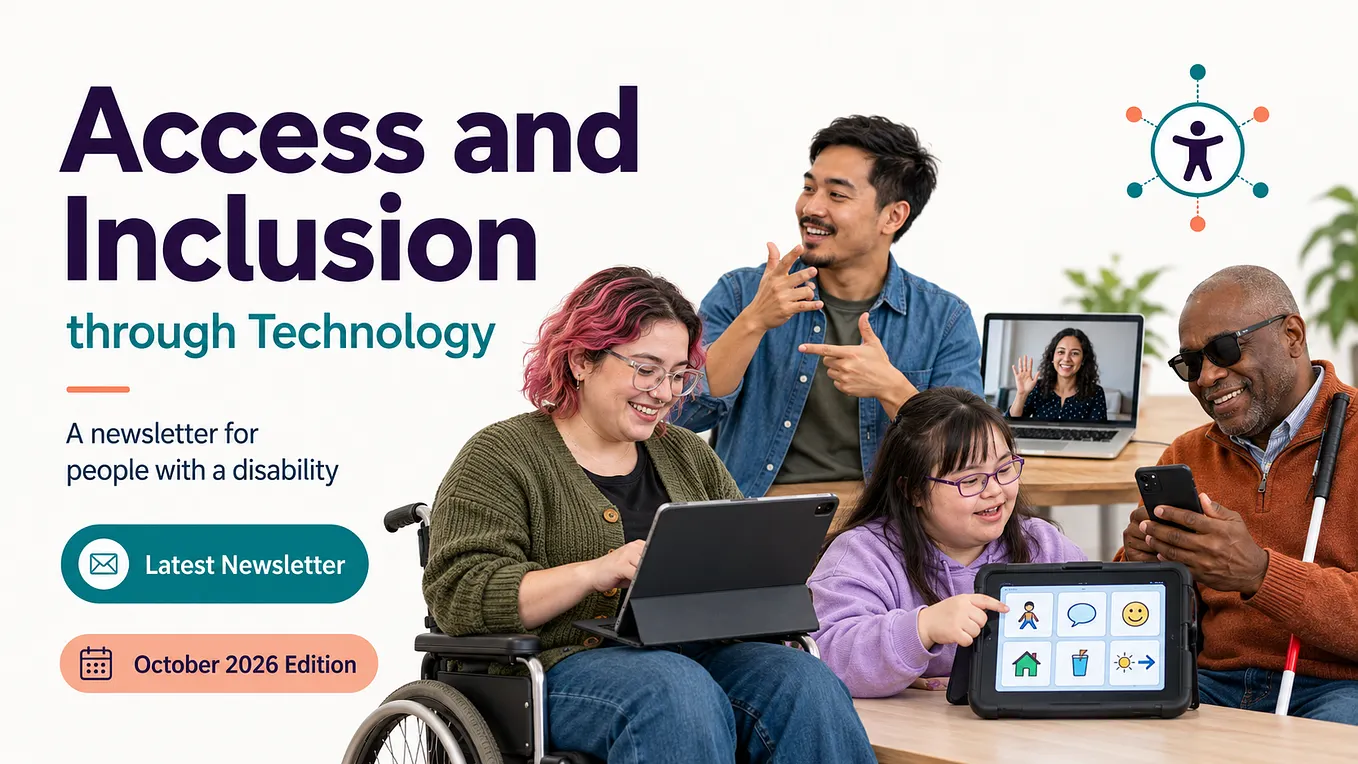
Access & Inclusion Through Technology — 1 September 2026


A Monthly Round-Up of Global News on Disability, Assistive Technology and Digital Inclusion
August 2026 Edition
Welcome to this month’s digest of news on access and inclusion through technology for people with disability — covering policy, service provision, research, training, awareness, and commercial products from North America, Latin America, Europe, Africa, Asia, and Australasia. Each entry is summarised briefly with a link to the original source for further reading.
🌎 North America
DOJ reverses course on disability rights enforcement
The US Department of Justice has reversed long-held positions in multiple federal court cases concerning the right of people with disabilities to access home- and community-based services, prompting concern among advocates about a possible drift back toward institutionalisation.
Healthcare providers face new federal accessibility deadlines
New accessibility obligations from the Department of Justice (ADA Title II) and the Department of Health and Human Services (Section 504) have taken effect for healthcare providers, requiring accessible patient portals, telehealth platforms and digital forms.
Meta names recipients of its AI Glasses Impact Grants
Meta awarded nearly $2 million across 30 US organisations exploring how its Ray-Ban Meta AI glasses can support independence, with a dozen recipients focused specifically on disability needs — including hands-free documentation of accessibility barriers and support for people with dementia.
🔗 Disability Scoop | Digital Watch Observatory
Lyft removes a Medicaid ride-share barrier for people with I/DD
Lyft has taken steps to let more people with intellectual and developmental disabilities access rides paid for through Medicaid home- and community-based services programmes, addressing a longstanding gap in transport funding.
Labor Department to rescind a decade-old disability hiring rule
A federal rule designed to boost employment of people with disabilities among federal contractors is being rescinded, ending a policy that had been in place for roughly a decade.
Tennessee engineering student 3D-prints a mobility chair for a toddler with cerebral palsy
After her family struggled to source a device through insurance, University of Tennessee at Chattanooga mechatronics student Austin McDade used open-source files and 3D printing to build a custom bright-pink mobility chair for two-year-old Amelia Aiken, giving her independent movement ahead of starting preschool.
🔗 UTC News
Google brings sign-language-to-text AI to the Pixel 11
Google DeepMind’s new SL2T model powers real-time sign-to-text dictation in Gboard and Live Transcribe on the Pixel 11, letting Deaf and hard-of-hearing users sign directly into their phone instead of typing — the first sign-language AI to ship at consumer scale, developed with Deaf Googlers and an AI Sign Language Advisory Committee.
Augmental’s tongue-controlled MouthPad goes on public sale in the US
Augmental has opened US public sales of MouthPad, a custom-fit, dental-resin mouthpiece that turns tongue and head movements into cursor control, clicks and scrolling over Bluetooth — built primarily for people with paralysis, limb loss or spinal cord injury, and already used daily by more than 100 people in early access.
🌎 Latin America
AI expands independence for people with visual disabilities in Argentina
Argentine reporting highlights how combinations of AI and assistive technology now let people with visual disabilities independently identify medication, read restaurant menus via smartphone camera, and navigate cities using GPS-enabled canes — tasks that once required a sighted helper.
Argentina raises disability service tariffs again in August
Argentina’s disability secretariat approved a further 2.1% increase to tariffs paid under its national system of basic disability supports, tracking July’s inflation figure — the second consecutive monthly rise, though advocates say cumulative increases still lag behind prior losses in real value.
🌍 Europe
EU AI Act’s transparency and disability safeguards become fully enforceable
From 2 August the European Commission began enforcing the AI Act’s transparency rules: interactive AI must disclose when a user is dealing with a machine, and AI-generated content must be labelled — disclosures that must themselves be perceivable and usable by disabled users. The same milestone brought a specific, standing prohibition on AI systems that exploit the vulnerabilities of people with disabilities.
🔗 European Commission, Digital Strategy | UserWay
Digital euro app designed to exceed EU accessibility minimums
The European Central Bank says its planned digital euro app will go beyond European Accessibility Act and EN 301 549 requirements, incorporating screen-reader compatibility, keyboard navigation, simplified language, reduced motion and time-out warnings, with accessibility testing planned during a 2027 pilot.
EN 301 549 v4.1.0 adopted, bringing WCAG 2.2 into Europe’s ICT standard
European national standardisation bodies have adopted EN 301 549 v4.1.0, updating the harmonised standard behind the European Accessibility Act to replace WCAG 2.1 with WCAG 2.2 and add six new Level A/AA requirements, including Target Size, Accessible Authentication and Focus Not Obscured. The revision is expected to be referenced in the EU’s Official Journal later in 2026.
🔗 BarrierBreak, Accessibility Buzz newsletter, August 2026
Wimbledon launches accessible broadcast for blind and low-vision fans
The All England Lawn Tennis Club, working with Hawk-Eye, introduced a new accessible broadcast feed designed to help blind and low-vision audiences follow live tennis coverage.
🔗 Centre for Accessibility Australia
AI sign-language avatar demonstrated at the European Parliament
Policymakers, researchers, disability organisations and technology companies gathered at a European Parliament conference on AI and digital accessibility, where an AI-driven sign-language avatar was among the technologies demonstrated.
🔗 Centre for Accessibility Australia
Spain gives 70,000 blind people an audio experience of the solar eclipse
For the 12 August total solar eclipse, Spain’s Instituto de Astrofísica de Andalucía built a synchronised audio system translating the eclipse’s progress into sound, letting tens of thousands of blind and low-vision people follow the astronomical event in real time.
A wave of new AI-powered hearing aids launches across August
Danish hearing-aid maker Oticon introduced Reveal, its first hearing aid built on a Dual AI system aimed at improving speech clarity while preserving useful background sound (orders opened 24 August). Jabra Enhance followed with three new FDA-cleared self-fitting models offering in-app tuning and virtual audiology support, while Swiss manufacturer Phonak launched its EON platform with a new chip, third-generation real-time AI processing and a smaller, longer-lasting design.
🔗 Oticon | Jabra (GlobeNewswire) | Phonak (GlobeNewswire)
Meta commits 15,000 free AI glasses to Vision Ireland
Meta will provide 15,000 Ray-Ban Meta glasses to Vision Ireland — enough for every blind or visually impaired adult the organisation supports — alongside assessment, in-person training and ongoing helpdesk support, making it a significant real-world test of mainstream AI wearables as assistive technology.
UK funds 11 accessible-transport innovators
The UK’s National Centre for Accessible Transport selected 11 organisations for further funding worth over £1 million through its Scaling Innovation programme, combining finance, research evidence, lived experience and specialist accessibility expertise.
🔗 National Centre for Accessible Transport
Catalonia relaunches €6.9m disability product assistance scheme
The Catalan government has restored its PUA assistance programme, covering more than 130 disability products and services including electronic magnifiers, hearing aids, wheelchairs, hoists and vehicle adaptations, after several years without a call for applications.
🌍 Africa
South Africa and China deepen disability-inclusion cooperation
Following a visit from the China Disabled Persons’ Federation, South Africa and China agreed to deepen cooperation on disability data, universal design, AI and assistive technology, moving from dialogue toward joint programmes and vocational exchanges for learners with disabilities.
🔗 SAnews
Nigeria hackathon challenges youth on “Technology Without Barriers”
Get David Banes’s stories in your inbox
Join Medium for free to get updates from this writer.
At the Nigerian Communications Commission’s fourth Hackathon Live Show in Abuja, young innovators presented AI-powered speech-to-text tools, real-time sign-language translation, voice-enabled complaint systems and image-to-voice navigation aids for people with disabilities.
South Africa: “move beyond charity” towards genuine disability inclusion
Closing South Africa’s 2026 Special Olympics National Summer Games, Deputy Minister Mmapaseka Steve Letsike called for a shift from charity and accommodation towards equal opportunity, dignity and meaningful participation for people with disabilities.
🔗 SAnews
🌏 Asia
India’s AssisTech Foundation ecosystem keeps fuelling AT startups
AssisTech Foundation, incubated in the IIT Madras ecosystem, continues to support assistive-technology startups such as NeoMotion, which builds customisable wheelchairs addressing the reality that “every wheelchair user is different, yet most wheelchairs are not.”
🔗 The Week
China sets AI and brain-computer interfaces as disability-tech priorities
China’s Disabled Persons’ Federation says its 15th Five-Year Plan (2026–2030) will further advance AI applications for people with disabilities and promote emerging assistive technologies including brain-computer interfaces, building on existing use of AI-assisted exoskeletons in hundreds of hospitals nationwide.
🔗 CGTN
Roland documents how a blind musician made a keyboard independently learnable
Japanese instrument maker Roland’s Future Design Lab worked with blind musician and accessibility consultant Jason Dasent to produce an accessibility guide plus audio and video resources, aimed at letting blind and visually impaired musicians learn the V-STAGE performance keyboard independently.
🌏 Australasia
New Zealand consults on a draft Digital Accessibility Standard
After two decades in which New Zealand’s public-sector accessibility standard covered web content alone, a draft Digital Accessibility Standard proposes to broaden its scope, replacing the current Web Accessibility Standard.
🔗 OZeWAI
Australia unveils draft aviation disability standards
At the 2026 Australian Aviation Summit, the federal government released draft standards, developed with people with disabilities and industry, to improve accessibility across the whole flying journey from booking through to boarding.
PWDA criticises Senate committee’s recommendation on NDIS Bill
People with Disability Australia condemned a Senate Community Affairs Legislation Committee recommendation to pass the NDIS Amendment (Securing the NDIS for Future Generations) Bill 2026, arguing the process gave insufficient time for meaningful scrutiny.
🔗 OZeWAI
🌐 Global Standards & Products
W3C issues a WCAG 3 Editor’s Draft
The W3C updated its accessibility work programme through August and issued a 28 August WCAG 3 Editor’s Draft, while also broadening the description of the WCAG Evaluation Methodology to cover digital products beyond websites.
🔗 W3C WAI
accessiBe adds a conversational AI assistant to its accessibility widget
accessiBe introduced a conversational AI interface within accessWidget, letting users describe their accessibility needs in natural language rather than configuring settings manually. The move is notable, though automated overlay approaches to accessibility remain contested within the accessibility field.
✍️ Blogs by David Banes
Recent posts shared on David Banes’ LinkedIn channel, from his ongoing “Access and Inclusion Through Technology” commentary on Medium.
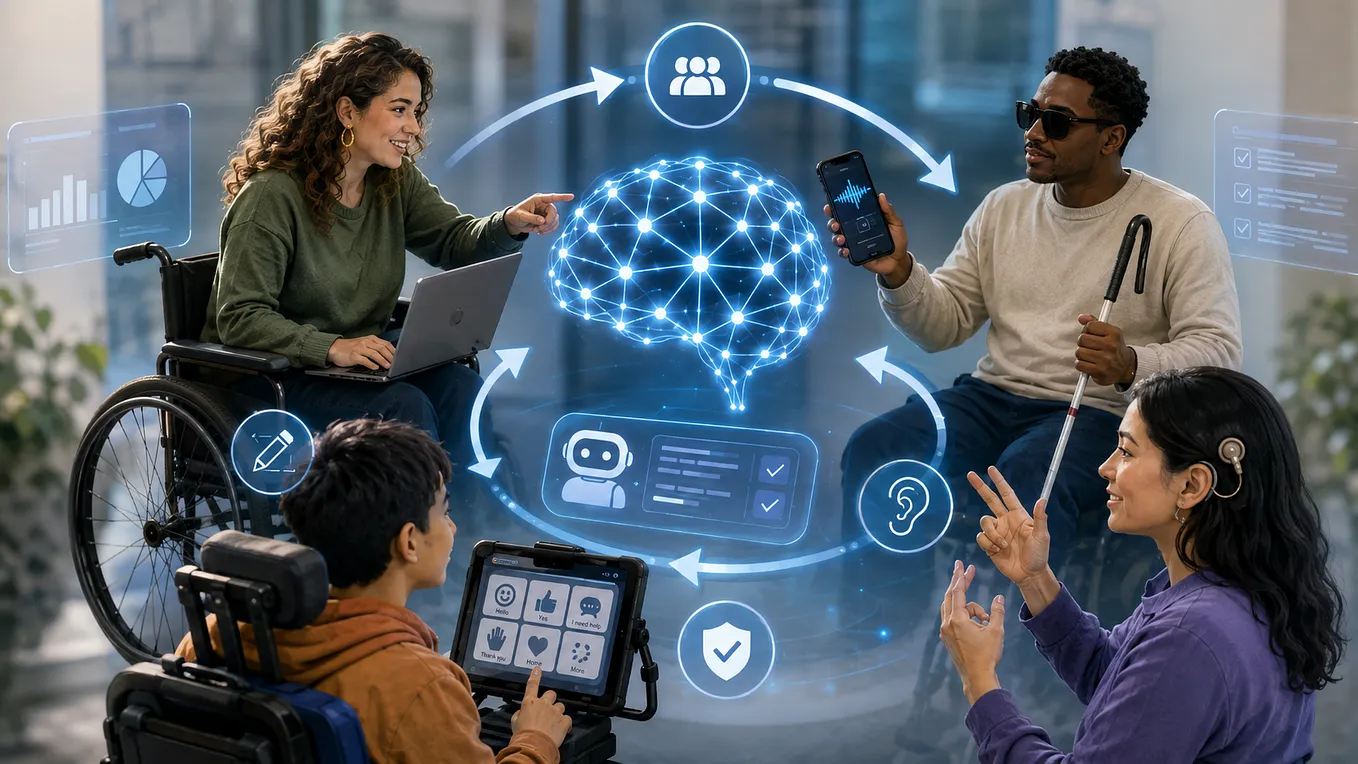
Human in the Loop: Why Inclusive AI Must Keep People with Disabilities at the Centre
Banes argues that “human in the loop” oversight of AI must include disabled people themselves, not just staff checking outputs after the fact. He walks through AAC prediction, recruitment screening, healthcare eligibility and automation bias, insisting the disabled person’s authority over decisions affecting their own life must be preserved, and that accountability for AI harms can never be transferred to the algorithm.
Shared by Banes: From Driverless Cars to Smart Wheelchairs
Banes shared this HomeBrace Germany blog examining how autonomous-vehicle perception and mapping technology could support semi-autonomous wheelchairs. The piece argues that shared control — where the chair prevents collisions and handles tricky manoeuvres while the user still decides where to go — is likely more valuable than a fully self-driving chair, and flags cost, reliability and privacy as key risks to manage.
Follow David Banes on LinkedIn or Medium for ongoing commentary on access, inclusion and assistive technology.
🔬 Research Spotlight
MIT: generative AI for adaptive physical therapy
MIT engineers introduced an adaptive physical therapy system that uses generative AI to learn from physical therapists and interactively support stroke patients through their rehabilitation exercises.
🔗 MIT News
AI for visual impairment: a functional-feature review
A new review in Disability and Rehabilitation: Assistive Technology maps the current functional features of AI-powered technologies for visual impairment, reflecting how quickly computer vision and AI are being folded into mainstream and specialist assistive tools alike.
🔗 PubMed
Study probes why free wearable assistive devices get abandoned
New peer-reviewed research examines public perceptions behind the abandonment of free-of-charge wearable assistive devices, offering insight relevant to funders and services trying to reduce device abandonment rates.
🔗 Disability and Rehabilitation: Assistive Technology (Taylor & Francis)
AAC in Asia: systemic barriers remain despite clear benefits
A review covering 29 studies from 11 Asian countries found that high-tech AAC can improve interaction, educational participation and user empowerment, but that cost, professional training gaps and sociocultural barriers continue to constrain adoption across the region.
🔗 PubMed
“Sign Pulse” AI framework aims to boost deaf and hard-of-hearing education
Researchers describe a hybrid AI-based learning framework designed to enhance educational outcomes for deaf and hard-of-hearing students, published in Disability and Rehabilitation: Assistive Technology.
🔗 Disability and Rehabilitation: Assistive Technology (Taylor & Francis)
Children help design picture-based brain-computer interface displays
Researchers used an interactive iPad tool to capture children’s preferences for picture-based P300 BCI-AAC displays, offering a useful example of user-centred design involving children who may ultimately rely on emerging brain-computer communication interfaces.
🔗 PubMed
Morse code learning studied at scale for alternative computer access
Researchers associated with Smartbox, AAC Tools and Ace Centre examined learning time, engagement and cue associations using a public Morse-Accesscode trainer, with implications for alternative computer and communication access methods.
🔗 PubMed
🎧 Podcasts & Media Worth Your Time
● United in Accessibility — a recent episode features Temitope Somuwa, 2025 IAAP Individual Impact Award winner, on driving digital accessibility change at one of Africa’s largest financial institutions and advising on the European Accessibility Act. Apple Podcasts
● Assistive Technology Update — Josh Anderson’s long-running weekly show recently featured Claudiu Hidas, CEO of head-control specialist Munevo, on hands-free wheelchair and device control. Apple Podcasts
● Assistive Tech Today Podcast — hosted by assistive technology specialist Vincent Livoti, covering AAC, adaptive tools and inclusive design for educators, therapists and families. Apple Podcasts
● The AbilityNet Podcast — features conversations with accessibility leads from major tech companies on adaptive accessories, AI personalisation and inclusive search. AbilityNet
📅 Coming Up
● IMATEx (Immersive Assistive Technology Expo) — free virtual event, 9 September 2026
● Let’s Meet Panamá 2026 — Ciudad del Saber, Panama, 7–8 September 2026
● Catalonia’s PUA disability product assistance — applications open until 2 October 2026
● Australian Assistive Technology Conference — Melbourne Cricket Ground, 11–13 November 2026
This newsletter is a curated summary compiled from publicly available sources for informational purposes. Always consult original articles for full details. Have a story to include next month? Suggestions welcome.