The Future of Onchain Finance Isn’t Louder — It’s More Automatic

Onchain finance doesn’t need more apps.
It needs less friction, less guessing, and far more structure.
For over a decade, crypto has promised a better financial system — open, permissionless, and global. Yet much of DeFi today still feels like finance in beta: dashboards everywhere, manual strategy hopping, fragile yields, and risk hidden behind high APYs.
If onchain finance is going to replace anything meaningful, it has to stop behaving like a casino and start behaving like infrastructure.
That’s where the future is heading — and why Concrete matters.
What’s Still Broken in DeFi
Despite massive innovation, DeFi hasn’t fully delivered on its core promise.
Today’s systems are still plagued by:
- Excessive complexity — users must understand protocols, bridges, strategies, and risks just to earn yield.
- Manual finance — rebalancing, claiming, restaking, and reacting to market changes is constant work.
- Fragmented liquidity — capital is scattered across protocols with little coordination.
- APY chasing over compounding — incentives favor short-term speculation, not sustainable growth.
- Risk concentrated in people — strategy decisions, timing, and mistakes live off-chain, in human hands.
This isn’t scalable finance. It’s labor-intensive finance disguised as innovation.
What Onchain Finance Becomes
The next era of onchain finance won’t feel like DeFi at all.
It will feel automatic.
In the future:
- Finance runs continuously, not episodically.
- Capital compounds by default, not by effort.
- Risk rules are enforced in code, not explained in Discord.
- Users allocate capital, not manage strategies.
- Systems matter more than interfaces.
Onchain finance becomes infrastructure — quiet, reliable, and always on.
Much like the internet itself.
The winning platforms won’t ask users to think harder.
They’ll remove the need to think at all.
Why Concrete Fits This Future
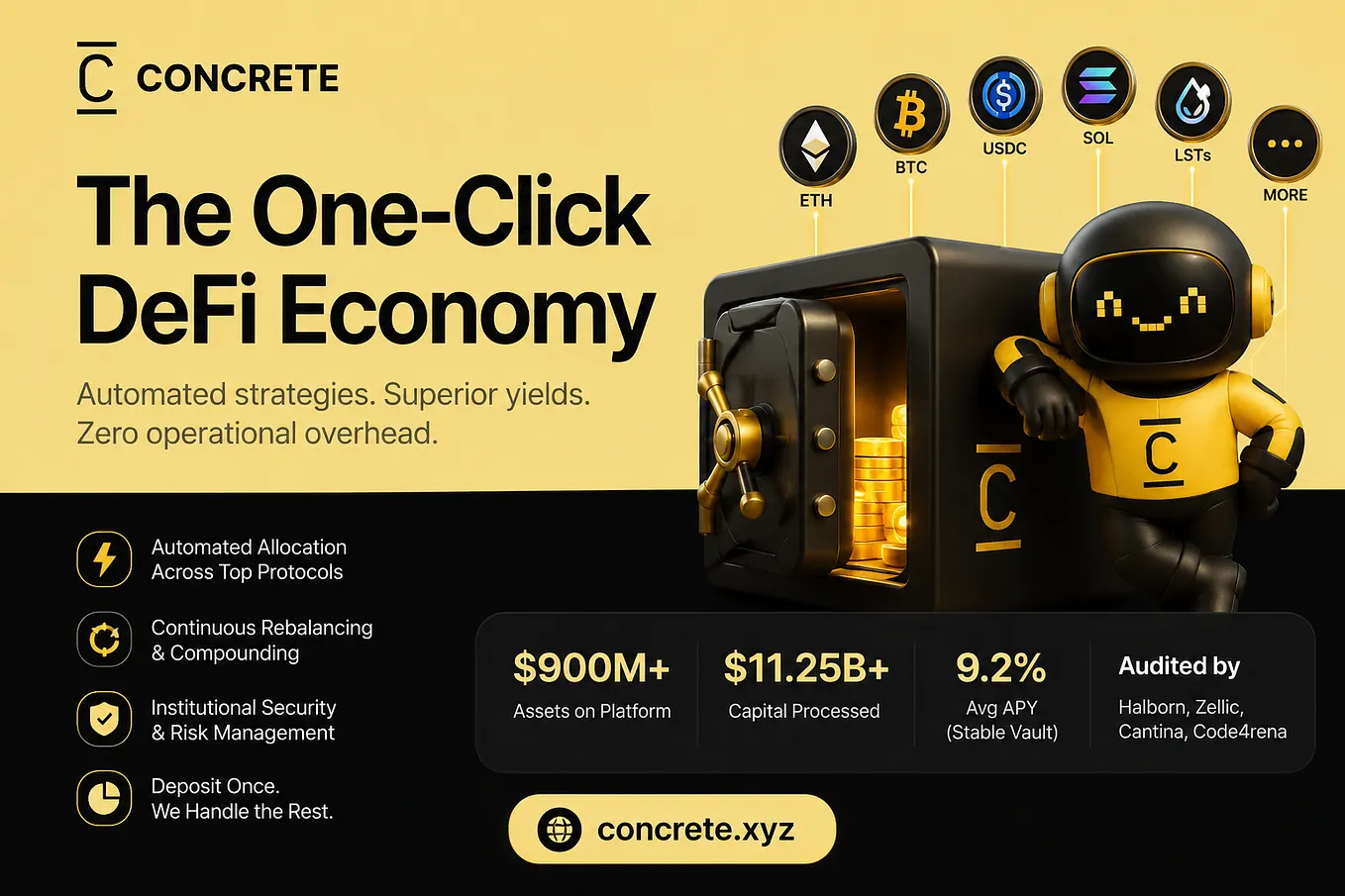
Concrete is built for this exact shift.
Get Achyuta’s stories in your inbox
Join Medium for free to get updates from this writer.
Rather than shipping isolated products, Concrete treats vaults as infrastructure — programmable, governed, and continuously operating financial systems.
Through:
- Managed onchain vaults that function like portfolios
- Continuous compounding instead of episodic yield farming
- Active onchain asset management with defined roles and controls
- ctASSETs as composable financial primitives
- Institutional-grade governance and role separation
Concrete turns DeFi from a set of tools into a coordinated system.
You don’t micromanage strategies.
You deploy capital into structured, automated finance.
That’s not just better UX — it’s a fundamentally different model.
Why This Future Is Better
For users, it means:
- Less work, more compounding
- Less noise, more clarity
- Less emotional decision-making, more consistency
For builders and institutions, it means:
- Standardized, auditable infrastructure
- Clear risk boundaries
- Systems that scale without relying on human coordination
For onchain finance as a whole, it means longevity.
Finance doesn’t win by being exciting forever.
It wins by being reliable long enough to matter.
The Conviction
The future of onchain finance isn’t about chasing yields faster.
It’s about building systems that compound trust, capital, and time.
Concrete isn’t just participating in that future —
it’s helping define it.
Concrete: The Future of Onchain Finance.