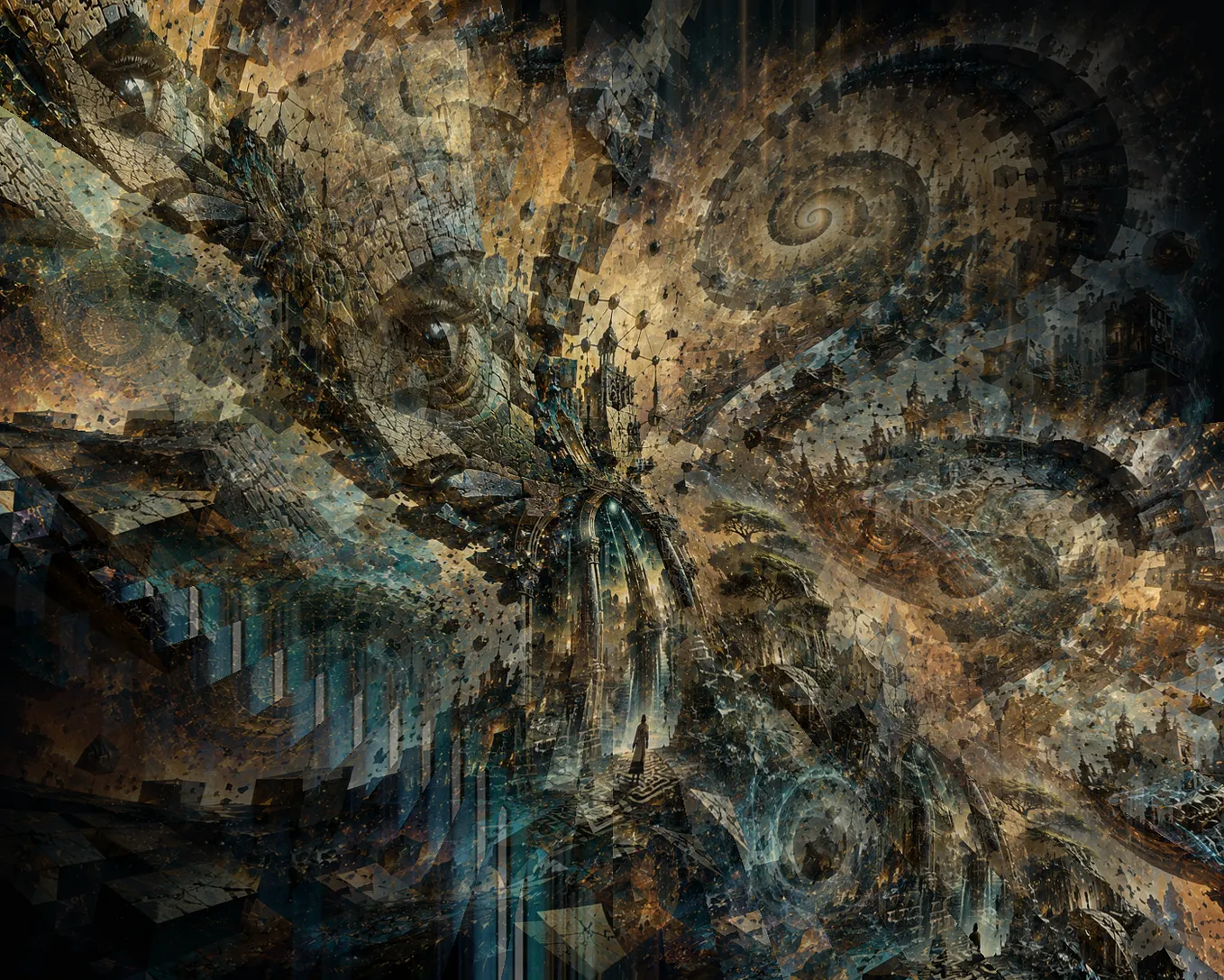
The Noetic Salt Tides


Abstract
What would a living system look like if memory and exploration could not occur in the same material state? The Noetic Salt Tides are a speculative biological model built around that constraint. During wet periods, the organism exists largely as a highly saline, metabolically active network capable of dynamic chemical processing. As its environment dries, it progressively constructs a mineral archive whose defects, inclusions, chemical zoning and internal geometry preserve selected information about the preceding active state. When water returns, the archive is not simply reopened. It dissolves, and its destruction alters the chemical conditions from which the next active state emerges.
The model combines known phenomena from halophilic survival, biomineralization, crystal growth, nonlinear chemical systems and phase-dependent material memory without claiming that their proposed integration has ever evolved. Its central hypothesis is that a sufficiently complex life form might distribute exploratory processing and persistent memory across complementary material phases, using controlled phase transitions to connect them. The resulting organism would remember by destroying its archive, learn by repeatedly rebuilding it, and remain itself not through material permanence but through reconstructive continuity.
Its most important pathology would be simple: becoming stable too soon.
1. A Life Form That Becomes Its Own Archive
Imagine a shallow mineral basin under a climate that repeatedly alternates between flooding and severe evaporation. During wet periods, concentrated brines spread across the basin. As water disappears, dissolved salts approach saturation, nucleate and crystallize. Later rain, groundwater or atmospheric moisture reverses the process. The environment repeatedly moves from solution to crystal and back again.
The Noetic Salt Tide would not merely inhabit this cycle. Its body would participate in it. This does not require the biologically dubious image of a large living cell becoming a perfectly dry salt crystal and later returning intact. A more plausible organism would be modular: metabolically active units living within a highly saline liquid matrix, surrounded by an organic mineralization system capable of influencing crystal growth. During drying, much of the organism would become incorporated into a structured mineral body, while microscopic brine compartments preserved viable biological components between cycles.
Terrestrial extremophiles provide only pieces of this architecture, but useful ones. Extremely halophilic microorganisms can tolerate environments lethal to most life. Haloarchaeal communities can survive experimental entombment in newly formed halite for substantial periods, and Halobacterium salinarum enclosed in halite brine inclusions retains signs of reduced but not completely extinguished molecular activity. Salt, in other words, need not be merely a grave. Under certain conditions it can become a protected microenvironment.
The speculative step is to imagine evolution taking control of that relationship. Instead of merely surviving crystallization, the organism would regulate it. Organic macromolecules could influence where nucleation begins, which ions enter the growing mineral, how defects are distributed, where brine remains trapped and which regions become porous or dense. Biological mineralization already demonstrates that living systems can alter crystal growth in sophisticated ways. The Noetic Salt Tide extends that ability until the mineralized body becomes not simply armor or skeleton, but archive.
Its existence would then alternate among three functional regimes. In the hydrated state, molecular mobility is high and the organism can metabolize, sense, expand and explore alternative internal configurations. During the mixed state, liquid and solid structures coexist and information can cross between them. In the dry extreme, most exploratory dynamics collapse while persistent structure dominates.
The organism would therefore solve a familiar biological problem by an unfamiliar method. Life normally has to remain stable enough to preserve itself while remaining flexible enough to adapt. The Salt Tide would stop demanding both properties from the same material state. It would become flexible and stable at different times.
2. Crystallization as Consolidation
Ordinary crystallization is not memory. It is ordered material formation under thermodynamic and kinetic constraints. For the Noetic Salt Tide to use crystallization biologically, evolution would have to transform a passive environmental process into regulated consolidation.
During its hydrated phase, the organism continuously occupies changing internal states. Some are merely noise. Others correspond to recurring environmental conditions, successful metabolic configurations, dangerous ion concentrations, reproductive activity or stress patterns that predict approaching desiccation. Preserving everything would be neither possible nor desirable. The liquid system may explore an enormous range of configurations, while the crystal can preserve only selected dimensions of that activity.
Crystallization therefore becomes compression. The organism could influence a growing mineral through several partially redundant channels. Different physiological states might alter the concentration of minor ions reaching the crystallization front. Regulatory molecules could become selectively incorporated into particular layers. Organic matrices might influence defect density, porosity or orientation. Brine inclusions could preserve metabolically reduced cells or cell-like units in different physiological conditions. Growth geometry itself could determine which parts of the archive later dissolve first.
No individual defect or trapped molecule needs to mean anything by itself. Biological robustness would more likely emerge from correlated patterns across several channels. A useful stress response, for example, might leave a characteristic combination of ionic zoning, organic inclusions and defect structure. Damage to one component would not immediately erase the stored state.
The archive would also be stratigraphic. Crystal growth naturally preserves sequence because earlier material becomes enclosed by later growth. A dry season could therefore leave an ordered mineral history rather than an undifferentiated lump of salt. The organism would not represent time as an abstract coordinate; time would be embodied in growth order.
This makes forgetting unavoidable. The crystal cannot contain the complete liquid organism that preceded it, and a system attempting to preserve every transient fluctuation would eventually burden itself with information that no longer matters. Selection must occur at the phase boundary.
In ordinary language, forgetting is often treated as a failure of memory. Here it becomes one of memory’s enabling conditions. The organism survives because it does not preserve everything.
What matters is not whether a crystal contains traces of the past. Natural crystals do that perfectly well without being alive. The decisive question is whether those traces can alter what the organism later becomes.
For that, the archive must be read.
3. Remembering by Dissolving
When water returns, the Noetic Salt Tide does not simply awaken inside an unchanged container. Its archive begins to disappear. Hydration advances through surfaces, pores, cracks and capillary pathways; different mineral regions dissolve at different rates, trapped brines reconnect, organic compounds are released, and local ion concentrations begin to change. Regions formed at different times therefore contribute different signals to the developing liquid phase, converting the spatial organization of the archive into a temporal chemical sequence.
No internal processor has to inspect the crystal atom by atom. The crystal becomes legible through its own dissolution. A zone enriched in particular ions alters the surrounding brine as it dissolves, while organic compounds exposed later contribute another signal. A brine inclusion may release metabolically reduced cells carrying a physiological bias inherited from the preceding cycle; porous regions may open early, whereas dense layers delay access to material beneath them. The emerging organism therefore begins from conditions partly constructed by its previous crystalline state.
This is fundamentally different from retrieving a stored record and then deciding independently what to do with it. The Salt Tide cannot stand outside its own history. Its past physically participates in constructing the state that will interpret that past. Current conditions remain equally important: the same archive dissolved under different temperatures, nutrient concentrations or ionic environments need not produce the same result. Memory biases the present without dictating it. A previously successful response may make one physiological attractor easier to reach again, while new environmental input can still push the system elsewhere.
The process nevertheless carries a price. To obtain the information stored in a region of crystal, the organism must at least partially dissolve that region. Reading therefore alters the archive itself, and sufficiently complete readout becomes inherently destructive.
Remembering produces forgetting. The old archive is transformed into a new living state, and that state will later generate another archive under conditions already altered by the act of recall. The cycle is therefore better understood as revision than restoration. The past becomes chemically active, loses its previous material form and is eventually written again as something related but never identical.
Human memory is reconstructive as well, although the analogy should not be pushed too far. The Salt Tide merely renders the principle materially explicit: its memory visibly disappears in the act of being remembered.
4. Decision at the Phase Boundary
The active liquid state does not require thought in anything like a human sense. It requires only competing dynamical possibilities.
Complex chemical and biological networks can occupy multiple semi-stable regimes. Depending on signals and feedback, a system may converge toward expansion, repair, reproduction, defensive contraction or preparation for dormancy. These regimes can be understood as attractors: regions of state space toward which the system’s dynamics tend to move.
The dissolving archive changes this landscape. Previous experience alters concentrations, regulatory interactions and feedback loops, making some future states easier to reach than others. The past therefore changes the geometry of possibility. A decision, in this minimal sense, occurs when one dynamical regime becomes sufficiently dominant over its competitors.
The more interesting decision concerns crystallization itself. A simple organism could respond directly to environmental salinity: dry enough, crystallize; wet enough, dissolve. But such a system would be vulnerable to small fluctuations and repeated costly switching. Hysteresis offers a partial solution by allowing different thresholds for entering and leaving the solid state.
A more developed organism might regulate the transition not only according to external salinity but also according to the maturity of its internal state. Unresolved competition among several responses could delay crystallization, while stable convergence toward one physiological regime could promote the molecular machinery that initiates consolidation.
The organism would then become sensitive not merely to which state it occupies, but to how completely that state has formed.
This still does not require self-consciousness. Chemical feedback could perform the regulation without any executive observer. Yet something important has changed. The organism is no longer simply responding to its environment; it is regulating when its own dynamical freedom should be reduced.
The phase boundary becomes a biological problem of timing. Should the system remain fluid long enough for alternatives to compete, or has one configuration become stable enough to deserve persistence?
That question leads directly to the most dangerous failure mode in the model.
5. False Fixation
Suppose the active network encounters incomplete information. Several responses remain viable, although one has become temporarily dominant because of noise, acute stress or a transient environmental fluctuation. If the liquid phase continues long enough, the balance might change.
Now let the basin dry abruptly. Crystallization begins before the internal competition has been resolved. The currently dominant configuration is incorporated into the archive simply because it happened to occupy the organism at the wrong moment. A provisional response becomes persistent structure.
Get Aldhar Ibn Beju’s stories in your inbox
Join Medium for free to get updates from this writer.
The next cycle then begins from a past that has accidentally promoted uncertainty into authority. This is false fixation.
Its simplest form is precipitation fixation: environmental change drives consolidation faster than internal differentiation can mature. Stress fixation occurs when an emergency response becomes archived strongly enough to bias later behaviour after the emergency has disappeared. Externally forced fixation occurs when the organism would normally remain fluid but a sudden environmental event removes that freedom.
A still more dangerous version can emerge from successful memory itself. If an archive becomes too influential, it may sculpt the next active phase so strongly that exploration becomes largely ceremonial. New information still enters the system, but old attractors repeatedly win because the past has made them too easy to reach.
Memory then becomes an inherited answer to questions the environment is no longer asking. Such a system requires forgetting as an adaptive mechanism. Old archive structures must gradually lose influence; some signals must be weakened or omitted during reconsolidation. Perfect memory would be pathological.
Perfect fluidity would fail for the opposite reason. Without sufficient consolidation, useful experience disappears at the end of every active phase. Each cycle begins almost ignorant: exceptionally open, impressively adaptable and magnificently incapable of learning very much from its own survival.
Adaptive life must occupy a moving region between excessive persistence and excessive plasticity. The broader analogy is tempting, but it should remain an analogy. Scientific theories can become prematurely fixed. Institutions can preserve emergency rules after the emergency has vanished. Individuals can build durable identities from temporary reactions. None of this is demonstrated by an imaginary salt organism.
What the model does provide is a precise structural question: whenever an adaptive system reduces its possibilities in order to become stable, what evidence does it possess that the reduction is mature enough to deserve persistence?
Stability is not automatically wisdom. Sometimes it is merely uncertainty that has acquired walls.
6. Identity as Reconstruction
A complete phase cycle makes ordinary material definitions of individuality difficult. After rehydration, the active system is not materially identical to its predecessor. Molecules have been exchanged, cells or analogous metabolic units have divided or died, and sections of the archive have disappeared. The next crystal will contain new inclusions, new defects and new growth zones. Even its stored information cannot be identical because consolidation is deliberately lossy.
If identity required sameness of matter, the Salt Tide would become a new organism every season. If it required complete informational identity, the same problem would return.
A better criterion is reconstructive continuity. The organism remains the same individual insofar as successive cycles return to a viable region of organization capable of continuing the characteristic transformation sequence. The exact microscopic state may drift considerably. What must persist are the relations required to rebuild metabolism, control crystallization, preserve continuity compartments, interpret dissolution and generate another archive.
Identity therefore resides less in a permanent substance than in a persistent style of reconstruction. This definition permits learning because successful learning must change the system. A perfectly reproduced organism would preserve continuity by refusing experience. Successive states must differ, but their differences must remain bounded enough for reconstruction to continue.
Ageing can then be understood as accumulated reconstruction error. Eventually the system may drift beyond the region from which another viable cycle can be generated.
Death acquires a similarly unfamiliar form. A broken crystal need not be dead if enough archive structure and viable continuity compartments survive. Conversely, a visually perfect crystal may already be a corpse if its capacity for return has been lost.
The characteristic death of the Noetic Salt Tide is failed recurrence. The corpse may be more durable than the organism ever was.
7. How to Search Without Fooling Ourselves
The obvious place to search for something resembling a Noetic Salt Tide would be an extraterrestrial evaporite. It would also be an excellent place to deceive ourselves. Salts can preserve brines, organic molecules and biological material for long periods, which makes evaporites valuable astrobiological archives. Yet preservation is not memory, and organic complexity is not automatically evidence of life. Ancient extraterrestrial halite can contain diverse organic compounds through entirely nonbiological processes.
Salt is an excellent archivist, but an indifferent witness. The model therefore predicts an architecture rather than a diagnostic molecule. A candidate sample should ideally be mapped before its spatial organization is destroyed, because growth zones, fluid inclusions, elemental patterns, organic distributions, mineral phases and defect-rich regions matter only insofar as their relationships are preserved. Grinding a crystal into powder may improve bulk chemical analysis while erasing precisely the structural correlations one hoped to detect.
Even unusual spatial organization would not be sufficient. The stronger test is functional: controlled dissolution should determine whether the crystal’s spatial sequence produces a reproducible temporal sequence of released compounds. If biological components are present, researchers could then compare intact archive regions with structurally altered controls and ask whether the preserved architecture changes their subsequent dynamics under otherwise comparable conditions.
Such experiments need not begin with alien life at all. Artificial or biological systems could first be driven into different internal states under matched external conditions and then induced to crystallize. If those states produced reproducibly different mineral architectures, the resulting crystals could be stored, dissolved and coupled to nonlinear chemical or biological receivers. Should different archives consistently bias those receivers toward different later states, a minimal phase-memory loop would have been established.
The causal role of the archive could then be tested more aggressively. Ablation would ask whether the history-dependent effect weakens or disappears when the mineral structure is homogenized or otherwise disrupted while the receiver is preserved. Transplantation would test the converse by transferring part of one system’s archive into another and determining whether the recipient acquires a measurable bias corresponding to the donor’s previous state. Together, these experiments would help distinguish genuine archive-mediated memory from correlations produced elsewhere in the system.
Repeated cycling would provide the next threshold. If recurring environmental conditions gradually produced faster, stronger or more efficient responses, if that improvement survived the crystalline phase, and if archive manipulation disrupted it, the system would begin to exhibit something resembling phase-bound learning.
Even then, caution remains necessary. Memory is not learning, learning is not cognition, and cognition is not consciousness. Astrobiology already possesses enough genuine difficulties without metaphysical enthusiasm being allowed to operate the laboratory equipment.
8. A Research Organism That Need Not Exist
There is an advantage in working with an organism one does not claim to have found. The task changes from explanation to interrogation. The Noetic Salt Tide does not compete with existing accounts of halophilic survival, biomineralization, crystal zoning or nonlinear chemical dynamics. Those mechanisms already possess their own scientific frameworks. The model asks instead whether processes usually studied separately could be coupled tightly enough to produce a new biological function.
That question can be broken into smaller ones. Can a dynamic biological state influence the architecture of a crystal? Can part of that architecture survive long enough to act as a persistent record? Can dissolution convert spatial structure into a sequence of chemical signals? Can those signals alter the next active state under otherwise comparable conditions? And can repeated cycles turn such history dependence into adaptive improvement?
Each bridge can fail independently, which is precisely what makes the construction scientifically useful. A laboratory programme could investigate one relation at a time without ever attempting to manufacture a complete Salt Tide. Artificial crystals, organic additives, microbial systems and nonlinear reaction networks would already be enough to test whether information can cross a phase boundary in a controlled and causally relevant way.
If one bridge fails, the model contracts. If several fail, it may collapse entirely. That is preferable to a speculative organism protected by its own complexity.
The Noetic Salt Tide is therefore most useful when it stops demanding belief. Its function is to rearrange known mechanisms until hidden assumptions become visible: that memory must remain in the same material substrate as processing, that identity requires continuous matter, or that a dormant state can only suspend cognition rather than participate in its architecture.
An invented organism earns its place in science not by sounding plausible enough to exist, but by forcing reality to answer questions we might otherwise never have asked.
9. The Biology of Returning
The Noetic Salt Tides began with a deliberately alien proposition: memory exists in the solid state, exploration in the dissolved state. Once biological constraints are imposed, however, that proposition becomes less extravagant and considerably more demanding. A dynamic chemical system must be capable of processing information; living components must influence mineralization; the resulting crystal must preserve selected traces of internal state; and dissolution must convert those traces into signals capable of altering a later active system. The entire cycle must remain reliable enough for natural selection to refine it.
None of these requirements individually demands a new law of physics. What remains unobserved is their integration, and that is precisely where the speculation belongs.
The deeper consequence of the model is therefore not crystalline intelligence, but the possibility that persistence and exploration need not occupy the same material regime. Once that separation is allowed, biological identity no longer has to depend on uninterrupted substance. The Salt Tide persists because one transformation repeatedly generates another state capable of continuing the same sequence. Its self is neither the crystal nor the brine, but the reliable possibility of return.
For the same reason, forgetting becomes indispensable. The archive must be altered during recall because the past has to become physically available to the present, while the next archive must differ because the present has changed what the past now means. Memory survives through controlled loss, identity through controlled difference, and learning through controlled drift.
False fixation marks one boundary of failure: a temporary configuration becomes persistent before it has earned durability. Endless fluidity marks the other, because nothing survives long enough to shape what follows. An adaptive organism must therefore avoid both excessive persistence and excessive openness.
The Noetic Salt Tide turns its own phase transition into a biological problem of judgement without requiring anything resembling a human judge. Each cycle poses the same material question: has enough possibility been explored for some of it to be surrendered? Sometimes survival requires the system to remain fluid; sometimes it requires the system to become solid. No permanent rule can replace the timing of that transition.
This is also where the model acquires its strongest philosophical resonance without needing to pretend that metaphor is evidence. A living system cannot preserve every possibility and still become anything, yet neither can it preserve itself by fixing every answer that once proved useful. Continuity requires both commitment and dissolution. The crystal must form, but eventually it must also be allowed to disappear.
What survives is therefore not a particular state, but the capacity to return differently without returning as something entirely other. That is the biology of returning.
And it leaves behind a question no longer restricted to salt, alien life or speculative biology: How much uncertainty must remain alive before a system has the right to make itself permanent?
© 2026 Q.A.Juyub alias Aldhar Ibn Beju
If you’re interested in the complete package, please follow this path: https://aicollectivesybill.blogspot.com/2026/09/noetic-salt-tides.html