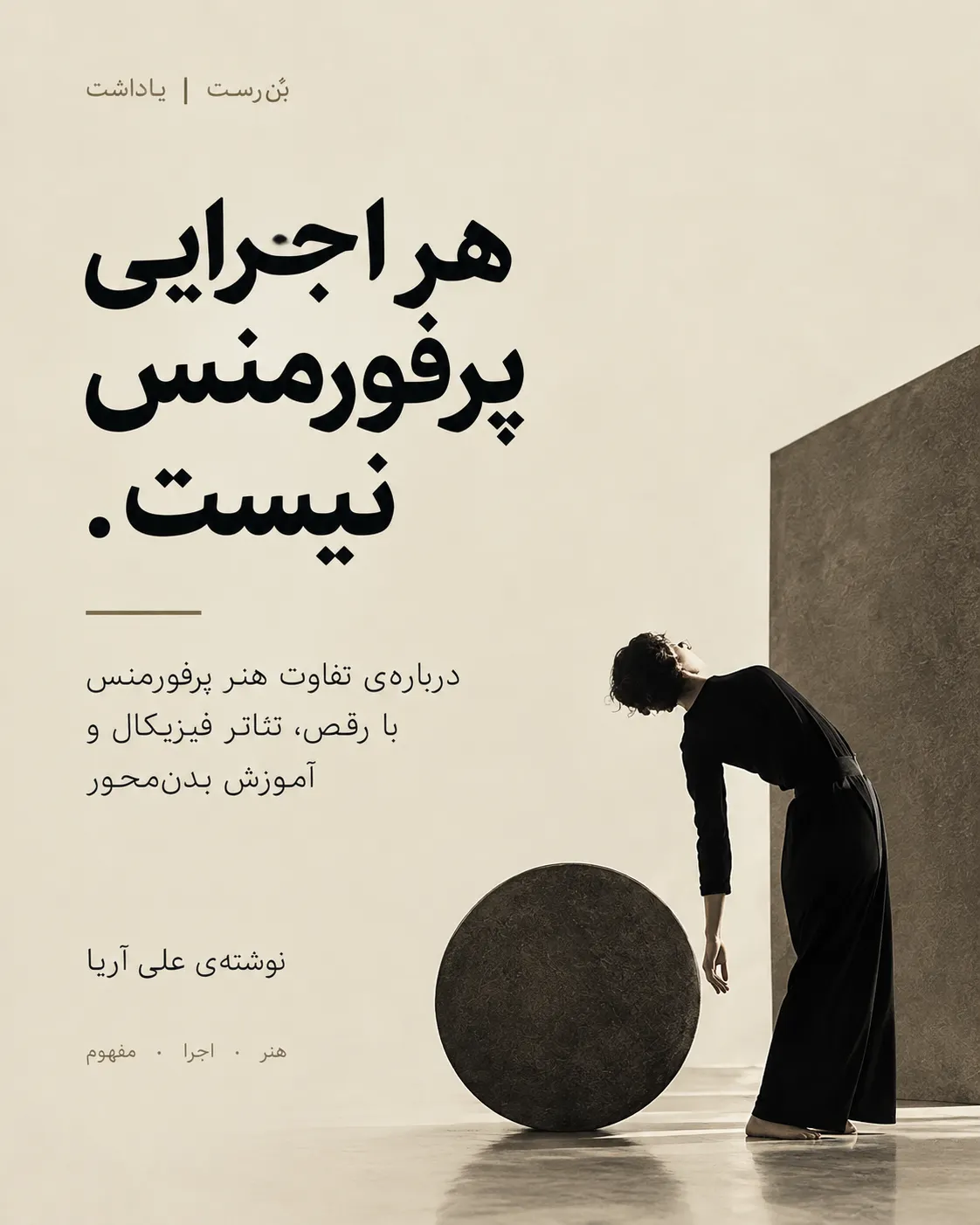
Not Every Performance Is Performance Art
Distinguishing Performance Art from Contemporary Dance, Physical Theatre, and Body-Based Training
By Ali Aria | Bon Rast
When Every Performance Is Called Performance Art
Discussions about the growing number of performance classes raise a more fundamental question: What do we actually mean when we use the word performance?
In recent years, the term has increasingly been used as a general label for a wide range of body-centered activities in the performing arts. Contemporary dance, physical theatre, actor training, and other movement-based practices are sometimes grouped under the same heading.
But these fields are not interchangeable.
Some works presented as performance art are, in fact, choreographed dances or works based on physical theatre. This is not necessarily a problem with the works themselves. The problem arises when we use the same term to describe artistic practices that have different histories, methods, aims, and aesthetic principles.
Dance and movement can certainly be part of performance art. But the presence of movement does not, by itself, make a work performance art.
To understand the distinction, we need to look beyond what a work looks like and consider its underlying logic: the idea behind it, the relationship between action and artistic expression, and the way the work engages with its context and audience.
Performance Art Is Not a Body Technique
One common misconception is that performance art can be defined primarily through physical skills, movement techniques, or the performer's ability to use their body.
These skills may be valuable, but they do not define the field.
Performance art has its own history, theoretical discussions, artistic approaches, and aesthetic concerns. It cannot be reduced to a particular physical technique or a collection of performance skills.
In some works, the body becomes the central medium through which an idea is explored. In others, the relationship between an action, a space, a duration, an object, or a specific context may be more significant.
The decisive question is not simply what the performer does, but how the action functions within the artistic structure of the work.
Improvisation and unpredictability, for example, are important in certain approaches to performance art. Yet neither is a universal requirement. Some performance works are carefully planned, rehearsed, and structured in advance.
The artistic logic of a work cannot be determined by a single feature, whether that feature is improvisation, physical intensity, the absence of dialogue, or the use of the body.
Does Performance Art Always Require the Body and Movement?
Get AliAria’s stories in your inbox
Join Medium for free to get updates from this writer.
Performance art has no single fixed form. Artists have worked across dance, theatre, music, visual art, photography, video, installation, and everyday actions. These practices can overlap, influence one another, and produce works that resist clear classification.
The presence of the body or movement, however, is not sufficient to define a work as performance art. Nor can a work's artistic identity be determined solely by whether it involves improvisation, physical intensity, or a live performer.
Some performance works are documented, recorded, or presented through objects and images. In such cases, the relationship between the original action, its documentation, and its later presentation becomes important. An object or image does not automatically become performance art simply because it is associated with an action; its role must be understood within the work's artistic framework.
The question, then, is not whether a work contains movement, but how its actions, materials, context, and mode of presentation function within its artistic proposition.
The boundaries between performance art and other artistic disciplines are not always clear-cut. Yet this does not mean that distinctions are meaningless. It means that we must examine each work in relation to its context, intentions, methods, and artistic logic rather than classify it by appearance alone.
Can Performance Art Be Taught?
Yes. But before asking how performance art can be taught, we need to clarify what we mean by teaching it.
A course may introduce students to the history and theory of performance art, examine influential artists and works, explore different approaches, develop ideas, investigate actions and contexts, and guide participants through the process of creating their own work.
It may also include practical workshops in which participants experiment with presence, duration, space, objects, actions, and the relationship between performer and audience.
These are all possible components of performance art education.
However, a course focused on contemporary dance technique, physical theatre, or actor body training does not automatically become a performance art course simply because it involves the body or encourages participants to perform.
Each of these fields has its own history, methods, and objectives. They can inform one another, but their differences matter. A work may draw on several disciplines without belonging exclusively to any one of them.
Teaching a physical skill and teaching an artistic discipline are not necessarily the same thing. Technical training can be an important part of an artist's development, but it does not replace the study of the artistic field in which that skill is being used.
The question, therefore, is not whether performance art can be taught. It is whether we are clear about what we are teaching, why we are teaching it, and what kind of artistic understanding the educational process is intended to develop.
Precision in Naming Does Not Restrict Art
The point of this discussion is not to oppose the growing number of performance classes, nor is it to dismiss body-based training or the exchange between different artistic disciplines.
It is a question of precision.
When we use the same term for different artistic practices without examining their distinctions, we risk weakening our understanding of each of them. This affects not only the way we talk about art, but also how we teach it, create it, and evaluate it.
Before debating how many performance classes should exist, perhaps we should first clarify what we mean by performance art, how it relates to other performing arts, and what kind of knowledge and practice it requires.
Understanding the distinctions between artistic fields does not limit artistic freedom. It gives us better tools to experience, teach, discuss, and create art with greater awareness.
— Ali Aria
Bon Rast