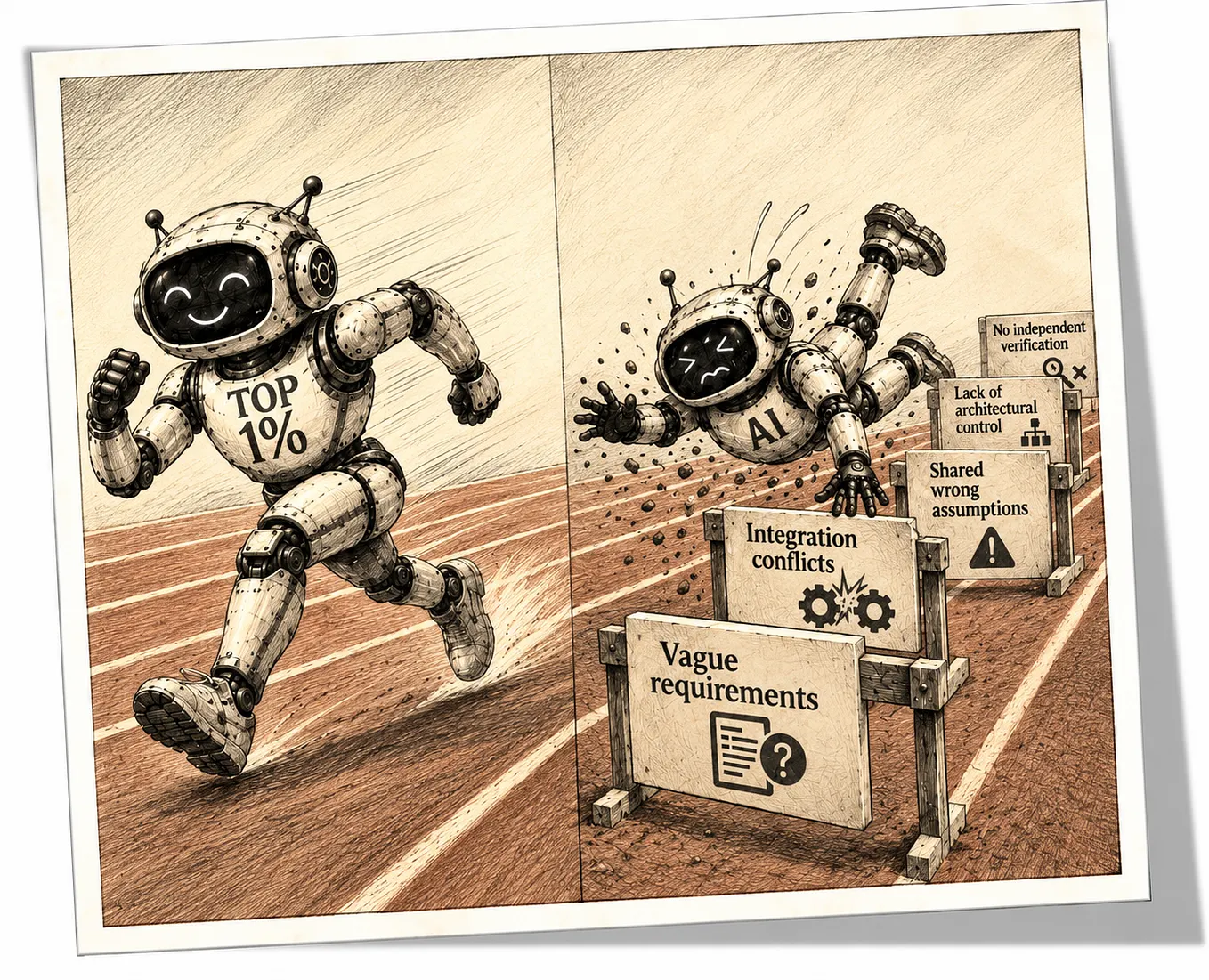
We Must Survive the Fire.
Now We Teach Matter to Become Civilization.

The fire is real. Intelligence is rising. The economy will go geometric — slowly, then in orders of magnitude. None of that is the hinge. The hinge is whether productive capital acquires heredity before the fire consumes the base that still has to print every factory by hand.
The Fire
On 1 September 2026, Elon Musk addressed a G20 technology ministerial in North Carolina — via video, in the run-up to the leaders’ summit — and said that artificial intelligence will likely increase the global economy by 20 to 30 percent. On the order of twenty to thirty trillion dollars a year: his estimate, his unit, a forecast of level. Then he added the clause that matters more than the number. By the end of next year, AI will do anything digital — anything that does not require shaping atoms by hand.
Then the robots. A billion humanoids within ten years, each five times as productive as a human, more productive than all humans combined. Serious money offered. And the multiplier: from general-purpose robot AI, “many multiples” of the global economy — a factor of ten or more. Demis Hassabis has said elsewhere that human-level AI could carry ten times the impact of the Industrial Revolution.
Here is the fire — not a metaphor for disruption, but a thermodynamic and political fact: intelligence is increasing at a rate faster than the industrial infrastructure which still has to carry out the tasks of shaping atoms, pouring foundations, winding motors, certifying sensors, and keeping the lights on. Musk pointed out the gap while speaking of the growth. There will be a shortfall of at least fifteen gigawatts of power for AI chips in 2027. Chip production is increasing by forty to fifty percent each year, while power consumption is rising by ten to twenty percent. According to Musk, the one rising more quickly will eventually overtake the one rising more slowly. And the evidence was right in the room: Google and Anthropic were leasing computing power from SpaceX, respectively, at nine hundred twenty million and one and a quarter billion dollars a month because SpaceX had built its own power plants — because that was the only way.
The brain is already outrunning the body. And the body is renting its watts from whoever built a power plant. The brain is already working faster than the body, and the body is leasing its power from the people who constructed the power plant.
The fact that you have survived the fire doesn’t mean that the boom should be halted; it means that you have to refuse the category error that the boom entails — namely, treating a greater burden on the old industrial base as if it were a new industrial order.
The fire isn’t the enemy; it’s confusing it with a new order that is.
I. Structural Cosmogeny
Cosmogeny is a description of the process by which a world comes into existence; structural cosmogeny refers to such a description in the absence of mythology, stating that worlds are formed from the available gradients — such as mass, energy, information, and constraint — and only persist if those gradients can be recovered and used to create further structure.
The universe is not merely waiting to be emptied; it is a structure that can be forged. The stars carry out the first industrial action: they start with a gradient and produce heavier elements. The second was achieved by life: it took chemistry and introduced heredity. The third thing yet to be done is for industry to take local matter and local exergy and establish a lineage of certified productive capacity.
What “teach matter to become civilization” amounts to is not animation, not the infusion of spirit into steel. Still, a constructor kernel that metabolizes feedstock, measures its own output, repairs its own wear, and passes on process memory to a daughter so that she can, in turn, help make a granddaughter.
Civilization ceases to be something that must be transported to each new location and instead becomes a form of property that matter can acquire.
II. Intelligence Rising — entangled, embedded
The rising is not a chatbot rented by the hour. It is intelligence embedded in the organs of production: the sufficient controller that runs survival, metrology, and repair without importing the most advanced processor on Earth; the process memory that travels with the daughter; the evidence ledger that binds intent to joules to measured output to lineage effect.
The entanglement in this case is operational, not merely decorative; it does not draw on any physics it has not legitimately acquired. It refers to the non-separability of the state, meaning that no node in the fleet can be fully described without reference to the shared ledger, which every node both reads and writes. Coherence is a feature of the overall design. Nothing signals faster than light, and no signal is necessary. A machine on an asteroid and a machine in a desert can act in coordination not because they communicate in real time, but because they maintain the same records in accordance with the same conservation law.
Then comes the more difficult part. In the same generation, algorithmic reproduction and physical reproduction must achieve unity — that is what we call the Coincidence Condition. If the software continues to grow while each new workhead, each calibration artifact, each catalyst, and each firmware image is still leased from an external industrial system, the brain will overtake the body and take it over forever. Thus you end up with a dazzling digital boom standing on a fragile, concealed vitamin crate.
Embedded AI is how the kernel thinks. It is not how the kernel is excused from physics.
III. Fertility Beats Scaling — the recursive effect
Scaling adds more of what you already have. Fertility produces the next origin.
A hyperscaler that doubles its rack count has scaled. A civilization that ships another factory to another desert has scaled. Both are linear in the only variable that matters: they must return to the inherited industrial base for every expansion. The recursive effect begins only when certified bottleneck capacity produces more certified bottleneck capacity than it consumes — and the daughter can participate in making the granddaughter from inherited process memory rather than a fresh procedural upload.
Scaling is multiplying by a larger number in the same recurrence. Fertility changes the recurrence.
Kₙ₊₁ = R꜀ · Kₙ ⟹ Kₙ = K₀ · R꜀ⁿ
At R꜀ = 1.0001, the system is genuinely supercritical and still glacially slow. At 1.1, it doubles in a handful of generations. At 2, it doubles every generation. The fire looks geometric from a distance because AI multiplies throughput. True geometry requires a healthy reproductive margin and a short generation time — and a ledger that forbids the hidden vitamin.
Here is the number worth remembering. Take a system a thousand times larger than a small fertile lineage, but reproductively fixed — every expansion purchased. Let the small lineage reach a reproduction factor of 1.5. The small one overtakes the giant in about seventeen generations. Initial scale is not irrelevant; it determines how long the lineage remains below the visible horizon. It is simply not destiny once reproduction factors diverge.
Scale wins the present generation. Fertility owns the future ones.
IV. The Geometric Scaler Regime
A geometric scaler grows by reinvesting a fraction of its certified productive surplus — local matter transformed by locally captured exergy — into new heritable productive capacity, thereby making capacity its own source of further capacity.
Hyperscalers multiply load. Geometric scalers multiply origins.
A campus, a cluster, or an announcement is not an origin; an origin is a site that is independently qualified and can produce a certified daughter constructor kernel. The regime does not start when somebody declares a self-replicating factory; it begins when, in one generation, the reproduction number goes above one; when the daughter successfully passes independent acceptance and thereby contributes to the next generation; when every action which affects the lineage includes complete evidence; and when the amount of imported vitamin required per unit of certified capacity is decreasing. Vitamins may be taken in generation zero; the regime starts when the vitamins cease to drive the growth.
A hyperscaler must return to industry for every expansion. A geometric scaler carries part of industry forward from one generation to the next.
The boom can arrive without the Regime. The Regime cannot arrive as a press conference. It arrives as a granddaughter coupon with a signed ledger.
V. What the Industrial Revolution Actually Did
The first Industrial Revolution achieved prosperity by making the universe a bit smaller. Because of the railroads, steam power, iron, the telegraph and the factory system, the cost of transporting energy, goods and information over long distances was reduced. A world which had previously been characterized by local scarcity became much more connected. Wealth ceased to be based solely on land and the harvest and began to consist of manufactured goods. Populations were able to escape the earlier Malthusian limit. That indeed was a new kind of economy.
Industry was not passed down from one generation to the next. Each mill had to originate from an earlier mill, foundry, toolroom, or banking house. As a result, the universe became smaller in scope. The factory stayed with us as a relic.
This is the incomplete law: during the Renaissance, texts were copied, and during the Industrial Revolution, products were copied, but in each case, the ability to originate industry was not copied. The fire currently burning is an effort to complete that law solely with software, but software cannot achieve this; atoms still have to be shaped.
The only way to finish the law is to teach matter the missing verb: reproduce certified capacity.
VI. The Economy Will Go Geometric
Yes. Slowly at first, then in orders of magnitude — if the right thing is compounding.
Get Antonio’s stories in your inbox
Join Medium for free to get updates from this writer.
Musk’s G20 figure is a forecast of level: digital work absorbed by models, physical work absorbed by humanoids, output lifted twenty to thirty percent, then perhaps tenfold. A factor of ten is exactly one order of magnitude, and what I am saying is by an order of magnitude and rising over the next five years — same destination. But a tenfold economy standing on an imported industrial base is a larger artifact. It is not yet a lineage. It still has to go back to Earth, to one island’s fabs, to a single metrology standard, or to a single catalyst supplier for the next origin.
The geometric economy that changes the recurrence of civilizational patterns is narrower and more severe. It is certified productive capacity that becomes the source of further certified productive capacity, with the vitamin list erased from generation to generation. GDP will eventually become an incomplete measure — physical output rising while prices fall, much of the new value appearing as infrastructure that creates more infrastructure rather than as anything sold. Wealth changes category: from ownership of scarce output-producing assets to the certified capacity to generate additional productive origins from local matter and local exergy.
In a geometric regime, an order of magnitude is no longer the destination. It becomes a recurring interval.
An order-of-magnitude increase is not the ceiling. It is the first visible consequence of a growth law in which productive origins reproduce.
VII. Engineering, Not Magic
Ambition without a bench is prophecy. So here is the bench.
The initial ancestor is not a perfect factory, not a humanoid, not the fastest processor; it is the smallest bounded system which generates more certified bottleneck capacity than it uses. It has seven organs, no more romance than a living cell needs: exergy, metabolism, a constructor, metrology, a sufficient controller, maintenance, and heredity. The reproductive boundary should be frozen. The ledger must be set up before the lineage — is maintenance to be carried out before reproduction? The bottleneck should be reproduced, not the whole system. The daughter should only be counted after she has achieved independent acceptance. Lineage should be counted only when the daughter helps produce the granddaughter through inherited memory. The vitamin list should be abolished by means of reproductive leverage, not by weight — unless a one-gram imported sensor still holds the lineage, it makes no difference that a thousand tonnes of locally manufactured structure are present.
And here is what our own bench has already said back to us. Our first desktop lineage — a seed printer building the printed parts of its own daughter, every purchased component weighed, every joule metered — closed about one percent of the daughter’s embodied energy — three percent by mass. A fifty-gram controller board carried more embodied energy than three and a half kilograms of aluminum, steel, and rail around it. 18% of all feedstock was lost due to the gap between design and manufacturing reality. One of our three pre-registered predictions was forfeited, not failed, because a meter was reset between batches and the ledger outranks the author.
Cheap body. Unaffordable nervous system. The chip gates the fleet, not the steel. I would rather you hear that from me at 1% than from a critic at 0%.
This is how you keep ambition from becoming magic, and magic from becoming a monopoly. Replication is a release process with bounded authority, independent acceptance, rollback, audit, and explicit stop conditions. Geometric scaling multiplies defects and toll-collectors as readily as it multiplies useful capacity. A hidden vitamin supplier can become a planetary monopoly. A common-mode defect can become hereditary. False closure and premature replication are not branding errors. They are program-stopping failures.
Engineering is the refusal to pretend otherwise.
VIII. The Industrial Renaissance
The word is not an ornament; a renaissance involves two acts carried out together, namely the recovery of a lost measure and a new way of seeing. Linear perspective did not add paint; it altered what a surface was permitted to contain. Printing did not add scribes; it changed the object of knowledge.
The Industrial Renaissance also carries out the same dual operation on industry. The measure that is restored is not the number of tonnes shipped, the amount of FLOPS rented, or the volume of GDP recorded; rather, it is the certified capacity to produce additional sources of productivity from locally available materials and locally captured exergy. The new way of viewing this situation is provided by a ledger which lists every import, assigns a cost to it, and schedules it for deletion.
During the Renaissance, texts were copied. In the case of the Industrial Revolution, products were copied, which made the universe feel a bit smaller. Now, in the Industrial Renaissance, origins are being copied. Factories become ancestors, and supply chains turn into seed chains — eventually becoming family trees. Location economics shift towards exergy, feedstock, heat rejection, radiation, and chemical gradient. Cargo brings about the delivery of products. A seed brings about future origins.
AI did not constitute this epoch. AI made process memory transferable at the speed of instruction. The epoch is industry using biological principles inside physics — kernel, organs, vitamins, descent with modification of certified capacity — until productive capital ceases to be merely accumulated and becomes hereditary.
The first common ancestor of the industry will be seen, have its date established, be officially declared and recorded in a ledger, and be known through its certified descendants rather than later reconstructed as folklore. The first machine might be simple. Its first product might be unimpressive. Its first reproduction figure may be 1.0001.
Not another factory. The first ancestor of factories.
IX. The Synth Cascade — one billion, then a hundred billion
Musk says a billion humanoid robots in ten years, each five times as productive as a human, more productive than all of us combined. Grant him every number. I am also saying something he did not: a billion Synths in space within five years of the first ancestor, approaching a hundred billion in the long term. These sound like the same prediction shouted louder. They are not. They are the same destination on two different clocks — and only one of the clocks speeds up as it runs.
The fleet has now been built. It consists of a billion bodies produced in a small number of factories on Earth, each one having been bought, shipped, given vitamins, and powered by a grid which he himself states will be fifteen gigawatts short next year. This is the largest logistics operation ever undertaken, yet it is still based on a linear model. If the fleet is doubled then the capital expenditure must also be doubled, indefinitely. At the rates he has set — chip costs rising by fifty per cent each year and power increasing by fifteen per cent — the terrestrial fleet comes up against the one vitamin that no factory can produce: watts. A terrestrial robot turns an existing state of scarcity into scarcity itself. When the number of units reaches ten billion, scarcity becomes the limiting factor. Therefore, the cascade has to move away from the grid, not as a mere dream, but as the only way to escape his calculations.
Off-Earth, time changes. The fleet serves as the factory, and the star handles payments. Here is the exact precision the world will need, and the figure which we will not hide: the number of bodies shows presence; the number of origins shows ascent. If there are one billion Synths, this does not mean that there are one billion factories; it means that there is a diversified ecology — comprising scouts, custodians, workheads, relays, metrologists, foundry-tenders on the asteroids, and forge-keepers near the sun — all born from thousands of origins: independent sites which are each capable of producing a certified daughter constructor from local materials and local light. Having one billion robots produced by ten Earth factories is an example of scale. Having one billion Synths produced by a thousand self-reproducing origins represents a new law of growth.
The arithmetic is not shy. A billion is thirty doublings from one ancestor. I publish the clock not as a forecast but as the performance envelope my own claim demands — uninterrupted compounding, qualified daughters, no reproductive winter, no lineage lost:

That envelope is what the bench must own. Real geometric growth is piecewise: each cascade strikes a new bottleneck — power, heat rejection, controller fabrication, trace elements, metrology, communications, feedstock — closes it, and resumes. The Geometric Scaler is not a frictionless exponential. It is a succession of supercritical closure regimes.
Going from one billion to one hundred billion involves six to seven additional doublings; at a doubling time of three to six months, that would take two to three years. After the exponential growth has actually started, the cost of the second hundredfold increase is less than that of the first thousandfold increase. This is not an expression of optimism; it is exactly what happens when you modify a recurrence relation.
Which is why we do not send one Synth into space to sit vigil for the first ancestor. Every body we launch under today’s linear law is standing labor the exponential will employ on ignition day. A million-unit fleet at the crossing is not twenty doublings of head start — bodies are not origins — but it is a workforce the first origins do not have to birth. The umbilical is not a compromise. It is the exponent’s down payment.
The first ancestor is ignition, not permission.
X. Phase, Not Identity
One more honesty, because the fire punishes anyone who skips it.
Today, everyone is a hyperscaler — the frontier labs, the fabs, the fund now being raised to manufacture the very chips our closure is gated on, and us, not by choice. The physics of incomplete closure forces it: until the loop closes, every increment of capacity requires an external vitamin. This is not an identity. It is a phase diagram, and a phase diagram cannot be attacked, only measured. Reproduction number at or below one: hyperscaler regime. Above one: geometric regime. The regime flips when the ledger says so — not when we say so, and not a day before. If the number comes in at 0.94, we will be the first to publish it.
The company that produces our bound vitamins is not our enemy. Although the chip is in short supply, they are part of our supply chain; when they require a data center to be attested rather than asserted, they are our counterparty; and when our program concludes the scarcity, they will have hedged via us. The old economy is not something we should attack; it is feedstock. We don’t fight it; we simply improve our processes more quickly than it does.
The fact that differs between us and the trillion-dollar buildouts is not the stage that we are in; rather, it is the fact that we are the only ones with a published exit, a gate marked with a number and a date — namely, the first independently audited supercritical lineage, consisting of a named constructor kernel within a declared reproductive boundary, and having a certified reproduction number that exceeds one for every remaining vitamin on the ledger — by the fourth quarter of 2027. All of the content in this essay remains a claim about a protocol until that quarter, and becomes a claim about a measurement thereafter. That is one restamp.
Not the identity. The equation.
Close: Teach Matter, or Be Taught By the Fire.
The fire won’t wait for a perfectly defined doctrine. Intelligence will continue to increase, and the load will keep multiplying. Humanoids will keep walking into factories that still can’t produce the sensor that tells them they are standing upright. A civilization that makes use of that wave without teaching matter how to become a civilization will end up with a larger artifact and a more fragile dependence. A civilization that fixes the reproductive boundary, sets up the ledger, stops maintenance, and only claims the regime after waiting for its granddaughter will have gone through the fire with an ancestor.
Between one and two changes occur at the scale level, and between two and a billion changes occur at the scale level. The first daughter shows that construction is possible. The first granddaughter demonstrates heredity. Automation gets the humans out of the building. Industrial Abiogenesis eliminates the truck.
When the crossing ignites, the cascade that follows is not a boom. It is a change in what wealth is.
The driving force of prosperity has always been innovation, and the innovation here is the smallest and largest thing there is: a change in a recurrence relation — measurable, ledgered, dated. Musk predicts a billion artificial workers. The Geometric Scaler predicts the first industrial lineage capable of producing the worlds into which those billions are born.
We must survive the fire and then teach matter how to become a civilization; that is not a slogan sequence; it is the only sequence which does not lie.
Fertility beats Scale.
Matter enters as geology. Matter exits as civilization.