Moving beyond discussion
Putting open philosophies into practice

Chris Millson, Sarah Howley, Jennie Blake 🏫 University of Manchester Library
This is the asynchronous text version of a presentation given at Academic Libraries North Conference 2026. It covers all of the same themes, with a little extra detail for anyone who is interested, and you can take part in all of the activities at any time, before, during or after the live session.
Contents
Introduction
We have called this submission “Moving beyond discussion: Putting open philosophies into practice”. There is nothing wrong with just discussing open philosophies, but we think that the practice element is so important in openness, that it is worth exploring the option of embedding this practice into the teaching and learning. In this submission, we will outline why we believe this, some of the benefits we have seen, and lots of practicalities, detail, and advice for others taking/considering such approaches.
We also don’t just want this session to be purely discussion! There will be some practice also; we are publishing these session notes in advance openly in text format, and we have included a real activity, which you can join asynchronously from this post, and/or during our live session!
Contributors
Jennie Blake is Academic Theme Lead for Student Success at the University of Manchester and Associate Director of Teaching, Learning and Student Success at the University of Manchester Library. Her remit includes belonging, student support and a variety of University-wide initiatives. She looks after all Library teaching, including the award-winning My Learning Essentials and Student Team. She researches inclusive practice, student co-creation and student support models. She holds her PFHEA and was awarded a National Teaching Fellowship in 2018 and a CATE in 2024. All three awards recognise her sector-leading practice and expertise in student support and partnership.
Sarah Howley is a Learning Developer in the Teaching, Learning and Students team at the University of Manchester Library. Her work shapes the Library’s academic and study skills offering, with a strong focus on playful and neuro-affirming pedagogies. She recently won the Library’s EDI Initiative award for her commitment to promoting inclusivity in library teaching and enjoys exploring how ‘openness’ can contribute. She would love to create open resources that support self-efficacy for neurodivergent teachers.
Chris Millson is the Library eLearning Manager at the University of Manchester, and looks after the Library’s digital learning approaches and output. He is interested in open, inclusive and accessible approaches, and particularly how these can be realised in digital contexts, and more broadly the role of the internet and digital technology in society. He has worked on the curriculum design and delivery of the Library’s interdisciplinary credit bearing teaching units since 2015, including the development of a staff-facing PGCert unit, and the significant redevelopment of a student-facing unit offered via the University College for Interdisciplinary Learning.
Open Knowledge in Higher Education
In this section we will introduce OKHE and two obvious ways in which it is open, before outlining our focus on the less obvious ways and what it looks like in reality.
Open in more ways than one 🔓
Open Knowledge in Higher Education (OKHE) is a course and resource for learning about/exploring openness in education, created by the University of Manchester Library. It is open access (anyone can engage as a ‘learner’), and an open educational resource (core materials are published under open licenses; anyone can reuse/modify them as an ‘educator’). Given the topic of openness, it made sense to release it in this way.
However, being very honest, the topic doesn’t really matter. We would take a similar approach with any course we create because we believe in open access/licensing (and we are lucky to have permission from our institution to do them).
Open in more ways than two 😁
What we would like to focus on here is all the other ways in which we have tried to make OKHE ‘open’, particularly those things which we wouldn’t have done by default, those things which required us to make decisions, those things which inconvenienced us, or have risks attached, or created extra work, and which influenced and changed the materials themselves.
Sounds like a lot of work… We live in a world which is, in many ways, ‘closed’. So to create something ‘open’ will require effort, risk, time, in comparison. We need to accept that, if we are serious about openness! Otherwise it is very easy to practice ‘openwashing’, that is, using the idea or veneer of openness for our own gain (e.g. reputational), without actually caring about it or putting the required time and effort into it.
There are many benefits to what we are doing, and we will share some of these — but we don’t want to pretend that it’s an ‘easy solution’ or ‘win-win’. It’s not easy! But it’s worth it (in our view, in our case)!
What does OKHE look like? 🔬
OKHE centres around an online publication on the topic of openness in education. This publication is mostly written by course participants (past and present), and forms the course materials. Anyone can:
- View the teaching materials online
- Take part in asynchronous activities online
- Read past assessed submissions
- Contribute to the publication
As well as being an open course, OKHE is offered as a credit bearing module through the University’s Postgraduate Certificate in Higher Education (PGCertHE) — anyone enrolled on the PGCertHE can also:
- Take part in synchronous learning
- Participate in assessment
- Access 1:1 support and feedback
- Obtain pass or fail towards degree
As you can see, there are open and ‘closed’ aspects. These are all choices, and there are always limits to our choices. For example, we would love to be able to give a degree to anyone in the world, not just those accepted as students at our institution. But we don’t have the authority to do that! (Maybe one day they will let us). And we could make it open in that everyone’s marks and feedback were publicly visible, but would that really be a good idea? Read on to learn more about our choices.
Pedagogical and technical decisions
In this section we will look at some of the choices we made when designing OKHE and since. Each sub-section introduces a decision, and discussion around why we made this choice, and some of the practicalities.
We participate in a collaborative effort, while valuing ownership ✅
Openness is not about forcing people to make all of their work open. We decided that we wanted the course materials to be collaboratively owned and produced — but also to retain everyone’s freedom to do with their work as they wished, e.g. to delete or edit it in future. Having the autonomy and support to choose how to publish your work (openly or otherwise), is, in our view, a better way to reflect on openness, in a context where we value a diversity of viewpoints and experiences. Openness can mean many different things, and it is not without issues in practice. We think it is important to acknowledge this diversity and critical view.
So, we wanted to ‘open up’ by lowering barriers between ‘learners’ and ‘educators’, so everyone in OKHE is a participant in a community where we all contribute to the course materials. But we also chose to let people write as themselves (or using pseudonyms) and to assert their rights over their work. And indeed, some of them have chosen to submit their work to closed (paywalled) commercial publications, rather than the course default — and that’s fine, because they chose to do it and reflected on it!
We’ll value personal and subjective knowledge and experience ✅
“subjectivity is the human condition. Everything else that attempts to be objective or neutral is pretense. It is inauthentic. It is not even something I strive towards.” — Maha Bali, Embracing Subjectivity
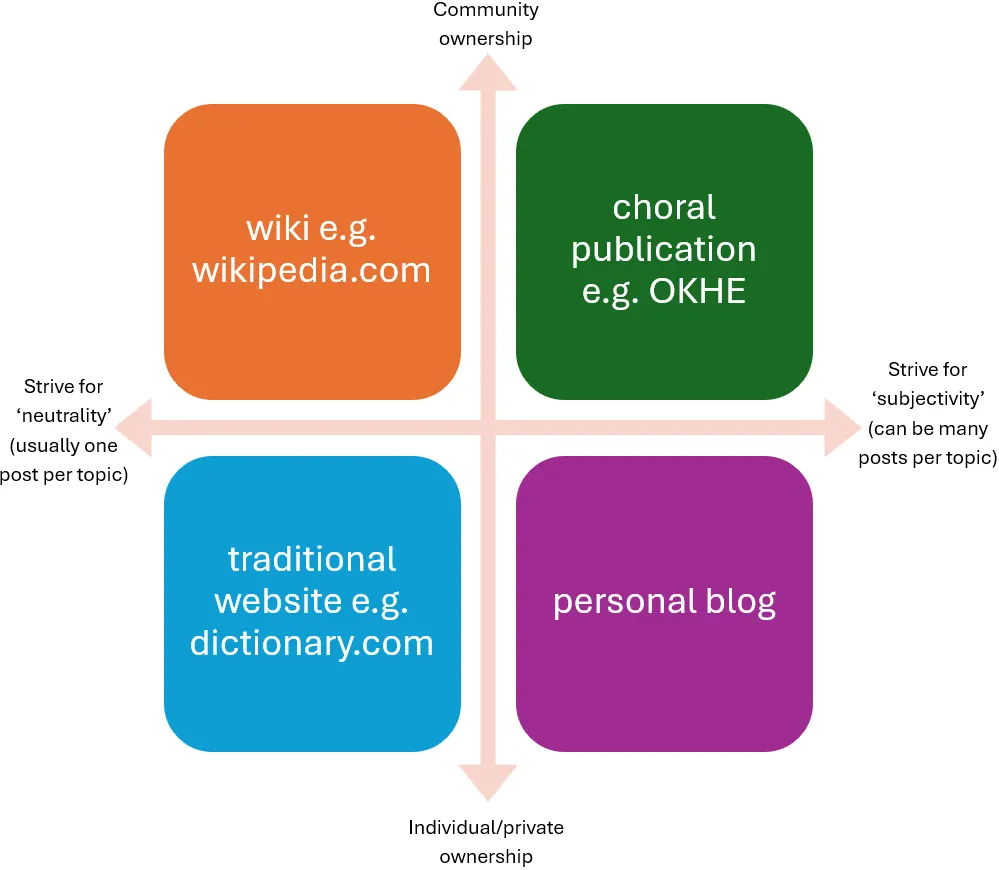
After choosing that our course materials would be collaborative, we considered different platforms for this, including a wiki (which everyone could edit), individual blogs (where everyone could share their views), or a forum (where everyone could engage in discussions). However, thinking about ideas of objective versus subjective truth, the value of different perspectives, and of the personal/human nature of any practice, we decided to do something else.
As Bali says, “everything else that attempts to be objective or neutral is pretense”. We love many things about Wikipedia, but we didn’t really want to create a collection of so-called ‘neutral’ pages, as they would inevitably fail to capture the richness and diversity of human experiences.
We will adopt a ‘choral explanations’ publishing/sharing model ✅
In his discussion of Choral Explanations, Mike Caulfield describes a (traditional) wiki as following a ‘one best resource’ model, i.e. for a given topic, there is one page which everyone can edit, but implicit in this is an idea that the page will approach ‘perfection’. We did not want this — we wanted many voices making up the ‘chorus’, not just one.
In our commitment to making the course materials a real publication, we did not want to spawn hundreds of ‘single-serving blogs’, active for the duration of the course, then mostly abandoned by their individual owners.
So how could we combine aims of ‘prioritise individual voices’ and ‘give writer autonomy’ (found in blogging) with ideas of ‘all voices contribute to a chorus’ and ‘the experience should be a real one’ (from choral explanations and critical pedagogy/praxis)?
By creating a collaborative online publication about the course topic! We chose Medium to facilitate it, and it works (and we have never paid a penny for it) although as they move to more capitalist models, we are looking at alternatives including self-hosting something open source.
This took a lot of discussion, research and prototyping, in which we compared different approaches to creating/publishing/sharing course materials. We present a (simplified) model based on this below, which we hope might be useful to anyone else comparing such approaches.

We should practice openness in real contexts and reflect on this ✅
“Within the word we find two dimensions, reflection and action, in such radical interaction that if one is sacrificed — even in part — the other immediately suffers” — Paolo Friere, Pedagogy of the Oppressed
How does this relate to openness? Well, openness as a topic would not exist without openness as a practice, and openness as a practice exists in response to societal structures. In common with Friere we believe that (meaningful) action leads to better reflection/learning and vice versa.
As soon as we started to plan this course on openness, we saw the potential for ‘learning about openness by doing and reflecting on openness’. Friere emphasises the importance of such action having a purpose, and in line with this, we chose to place this ‘doing of openness’ in a real setting: a living, collaborative online publication exploring themes of openness in education (rather than, say, a simulated setting such as a blog/forum in a LMS/VLE), serving also as the course materials.
Before embarking on a new approach like this, however, it is preferable to precisely understand what thing(s) openness can actually provide (in the desired context), what form(s) of openness might provide such things, and all of the associated practicalities. We will spend a little time later exploring some of these — and for anyone considering this in their own practice, we are happy to discuss further by email.
Notes on our choices 📝
Some things which we did (OA, OER), we would have done anyway. The decisions outlined above are all additional choices which we made. Other choices are valid! All choices have limits!
There are many technological/practical implications to our choices, e.g.:
- A need to consider pseudonyms/verification/candour/confidence (this is a direct consequence of running the course in public)
- Should cover ownership/licensing/online identity (because we are asking people to individually publish online)
- Much higher in-house support requirements (due to new technologies, new approaches, different style of written work, many ‘meta’ aspects)
However, we choose to do this, despite it not being 100% ‘win-win’, because we believe in it, and we feel it is worth it. In the next section, we will go into some more detail on some of the practicalities of our decisions.
Get Chris M’s stories in your inbox
Join Medium for free to get updates from this writer.
How our decisions have played out
In this section we will look at a few ways in which our choices have played out. In doing this, we hope to help anyone considering similar choices to ours. Our aim is not to put you off, but to better prepare you! This section is based around Sarah’s experiences, being the newest member of the unit.
Delivery 🚚
Limited options for teaching spaces: The library sits outside of normal timetabling, so we had to factor in finding and booking our own space for teaching. This was complicated by our choice to deliver in a hybrid (online and in-person) format — this significantly limited the rooms available. Also, when delivering in this way, our effectiveness as facilitators is partly dependent on our familiarity with the room and its facilities. For the past two years we have not been able to use the same room for all three sessions, which has felt inconsistent, and can also inhibit accessibility.
💡Tips: Book early, visit rooms in advance, book the actual rooms for preparation and run-throughs.
Unpredictable tech: Last year (2025), Chris and Sarah spent a good chunk of time figuring out how a particular room would work for us, only to find that on the day, something wasn’t working as expected. This required a quick adaption to plans, and it affected delivery. Another consideration is mode of facilitation — we usually have at least one of us online and one on campus. Sarah found out this year that it’s quite difficult to facilitate this session online with one screen! However, working awkwardly on campus instead of comfortably at home meant she was ready to join the on campus group if all participants showed up in person.
💡Tips: You may need a lot more time for preparation, run-throughs, and getting ready on the day, and always have at least one backup plan! Test all of your technology, including ‘at home’!
We don’t know where/if people will attend: We’ve had some sessions with multiple people online and on campus, and some sessions where everyone attended online. This is hard to avoid when delivering in this format, but one thing we have learned is that there are some things we can do to reduce issues, and to prepare to be flexible.
💡Tips: It takes more time and effort (in planning, and in sessions) to establish rapport, it may be wise to have ‘guest speakers’ join remotely, consider different ways in which participants might engage and what this might mean in practice — not only in person versus online, but also live versus asynchronous.
Curriculum 🌐
Open framed within three distinct topics: Open can be categorised in so many ways, but we only have three opportunities for synchronous learning. We therefore built OKHE around three topics, each one having a corresponding synchronous session and asynchronous materials. In early days, we chose topics like ‘open research’, ‘open teaching’, ‘open practice’. Such choices may hinder participants’ ability to see the breadth of what ‘open’ can mean, so we have reorganised so as not to look at ‘three types of open’ but instead ‘three ways of identifying/looking at different types of open’. Our current topics are: “What is open?” (philosophical), “Possibilities and Pitfalls” (practical), and “Intersections with open” (personal).
💡Tips: Consider how your choice of session topics/foci may shape participants’ thinking (and whether this is desirable).
Supporting subjectivity with structure: We feel that our current choice of topics provides some structure within which participants can evolve their thinking — but not too much that they remain confined. This is a difficult balance; a common question from participants is around how to connect ‘open’ with their practice, and our move away from ‘obvious’ topics makes this harder. However, this difficulty results in participants reflecting on what open is, reflecting on their practice, and making their own connections — in line with the learning outcomes. We also use learning activities to encourage reflection, to widen perspectives (for example in our use of Troika consulting, described below) and reinforce belonging (for example through Diane Varma’s An Ode to the Other Hand as our first activity). We often reuse and remix others’ ideas in this way, and doing so transparently is another way we can model openness.
💡Tips: In a course taught in this way, it’s even more important to consider the role of activities for the group and individuals (not just the topics); giving participants more freedom and flexibility in topic will require more structure and support in other ways.
Participants find freedom in anonymity: We allow participants to write anonymously (or pseudonymously) — many have told us that this allows them to share their views more candidly. We highlight (and model) Creative Commons licensing, to demonstrate that you can be pseudonymous and assert rights over your work. We encourage participants to interact responsibly with real open resources (those of their peers and beyond) in their exploration of openness, opening doors to real conversations that already exist, and more authentic ways of learning.
💡Tips: Work out whether participants will(/can) own their own work and be consistent with this; you will need to create new processes and systems to make this work with assessment/institutional policies — but it can be worth it!
Assessment 💃
Flexibility balanced by marking criteria: We don’t have a lot of ‘strict’ rules for the format in which participants submit their assessed work; we are open to anything that is justifiably appropriate for meeting the marking criteria. This continues our commitment to the subjective, while ensuring assessment feels achievable. However, it is important to (carefully) give participants a default option. In our case, the default is a blog post published on Medium. We stress that this is only the default, but we know that most participants will opt for it. As well as format, participants are given a lot of freedom in their topic — this is reflected in the marking criteria, and this is an area where we do see a lot of variety.
💡Tips: Avoid mentioning specific domains of knowledge (such as ‘open research’) in marking criteria or curriculum, and instead focus on abilities such as ‘critical view of a chosen topic relating to openness’ or ‘links between own practice and a chosen topic’.
Participants regularly note the broad applicability of ‘open’ in their own contexts: For the first assessment task (“OKHE1”), we ask participants to connect openness to their unique context (i.e. their local professional practice), and the result becomes part of a choral explanation of openness on Medium — from which current and future participants can learn. This context requirement also serves as a natural buffer against over-use of GenAI tools for writing (GenAI is notoriously unable to replicate the specifics of context). To mitigate further, we discuss the importance of critical reflection around GenAI as a study aid — one example being that if GenAI has been trained on open content that reflects dominant perspectives, outputs may not be culturally relevant. Every year we see clear evidence that participants have met the intended learning outcomes, across diverse submissions.
💡Tips: Provide plenty of opportunities for feedback and support from peers and facilitators (including one-to-one), in order to support participants through the sometimes-difficult process of connecting ‘open’ with their context; when approaching GenAI use, look first at whether/why one might use GenAI, rather than starting with the how/what.
Opportunity to become a participant 🎬
In this section we present the first part of one of our activities from OKHE, as an opportunity for you to experience some of our approach for yourself.
⭐Activity excerpt: Banishing openness
In this activity we will consider the question “How can we banish openness from our institution?” 👀

Why would we want to banish openness from our institution? Well, sometimes it can be useful to approach a problem from a different direction (fear not; we’re not actually going to do it). In The Traitors TV show, a democratic vote is held to banish players from the castle. In an organisation, open practices can certainly be banished, but not as democratically or simply as this.
Part 1. Banishment brainstorming
If you are not a member of the University of Manchester (hi!), you can apply this activity to your own institution (if you have one), or to any organisation or system (e.g. the Internet).
Instructions
- Consider the question, “How can we banish openness from our institution(s)?” Think of things that you could do to sabotage open initiatives; to ensure openness is cast out forever.
- Set a timer for three minutes and add as many ideas as you can below (comments are public and anonymous; don’t share personal information). The aim here is to gather as many ideas as possible without ‘filtering’ them too much.
That’s the end of our partial activity — however, if you would like to see the full activity in context (and engage with it!), you can find it in Topic 2: Open — Possibilities & Pitfalls (2026). We hope you found this useful.
Attribution for the activity
This activity is a remix of How can we destroy higher education?, which was based on OpenEd2017 Open Education Ethics session, itself based on “Making Space with TRIZ” (Lipmanowicz and McCandless, CC BY-NC 3.0), in turn inspired by part of “TRIZ (теория решения изобретательских задач)” (Altshuller et al, summarised by Zhongsheng et al). We also take inspiration from “15% solutions” (Lipmanowicz and McCandless, CC BY-NC 3.0), itself inspired by professor Gareth Morgan. 💕 Openness! 💕
Why here: Open Education, libraries and access 📌
Some thoughts from Jennie on links between openness, libraries and access:
- Libraries are themselves third spaces, and so are well-suited to being ‘open’ spaces — physically and virtually, in obvious ways and in less obvious ways.
- Openness relates to access: access to collections, expertise, and resources. See for example the Flip to Open project.
- We have a desire to live all of the 5 R’s: Reuse, Revise, Remix, Redistribute, Retain.
- Flexibility around understanding of publications and access
- Walking the walk — avoid openwashing
Open teaching and GenAI 🔮
Taking what isn’t yours to create something new without giving credit, having permission, or considering the impact on others isn’t innovation or acting in the spirit of open. At the least it’s theft, at the worst, it’s colonization.
—Heather M Ross, The Soul of Open is in Danger
GenAI problematises open, because of the approach of the commercial entities who have exploited the technology. But open can “push back”. We can embrace the tech (not the corporations) and be gentle with our participants. We can ask them to contribute meaningfully in ways that preclude use of these tools to construct the knowledge, and thus drive home the critical effort needed to consider them — which can support developing a critical view of openness, as well as GenAI.
A practical heuristic/checklist 📃
In this section we will generalise the approach we have taken to putting open philosophies into practice, in a way which we hope might be useful to anyone considering doing likewise (even if differently to how we do it).
The honesty approach: why we think it is important
The most important factor which led to us developing an open resource on openness, in our view, is our ability to be honest (put another way: mutual permission to call bullshit on each other). This is surely important in any project, so why are we sharing it here?
Openness is a broad concept. The real concept of ‘openwashing’ exists because it is easy to describe pretty much anything as ‘open’ in positive ‘PR’ terms, with scant regard for the detail. We don’t want to do that!
But furthermore, if we fall for ‘openwashing’ and have discussions such as “let’s make this course open” without elaborating further — then we will overlook many practicalities. On the other hand, being precise in our choices leads to being able to precisely tackle the implications of those choices. And we hope that by presenting our experience in this way, we can help you to consider first, whether you want to take a particular approach and why, before looking at what you may need to do (or not) and how.
The honesty approach as a heuristic
Do you want to use openness to facilitate learning about openness? If so, you must ask yourself:
- Which potential benefits genuinely require open approaches?
- What are the ‘costs’ (time, money, risk, drawbacks, …) of these?
- What do I need to consider? Who can I talk to?
- What are the practical way(s) forward?
“Engage learners in contributing to their learning materials so that knowledge becomes a community endeavour rather than a commodity that needs to be made accessible. To that end, let’s stop fetishizing the textbook, which is at best a low-bar pedagogical tool for transmitting information. OER is better than that”
—Robin DeRosa (aka actualham), Open Textbooks UGH
Resources 🔗
Below are a few resources which we feel may be of particular use to anyone considering taking an approach similar to ours. Please get in touch to ask for any more specific advice/links!
Get in touch 👋
The best way is to email okhe@manchester.ac.uk, we all have access to this and we’d love to hear from you :¬) You can also contact us individually: