Reformulating the Black Hole Information Paradox: A Lesson From Haag’s Theorem

The black hole information paradox is usually presented as a conflict between two extraordinarily successful ideas.
General relativity allows matter to collapse into a black hole. Quantum field theory tells us that black holes are not completely black. Stephen Hawking showed that they should slowly emit radiation and, given enough time, can eventually evaporate.
And there lies the problem.
Quantum mechanics tells us that information should not simply disappear. A quantum state can become extraordinarily complicated. Its information can become scrambled beyond practical recovery. But under unitary quantum evolution, the distinctions contained in the original state are not simply erased.
Hawking’s original calculation seemed to threaten this principle.
The radiation emitted by a black hole appeared thermal. If the black hole eventually disappears and leaves only thermal radiation behind, what happened to all the information contained in the matter that formed it and subsequently fell into it?
That is the black hole information paradox.
But an apparently unrelated result from quantum field theory may suggest that there is another question hidden underneath it.
It is called Haag’s theorem.
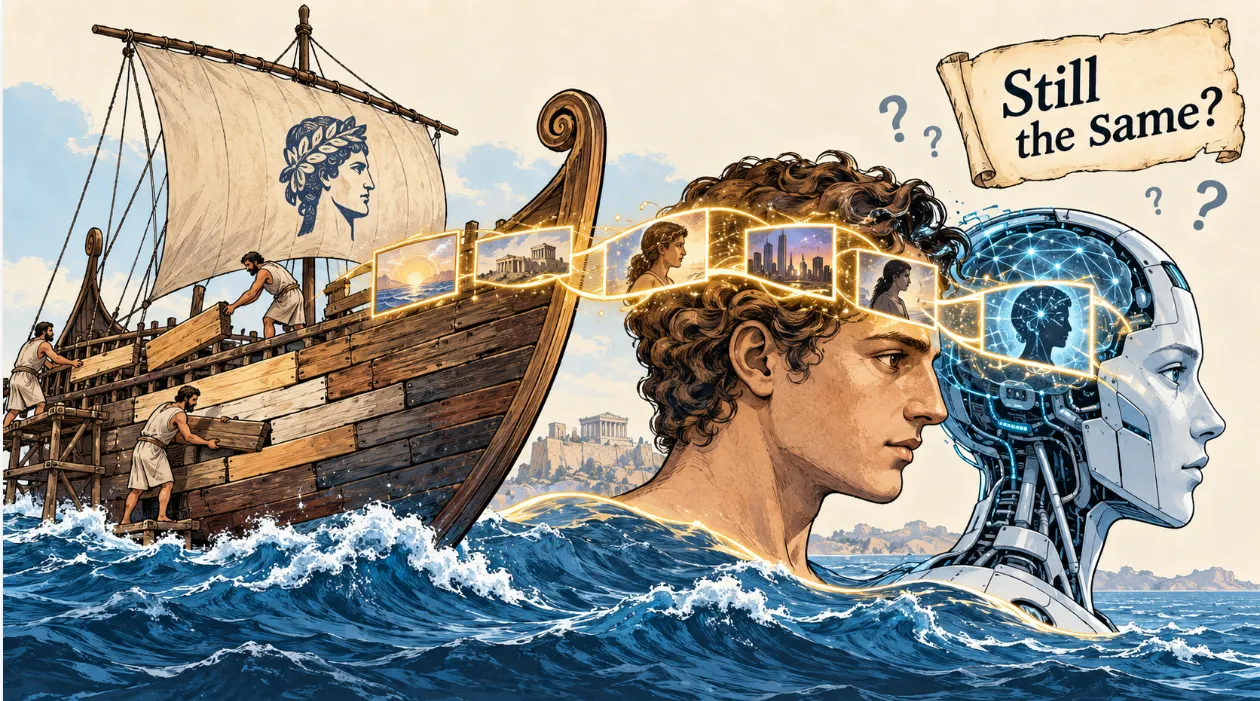
And its lesson may be that before asking where the information went, we should ask what exactly we mean by information remaining the same through such a radical transformation.
The Picture We Carry in Our Heads
The usual story is easy to visualise:
matter → gravitational collapse → black hole → Hawking radiation
We naturally imagine one enormous quantum state passing through these stages.
There is an initial quantum state describing the matter.
There is a state describing the black hole.
Eventually there is a state describing the outgoing radiation.
Behind this picture sits another assumption that is rarely made explicit: all these states can ultimately be regarded as belonging to one enormous quantum arena — a Hilbert space — with quantum evolution carrying the initial state into the final state.
If the evolution is unitary, the information survives.
If it is not, information appears to have been destroyed.
This way of thinking is so deeply embedded in ordinary quantum mechanics that it can seem almost synonymous with information conservation itself.
But quantum field theory is more subtle.
Haag’s Warning
In ordinary quantum mechanics, we become accustomed to thinking of one Hilbert space containing all the possible states of a system.
Quantum field theory deals with infinitely many degrees of freedom, and something surprising happens.
Imagine starting with a field whose particles do not interact — a free field. We might naturally think that we can then switch on interactions and describe the interacting field within essentially the same Hilbert space.
The free and interacting descriptions would simply be related by an appropriate unitary transformation.
Rudolf Haag showed that, under the usual assumptions of relativistic quantum field theory, this seemingly innocent picture cannot generally be made exact.
The free and interacting fields can require unitarily inequivalent representations.
Haag’s theorem does not say that quantum mechanics is non-unitary.
It does not say that information is destroyed.
And it certainly does not solve the black hole information paradox.
Its lesson is more subtle:
we should not automatically confuse a particular Hilbert-space representation of a quantum system with the underlying quantum physics itself.
Different physical regimes can require different representations.
And that becomes particularly interesting when the physical regime changing is spacetime itself.
A Black Hole Is an Extreme Change of Regime
During gravitational collapse, something far more dramatic occurs than particles simply interacting with one another.
Spacetime changes.
A horizon forms.
Regions that could previously communicate become causally separated.
Quantum fields now exist in a profoundly different geometry.
Hawking radiation appears.
The black hole shrinks.
And if evaporation eventually completes, the horizon disappears altogether.
Yet when discussing information, we often imagine all of this as though nature were simply moving a state vector around inside an unchanged mathematical container.
Perhaps that is correct.
But Haag gives us a reason not to assume it automatically.
The quantum representation naturally describing matter before collapse might not be identical in any simple sense to the representation appropriate to the black-hole regime, which might differ again from the representation appropriate to the final radiation.
That possibility changes the question.
What Exactly Must Be Preserved?
Suppose some matter falls into a black hole.
We normally ask:
Where is its information in the final Hawking radiation?
But perhaps there is a deeper question:
What exactly has to remain unchanged for us to say that its information survived?
Those questions are not necessarily identical.
We tend to imagine information almost as though it were a substance. A book falls into the black hole, and therefore somewhere in the final radiation there must be an extraordinarily scrambled quantum version of that book.
There is considerable reason to think something like this does happen: modern work on black holes strongly supports the idea that information is encoded in subtle correlations within the final quantum state.
But perhaps the deeper continuity does not belong to the particular representation of the information.
Perhaps it belongs to the relationships that distinguish one physical situation from another.
That leads naturally to another way of formulating quantum theory.
Put the Relationships First
In algebraic quantum field theory, we can begin not with a particular Hilbert space but with physical observables and the mathematical relationships between them.
Those observables form an algebra.
A Hilbert space then provides a particular representation of that algebra.
This reverses the hierarchy we normally carry in our heads.
Instead of thinking:
Hilbert space → states → relationships
we can think:
relationships between observables → representation → states
The distinction may sound abstract, but conceptually it is profound.
It allows the possibility that different Hilbert-space representations can express an underlying quantum structure without requiring those representations to be straightforwardly equivalent.
The representation can change without everything represented by it necessarily being destroyed.
And now the black hole looks different.
Three Descriptions, One Deeper Structure
Imagine the history of an evaporating black hole again:
Get Bill Giannakopoulos’s stories in your inbox
Join Medium for free to get updates from this writer.
before collapse → black hole → after evaporation
Perhaps each stage possesses its own natural quantum representation.
Before collapse, one collection of observables is natural.
After a horizon forms, the causal organisation of the system changes and another description becomes natural.
After evaporation, the remaining Hawking radiation supplies yet another.
We might therefore picture:
Representation A → Representation B → Representation C
without immediately assuming that the fundamental physical content consists of something literally sitting inside all three representations unchanged.
What may provide continuity is a deeper structure of relationships.
This suggests a different interpretation of information conservation:
The representation of information may change while the relationships carrying the information remain preserved.
That is not the same as saying information has been destroyed.
It may instead mean that we were looking for its persistence at the wrong level.
The Page Curve Becomes Especially Interesting
Modern developments in the black hole information problem provide an important clue.
Consider the Hawking radiation produced as a black hole evaporates.
Initially, the radiation looks increasingly thermal and its entropy rises.
If that continued until the black hole completely disappeared, Hawking’s original information-loss problem would remain.
But an information-preserving process should behave differently. Eventually the entropy should reach a maximum and begin falling again as correlations become encoded within the radiation.
This rise and fall is the Page curve.
Recent work involving quantum extremal surfaces and so-called islands has shown how gravitational calculations can reproduce this behaviour.
This is usually described as evidence that black-hole evaporation can preserve information.
But from our perspective, the Page curve can be read slightly differently.
Perhaps it is showing us the changing accessibility of quantum relationships.
Early in the black hole’s evaporation, much of the relevant relational structure cannot be reconstructed from the radiation alone.
Later, increasingly rich correlations become available within the outgoing radiation.
Eventually, the final radiation collectively contains the relationships required for the global quantum description to remain information-preserving.
The information need not be imagined as tiny labels riding outward on individual Hawking particles.
It exists in the pattern of relationships between them.
And Haag invites one further question:
Must the representation of those relationships remain the same throughout the process?
Perhaps not.
An Unexpected Convergence
What makes this more than an idle philosophical thought is that modern quantum-gravity research has begun moving in a strikingly algebraic direction.
Recent work by researchers including Edward Witten, Geoff Penington, Erik Verlinde and others has explored black-hole entropy, horizons and quantum gravity using operator algebras rather than treating a particular state-space representation as the only fundamental starting point.
In 2025, Jeremy van der Heijden and Erik Verlinde made this connection particularly explicit in a paper titled An Operator Algebraic Approach to Black Hole Information. Their treatment describes aspects of black-hole information recovery through relationships between von Neumann algebras.
This work does not derive from Haag’s theorem, and it would be misleading to suggest that it does.
But the convergence is intriguing.
Haag’s old result tells us that quantum field theory already contains a warning against assuming that every physically meaningful regime must be represented within one straightforwardly equivalent Hilbert-space description.
Modern black-hole research is independently discovering that algebras of observables may be an especially natural language for describing gravity, horizons and information.
Perhaps these two developments are telling us something related.
Unitarity and Representation Are Not Quite the Same Thing
This also suggests that we should be careful about what we mean by unitarity.
In ordinary quantum mechanics, several ideas become closely intertwined.
Unitary evolution preserves probabilities.
It preserves quantum distinctions.
It means that information encoded in an initial state is not simply erased.
And because we usually work within one Hilbert space, it becomes natural to associate all of this with a unitary transformation acting within that space.
Haag reminds us that quantum field theory complicates the final step.
The absence of unitary equivalence between two representations does not automatically mean that the underlying physics has become non-unitary or that information has vanished.
So we should distinguish:
preservation of quantum information
from
unitary equivalence of every representation used to describe that information.
The first may be fundamental.
The second may be a property of particular descriptions.
That distinction could become especially important for black holes, where the geometry defining what can be observed is itself changing.
Reformulating the Black Hole Information Paradox
The conventional information paradox asks:
How can the information contained in matter falling into a black hole eventually be encoded in Hawking radiation without violating quantum unitarity?
That remains a profound and unresolved question.
But Haag’s theorem suggests that there may be another question underneath it:
What does it mean for quantum information to remain preserved when the natural representation through which we describe that information can itself change?
Perhaps the initial matter, the black hole and the final Hawking radiation should not be thought of simply as three states moving through one intuitively fixed mathematical container.
Perhaps they are different representations of a deeper quantum structure.
If so, information conservation would not necessarily mean preserving the appearance of information within one representation.
It would mean preserving the deeper relationships that allow different physical possibilities to remain distinguishable.
Haag’s theorem does not solve the black hole information paradox.
But it may expose an assumption hidden inside the way we usually formulate it.
For decades we have asked:
Where did the information go?
Perhaps the more fundamental question is:
What remains the same when the way reality represents that information has changed?
Postscript: A Possible Bridge
Two developments add an intriguing perspective to the connection between Haag’s theorem and the black-hole information problem.
Edward Witten has explored a background-independent algebra for quantum gravity: rather than beginning with a fixed spacetime and its Hilbert space, one begins with an algebra of observables that does not depend on a predetermined geometry. This raises the possibility that spacetime and particular Hilbert-space representations are secondary descriptions of something deeper.
Holography adds another remarkable ingredient. The mapping between gravitational bulk and boundary has the structure of quantum error correction. The same underlying quantum information can have different effective reconstructions; it need not belong uniquely to one location or one spacetime description.
Put beside Haag, this suggests a different way of viewing black-hole information. Perhaps information preservation does not require one Hilbert-space representation to remain valid throughout the entire process. What must persist may instead be the deeper algebraic relationships from which different representations — and ultimately different spacetime descriptions — can emerge.
The question then subtly changes from “Where did the information go?” to “What remains invariant as its representation changes?”
This is not a solution to the black-hole information paradox. But Haag, Witten’s algebra-first approach and holographic error correction may be pointing toward the same conceptual possibility: the representation can change without the underlying information being lost.