Philosophical Gods and Ghosts at the House on the Hill

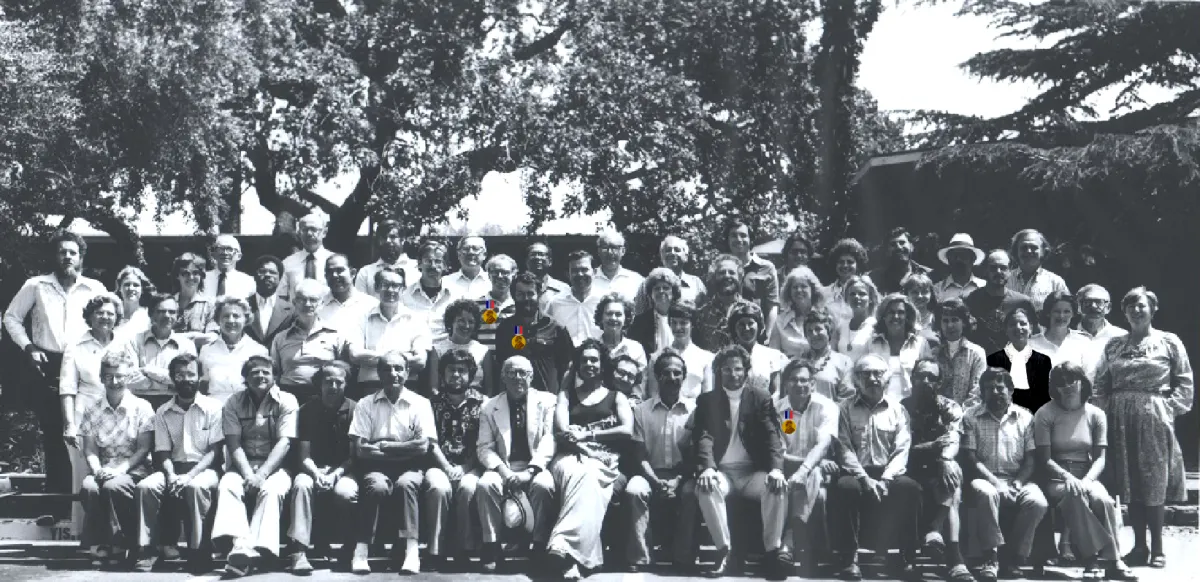
CASBS fellows often choose their offices (called studies here) for specific reasons, or get inspired once they see lists of their studies’ occupants or other studies’ occupants (‘ghosts’) throughout CASBS history. Kepa Korta, a 2026–27 fellow, interweaves his connections to a number of those ‘ghosts’ in this inspiring essay.
My story with CASBS starts in a footnote. In a paper entitled “Castañeda on he and I,” the Stanford philosopher John R. Perry used a last footnote to acknowledge his debt to his colleagues Michael Bratman, Jon Barwise, and John Etchemendy as well as to CASBS, where he concluded the article while he was a fellow. I did not suspect when I read it how the people and the place in the footnote would affect, in different ways, my intellectual development, my philosophical career, and, ultimately, my life.
John Etchemendy was the improbable gatekeeper who welcomed me at Stanford in January 1990. I was a young graduate student attracted by Situation Semantics, the pioneering theory of meaning and information developed by Barwise and Perry. Etchemendy showed me the way from the Philosophy department, in the Main Quad, to the research center they founded a few years earlier, the Center for the Study of Language and Information (CSLI), in Ventura Hall and Cordura Hall on Panama Street.
I did not realize then that my gatekeeper’s Basque name encoded a sort of premonition: Etche (Frenchified rendering of Etxe) means House or Home; Mendy (Mendi) is Basque for Mountain or Hill. So Etchemendy (Etxemendi, in its standard-Basque spelling) means House on the mountain or something like that, but we rarely pay attention to the meaning of a proper name when we take it as a proper name. As the famous logician and 1978–79 CASBS fellow Ruth Barcan Marcus might have put it, proper names have no meaning; they simply tag.

I continued with my short visits to CSLI until I completed and read my Ph.D. dissertation in Donostia. Then, my visits grew sparser but longer and, especially, more interesting and productive. John Perry became my mentor, co-author, and friend. He also visited me in Donostia several times, and I was even featured in his bestseller The Art of Procrastination (2012, Workman), a book prompted by the Ig Nobel Prize in Literature he was awarded in 2011.
Get CASBS at Stanford Univ.’s stories in your inbox
Join Medium for free to get updates from this writer.
Our common tendency to procrastinate did not prevent us from writing and publishing about twenty articles and two books — and many footnotes — together: Critical Pragmatics, in 2011, by Cambridge University Press; and Three Demonstrations and a Funeral and Other Essays, in 2025, with María de Ponte, by CSLI Publications. I do not exaggerate when I say that his CSLI office at the southwest corner of Cordura Hall ended up being my second philosophical home until its closure in 2025.
I must confess that I am an enthusiast for abstracts, prefaces, introductions, acknowledgments, and the rest of what specialists call the “paratext.” That is most likely why I initially identified CASBS as that mysterious place so often mentioned by distinguished scholars in their acknowledgments. That is how I came to think of it as a Mount Olympus of philosophical gods and goddesses. Popper, Quine, Davidson, Rawls, Donnellan, Barcan Marcus, Foot, Rorty, Dummett, and many others have all been CASBS fellows and have expressed their gratitude to it some time or other.
Eventually I discovered that CASBS’s location is not exactly a mountain, but rather a hill; and that the building looks more like a motel than a house. However, Etchemendy — or, nowadays, Etxemendi — would still be an appropriate descriptive name for it. Most importantly, I have learned that it can host not only divine creatures, but also mere mortals like me — along with coyotes, wild turkeys, or deer, as regular visitors. I have confirmed that, besides Perry, who was a CASBS fellow in 1980–81, the philosophers in the title and footnote of his paper had also been fellows at CASBS — Castañeda in 1981–82; Bratman in 1997–98 and 2003–04; and Barwise in 1981–82 and 1989–90. Etchemendy is the exception: he never was a CASBS fellow, probably because being Stanford’s longest-serving provost kept him busy enough.
A couple of weeks ago, Stanley Peters, a linguist who was a CASBS fellow in 1981–82 (and later in 2003–04), told me that lunch meetings on the CASBS patio during 1981–82 — including Barwise, Perry, Kamp, and himself — gave birth to the ideas leading to Situation Semantics and the creation of CSLI. So, as it turns out, I have come full circle from my first visit to CSLI in 1990 to the place where it all started. If it all goes well, my story with CASBS will end in a paper or a book — or , why not, both — on linguistic justice, resulting from my fellowship, with my acknowledgment in a footnote, not as a god, but as a ghost. Amen.
(Note: None of the fellows mentioned above are, strictly speaking, ghosts in my study, #46, but their presence feels stronger than the presence of the actual philosophical ghosts occupying study #46 before me: Carl G. Hempel, 1963–64; Gregory Vlastos, 1967–68; Roderick Firth, 1967–68; Kenneth L. Manders, 1987–88; and Ruth Garrett Millikan, 1991–92. While I was reading the list of previous occupants, I have stumbled on another fact about the ghosts in my study: The number of linguists who occupied this study from 1954 is zero — no one. At the other extreme, the number of political scientists is seventeen. Perhaps this is why, for my fellowship, I moved from research in semantics and pragmatics of natural language to the study of political issues about languages and nations. Who knows.)
-Kepa Korta