What a Patient’s Unexplained Jaw Pain Taught Me About the Limits of a Single Diagnosis


When scans come back clean but the pain is real, the answer is rarely in one discipline alone.
A patient came to me recently with jaw pain that didn’t match anything on the CT scan. No fracture, no visible lesion, nothing a radiologist would flag as abnormal. And yet the pain was real enough that it was affecting daily life — eating, talking, sleeping.
This is one of the more uncomfortable moments in clinical practice: when the imaging says “normal,” but the patient in front of you is clearly not fine.
As a dentist trained also in oral medicine and molecular cell biology, I’ve learned to resist the urge to treat “no findings” as “nothing is wrong.” Absence of evidence on a scan is not evidence of absence of a real, physical problem. It usually means we’re looking in the wrong place, or with the wrong tool, or that the cause sits at the intersection of several systems rather than inside one of them.
In this particular case, a few details stood out once I started asking broader questions instead of narrower ones: a specific point of tenderness near a nerve exit point in the jaw, a history of unrelated hearing changes on the same side, and pain that didn’t behave like a typical dental or muscular problem. None of these alone would have justified a referral. Together, they suggested something outside my own scope — likely neurological — and I referred the patient to a neurology department at a larger hospital for further evaluation.
I want to be careful here: I am not claiming to have diagnosed anything. I didn’t. What I did was something more modest and, I’d argue, more important: I recognized the edges of my own competence and connected the patient to someone better positioned to investigate further. I also kept an open mind that, in cases where a clear structural cause can’t be found, nutritional and autonomic nervous system factors are sometimes worth exploring as a parallel, gentle avenue — not as a replacement for proper specialist evaluation, but as a complement to it.
This is the part of dentistry that rarely makes it into textbooks: the negotiation between specialties, the humility required to say “this is not fully my domain,” and the relief a patient feels not when you have all the answers, but when you take their experience seriously enough to keep looking.
Get Mitsuro’s stories in your inbox
Join Medium for free to get updates from this writer.
I think about this through a lens I’ve come to call narrative medicine — though I didn’t invent the term, and better thinkers than me have written about it more rigorously. The basic idea, as I use it in my own practice, is simple: every patient’s symptom comes wrapped in a story, and the story usually contains information a scan cannot capture. A symptom that “doesn’t fit” the obvious diagnosis isn’t necessarily a dead end. It’s often a signal that the story is bigger than the chart in front of you.
Practically, this changes how I run a consultation. I ask about sleep, stress, diet, and unrelated symptoms that a patient might assume are irrelevant to their teeth. Sometimes those threads connect to something real — and sometimes they don’t, and that’s fine too. The point isn’t to find a connection everywhere. It’s to leave room for one to appear.
There’s a quieter benefit to this approach that’s easy to overlook: it changes the patient’s experience of uncertainty. Most people don’t actually need a doctor to have an immediate answer. What unsettles them is the feeling of not being heard, or being dismissed once a scan comes back clean. A clear next step — even if that step is “let’s get a specialist’s opinion” — replaces helplessness with a plan.
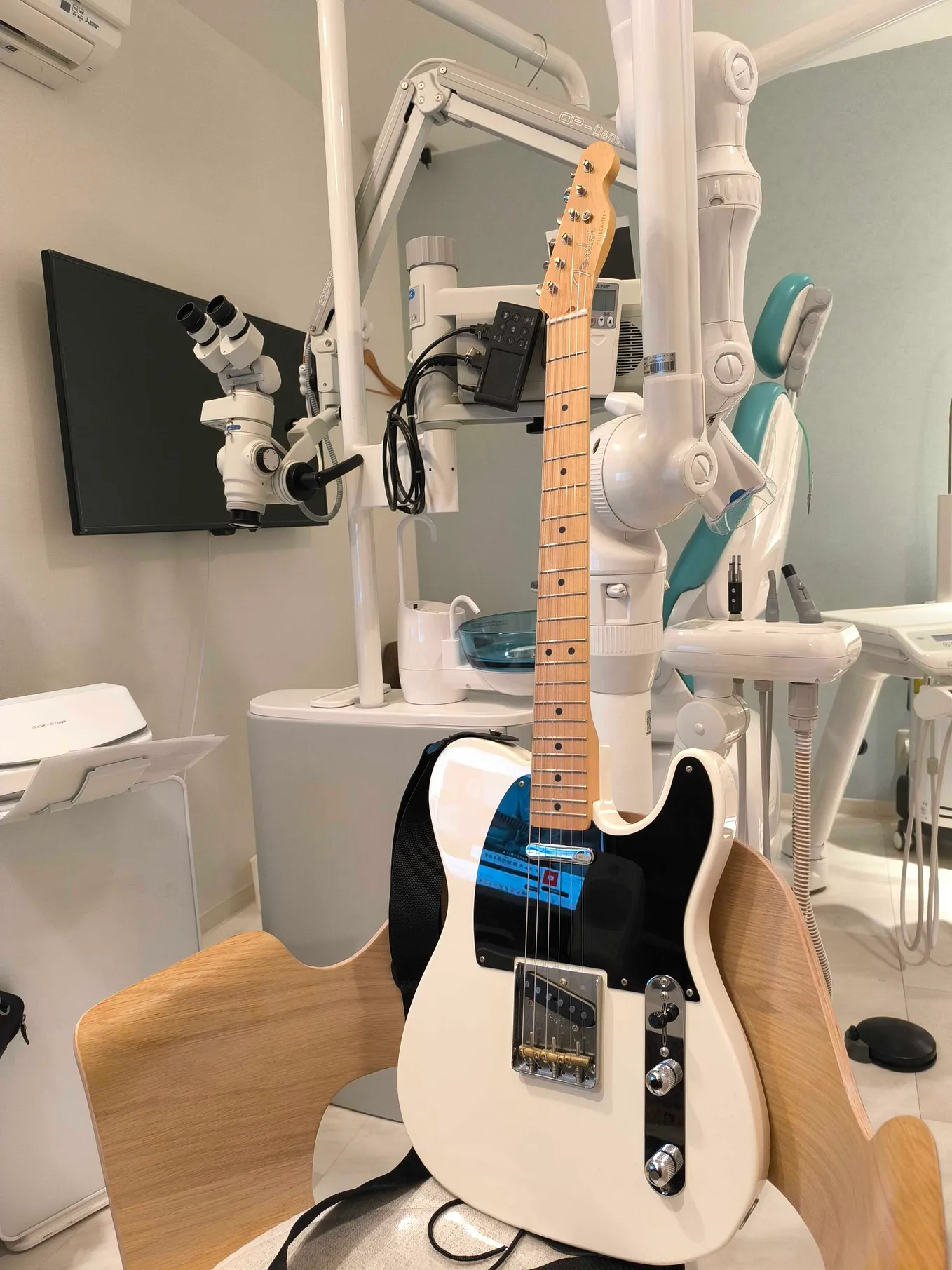
I run a small clinic, and I’m also, somewhat unusually, a musician. I mention this not as a curiosity but because the two practices have taught me something similar: in both medicine and music, the most interesting problems rarely live inside a single discipline. A patient’s pain, like a piece of music, often makes more sense once you stop trying to explain it with only the tools you already have in hand.
I don’t have a tidy resolution to this story yet — the referral is still in progress, and I may never know the full outcome. But the experience reinforced something I try to hold onto in every consultation: an unclear cause is not a failed diagnosis. It’s an invitation to keep listening, to bring in the right collaborators, and to treat the whole story — not just the symptom in front of you — as the actual subject of the visit.
About the Author
Dr. Mitsuki Tezuka (Mitsuro) is a dentist, Ph.D. (Oral Medicine & Molecular Cell Biology), and the director of Healthy Life Dental Clinic in Shinbashi, Tokyo. He integrates oral medicine, functional medicine, and autonomic nervous system science into a new model of whole-body wellness dentistry. He is also a composer and artist under the name Mitsuro (Sound Lab), creating cinematic rock music designed to support the nervous system and patient wellbeing.
🎵 Listen on Spotify: https://open.spotify.com/intl-ja/artist/60tbZfecqsP9w7gkMa5z09
🦷 Healthy Life Dental Clinic: https://healthylife-dental.com/
🌱 JUJU & Bloom: https://sites.google.com/jujuandbloom.com/jujuandbloom/