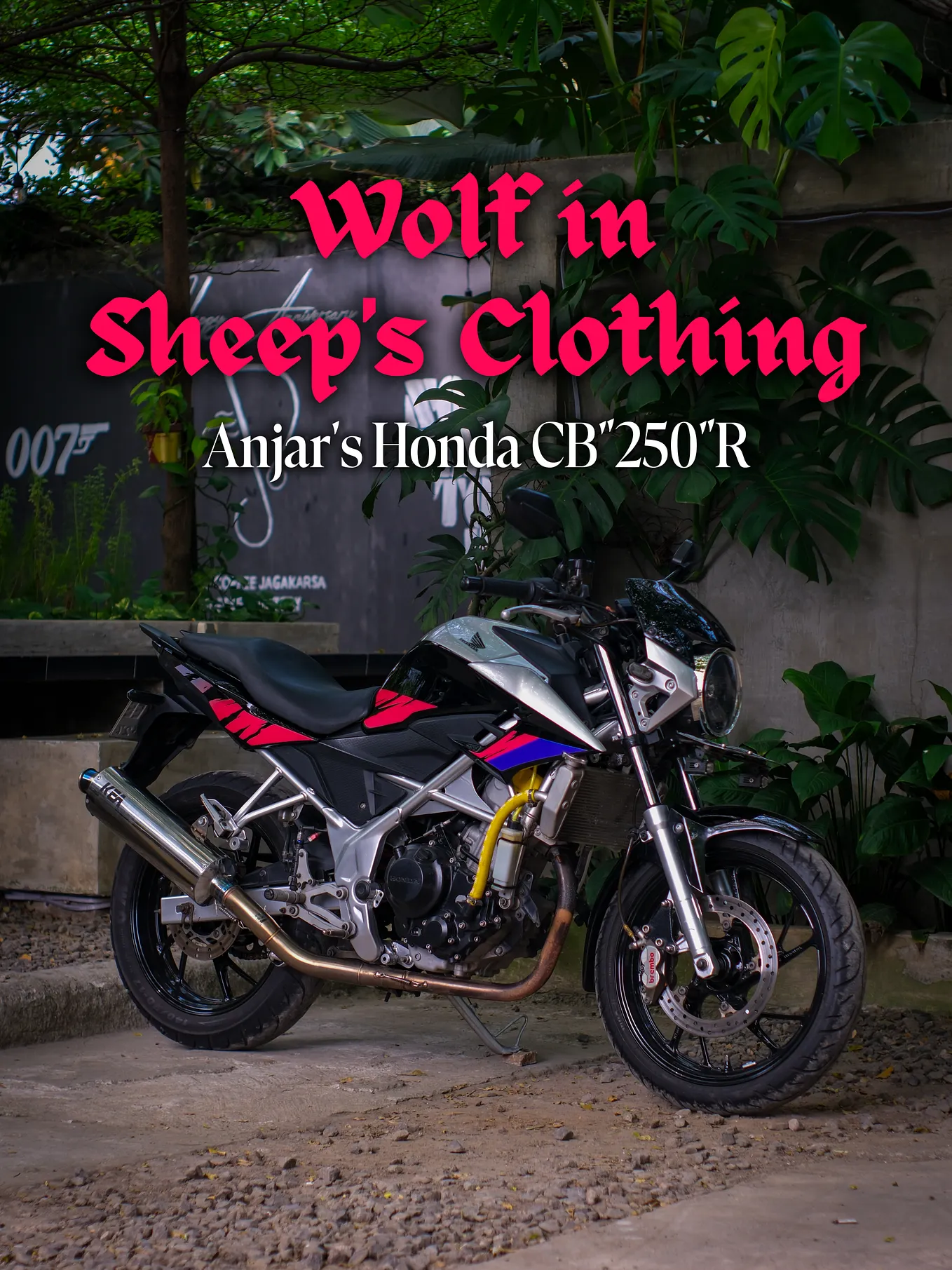
#FeatureFriday: Ardy’s Honda CBR 250R


The goal of #FeatureFriday has never been just to go through someone else’s motorcycle specs. I also want to get to know the person behind the handlebar on a deeper level. That’s why, for now, the people featured in this series are still limited to friends within my own circle.
In this fifth episode, we’re taking that concept a little further. By the time you finish reading this, you might not only get to know the subject of this article better, but perhaps also learn a little more about yourselves. Yeah, I know, cheesy stuff.
But seriously, this particular subject has had quite a significant impact on me, especially in the way I look at the hobby we all love: motorcycling.
Ever since I got to know the owner of this Honda CBR250R MC41, affectionately named Oren (and yes, I’m just as confused about where that name came from), I’ve gained some fresh perspectives on what I’ve been doing throughout my decade-plus journey in the motorcycle scene. Some things I used to believe were right turned out to be wrong, and sometimes, the other way around.
Motorcycling isn’t always about satisfying ourselves or simply seeking validation from others. There’s so much more to it. In fact, if we’re willing to explore this passion and embrace it more deeply, it can lead to something much bigger.
This motorcycle, along with a similar one that came before it (we’ll get into that later), helped its owner turn his dream of running his own motorcycle workshop into a reality. Yep, this bike has been making money for its owner for the past five years.
So, without further ado, let’s get into the story!

Meet Ardy. I first discovered him through social media, and back then, I never really thought about getting in touch or even following his account. You know those Instagram profiles that make you curious enough to scroll all the way down to their very first post because you just can’t seem to find anything quite like them elsewhere? That was my first impression of Ardy.
There was something particularly interesting about the way he tinkered with and personalized his motorcycles.
From turning his previous MC41, nicknamed Nardo, into a CB Bol d’Or replica, transforming it into a track bike, and eventually settling on its final form as a naked bike finished in Nardo Grey (yep, that’s where the name came from). That was until its engine finally gave up after clocking 150,000 km. A spun bearing brought Nardo’s nine-year service to an end, following a missed shift at 170 km/h. What a way to call it a day.
Not long after, Ardy established his own motorcycle workshop, VPM Garage.
Intrigued by his approach to tinkering and his perspective on motorcycle modifications, I eventually decided to pay his workshop a visit. After meeting him and having a proper conversation, I finally understood what made his way of thinking so interesting.
Ardy comes from a background deeply rooted in motorsports. His late father was also a petrolhead who had been actively involved in the car racing scene. No wonder he lives, breathes, and bleeds motorsport. And he’s a hardcore greasemonkey, too.
Let me explain what I mean in the next paragraph.

After briefly exploring the world of two-strokes and underbone motorcycles following his time with Nardo, Ardy could no longer resist the urge to get himself another MC41.
Meet Oren, this Honda CBR250R MC41, which started life as a neglected, low-mileage Repsol-liveried variant. That’s where the nickname “Oren” originally came from.
As time went by, Ardy’s changing activities and interests led him to take a different approach with his next build. Remember when I called him a hardcore greasemonkey?
What started out as a stock, low-mileage motorcycle has since become a canvas for his self-expression and a playground for experimentation, allowing him to continuously develop his mechanical skills for his own workshop.
This bike has become his learning ground: a place to experiment, make mistakes, and eventually achieve something worth celebrating. He’s constantly tinkering with it, and according to him, he can’t even sleep properly if he goes a whole day without working on a motorcycle.
The black-and-silver look you see here is just one of countless “skins” this bike has worn over the years.
For all we know, by the time this article goes live, Oren might already be wearing a completely different look. It’s a motorcycle that’s constantly evolving and improving, right alongside Ardy.
They say you can judge a person by their motorcycle. With that in mind, let’s take a closer look at how Oren reflects the man behind the handlebar!

Let’s start with the elephant in the room: that HUGE exhaust.
There’s just something about a big-volume exhaust that makes every motorcycle enthusiast secretly think, “You know what? That would look pretty damn good on my bike.”
But this particular specimen is a little unconventional. Something feels off, doesn’t it? Is it the mounting bracket positioned at the front when it should be at the rear? Wait a minute, what exhaust is this, anyway? And where’s the logo?

Turns out the logo was hiding on the left side of the muffler. So, is this actually a left-side exhaust? You bet. This is an original exhaust muffler from the Ducati Monster 900ie, a familiar L-twin motorcycle that most of you probably already know.
In its previous life, this muffler was responsible for handling the exhaust flow from one of the Monster 900ie’s cylinder banks, each displacing roughly 450cc. That makes it a rather sensible choice for Oren’s 250cc engine, especially considering the modifications already made to its cylinder head.
Think of it as running an aftermarket performance exhaust: more flow, thanks to its original application on a larger-displacement engine. But since this is still an OEM exhaust component, it retains the relatively refined and subdued sound you’d expect from a factory setup.
So, Ardy isn’t just throwing Ducati parts onto Oren for the sake of looking cool. There’s actually some engineering logic behind the madness.

Speaking of aesthetics, the titanium header connecting the muffler to the engine definitely adds another layer of visual appeal to Oren. But once again, it’s not just about looks.
Titanium offers excellent heat resistance and a favorable strength-to-weight ratio, making it an attractive material for exhaust applications. Its thermal properties also make it a suitable choice for managing heat around the exhaust system. In other words, it’s more than just a pretty piece of metal.

So, what exactly has been done to the cylinder head? Just a little porting and polishing. That’s it.
Oh, and there’s also a Barnett clutch spring and an OEM ignition coil from the Suzuki V-Strom 250. But that’s about it.
Sounds a little underwhelming, doesn’t it? Especially in an era where we’ve seen MC41 engines pushed to 363cc through big-bore conversions, alongside all sorts of extreme modifications that continue to push the boundaries of internal combustion engineering.
It almost feels like everyone is racing to deliver one last swan song, a bittersweet farewell to the internal combustion engine before everything eventually gives way to EVs. But that’s a story for another day. Let’s not get too carried away, shall we?
Instead, let’s focus on why Ardy chose to stick with nothing more than porting and polishing for his race bike.
Well, it’s enough for him. It’s enough for what he’s trying to achieve.
You see, while this motorcycle does serve as VPM’s race bike, the kind of racing they participate in is a little different. We’re talking about grassroots racing events held on karting circuits, using a time-bracket classification system.
So, what’s the point of building the fastest engine possible?
These events can put Oren on the same grid as 150cc four-stroke sportbikes, 150cc two-strokes, and even 1,000cc superbikes. The only real requirement is that everyone qualifies within the same time bracket.
It’s all about having fun at the end of the day.
Racing in this format puts more emphasis on other supporting components, such as suspension, braking, tire selection, and, most importantly, engine reliability. After all, you need a machine that can consistently hold its position all the way to the finish line.
That’s where a relatively stock engine makes perfect sense.
Get Farhan Zhafar’s stories in your inbox
Join Medium for free to get updates from this writer.
There are other benefits, too. Lower running costs and less wasted power. While other competitors might be busy adjusting valve clearances, dialing in cam timing, or replacing piston rings the night before race day, all Ardy has to do is change the oil and get a good night’s sleep.

If I could only upgrade one aspect of the engine, my choice would be the cooling system. And what’s the easiest way to do that? A bigger radiator, of course. For this build, Ardy relies on a big-volume radiator from Huwi.
Proper cooling isn’t just about keeping the internal engine components at optimal temperatures. The intake air benefits from it, too. Cooler air entering the engine can contribute to more efficient combustion.
To achieve this, Ardy also applied aluminum foil to the exterior of the airbox, acting as a heat shield to prevent engine heat from warming up the airbox and, ultimately, the incoming air.

With the engine sorted, let’s shift our attention to the other modifications, starting with the running gear.
For the front suspension, Ardy opted for the original Yamaha R25 forks, which have been extensively retuned. Suspension tuning, by the way, is something his workshop has become quite well known for.
Wait, R25 forks???
Yep. This is where we start getting a deeper look into Ardy’s way of thinking. He’s a bit of a mad scientist, if you ask me.
His reasoning? The R25 forks feature a 41 mm inner tube diameter, considerably larger than the CBR’s 37 mm. They also have a steeper fork angle, resulting in a sharper front-end geometry.
And what’s the outcome?
A stiffer front end and a shorter wheelbase, allowing for quicker turn-in during cornering while maintaining stability.
Brilliant.

For the rear suspension, Ardy relies on an aftermarket Delkevic shock absorber with 3-way adjustability. No fancy Öhlins here. Because, once again, it’s more than enough for what he needs. This shock has been serving Oren for the past two years without giving him any trouble.
And if you look closely, you’ll notice the safety wire.

Still on the running gear, let’s move on to the braking system.
“Wait, where’s the Brembo?”
You won’t find one here. Instead, stopping duties are handled by the original Yamaha R25 calipers.
Contrary to popular belief, you don’t necessarily need a 4-pot or even a 6-pot caliper on a motorcycle under 250cc to achieve good braking performance. A properly set up 2-pot caliper is more than capable of getting the job done, provided you get the right brake pads and tuning.
In this case, the calipers are paired with aftermarket brake pads and braided brake lines to further improve braking performance.
And, of course, there’s more safety wire. Because, well, it’s a race bike.

Every upgrade you make to your motorcycle should serve a purpose and be properly thought out. In this economy, you don’t want your hard-earned money going to waste, do you?
In this particular braking setup, this is where the upgrade actually makes sense. The original axial master cylinder from the CBR, which is often considered underwhelming, has been replaced with a KTC HMBR radial master cylinder featuring a 12.7 mm piston diameter.
Switching to a radial master cylinder provides better brake modulation, especially when braking into corners.
And that’s exactly what you want in a gruelling race situation, where precision really matters.

A steering damper from Motohaus also helps sharpen Oren’s handling while reducing hand fatigue, particularly when pushing the bike hard in race conditions.

Speaking of hand fatigue, even the most capable suspension and braking setup won’t mean much without properly dialed-in ergonomics. After all, road racing isn’t just about the machinery; it’s also about the rider. The rider needs to be as comfortable as possible to perform at their best.
For the hand contact points, Ardy opted for BPro handlebars with a 10-degree angle. A tried-and-true choice.

For the foot controls, Ardy went with a Nui Racing rearset paired with Delrin-tipped footpegs, designed to prevent them from catching on the asphalt when ground down mid-corner #BecauseRaceBike.

To improve comfort and aerodynamics while in a tucked position, the windshield was replaced with a taller one from Diana Motorsport, offering more complete protection for the rider against wind blast.

In the previous paragraph, you probably noticed the gold component hidden behind the 320mm disc rotor. Yep, this bike is flexing a set of legendary Daytona GP Wheels. Fancy, right? These parts almost shattered my premise about this bike’s build philosophy, which leans toward frugal. But of course, these wheels weren’t bought just to get validation from the internet.
In fact, Bimo, Ardy’s friend, bought these wheels brand new back when they were still a common aftermarket part, at a price that hadn’t been inflated yet. Later on, the wheels just sat collecting dust in a storage room because Bimo had moved on to a different set.
This particular Daytona GP Wheel was actually made for the Honda Tiger, in a 17x2.50–3.50 size. With a narrower width and lighter rotating mass than the stock CBR wheels, this bike became a cornering monster.
That’s what got Ardy interested in retrofitting these wheels onto Oren. It’s a bonus in style points too, because these wheels, which look a lot like Marchesini wheels, are just really good-looking. No wonder they’re still hunted down to this day. This is a race bike after all, what’s the point of going fast if you ain’t looking good doing it?
As for tires, after trying out a bunch of different ones, Ardy has settled on the IRC MBR 110 in 110/70–17. It’s the best bang-for-your-buck race-ready tire right now.

Another look at these fancy-smancy wheels, this time from the back. As for the gearing, it still runs the original final gear, paired with a red DID VF chain. It clashes a bit, but that’s just Ardy for you. He is an outlaw, and compromising with the norm is not in his book.
At the rear, the job of being the contact point with the asphalt is still handled by a Dunlop Q-Lite in 140/70–17, but soon it will be replaced by an IRC MBR in the same size.
The devil is in the details. If I had to describe this bike in one word, it’s GRITTY. No nonsense whatsoever. There’s nothing to hide, nothing that needs to be faked to look perfect. Every battle scar is worn with pride. There’s no time to deal with it, because it’s better to focus on more important things that will produce something more meaningful.

Oh, about that twisty wire that’s all over this bike: in a race situation, the vibration the bike produces is much more severe than during normal riding, and it risks causing the bolts on the bike to back out. That’s why safety wire is needed to hold crucial bolts, such as the wheel axles, calipers, and others, so they don’t move when vibrations occur. It’s something we take even further to maximize safety on the racetrack. No safety, no fun, agree?

So, there it is: another story about the connection between human and machine. This one turned out a little more technical than usual, because there is so much more to this machine and the man behind it. I hope a build like this opens your eyes a bit and lets you see motorcycling from a different perspective, because there is much more to it than what you already know. This goes beyond the build.
What do you think of this outlaw street-track CBR 250R build? Let me know in the comments below!