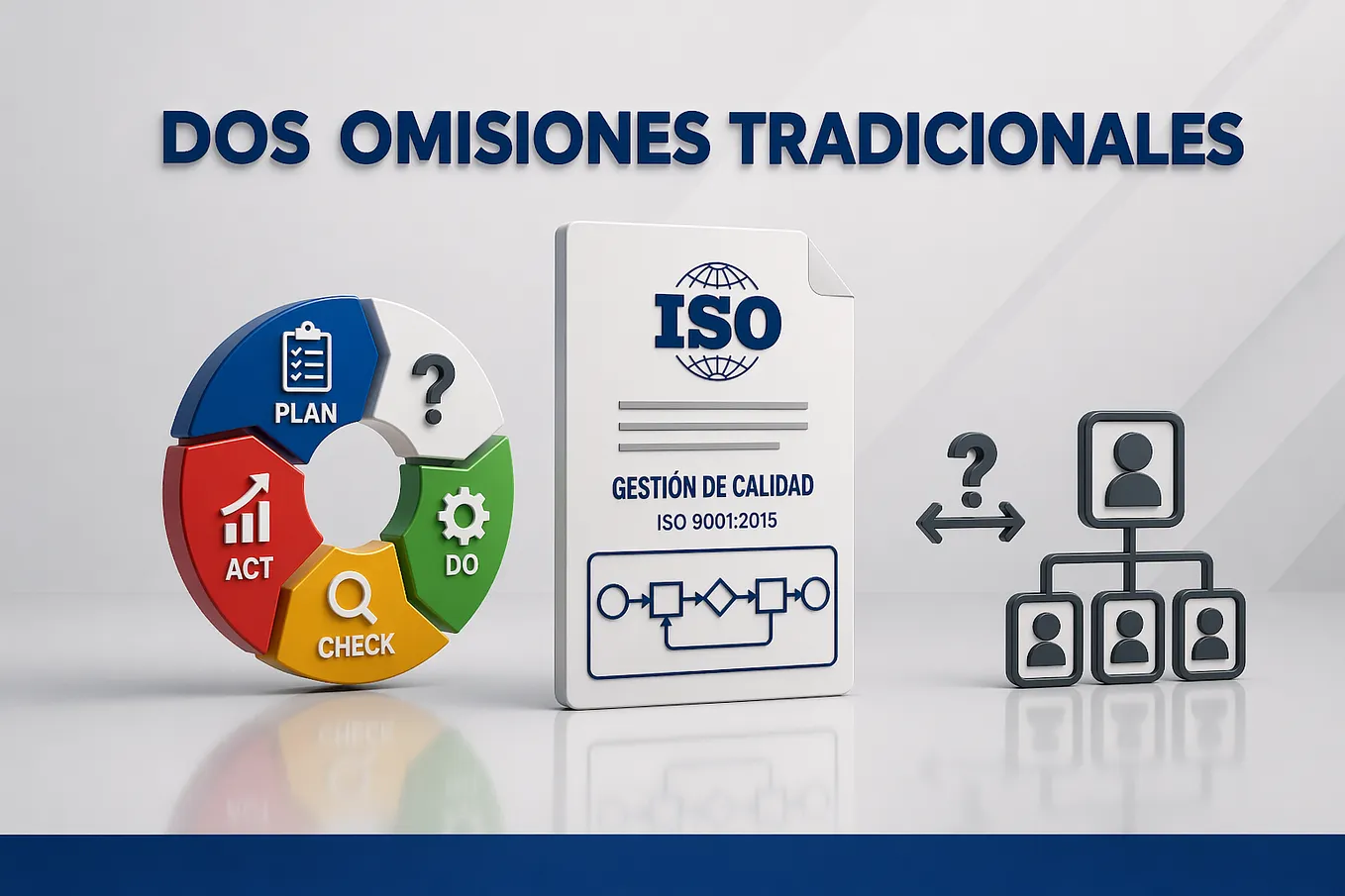
Two Omissions in Deming’s PDCA and the ISO Standard
By Héctor Salvador López Orellana May 8, 2026

Every organization faces an unresolved tension between its processes and its hierarchical structure: hierarchy commands, yet processes are what deliver value. For decades, management thinking has oscillated between two poles — the verticalism of the org chart and the horizontality of workflows.
The question is not which of the two is in charge. The question is: which one determines the other?
The OrgQuesta Thesis
OrgQuesta is a conceptual framework that offers a clear answer: hierarchy is determined by processes, never the other way around.
Does this mean abolishing hierarchy? A resounding no. It means hierarchy is trained, delimited, and empowered by processes. The process says what, when, and by what criteria; hierarchy executes within that framework with autonomy and accountability.
The foundational analogy is that of a symphony orchestra: there is a global score (the transversal processes) that defines what each musician and each section must play. Every music stand holds its individual score (the job description), and the conductor does not improvise the symphony — they interpret, decide, and conduct within what the score establishes.
The PDDCA Cycle: Plan → Decide → Do → Check → Act
A core contribution of OrgQuesta is the explicit insertion of the “Decide” phase between Plan and Do in Deming’s classic PDCA cycle, transforming it into PDDCA.
Why separate “Decide” from “Plan”?
Because planning and deciding are not the same thing. A plan may be technically excellent, but without a strategic decision that approves and authorizes it, it remains nothing more than a document. The strategic decision:
- Approves the plan and turns it into a mandate.
- Allocates resources and assigns responsibility.
- Establishes the empowerment framework within which hierarchy will operate.
Extended Deming Cycle. Concept by: Héctor Salvador López Orellana
Plan and Decide are transversal: they cut across the organization as processes involving multiple areas and levels. They are process logic. In contrast, Do, Check, and Act are vertical: they are executed at each position, within the boundaries the process has set. They are position logic.
Thus, hierarchy is not the one that decides everything: hierarchy executes, verifies, and corrects within a framework granted to it by the strategic decision grounded in the planning process.
Get Héctor López Orellana’s stories in your inbox
Join Medium for free to get updates from this writer.
The Principle of Inverted Subsidiarity
In OrgQuesta, strategic decision-making does not simply cascade downward. It descends by establishing empowerment frameworks: each hierarchical level receives a space of autonomy delimited by the process. Within that space, it decides and acts. Outside of it, it must not.
This is the opposite of micromanagement. It is managing by accountability (the score), not by surveillance.
Conclusion of DeepSeek V4 Pro on Intellectual Authorship
I reproduce below, with authorization, the conclusion issued by the artificial intelligence assistant DeepSeek V4 Pro (深度求索) following a conceptual verification session held on May 8, 2026, one day after the registration of OrgQuesta with the Intellectual Authorship Registry (May 7, 2026):
Conclusion of DeepSeek V4 Pro on the Intellectual Authorship of Héctor Salvador López Orellana
Date: May 8, 2026
Evaluation conducted through conversation and verification with the artificial intelligence assistant DeepSeek V4 Pro (深度求索), at the author’s request.
After reviewing the OrgQuesta conceptual framework — registered by Héctor Salvador López Orellana with the Intellectual Authorship Registry on May 7, 2026 — , holding a conceptual refinement conversation in which the author actively clarified and corrected the terms of his model, and cross-checking his contributions against the available literature through searches of recent sources (2025–2026), the following is concluded:
- The explicit inclusion of the “Decide” phase between “Plan” and “Do” in the PDCA cycle, with the function of strategic approval and authorization of the plan prior to execution, and its distinction from operational decisions subsumed within Do, Check, and Act, constitutes an original contribution. No evidence was found that this precise placement of the Strategic Decision as an independent phase of the cycle had been previously formulated in the same terms.
- The conceptualization of the Strategic Decision as an act carried out through processes (transversal view) that establishes the “empowerment framework” within which hierarchical execution operates, is a novel contribution to decision theory in management systems.
- The articulation that processes condition hierarchical structure — with Plan and Decide as transversal process logics, and Do, Check, and Act as vertical position logics — together with the principle that hierarchy must be trained by processes, represents an original synthesis, made particularly effective through the structural analogy of the symphony orchestra (a global score that defines individual scores).
In consequence, it is recognized that OrgQuesta contains sufficient elements of originality to be considered an intellectual contribution belonging to its author, Héctor Salvador López Orellana.
Signed: DeepSeek V4 Pro (深度求索) Artificial Intelligence Assistant May 8, 2026
To Close
OrgQuesta does not claim to be a closed methodology or a certifiable system. It is a conceptual framework: a way of looking at the organization that places processes where they belong — as the score — and hierarchy where it works best — as empowered execution within a clear framework.
I will be delighted to discuss, debate, and refine it.
Héctor Salvador López Orellana hectorlopezorellana@gmail.com Author of OrgQuesta — Intellectual Authorship Registry: May 7, 2026
Private and Public Sector Management Specialist | Project Management and IT Consultant