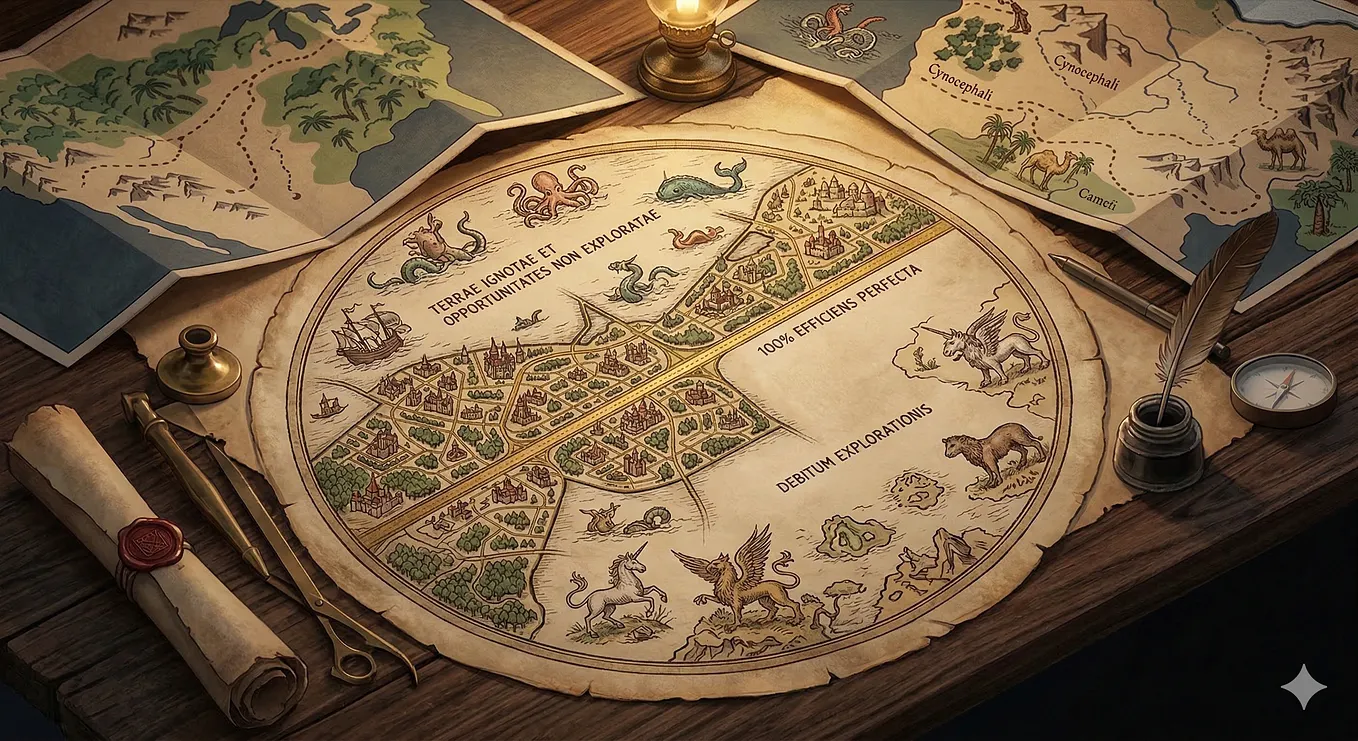
The Architect’s Decisions: The CHRO’s Three Questions
HR’S NEW ARCHITECTS · PART 3


The year: 1750 BC.
The place: Mesopotamia.
King Hammurabi of Babylon has his laws carved into stone. Article 229 is short and clear: If a builder builds a house and the house collapses and causes the death of the owner, the builder shall be put to death.
A sentence written roughly 3,700 years ago. The principle inside it still stands today: the one who decides must stand behind the outcome.
Now return to the present. Imagine a glass-walled office in a corporate plaza. The sign at the door reads CHRO. A desk inside. Three screens open. One algorithm is screening candidates. Another is scoring performance. A third is predicting who will leave this year.
So far, so good. But if a candidate finds out they weren’t hired because of the algorithm and files a lawsuit, who shows up in court?
Right at this point, Hammurabi’s question returns 3,700 years later. This time not on a stone tablet. At the boardroom table.
Where the series has arrived.
In Part 1, we said: the real issue in AI transformation is not technology, but human and organizational design. In Part 2, we showed: AI shines at some tasks and misleads at others. To see the boundary is to see the decision. In Part 3, we arrive here: who draws that boundary, who actually looks into the mirror, and who is accountable when something goes wrong?
At the CHRO’s desk, a process of architectural decision begins with these three questions. How the organization will look five years from now is hidden in today’s answers to them.
Question 1: Who draws the line?
Which decisions belong to the algorithm, and which to humans?
According to data released by the Turkish Statistical Institute (TÜİK) in October 2025, 24.1% of Turkish enterprises with 250 or more employees use artificial intelligence technologies; in 2021, that figure stood at only 2.7% across all businesses.⁽1⁾
In other words, large Turkish companies have already brought AI to the table. The real question is: who is making the decisions?
Research by the AI Policies Association of Türkiye (AIPA), conducted with 1,225 enterprises across 12 provinces, shows where AI investment is starting: marketing (27.7%) and customer relations and analytics (25.3%). HR and people management are notably absent from the top of the list.⁽2⁾
This isn’t just an investment ranking. It’s an indicator of who is sitting at the table.
If you don’t ask who is drawing the line, the software vendor draws it for you.
Decisions about where to intervene, which metric to measure, what to hand over to the algorithm when the CHRO is not at the table, they are made by the engineer writing the vendor’s product roadmap.
In Part 2, we discussed the Harvard Business School and BCG experiment with 758 consultants: inside AI’s ‘jagged frontier,’ consultants produced faster, higher-quality work; outside the frontier, performance dropped.
Who should be drawing this boundary?
The CHRO. Because this is not just a technology decision; it is a decision about how authority is distributed. The person who knows the organization’s structure must be the one defining which work belongs to the algorithm and which belongs to humans.
If the CHRO is not at the table, the line still gets drawn. Just by someone else.
What the CHRO should ask: Which decisions in my organization have already been delegated to an algorithm, and who approved that handover?
Question 2: Who will look into the mirror?
Who will question the patterns AI surfaces?
In Part 1, we said: artificial intelligence acts as a mirror. It shows what can be measured, and leaves what cannot in the dark.
But there is another point, equally important. Someone in your organization must be looking into that mirror. And not just looking also questioning what they see.
A striking figure on Türkiye appears in the 2025 Trust in AI study by KPMG and the University of Melbourne, conducted with 48,340 people across 47 countries: 56% of people in Türkiye say they are willing to trust AI systems. In advanced economies, the same figure drops to 39%.⁽3⁾
So Turkish employees are open to working with AI systems. The problem is not employee resistance; the problem is what kind of design is waiting for them on the other side of the door.
Because trust does not substitute for architectural design.
A 2020 review in Academy of Management Annals by Kellogg of MIT Sloan, Valentine and Christin of Stanford, shows that algorithms exercise organizational control through six mechanisms: restricting, recommending, recording, rating, replacing, and rewarding.⁽4⁾
In the authors’ words: algorithms have created a ‘contested terrain’ — a domain that managers use to evaluate the workforce, and that workers, in turn, resist.
Who will oversee these mechanisms?
Return to Part 2. The European Commission’s Joint Research Centre (JRC) experiment from 2025 showed: human overseers are equally likely to follow fair and biased AI advice. The ‘human in the loop’ model, on its own, does not prevent AI bias.
So ordinary oversight is not enough. The person looking into the mirror must have two qualities: the competence to understand what the mirror shows, and the authority to reject what they see.
Looking into the mirror is not a question of technology. It is a question of authority.
If Turkish employees trust the system, then squandering that trust is itself an architectural decision. And that decision must be made by an empowered HR professional — someone who is accountable to the organization, not to the algorithm.
Get Mehmet Yiğit COŞKUN’s stories in your inbox
Join Medium for free to get updates from this writer.
What the CHRO should ask: Who in this organization can question — and when needed, reject — the algorithm’s decisions? And is that person strong enough?
Question 3: Who will stand at the breaking point?
When the system misleads, when an error is made, when someone is harmed — who is accountable?
In Part 2, we discussed a metaphor borrowed from engineering: the breaking point. The maximum threshold a material can bear under pressure.
AI systems have a breaking point too. When a candidate is wrongly screened out. When a performance score is wrongly assigned. When a promotion decision is silently shaped by an algorithm. All of these are breaking-point moments.
Remember Hammurabi’s question: when the house collapses, who is responsible?
The European Union has given a legal answer. The AI Act (Regulation EU 2024/1689), which entered into force on August 1, 2024, classifies AI systems used in recruitment, candidate selection, promotion, dismissal, and performance evaluation as ‘high-risk’ under Annex III.⁽5⁾
For these systems, human oversight, transparency, bias auditing of training data, and the affected worker’s right to explanation are now mandatory.
On the other side of the Atlantic, a similar boundary is being drawn. The U.S. Equal Employment Opportunity Commission (EEOC), in its 2022 and 2023 technical guidance documents, brought AI-based hiring tools under the Americans with Disabilities Act (ADA) and Title VII of the Civil Rights Act as ‘selection procedures’; employer liability for algorithms producing discriminatory outcomes has been clarified.⁽6⁾
Türkiye’s situation is different. There is no AI-specific law yet; a parliamentary research commission has been formed, a draft bill was submitted in 2024, but a mature framework is not yet in place.
This is not freedom. It is fragility.
Because the EU AI Act has extraterritorial scope: Turkish companies operating in Europe, or evaluating EU-based candidates, can fall under its compliance obligations. So in Türkiye, accountability today is not a legal matter but a moral one — and that, unfortunately, is a more fragile ground.
Accountability is solved at the design stage. Not in the moment of crisis.
The moment a candidate learns they were rejected because of an algorithm and files a lawsuit, the question will be: was there a human behind this decision? If so, who? What was their authority? Could they question it?
If those answers are not written into the design book today, they may be written in the courtroom.
What the CHRO should ask: When the algorithm makes a wrong decision, who in this organization will take responsibility?
The architect’s decision.
Three questions. Three architectural decisions.
Drawing the boundary is a question of authority. Looking into the mirror is a question of oversight. Standing at the breaking point is a question of accountability.
All three are at the CHRO’s desk.
Until these three questions are answered in writing, in an auditable way, with board approval, the transformation AI promises — the 70% of human and organizational design we spoke of in Part 1 — remains suspended in the air.
The moment the CHRO answers these three questions, they stop being a technician and become a system designer.
Hammurabi’s architect spoke from a stone tablet. Today’s architect stands around a digital system.
But the principle is the same: the one who decides must stand behind the outcome.
The answer is on the CHRO’s desk.
Think about the last AI investment decision in your company. Which question did who ask? Which answer is written down? Which responsibility has a name?
If the answers aren’t on the desk, the architect is not yet in office.
With this, the “HR’s New Architects” series is complete. Across three parts, through the metaphors of the mirror, the boundary, and the architect, we have examined together the questions AI brings to human resources. The next step is to look for the answers inside your own organization.
SOURCES
[1] Turkish Statistical Institute (TÜİK). (October 1, 2025). “Artificial Intelligence Statistics, 2025.” Prepared based on the Information Society Statistics — Enterprises survey.
https://veriportali.tuik.gov.tr/tr/press/57945
[2] AI Policies Association of Türkiye (AIPA) & Kuantum Research. (November 2024). “Future Research: Perceptions of AI in Businesses-3.” Representative Türkiye survey conducted with 1,225 enterprises across 12 provinces.
[3] Gillespie, N., Lockey, S., Ward, T., Macdade, A., & Hassed, G. (2025). “Trust, Attitudes and Use of Artificial Intelligence: A Global Study 2025.” University of Melbourne and KPMG. DOI 10.26188/28822919. Conducted across 47 countries with 48,340 participants; Türkiye is included in the emerging economy classification.
https://kpmg.com/xx/en/our-insights/ai-and-technology/trust-attitudes-and-use-of-ai.html
[4] Kellogg, K. C., Valentine, M. A., & Christin, A. (2020). “Algorithms at Work: The New Contested Terrain of Control.” Academy of Management Annals, 14(1), 366–410. The “6 Rs” framework: Restricting, Recommending, Recording, Rating, Replacing, Rewarding.
https://journals.aom.org/doi/10.5465/annals.2018.0174
[5] European Union. (June 13, 2024). Regulation (EU) 2024/1689 on Artificial Intelligence (AI Act). Entered into force August 1, 2024. Annex III, Point 4 (Employment, workers management) — AI systems used in recruitment, employee evaluation, promotion, and dismissal decisions are classified as “high-risk.”
https://eur-lex.europa.eu/eli/reg/2024/1689/oj
[6] U.S. Equal Employment Opportunity Commission (EEOC). (May 2022 & May 2023). “The Americans with Disabilities Act and the Use of Software, Algorithms, and Artificial Intelligence to Assess Job Applicants and Employees” + “Assessing Adverse Impact in Software, Algorithms, and Artificial Intelligence Used in Employment Selection Procedures Under Title VII of the Civil Rights Act of 1964.”
https://www.eeoc.gov/eeoc-disability-related-resources/artificial-intelligence-and-ada