#treffen
Interview with Matteo Trevisan
From the banks of the Isonzo to the Saguenay Fjord


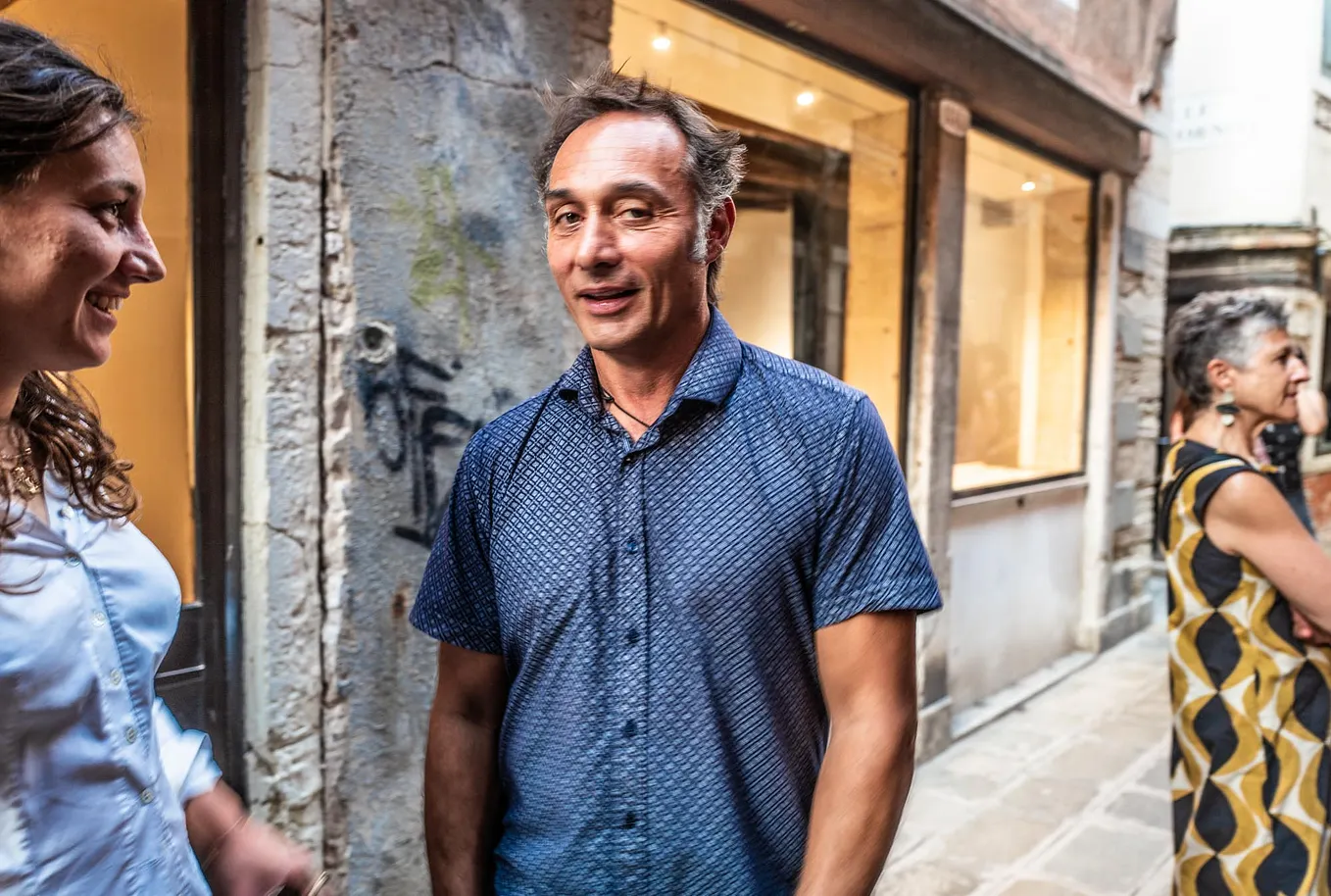
We’re continuing our series of conversations with photographers. This time we’re in Padua, meeting photojournalist Matteo Trevisan, who now lives here. We wanted to speak with him after learning he’ll be taking part in the Zoom Festival in Canada in the coming days (we’ve already written about the festival elsewhere. Knowing the organiser’ forward-thinking approach, we were keen to learn more about the project he’ll be exhibiting. So, one sunny morning on the Isola Memmia in Prato della Valle, we sat down and asked him a few questions.
Tell us about yourself and your journey.
I was born and raised in a small town on the outskirts of Italy — specifically Gradisca d’Isonzo, less than 10 minutes from Slovenia and, fortunately, bordering the Isonzo River. After my three-year undergraduate degree, I moved to London: I needed to try something completely different from my rural background, which I’m very proud of. I planned to stay for a few months, but two years passed — years that mattered, because that’s where I began to think photography could be my path. I decided to return south; the north isn’t for me, and I moved to Rome, where I started studying photography at ISFCI. I stayed there for seven years. During that time, I began my first projects, joined Contrasto agency, and produced my first photo book on young people in the No TAV movement. Recently, though, I left Rome — which I still care deeply about — and moved to Padua to be with my partner. I’m very happy with this choice. I find it a more human scale of life.
You were born in a borderland and studied in Trieste. How do you think that geographical position — straddling different peoples and languages — has influenced you?
It’s a question I often ask myself. I couldn’t give you a clear-cut answer. What certainly influenced me was growing up in a marginal, out-of-the-way, rural area. Instinctively, in my projects I seek that relationship with the land, that community which no longer exists in Friuli but which I’ve always sensed through my grandparents’ stories. I feel tied to the land, and my projects always are too. Perhaps the history of my place conditioned me: yes, a borderland, but also one of great wars and conflicts. Since I was small, I’ve had a strong fascination with partisans’ stories, and that’s something I almost always look for: resistance.
Get Francesca Magnani’s stories in your inbox
Join Medium for free to get updates from this writer.
What struck you about the story you’re bringing to Canada?
In Canada, I’m presenting a project I began over a year ago and am still continuing, on the ecological and social revolution of Rojava, in north-eastern Syria. At the centre of this revolution are women. I believe the revolution that has been underway in Rojava for over 15 years is something extraordinary — not only in the Middle East but worldwide. It’s a concrete attempt to create a society based on direct democracy, women’s liberation, and ecology. With my project, I initially decided to focus on the ecological aspect, but then I realized it was impossible not to address the question of women too: philosophically, woman is nature, and there can be no ecology without women’s liberation. I’d say it’s one of the few examples of a society that has put into practice the model of social ecology idealized by Murray Bookchin. The decision to go was something I’d been maturing for years. As I said, I’ve always been drawn to themes linked to ecology and resistance; I just had to wait for the right moment.
To what extent has your background in sociology and politics “prepared” you for this work?
It’s an ongoing process of study. They certainly help me understand and get to know dynamics and realities beyond the daily streaming we’re used to. Finding concrete examples that offer alternatives to this capitalist system is definitely valuable study and preparation. It follows, then, that I’m drawn to stories involving social and political movements. I’d say they help me understand and find new stimuli. They also give me a sense of active purpose in making photography; in a small way, I do a kind of activism or militancy by speaking about certain topics.
Next month you’ll also be exhibiting in Belgrade. Which project are you bringing there?
In Belgrade I’m presenting More Necessary Than the Sun, a long-term project lasting over three years on the consequences of environmental pollution in the Western Balkans, caused by industries, mines, and energy production hubs that don’t respect environmental regulations. Here we often witness phenomena of neocolonialism; I’ve found Chinese, Indian, Russian, and Turkish companies. The situation is very serious, and I wanted to document what effects all this has on the local population. The exhibition has already been shown in various venues, but finally it’s arriving in Belgrade in its most extensive version yet — and it’s certainly important to stage it there to give something back to the people I’ve met over these years, many of whom have become friends. The show is held at the Cultural Centre of Belgrade and opens on October 22.
What do you appreciate and value about a city like Padua? What did you find here that made you choose it?
I came here for love, but what I certainly appreciate are the distances: getting around by bike has a unique value, human relationships are easier to cultivate, and getting out of the city is very quick and easy.
https://www.matteotrevisan.net/
http://zoomphotofestival.ca/
Matteo Trevisan, “Jin, Jiyan, Azadî — Woman, Life, Freedom”
9 October — 1 November 2026
Opening hours: daily, 9:00–17:00
Free admission: Pulperie Building 1912–300 rue Dubuc, Chicoutimi[iicmontreal.esteri][iicmontreal.esteri][zoomphotofestival]