WCAG and Learning Management Systems: What EdTech Teams Need to Know


WCAG and Learning Management Systems: A Practical Guide for EdTech Teams
Online learning has grown fast. Universities, corporate training teams, and schools now rely on learning management systems to deliver everything from compliance courses to full degree programs. But as digital classrooms expanded, accessibility often got left behind.
For students who use screen readers, keyboard navigation, or captions, an inaccessible LMS is not an inconvenience. It is a wall. And for the organizations running those platforms, that wall carries legal risk under the Americans with Disabilities Act, Section 508, and increasingly, international frameworks like the European Accessibility Act.
WCAG — the Web Content Accessibility Guidelines — is the standard that defines what accessible digital content looks like. Understanding how it applies to WCAG learning management systems is no longer optional for EdTech teams. It is the baseline.
What WCAG Actually Requires in an LMS Context
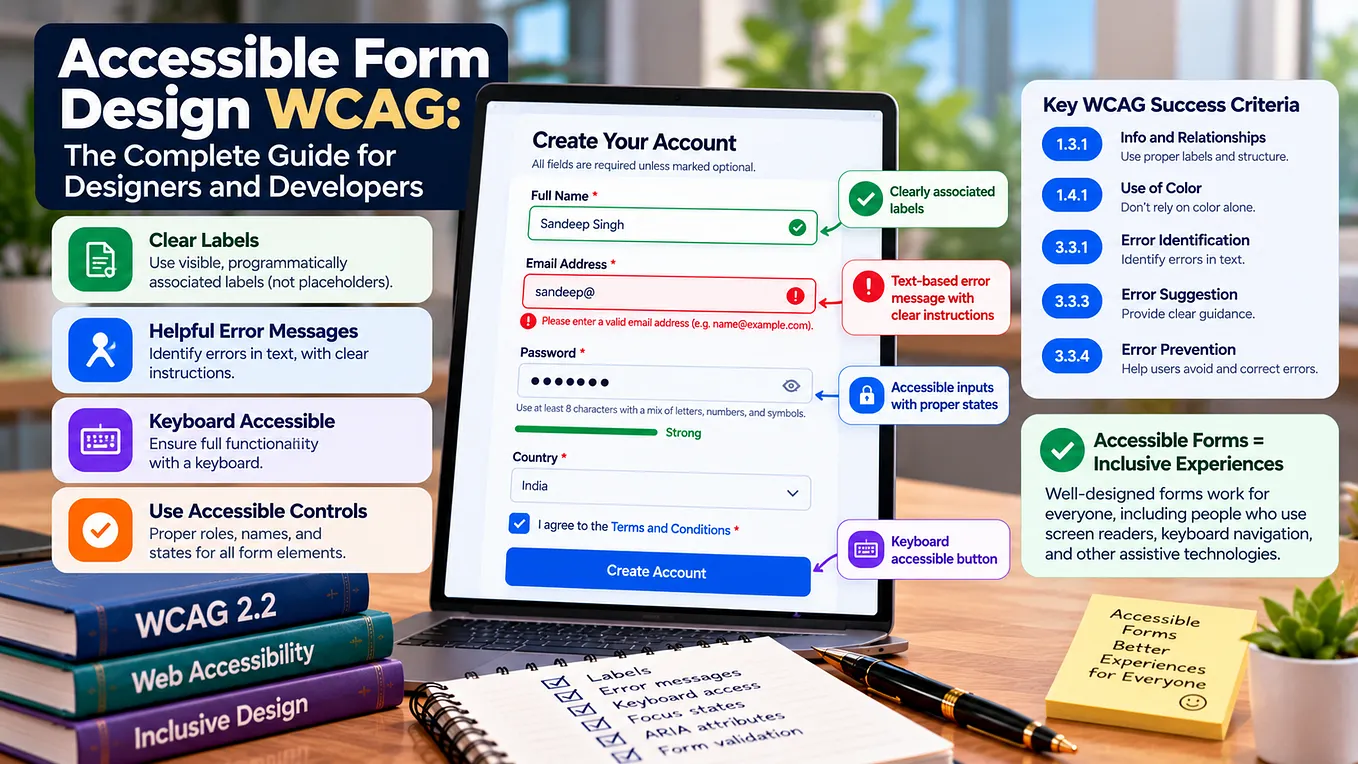
WCAG is built around four principles: content must be perceivable, operable, understandable, and robust. Those principles sound abstract until you apply them to an actual course platform.
Here is what each means in practice:
Perceivable means every piece of content can be seen or heard, even if a student cannot use one of those senses. A video without captions fails this test. An image without alt text fails this test. A PDF that is a scanned image — with no underlying text — fails this test.
Operable means a student can navigate and interact with the LMS without a mouse. Every dropdown menu, quiz, discussion board, and file upload button needs to work with a keyboard alone. If any part of a course requires a click-and-drag interaction with no keyboard alternative, it is inaccessible.
Understandable covers both language and behavior. Instructions should be clear. Error messages should explain what went wrong and how to fix it. Navigation should be consistent across the platform.
Robust means the platform works with assistive technologies — screen readers, voice control software, magnification tools — and continues to work as those technologies update.
WCAG 2.1 Level AA is currently the accepted compliance target for most organizations. WCAG 2.2 introduced additional criteria, including improvements to focus indicators and dragging movements, that are increasingly relevant for complex eLearning interfaces.
The Most Common Accessibility Failures in eLearning Platforms
Automated testing tools catch roughly 30 to 40 percent of accessibility issues. The rest only surface through manual testing, often by testers who actually use assistive technologies.
The failures that show up most frequently in LMS audits:
Video content without captions or transcripts. Pre-recorded lectures, onboarding videos, and explainer clips that have no captions lock out deaf and hard-of-hearing learners. Auto-generated captions from video platforms are rarely accurate enough to count.
Inaccessible course documents. PDFs uploaded to an LMS are often the original design files converted to PDF — no tags, no reading order, no alt text on images. A screen reader presented with one of these files produces an unusable output.
Quiz and assessment interfaces. Timer-based quizzes without accommodation settings, drag-and-drop interactions with no keyboard alternative, and error messages that only use color to indicate a wrong answer are all common failures.
Third-party content embedded in the platform. An LMS may be technically accessible, but embedded tools — simulations, interactive assessments, external video players — introduce their own accessibility issues that the platform owner is still responsible for.
Missing focus indicators. Keyboard users navigate by tab key, and a visible focus indicator shows them where they are on the page. Many LMS platforms suppress the default browser focus ring for aesthetic reasons, leaving keyboard users with no visible cue.
How to Approach WCAG Compliance for an LMS
Compliance is not a single audit. It is an ongoing process that runs across content creation, platform configuration, and vendor management.
Get BarrierBreak’s stories in your inbox
Join Medium for free to get updates from this writer.
Start with a structured audit. Before making changes, map what exists. A proper eLearning accessibility audit covers the platform interface, existing course content, embedded tools, and the document library. It should combine automated scanning with manual testing by accessibility specialists — ideally including people who use assistive technologies in their daily work.
For organizations looking for expert guidance on what an Ed Tech accessibility assessment covers, BarrierBreak’s accessible Ed Tech page outlines what a people-first approach to this type of testing looks like in practice.
Fix content at the source. Caption videos, remediate PDFs, add alt text to images, and build accessible course templates that content authors use from the start. Retrofitting is expensive. Building accessible content habits into the creation process is not.
Evaluate the LMS platform itself — and its vendors. Request Voluntary Product Accessibility Templates (VPATs) from your LMS vendor and any third-party tool providers. A VPAT is a structured disclosure of where a product meets WCAG and where it does not. Gaps in a vendor’s VPAT become your organization’s compliance gaps if you deploy their content.
Train content creators. Accessibility knowledge should not sit only with the compliance team. Instructional designers, L&D managers, and faculty uploading content to an LMS all make decisions that affect whether a course is accessible. Basic training on captions, alt text, reading order, and color contrast covers the majority of common authoring mistakes.
What WCAG 2.2 Changes for Online Learning
WCAG 2.2 added nine new success criteria. Several are directly relevant to eLearning interfaces.
Focus appearance (2.4.11 and 2.4.12) sets minimum size and contrast requirements for keyboard focus indicators — addressing exactly the hidden focus ring problem common in LMS platforms.
Dragging movements (2.5.7) requires that any interaction using a drag motion has a single-pointer alternative. This matters for course interfaces that use drag-and-drop for sorting questions or building timelines.
Consistent help (3.2.6) requires that help mechanisms appear in the same location across pages. For complex LMS platforms with context-sensitive support, this requires careful design.
Not every organization needs to be fully WCAG 2.2 compliant today — regulatory requirements vary by market — but building to 2.2 now avoids a second round of remediation when requirements catch up.
The Legal and Institutional Stakes
In the United States, Section 504 of the Rehabilitation Act, IDEA for K-12, and ADA Title II for public universities create overlapping legal obligations around accessible educational technology. Complaints to the Department of Education’s Office for Civil Rights related to inaccessible LMS platforms have resulted in resolution agreements requiring institutions to conduct full audits and remediate content on specific timelines.
Organizations operating in the EU face the European Accessibility Act requirements from 2025 onward. Australia, Canada, and the UK each have their own frameworks that map closely to WCAG 2.1 AA.
The practical point: legal exposure is real, the complaint pathway is well-established, and most institutional buyers of LMS software now require vendors to demonstrate accessibility compliance as part of procurement.
BarrierBreak works with universities, EdTech companies, and corporate training teams across the US, UK, Australia, and India to test, audit, and remediate digital learning environments for compliance with WCAG, Section 508, and ADA requirements.
Frequently Asked Questions
What WCAG level should an LMS meet?
WCAG 2.1 Level AA is the current standard expected by most regulators and institutional buyers. WCAG 2.2 is the latest version and organizations building or procuring new platforms should target it.
Does WCAG apply to uploaded course content or just the LMS platform itself?
Both. The platform interface and every piece of content delivered through it — videos, PDFs, quizzes, embedded tools — must meet accessibility requirements. Platform compliance does not automatically make course content compliant.
Can automated tools check LMS accessibility?
Automated tools are useful for catching structural issues like missing alt text or poor color contrast ratios, but they catch only a fraction of real accessibility problems. Manual testing by experienced testers, including users of assistive technology, is essential for a complete picture.
What is a VPAT and why does it matter for LMS procurement?
A VPAT (Voluntary Product Accessibility Template) is a document where a vendor discloses how their product meets WCAG and Section 508 requirements. It is the starting point for evaluating whether an LMS vendor’s accessibility claims are substantiated.
How long does an eLearning accessibility audit take?
It depends on the scope — platform-only, content-only, or both. A focused audit of a single LMS instance with sample course content typically takes two to four weeks. Larger content libraries take longer, especially if document remediation is included.
Is Section 508 the same as WCAG?
Section 508 references WCAG 2.0 Level AA as its technical standard for web content, so there is significant overlap. However, Section 508 also covers software, hardware, and telecommunications, making it broader in scope than WCAG alone.