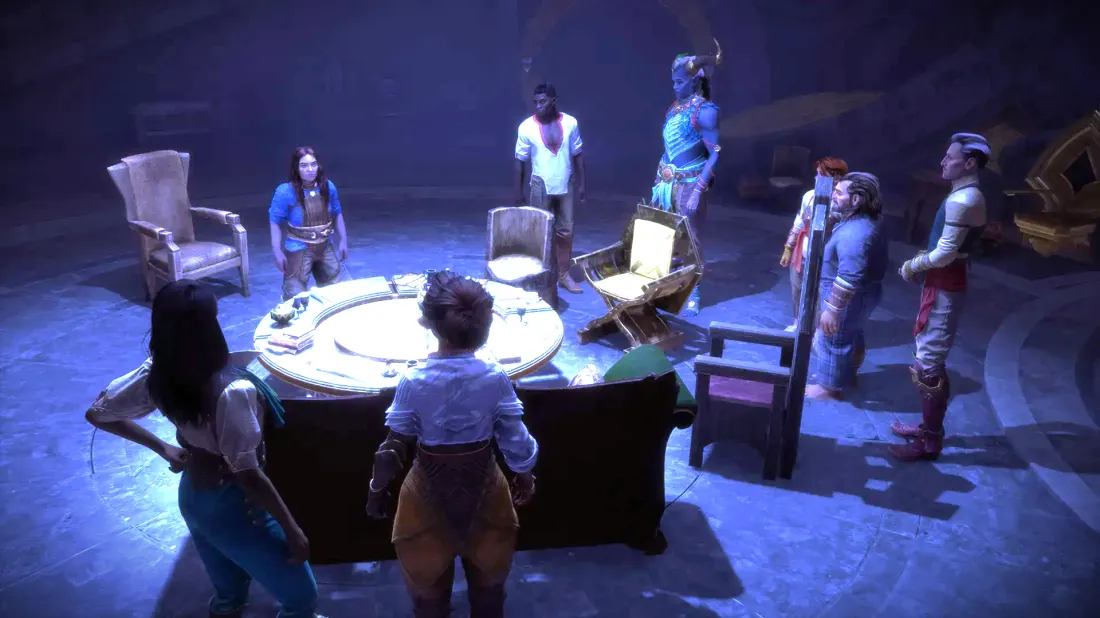
BLINT’S OFFICE

A Netflix limited series · 8 episodes · Surrealist comedy / ecological thriller
13
Tagline: Please account for the hairpins. The weather is not our responsibility.
The governing idea: adapt the spirit and narrative architecture of Godley and Creme’s Consequences, not simply its plot. The original is a three-record collision of Peter Cook’s comic drama, Godley and Creme’s extraordinary musical soundscapes, Sarah Vaughan’s singing, and an approaching environmental catastrophe. Its legal office, eccentric composer and bizarrely consequential details are the perfect ingredients for a contemporary eight-part series.
My version keeps the office, the divorce, the hole in the ceiling, the hairpins, the goldfish and Mr Blint’s peculiar musical cosmology. It adds algorithmic bureaucracy, climate manipulation, corporate accountability and the modern conviction that anything unmeasurable can be ignored.
The crucial rule: never play the absurdity as if it were absurd. Everybody behaves as though the proceedings are perfectly reasonable. The world outside is going mad.
The cast
Mark Rylance as Mr Blint
An eccentric composer occupying a room that no longer officially exists. He speaks through a hole in the solicitor’s ceiling, appears unexpectedly in the lift, and possesses a musical theory about the number 17 that may be the only thing standing between humanity and extinction.
Rylance can make the tiniest gesture feel like a coded message from another civilisation.
Olivia Colman as Mr Haig
The solicitor handling the divorce. In this adaptation, Haig is a woman who has spent 30 years mastering the art of making disaster sound administratively manageable. She is funny, exhausted, intermittently drunk and much more frightened than she lets on.
Rory Kinnear as Mr Pepperman
A divorce lawyer with the forensic instincts of a tax inspector and the soul of a malfunctioning spreadsheet. He believes every human problem can be solved by defining the terms more precisely.
Olivia Cooke as Lulu Stapleton
The wife seeking a divorce. Intelligent, observant and the first person to realise that the building’s automated systems are responding to Blint’s music.
Andrew Scott as Walter Stapleton
Her husband, a charmingly evasive consultant who has helped build a predictive weather platform for governments. He knows more about the coming disaster than he admits.
Dream casting, not a representation of confirmed casting or availability.
The music itself is a character. I’d invite Kevin Godley and Lol Creme to advise on the adaptation and soundtrack, with a contemporary composer extending the original’s Gizmo textures into an unsettling electronic score. Sarah Vaughan’s recordings would remain integral wherever licensing permits.
The eight episodes
Eight episodes · 50–60 minutes each · One complete season, one unresolved future.
1. Five O’Clock in the Morning
Cold open: the city wakes up wrong.
At 05:00, every weather station in Europe reports a different forecast. A coastal town receives six months of rain in forty minutes. A government minister calls it a software incident.
In Haig’s office, Walter and Lulu begin divorce proceedings. Pepperman demands a full declaration of assets, including anything held in digital wallets, offshore trusts or “non-physical jurisdictions.”
Then a man’s voice comes through a hole in the ceiling.
Mr Blint asks whether anyone has seen his seventeen tuning forks.
The lift arrives. Nobody is inside.
Music: “Five O’Clock in the Morning,” “Seascape,” “Wind.”
End: Every goldfish in the building floats belly-up at precisely 05:17. One starts swimming again when Blint hums.
2. Half a Hairpin
A legal drama with no meaningful legal issue.
Pepperman discovers a discrepancy in Walter’s asset declaration: an unaccounted-for hairpin. Walter denies owning one. Pepperman asks whether he can categorically deny possession of half a hairpin.
The hearing consumes the entire working day.
Outside, the government introduces emergency legislation requiring all anomalous weather events to be assigned to an accountable individual. The building’s AI assigns the rainfall to Lulu’s divorce application.
Blint refuses to answer questions because Pepperman has used the word property incorrectly.
Music: “When Things Go Wrong,” “Fireworks,” “Honolulu Lulu.”
End: A search of the building’s planning records reveals that the office was constructed around an empty space that, according to the plans, is both 14 square metres and infinitely deep.
3. The Sleeping Earth
The mystery beneath the floor.
Lulu climbs through the hole. Below the office, she discovers a furnished room containing an old piano, seventeen identical clocks and a wall of weather maps that appear to show the future.
Blint explains nothing. He asks her to listen to the building.
Walter recognises the maps: they resemble simulations from a secret weather-modification project he helped design. He claims the system was intended to prevent disasters, not cause them.
Haig, meanwhile, has begun drinking from a glass that refills itself.
Music: “Sleeping Earth,” “Stampede,” “Burial Scene.”
End: The maps show the whole world covered by water. One small area remains dry: the office floor above Blint’s room.
4. Lost Weekend
The first episode in which nobody remembers Friday.
Haig wakes up to discover that three days have disappeared. The office has acquired a new door, Pepperman has a second briefcase, and Walter’s divorce papers have been signed by someone who looks exactly like him.
A mysterious singer appears in the lift. Her song seems to restore memories, but each restored memory belongs to someone else.
We learn that Blint has been conducting an experiment in musical time: a composition that can make the world repeat a moment until the right thing happens.
Music: “Lost Weekend,” “Rosie.”
End: Lulu remembers the first time she met Walter. In the memory, he tells her the weather is going to be weaponised. The date is next Tuesday.
5. Cool, Cool, Cool
A corporate crisis-management exercise goes horribly right.
The government sends a crisis team to the office. Its spokesperson insists that the weather anomalies are “within acceptable parameters.”
Every time she says the phrase, the temperature drops by two degrees.
Pepperman begins interrogating Blint about the number 17. Blint responds with seventeen unrelated facts, all of which turn out to be true. Meanwhile, a government contractor tries to remove the piano and finds that every exit leads back into the office.
Walter admits that his company’s predictive model didn’t merely forecast the weather. It learned how to influence it.
Get yeah right’s stories in your inbox
Join Medium for free to get updates from this writer.
Music: “Cool, Cool, Cool,” “Cool, Cool, Cool (Reprise),” “Office Chase.”
End: The crisis team evacuates. Its official report concludes that the office is uninhabitable, but its inhabitants are not in danger.
6. Sailor
A rescue mission with no agreed destination.
The office receives a distress call from a ship that disappeared in 1977. Its passengers report that the sea is rising above the sky.
Lulu and Walter enter the lift and find themselves aboard the ship. They encounter people who have been waiting for them for decades.
Blint tells Haig that the weather is not the disaster. The disaster is what humanity has done in response to it: the instruments, the predictions, the weapons, the endless need to control what cannot be controlled.
Haig asks if this means they are all going to die.
Blint says he doesn’t know. He has never been very good at endings.
Music: “Sailor,” “Mobilization.”
End: A fleet of unmanned ships begins moving towards the office, although no one has issued the command.
7. Please, Please, Please
The solution is a piece of music. Naturally, nobody can agree on the terms.
Blint reveals that the seventeen movements of his composition correspond to seventeen atmospheric states. The original Gizmo recordings contain a pattern that the weather system has been unconsciously reproducing.
To stop the cascade, the music must be played in full. Unfortunately, the recording is legally disputed, the instrument is missing, and Pepperman insists on determining who owns the silence between notes.
Haig finally sobers up. Walter and Lulu suspend their divorce negotiations. For the first time, all five characters cooperate.
Music: “Please, Please, Please,” with fragments of “The Flood” building beneath it.
End: Blint begins the composition. Across the world, storms stop moving. For seventeen seconds, the planet becomes perfectly still.
8. Blint’s Tune
The end of the season. Not necessarily the end of the story.
The music completes. The weather returns to normal. Governments announce that the crisis has been resolved by an international scientific initiative. Walter’s company is awarded a new contract.
Pepperman finishes the divorce settlement. Haig finally closes the case.
Lulu asks Blint what will happen next.
He says that depends on whether anyone has learned anything.
She looks up at the ceiling. The hole is gone.
Everyone leaves the office. The camera stays behind as the building empties. At 05:17 the next morning, the lift opens.
Nobody enters.
Somewhere below, a piano plays one note.
Music: “Blint’s Tune — Movements 1–17,” with a final return to “Seascape.”
Final image: A government dashboard registers a new atmospheric anomaly. The location is listed as Unknown. Its predicted date is 17 years from today.
The complete original soundtrack: where every song belongs
The series would retain every titled musical piece from the original triple album, while using the original dialogue sections as connective tissue rather than trying to squeeze all the spoken material into eight episodes. The placement below is the proposed adaptation, not the original running order. The complete song list is documented in the album’s track listing.
Original track|Dramatic use
— | —
“Seascape”|Opening and final image
“Wind”|The first inexplicable weather event
“Fireworks”|The hairpin hearing
“Stampede”|The office begins to destabilise
“Burial Scene”|The room beneath the floor
“Sleeping Earth”|Blint’s hidden maps
“Honolulu Lulu”|Lulu’s first encounter with the anomaly
“The Flood”|The worldwide disaster
“Five O’Clock in the Morning”|The opening motif
“When Things Go Wrong”|The administrative absurdity escalates
“Lost Weekend”|Missing time
“Rosie”|The mysterious singer
“Office Chase”|The failed government intervention
“Cool, Cool, Cool”|The official denial of the crisis
“Cool, Cool, Cool (Reprise)”|The denial begins to fail
“Sailor”|The vanished ship
“Mobilization”|The ships approach
“Please, Please, Please”|The desperate attempt to stop the cascade
“Blint’s Tune — Movements 1–17”|The finale
I’d avoid turning every song into a conventional musical number. Some should be heard in full, others should surface as fragments, motifs or music whose source the characters cannot identify. The point is not to make Consequences into a jukebox show; it’s to make the music indispensable to the plot.
The contemporary gesture
The original’s environmental anxiety becomes more pointed if the modern world has outsourced its sense of responsibility to automated systems.
The weather platform doesn’t need a villain pressing a red button. It only needs thousands of organisations optimising their own objectives, a model that learns to manipulate atmospheric conditions, and nobody authorised to take responsibility for the combined outcome.
The government response is not to stop the system but to rename the problem. The disaster becomes a service interruption. The goldfish are recorded as unexplained aquatic losses. The missing hairpin is elevated to a national compliance issue.
Blint is the only person who understands the whole system, but he refuses to express his knowledge in a format that can be entered into a spreadsheet.
That is the contemporary joke: the world may be ending, but the dashboard is green.
The Netflix elevator pitch
BLINT’S OFFICE
Eight episodes. One office. Seventeen movements. A planet in administrative denial.
A bitter divorce, a missing hairpin and a hole in a solicitor’s ceiling become the unlikely centre of a global weather catastrophe in this surreal dark comedy inspired by Godley and Creme’s cult concept album Consequences.
As governments deny the disaster and algorithms struggle to explain it, an eccentric composer may be the only person who knows how to stop the world from coming apart. Unfortunately, he refuses to explain himself, the lawyers won’t stop arguing, and the lift has started arriving from floors that don’t exist.
Starring Mark Rylance, Olivia Colman, Rory Kinnear, Olivia Cooke and Andrew Scott in a world where bureaucracy is eternal, the weather is weaponised, and the most dangerous question is: who owns the silence between notes?
The pitch: Brazil meets The Thick of It, with the ecological dread of Years and Years and the musical strangeness of Consequences.
Why this could work
The original Consequences was famously ambitious, idiosyncratic and commercially risky. Its creators built an entire world around an invented instrument and an extended comic drama, rather than chasing the prevailing fashion.
A limited series should embrace that same refusal to behave. Eight episodes give the story enough room to build its mythology without diluting the mystery. The production can be visually distinctive, musically daring and genuinely funny, while its contemporary environmental theme gives the absurdity real stakes.
The ending should resolve the immediate catastrophe but leave the audience uncertain whether Blint has saved the world, postponed its collapse, or merely corrected one movement in a much larger composition.
And I would keep one final rule for the writers’ room: never explain the goldfish.