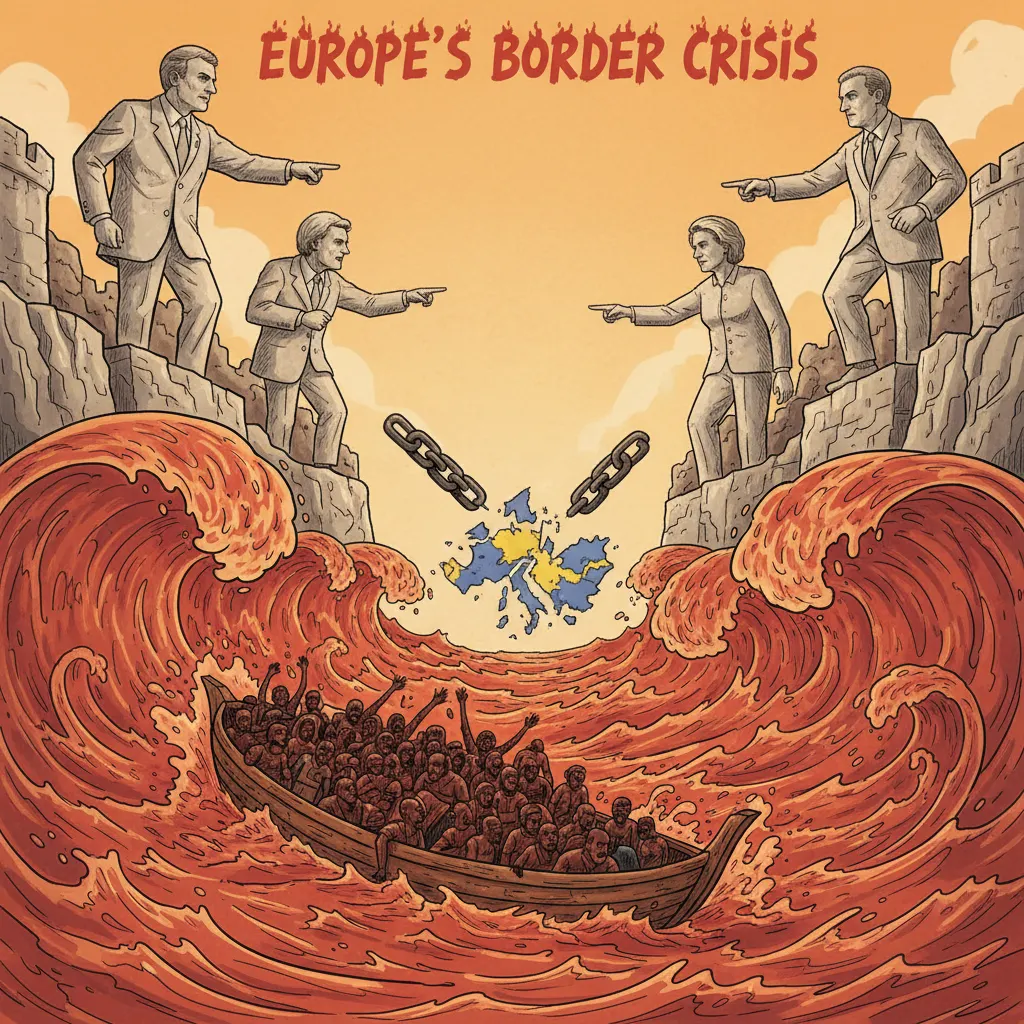
Europe's migration panic has a new target: the people already here


As leaders trade blame over boats and borders, 6.6 million refugees inside the EU face a slower crisis — integration programmes cut, legal aid withdrawn, and a political class that has stopped pretending they're welcome.
The Boat Is Not the Story
In the Sicilian port of Pozzallo last month, a rescue ship docked with 47 people aboard. The cameras came, filmed the blankets and the babies, and left within the hour. What the cameras didn't stay for was the part that actually matters: the 1,400 unaccompanied minors currently held in Italian reception facilities that the Council of Europe's own monitoring body has said fall short of basic standards. The boat is a photograph. The reception centre is a life.
We have spent a decade arguing about the crossing and almost no time arguing about what happens after it. That is the real scandal of European migration policy in 2026, and it is one the continent's leaders are now actively making worse.
The Numbers Nobody Puts on a Podium
Here is what the shouting on X misses. According to Eurostat, the EU granted protection status to roughly 400,000 people in 2024 alone. Add that to the existing refugee population and you're dealing with 6.6 million refugees and asylum-seekers currently living inside the European Union, according to UNHCR figures. The vast majority are not in holding centres on the Med. They are in apartments in Berlin, council flats in Malmo, shared houses in Naples. They are, in the cold bureaucratic phrase, "integrated" — or they were supposed to be.
And that's precisely where the money is disappearing. Germany's 2025 federal budget cut integration courses — the state-funded German-language and civic classes that have been the backbone of refugee employment policy since 2015 — by nearly a third compared with the year before. In Sweden, the government has slashed funding to civil society organisations that provide legal aid to asylum-seekers, a sector that the Swedish Refugee Law Center says has already lost around 40 percent of its capacity. Italy's reception budget, according to the Ministry of the Interior's own figures, has been steadily squeezed for three years running.
The pattern is consistent across the continent: leaders announce tougher border controls to appease voters, then quietly defund the policies that make the people already here functional members of society. The border is theatre. Integration is the actual work. And the actual work is being abandoned.
The Meloni Model Doesn't Fit the Facts
Let's be clear about what the "Meloni model" actually delivers. Italy's Prime Minister has built her reputation on blocking boats and externalising processing to Albania — the controversial protocol under which migrants rescued in international waters are transferred to Albanian-run centres for screening. In April 2025, an Italian court referred the scheme to the European Court of Justice, which has not yet ruled. Meanwhile, the Italian interior ministry's own figures show that sea arrivals fell sharply in 2024 and 2025 — partly through diplomatic deals with Tunisia and Libya, partly through weather, partly through the sheer brutality of the Libyan coast guard, which the UN has documented returning migrants to detention centres where torture is routine.
Get NapoleanIV’s stories in your inbox
Join Medium for free to get updates from this writer.
So arrivals are down. Does anyone believe the people already in Italy are suddenly more welcome? Of course not. The message sent by the entire apparatus of Italian migration politics — the decrees, the naval blockades, the Albanian offshore centres — is not "we have control." It is "we wish you weren't here." That message lands on the 3.5 million foreign nationals legally resident in Italy, a huge proportion of whom are now watching their host government spend political capital on keeping out people who look like them.
The Vicious Circle Nobody Names
Here is the trap. When mainstream parties adopt the language of the far right to defuse it, they don't defuse it — they legitimise it. This is not a theory. Look at the trajectory in France, where Marine Le Pen's Rassemblement National has spent years tightening its grip on local councils while the Macron government passed an immigration law in December 2023 so restrictive it was partly struck down by the Constitutional Council. Look at the Netherlands, where Geert Wilders's PVV entered government in 2024 on a platform of "asylum crisis" measures that included suspending family reunification. Look at Germany, where the AfD is polling in the low twenties nationally and Friedrich Merz's CDU/CSU has adopted much of its language on deportation.
The centrists keep thinking they can outflank the right by being slightly less cruel. It never works. The right always finds another gear.
Meanwhile, the demographic reality doesn't budge. The European Commission's own 2024 Ageing Report projects that the EU's working-age population will fall by roughly 27 million by 2050, and the old-age dependency ratio will climb from around 33 percent to nearly 57 percent. Someone has to staff the care homes, pick the fruit, drive the lorries. The EU's legal migration channels are being tightened at the exact moment they need to be widened. That's not a policy failure. That's a choice.
What a Different Politics Would Look Like
There is a version of this story that doesn't end in more razor wire and fewer language classes. It involves actually funding the reception system so that asylum decisions don't take 18 months and leave people trapped in limbo. It involves recognising that the Slovak and Polish governments' refusal to accept relocation quotas under the 2024 Migration Pact is a political problem requiring negotiation, not a moral crusade. It involves calling out Russia and Belarus for the weaponised migration they're directing at the Finnish and Polish borders — which is real, documented hybrid warfare, and which deserves a serious response rather than being folded into the general panic.
But none of that happens while the political centre is running scared of its own shadow. The real crisis of European migration policy isn't the boats. It's the cowardice. It's elected leaders who know the numbers, know the demography, know the history — and choose to campaign on fear anyway.
The 6.6 million people already here aren't going anywhere. The question is whether the continent's leaders will keep pretending they're a problem to be managed, or start treating them as citizens-in-waiting. The boats will keep coming. The people already onshore are waiting to see if Europe actually wants them.
---