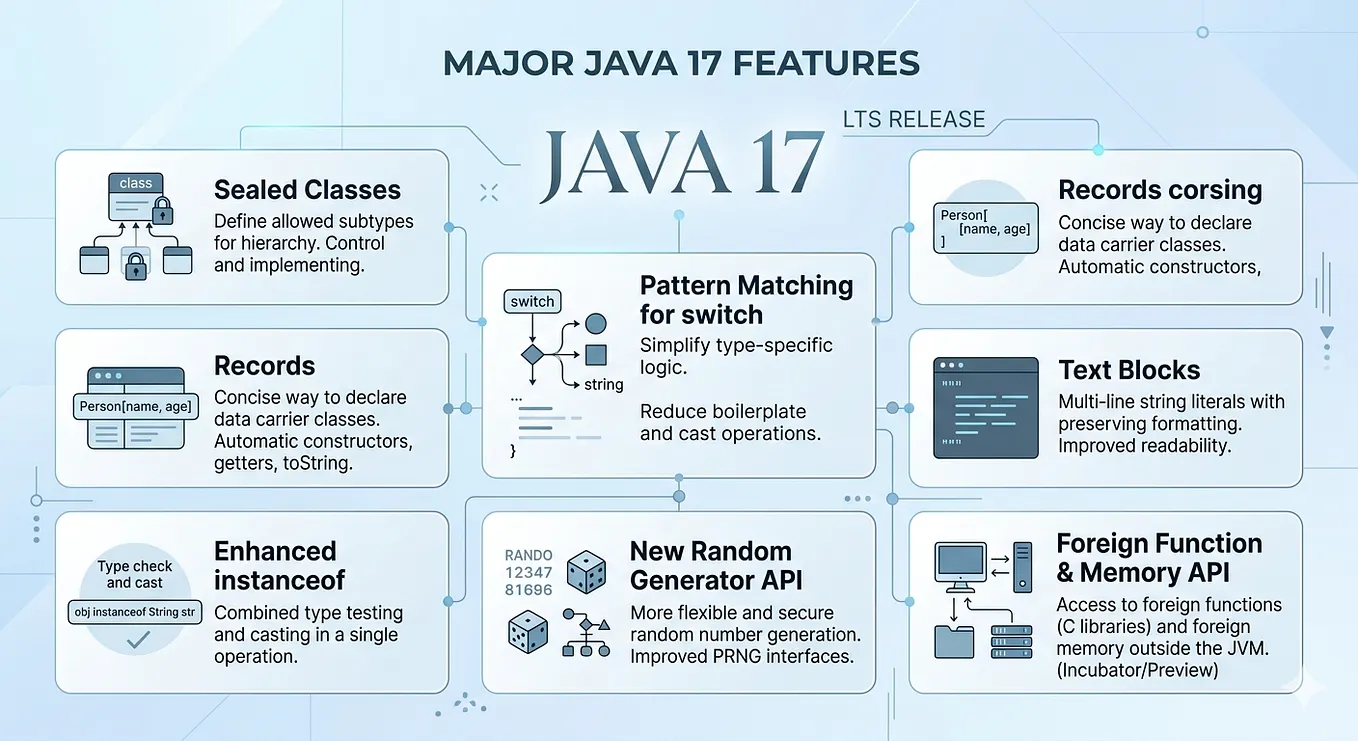
Sealed Classes

Sealed Classes in Java (Java 17 → 21) — structured, practical, and with real-world insights.
1. What are Sealed Classes?
Sealed classes restrict which classes can extend or implement them.
sealed class Shape permits Circle, Rectangle, Square {}Only Circle, Rectangle, Square can extend Shape.
2. Why Sealed Classes?
Problem (Before Java 17)
- Anyone could extend your class → uncontrolled inheritance
- Hard to enforce domain constraints
- Pattern matching not safe (no exhaustiveness)
Solution
Sealed classes give:
- Controlled hierarchy
- Better domain modeling
- Compiler guarantees
- Perfect fit with pattern matching
3. Types of Sealed Hierarchy
Every permitted subclass must declare ONE of these:
1. final
final class Circle extends Shape {}
➡ No further inheritance
2. sealed
sealed class Rectangle extends Shape permits FilledRectangle {}
➡ Further restricted hierarchy
3. non-sealed
non-sealed class Square extends Shape {}
➡ Open for extension again
4. Rules (IMPORTANT for interviews)
→A sealed class must specify permits
→All permitted classes must:
- Be in same package (or same module)
- Extend the sealed class directly
→Subclasses must declarefinal/sealed/non-sealed
5. Full Example
sealed interface Shape permits Circle, Rectangle, Triangle {}

record Circle(double radius) implements Shape {}

record Rectangle(double length, double width) implements Shape {}

final class Triangle implements Shape {
  double base, height;
}
6. Best Feature: Works with Pattern Matching
Exhaustive Switch (NO default needed)
public static double area(Shape shape) {
  return switch (shape) {
    case Circle c -> Math.PI * c.radius() * c.radius();
    case Rectangle r -> r.length() * r.width();
    case Triangle t -> 0.5 * t.base * t.height;
  };
}
Compiler checks:
- All types covered
- No missing cases
7. Sealed Interfaces vs Sealed Classes
Feature Sealed Class Sealed Interface
Inheritance single multiple
Use case base class domain contracts
Preferred for behavior + fields abstraction
Get Syed Nazeer’s stories in your inbox
Join Medium for free to get updates from this writer.
In modern Java: Prefer sealed interfaces + records
8. Real-World Use Cases
1. Domain Models
sealed interface OrderStatus permits Created, Shipped, Delivered, Cancelled {}2. API Responses
sealed interface ApiResponse permits Success, Error {}3. Payment Systems (classic)
sealed interface Payment permits Card, UPI, Cash {}4. State Machines
- Order lifecycle
- Workflow engines
- Finite states
9. Sealed vs Enum (VERY IMPORTANT)

Example Difference
❌ Enum:
enum Status {
  SUCCESS, ERROR
}
✅ Sealed:
sealed interface Response permits Success, Error {}
record Success(String data) implements Response {}
record Error(String message) implements Response {}
10. Sealed vs Abstract Class

11. Integration with Records (Best Practice)
Most modern design:
sealed interface Event permits UserCreated, UserDeleted {}
record UserCreated(String name) implements Event {}
record UserDeleted(String id) implements Event {}
→ Immutable
→ Thread-safe
→ Clean DTO modeling
12. With Guards (Advanced pattern matching)
return switch (shape) {
  case Circle c && c.radius() > 10 -> "Large Circle";
  case Circle c -> "Small Circle";
  case Rectangle r -> "Rectangle";
  case Triangle t -> "Triangle";
};
13. When NOT to Use
→ When extension must be open
→ Framework-based inheritance (Spring proxies)
→ Plugin systems (unknown subclasses)
14. Performance Impact
- No runtime overhead
- Purely compile-time safety feature
- Works efficiently with switch bytecode
15. Version Timeline

16. Interview One-Liner
“Sealed classes restrict inheritance and enable exhaustive, type-safe pattern matching, making them ideal for modeling closed domain hierarchies.”
17. Common Interview Questions
Q1: Why sealed classes?
➡ To control inheritance + enable exhaustive pattern matching
Q2: Difference from enum?
➡ Sealed supports state + behavior + hierarchy
Q3: Why no default in switch?
➡ Compiler knows all subclasses
Q4: Can sealed be extended outside package?
➡ No (unless using modules with exports)
18. Best Practices (VERY IMPORTANT)
✔ Prefer sealed interface + records
✔ Keep hierarchy small and meaningful
✔ Use with switch expressions
✔ Combine with pattern matching
✔ Avoid unnecessary deep hierarchies
Final Takeaway
Sealed classes = Controlled OOP + Functional style branching
They shine when combined with:
- Records
- Pattern matching
- Switch expressions