[Full Comparison] Ambient Ø vs. Evokǝ — SONICWARE Ambient Groove Boxes


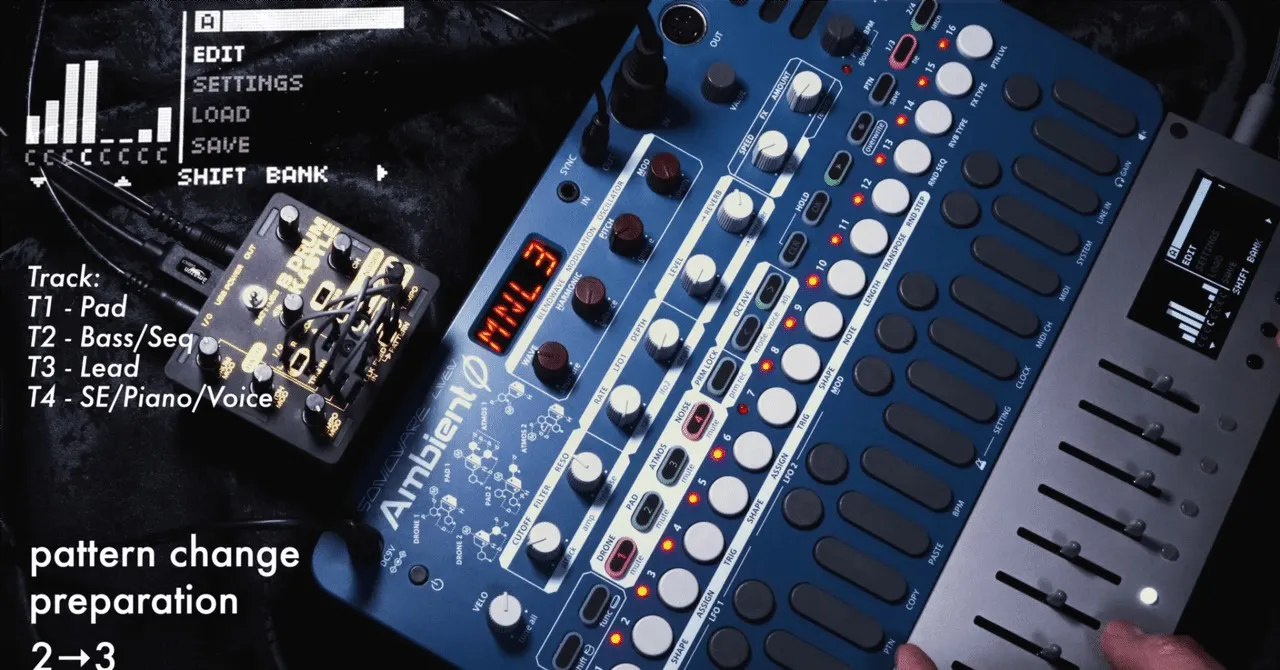
In this article, I’ll compare two devices from the SONICWARE LIVEN series that I frequently use in live performances and jam sessions: Ambient Ø and Evokǝ.
I often see comments on my YouTube videos and threads on overseas forums like Reddit asking:
“How do these two devices compare?”
I wrote this article to provide a reference for anyone who’s curious about the same question.
Please note that everything in this article is based on my personal experience and opinion.
Now Available! The Ultimate Guide to Mastering Sound Design with Ambient Ø — All 6 Volumes
Table of Contents
・Overview of the Two Devices
・Biggest Difference
— Ambient Ø
— Evokǝ
・Comparison Summary So Far
・Detailed Comparison
— Polyphony
— Number of Tracks
— Reverb
— Common Points
— Effects
・Other Feature Differences
・If I Were to Buy One
— Reasons
・Final Conclusion
Overview of the Two Devices
Both devices belong to the LIVEN series, and since Evokǝ was released after Ambient Ø, they share many similarities in chassis design, knob layout, operation method, and sequencer features.

Another key point is that both are designed to allow easy creation of ambient music.
They feature user-friendly ambient sound sources and a versatile sequencer, enabling expressive performances through intuitive knob controls.
Additionally, the price for both is $239.00(as confirmed on the official website on September 7, 2025).
Therefore, when considering purchasing one for ambient music, it might be difficult to decide which one suits you better.
Biggest Difference
We’ll go into the finer points later, but first, let’s look at the most distinctive feature of each device — the area where they differ the most.
Ambient Ø:

The core of Ambient Ø is sound design using six different “Structures”.

Your understanding of these Structures greatly influences how enjoyable Ambient Ø can be. In other words, they are the key to enjoying Ambient Ø.
A Structure is essentially a system that determines how the sound is played.
For example, when layering sine waves, you adjust parameters such as:
- Which pitch to assign to each layer
- The volume balance of each layer
By taking advantage of the characteristics of each Structure, you can create a wide variety of sounds, such as:
- Flowing drone sounds
- Enveloping pad sounds
- Thick synth basses
- Electric piano–like tones
- Abstract, textured electronic sounds
- Sparkling, crystalline metallic sounds
Additionally, by combining two LFOs and effects with the Structures, you can add the depth and temporal variation characteristic of ambient music.
However, note that while Structures are Ambient Ø’s greatest strength, their full potential is revealed only if you understand how they work.
Note: For those who want to fully master the Structures, I wrote a detailed “super guide” article.
Of course, even right after purchase, you can have plenty of fun by simply turning the knobs or programming the sequencer.

But when you utilize Ambient Ø’s synthesis capabilities to shape the sounds according to your own ideas and integrate them into your compositions, the enjoyment expands even further.
When choosing Ambient Ø, the extent to which you want to dive into sound design becomes one of the most important points.
Evokǝ:

The main feature of Evokǝ is that it allows you to create music using acoustic-based sound sources combined with back-tide modulation and granular effects.
Unlike Ambient Ø, where you select the sound system via Structures, Evokǝ allows you to layer acoustic instruments such as piano or cello with electronic sounds like sine waves to develop your tones.
For example, you can create a morphing-like sound, where the piano is prominent at first, and over time the volume of the layered sine waves gradually increases while the piano decreases, resulting in a smooth transition to a different timbre.

The basic approach is to then add granular effects to process the sound in a complex way while expanding it throughout the composition.
Granular Effects:
An effect that splits the played sound into tiny grains and reconstructs them. By adjusting how the fragments are played or processed, you can create ethereal, fluctuating textures.
Backtide modulation is a modulation that continues to fluctuate the instrument’s waveform after the instrument’s attack stage ends, repeating like the ebb and flow of the tide.
The BACKTIDE knob sets the range of the modulation, and the
SPEED knob sets the speed.The modulation speed changes relative to the modulation range,
allowing you to create more organic sounds or effects like tremolo and reverse.
Source: SONICWARE LIVEN Evokǝ Official Manual
As an additional note, by adjusting the volume balance, it is possible to completely mute the acoustic sources and play only the layered electronic sounds, such as sine waves.
When choosing Evokǝ, the key points are:
- Whether you enjoy the timbres of acoustic instruments like piano
- Whether you want to use granular effects for sound design
Comparison Summary So Far
Ambient Ø is better suited for creating abstract ambient worlds, focusing on drones, abstract sounds, noise, and textures using its core Structures.

Evokǝ simulates acoustic instruments such as piano and cello and also includes Chord Mode (e.g., the ability to play a full chord with a single key).
By leveraging the timbres and resonance of acoustic instruments, Evokǝ is ideal for lyrical ambient music that evokes scenes and emotions.
Lyrical:
A style that expresses personal feelings, sensations, emotions, or imagination, projecting the inner world through the work.

Ambient Ø:
Recommended for those who want to pursue textures and abstract sounds.
- By fully utilizing Structures, you can create a wide range of sounds including drones, noise, pads, and electronic textures.
- The appeal lies in building abstract ambient soundscapes while enjoying sound variations and serendipitous expressions.
Note: To fully enjoy sound design, learning how Structures work is necessary.
Evokǝ:
Recommended for those who want to play melodies and chords with acoustic sounds and express lyrical ambient music
- By layering acoustic instruments like piano with electronic sounds and using granular effects, you can create expressive sounds that convey scenes and emotions
- Chord Mode allows you to take advantage of the resonance unique to acoustic instruments while composing.
Note: To make the most of acoustic timbres and resonance, some musical knowledge, such as chords, may be necessary.
Detailed Comparison
From this point, we will take a closer look at the differences in features.
(Specifications that are the same, such as the number of sequencer steps, will be omitted.)

Polyphony
Ambient Ø
The maximum polyphony is counted as the total across all layers.
As stated in the official manual, each Structure consumes a specific number of oscillators, which determines the maximum polyphony.
For more details, please refer to the Ambient Ø Official Manual.
If the maximum polyphony is exceeded, notes will be turned off starting with notes on the lowest priority Layer. (Priority is Layer 1 > Layer 4 is the order. However, sounds that are being released will be turned off first in Layer priority order.)
Source: SONICWARE LIVEN Ambient Ø Official Manual, Rev. 3
Evokǝ
For Evokǝ, the situation is as follows.
Please note that the priority differs from that of Ambient Ø.
If the maximum polyphony is exceeded, notes will be turned off starting with notes on the lowest priority Track. (Priority is Track 4 > Track 1 in order. However, sounds that are being released will be turned off first in Track priority order.)
Source: SONICWARE LIVEN Evokǝ Official Manual
Based on my personal experience, when creating music with sequenced tracks, it’s easy to get carried away and increase the number of notes.
As a result, during sequencer playback, you may exceed the maximum polyphony, causing notes to shift or cut off.
Get NicaFelt’s stories in your inbox
Join Medium for free to get updates from this writer.
Therefore, it’s important to be mindful of polyphony and program your parts carefully to avoid unnecessary notes whenever possible.
In the following video using Evokǝ, for example, the piano melody at 5:21 shifts unintentionally.
The reason is that the flute played by hand while using Chord Mode exceeded the maximum polyphony.
Fortunately, the result ended up sounding good, so it was fine in the end.
Number of Tracks
Both models have four tracks, but:
For Ambient Ø, Track 4 is dedicated to environmental sounds.
(Structures cannot be applied to environmental sounds.)
When creating music with Ambient Ø, this point needs to be taken into account.

Reverb
Ambient Ø
Equipped with Shimmer Reverb, an important element in sound design that is not available on Evokǝ.
Evokǝ
Equipped with MIRAGE Reverb. Unlike other reverbs, it emphasizes texture rather than decay time, and because the pre-delay is short, the sound does not easily become muffled even when applied heavily.
This makes it easy to use in sound design while clearly perceiving the reverb component.
Common Points
The built-in reverbs on both Ambient Øand Evokǝ may not match dedicated units such as Strymon in terms of quality.
However, because they are designed to work with the internal sound sources of Ambient Ø and Evokǝ, they are high-quality enough for music production.
The following track was created using Ambient Ø’s INFL (Infinity.L) reverb
(characterized by a larger-scale space with a relatively short decay).
The following track was created using Evokǝ’s MIDL (Mid.L) reverb
(characterized by a medium-scale space with a relatively short decay).
In addition, both instruments allow you to apply the built-in reverb to external gear connected via the LINE IN jack.
On top of that, Ambient Ø lets you process external signals with its master effects, while Evokǝ allows you to apply its granular effect.
In a live performance, it feels like adding an extra stereo channel, and because the external instruments are processed with the same reverb and effects as the internal sounds, everything blends together to create a cohesive and unified sonic space.
Effects
Ambient Ø
One of its key features is the inclusion of six master effects, such as delay and stereo chorus.
Personally, I really like the Reverse Delay, as it can add rhythmic variations and create a strong sense of groove.
However, one important point to keep in mind — as shown in Figure 1 “Sound Architecture” of the official manual — is that the master effects are placed after the reverb in the signal chain.

In other words, the master effects are applied to the entire signal after the reverb.
It is also possible to reconfigure the routing of the overall pattern level (separate from the main volume) either before or after the master effects. However, it is important to keep in mind that the master effects are positioned downstream of the reverb in the signal chain.
For example, instead of sending a delayed signal into the reverb, the system applies delay to the entire reverb-processed sound.
Evokǝ
One of the major attractions of Evokǝ is its granular effect (GRAIN FX).
While it is simpler than SONICWARE’s granular synthesizer/effect LIVEN Texture Lab, it still allows for detailed adjustments.
Using the granular effect enables much more diverse and unpredictable sonic expressions than typical effects like delay, making sound design truly exciting and creative.
However, an important point to note:
The granular effect is extremely powerful, and even a small amount can dramatically change the sound.
For example, applying it heavily to all four tracks can quickly lead to chaos and disrupt the composition.
To use an analogy, it is like a highly concentrated spice in cooking: a tiny pinch can transform the entire dish, adding unique flavor, but overusing it can completely overwhelm and throw off the balance.
Additionally, the granular effect is applied globally across all four tracks, meaning you cannot adjust parameters individually per track (the same applies to external sources).
Therefore, it is essential to carefully control how and how much the effect is applied when using it.

Other Feature Differences
Ambient Ø:
Tuning settings
It allows you to set the tuning for each pattern.
In addition to the standard 12-tone equal temperament, you can also select from just intonation, Solfeggio frequencies, and planetary frequencies.
This feature lets you shape the tonal character and emotional atmosphere of each pattern. For example, using just intonation or Solfeggio frequencies can produce a more harmonious and meditative feel.
For those interested in spirituality, frequencies, or quantum mechanics, Ambient Ø can be used to its full potential across a wide range of applications.
Sampling
You can sample any sound from the LINE IN and save it into eight slots.
(Maximum 8 seconds of stereo sampling at 16bit/32kHz)
(Audio files can also be imported into the Noise layer)
Although there is a time limit, this feature allows you to import collected environmental sounds, noise, drum loops, and more, significantly expanding your options for music production.

Evokǝ
Chord Function
LIVEN Evoke features a function that allows you to easily play chords by simply pressing the white keys on the keyboard. The chord structure can be customized by altering the individual notes played, allowing for quick chord input into patterns and facilitating drone-style performances using the hold function.
Source: SONICWARE LIVEN Evokǝ Official Manual
With a polyphony of 11, it is sufficient for inputting any desired chord. Moreover, the ability to input chord progressions easily with a single key is an advantage that Ambient Ø does not have.
In lyrical or emotionally expressive compositions, chord progressions play a critical role. Therefore, in terms of ease of composition for such music, Evokǝ may be the more suitable choice.
If I Were to Buy One
Before giving a final conclusion, if I did not already own either Ambient Ø or Evokǝ and had limited knowledge about both instruments, deciding which one to purchase would be difficult… but I would probably choose Evokǝ first.
Reasons:
- It comes with piano and electric piano sounds (I like acoustic instruments).
- I prefer the color design of Evokǝ.
- The granular effect could likely be used with other gear.
- You can produce songs using all four tracks (Ambient Ø’s track 4 is reserved for environmental sounds).
However, if you are already familiar with the fun and depth of Ambient Ø’s structures through videos on YouTube or other sources, you would likely choose Ambient Ø instead (for example, even if you don’t fully understand how to create sounds with the structures, knowing the possibilities they offer).
One thing that applies to both instruments is that experiencing the most interesting features of the instrument beforehand seems to be a key factor when deciding to purchase.
Once you become interested in the instrument, trying out the sounds and experimenting with sound design in person — regardless of whether you plan to purchase — may be the easiest way to determine if it truly suits your needs.
Final Conclusion
There is no doubt that both Ambient Ø and Evokǝ are profound instruments suited for ambient music production.
However, the choice between the two depends on the following points:
Ambient Ø
- Looking to experience the fun of sound design
- Interested in creating songs with a wide variety of tones.
- Wanting to focus on drones, noise, and textured, abstract sounds
- Planning to import sampled sounds (any audio material).
- Curious about spiritual concepts and experimenting with different tuning systems, such as Solfeggio frequencies.
Evokǝ
- Aiming to create music that evokes imagery and appeals to emotions.
- Wanting to easily create chord progressions.
- Planning to combine acoustic and electronic sounds.
- Looking to make use of granular effects with other gear.
Depending on the type of music you want to create, one instrument may suit you better than the other.
In any case, SONICWARE’s groove boxes, which integrate sound sources and a sequencer at an accessible price, and feature a basic built-in speaker and a 27-key keyboard (not velocity-sensitive, with velocity adjustable via a knob), are highly recommended for those who want to easily produce ambient music with a single device.
For those who may find DAW-based production too tedious, these hardware instruments provide a hands-on perspective for engaging with music.
Lastly, although this is not a direct comparison, because the two instruments are similar, learning the sequencer on Ambient Ømakes it almost directly transferable to Evokǝ, which is a significant advantage.
I hope this article can serve as a useful reference for anyone interested in these instruments.
Thank you very much for reading to the end.