In an Age When AI Defines What Is Normal, Can Humans Remain Free?

— Reflections on Freedom and Human Values, Inspired by My Experiences in America 35 Years Ago | Part 5: The Final Chapter

Part 5 — The Final Chapter
Thirty-five years ago, I witnessed something remarkable at an American elementary school.
A group of children were gathered around a small Macintosh computer, happily playing with it.
At the time, computers were still special machines in Japan, used mainly by certain adults. Yet here in America, elementary school children were already using them as if they were part of everyday life.
“What will the world look like when these children grow up?”
I remember feeling both astonished and excited about the future.
Nearly 35 years have passed since then.
Today, we are witnessing a technological revolution even more profound than the one I saw back then.
Artificial intelligence.
But this time, something feels different.
Thirty-five years ago, computers seemed like tools that would expand human possibilities.
Today, AI is beginning to influence not only how we work, but also how we think and make decisions.
Are we moving from an age in which humans use AI to one in which AI determines how humans behave?
The World Map That Left Japan Out
During my time in America, I encountered many different ways of thinking.
In New York, I met people from all over the world, each living according to their own beliefs and values.
One experience in particular has stayed with me.
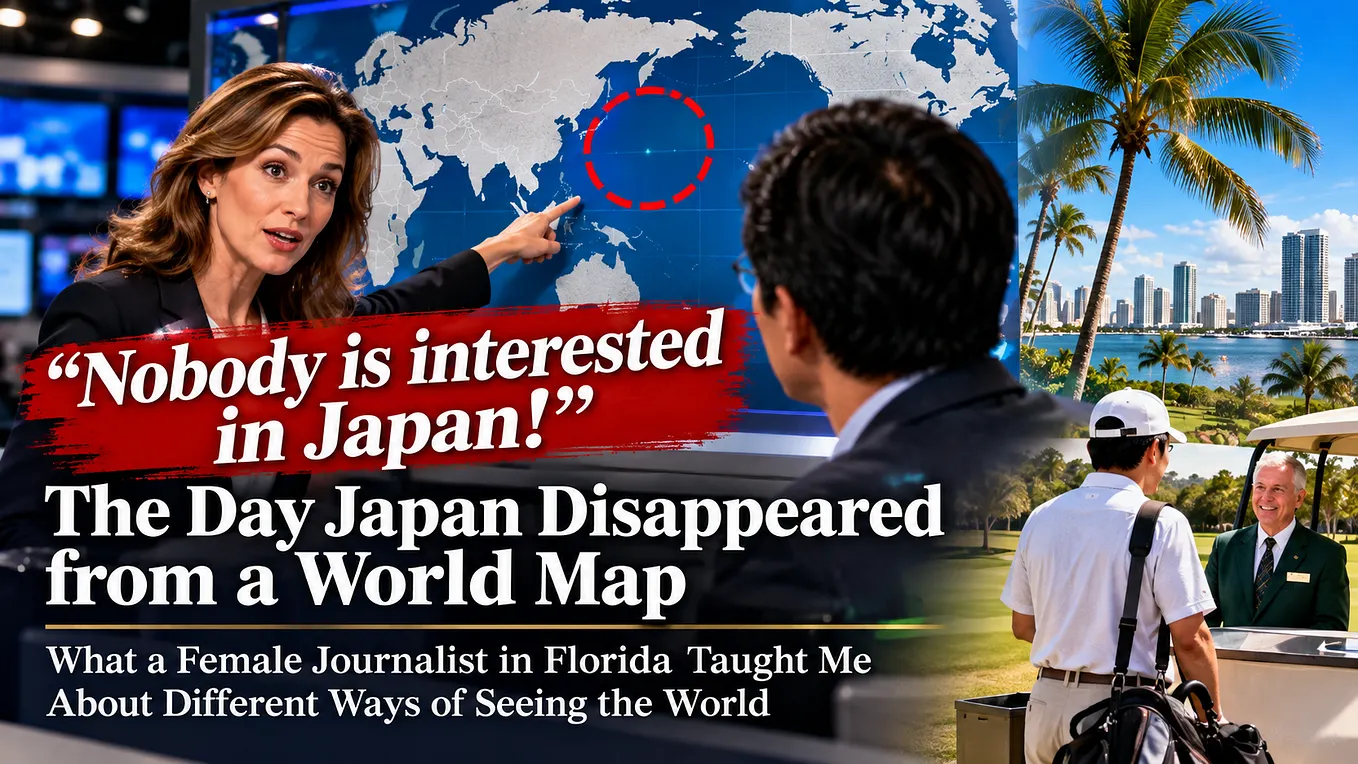
I was visiting a television station in Florida when I noticed a world map displayed inside the building.
I looked at it and was stunned.
Japan had been left off the map.
As a Japanese person, I could hardly believe what I was seeing.
Why had Japan been omitted? I never learned the reason.
But the experience made me think.
Something that seems important and obvious to us may not hold the same importance in someone else’s world.
At that television station, I also met a female journalist who told me she preferred Italian to English.
It was another reminder that the values we take for granted in Japan are not necessarily shared elsewhere.
I encountered such differences many times during my stay in America.
And now, we are entering an era in which AI selects, organizes, and presents information from around the world.
Could something important be quietly left off the world map that AI creates for us, without our even noticing?
Who Decides What Makes a “Good Employee”?
Consider how companies evaluate their employees.
AI can analyze sales performance, working hours, customer feedback, and teamwork.
Those assessments may then influence promotions and salaries.
At first glance, this seems fair and rational.
Perhaps AI could even reduce the personal biases and favoritism that sometimes affect human evaluations.
But something bothers me.
During my years as a company employee, people sometimes called me a “lone wolf.”
I never thought of myself as someone who couldn’t work with others.
I simply believed in thinking for myself and making my own decisions.
Sometimes that meant disagreeing with my supervisors or colleagues.
How would AI evaluate someone like me?
Would I receive a lower score because I didn’t always follow the group?
Of course, a well-designed AI evaluation system could recognize creativity, independence, and the willingness to take risks.
But that leads to a more important question.
Who decides the standards by which people are judged?
Imagine a company that becomes increasingly efficient by rewarding conformity and discouraging unconventional ideas.
Its productivity might improve.
But what would happen to the people who challenge established thinking?
Would the company still be capable of genuine innovation?
What Journalism Taught Me About the Freedom to Question
When I was young, I worked as a police reporter in the news department of a Japanese television station.
In Japan, we called this kind of assignment satsumawari — covering police stations, investigations, and crime-related news.
One principle mattered more than almost anything else.
Verification.
Whenever information came in, we checked it.
We didn’t rely on a single person’s account. We sought confirmation from other sources.
Even after writing a news script, we discussed it with editors and senior colleagues.
Why were we so careful?
Because journalism carries a responsibility to the public.
A single inaccurate report can damage someone’s reputation or even change the course of a person’s life.
Questioning information was not an inconvenience.
It was part of our job.
Today, however, AI can produce remarkably natural and convincing writing.
It can organize complex information and present conclusions that sound perfectly reasonable.
I use AI myself, and I appreciate how useful it has become.
But I sometimes wonder whether its polished answers make us less willing to question them.
“AI says it’s true, so it must be true.”
If that attitude becomes widespread, I believe we will face a serious problem.
A free society needs more than access to seemingly correct answers.
It also needs the right to question those answers, challenge them, and verify the facts independently.
Two Kinds of “AI Refugees”
I suspect that the coming years may produce a new group of people whom we might call “AI refugees.”
The first group is relatively easy to imagine.
These are people who cannot effectively use AI and consequently find themselves at a disadvantage in employment or everyday life.
Get Sunny Shikoku’s stories in your inbox
Join Medium for free to get updates from this writer.
Technology advances too quickly, and they struggle to keep up.
But I believe there may be a second, more troubling kind of AI refugee.
These people use AI every day.
Their work becomes more efficient.
Information is available instantly.
Their lives become increasingly convenient.
Yet without realizing it, they gradually lose opportunities to think independently.
AI recommends a product, and they buy it.
AI selects the news, and they read it.
AI evaluates something, and they accept the result.
AI suggests a career or life plan, and they follow it.
There is nothing inherently wrong with using AI in these ways.
The problem begins when people stop examining its recommendations.
They believe they are mastering AI, while gradually handing over their own judgment to it.
To me, this second possibility is even more concerning.
Can Human Worth Be Measured by Rationality Alone?
These days, I often have conversations with foreign visitors at Dogo Onsen, a historic hot spring resort in Japan.
I have met people from Italy, South Korea, Israel, and many other countries.
Our conversations are not always about serious subjects.
“I love Japanese food.”
“The hot springs here are wonderful.”
“I’d like to work in Japan someday.”
Simple, everyday exchanges.
From a purely efficiency-driven perspective, chatting with strangers might seem like a waste of time.
But I don’t see it that way.
A person’s facial expression, tone of voice, or unexpected comment can reveal something new.
AI can explain the history and culture of another country in seconds.
But understanding what the person standing in front of you truly feels is different.
Sometimes, you have to speak with them to discover it.
There are aspects of human life that cannot be explained by rationality alone.
Taking the longer road.
Making mistakes.
Occasionally choosing the wrong path.
And still having the freedom to decide where to go next.
I believe those imperfections are part of what makes us human.
The Freedom to Say “No” to AI
In the years ahead, AI will likely play an increasingly important role in government, healthcare, education, and business.
The benefits could be enormous.
AI may help us solve problems that have long been beyond human capabilities.
I have no intention of rejecting technological progress.
On the contrary, I have great expectations for AI.
But there is one principle I am unwilling to surrender.
Human beings must retain the freedom to say “no” to AI.
An employee who receives a negative AI-generated evaluation should have the opportunity to challenge it.
A citizen affected by an AI-assisted government decision should have the right to appeal.
People should remain free to choose lives that differ from the paths AI recommends.
And when important decisions are made, there must be identifiable people or institutions responsible for them.
That is the kind of society I hope we will build.
No matter how intelligent AI becomes, we should never hand over the responsibility for protecting human freedom and dignity entirely to machines.
From America 35 Years Ago to Japan Today
I still remember those American schoolchildren gathered around a Macintosh.
The people I met in New York, each with their own values and perspectives.
The world map at a Florida television station that had left Japan out.
And the lessons I learned as a journalist about checking facts and making independent judgments.
Looking back, I realize that these experiences share something important.
The need to think for ourselves.
Technological progress can make society more convenient.
But convenience and freedom are not the same thing.
Imagine a future in which AI offers an optimal answer to almost every question.
Following those answers might reduce mistakes.
But would that truly satisfy us as human beings?
I don’t think so.
We have the freedom to take a longer route.
The freedom to disagree with others.
Even the freedom to make mistakes.
Of course, those freedoms must be exercised with respect for the rights of others.
But would a society in which every decision is governed by rational efficiency really be a richer society?
Thirty-five years ago, when I watched American children using Macintosh computers, I felt hopeful about the future technology would create.
I still feel hopeful about the future AI may bring.
But this time, one thought weighs heavily on my mind.
What frightens me more than a future in which AI controls humanity is a future in which people stop thinking for themselves — and don’t even realize it has happened.
What must we protect in the age of AI?
It is not simply our jobs or our incomes.
It is something more fundamental.
The freedom to think for ourselves, make our own choices, and say “no” when necessary.
I believe that freedom will become one of the most important human values in the age ahead.
— End of Series —