cipherCHIP tap2verify
A Blockchain-Integrated Contactless Product Authentication and Verification System (Patent Pending)
Abstract:
The “cipherCHIP tap2verify” system presents a novel approach to product authentication by integrating Near Field Communication (NFC) tags, Non-Fungible Tokens (NFTs), and blockchain technology. This paper delves into the intricate workings of cipherCHIP tap2verify, highlighting its potential to revolutionize product provenance and authentication.
— -
1. Introduction
In an era where counterfeiting has become increasingly sophisticated, ensuring product authenticity is paramount. cipherCHIP tap2verify addresses this challenge by combining the unique identification capabilities of NFC tags with the immutable nature of blockchain technology, further enhanced by the uniqueness of NFTs.
— -
2. System Overview
2.1 Components
- NFC Tags: Small electronic devices embedded or attached to products, containing a unique ID.
- Blockchain: A decentralized ledger that records transactions across multiple computers.
- Smart Contracts: Self-executing contracts with the agreement directly written into code.
- NFTs: Unique digital tokens representing ownership or proof of authenticity.
2.2 Workflow
1. Assign a unique NFC tag ID to each product.
2. Deploy a smart contract capable of minting NFTs.
3. Mint an NFT for each product, embedding its NFC tag ID.
4. Transfer NFT ownership as the product moves through the supply chain.
5. Verify product authenticity by scanning the NFC tag and querying the blockchain.
— -
3. Detailed Process
Get Oluseyi Akindeinde’s stories in your inbox
Join Medium for free to get updates from this writer.
3.1 NFC Tag Assignment
Each product receives a unique NFC tag, which contains a distinct ID. This ID serves as the primary identifier for the product throughout its lifecycle.
3.2 Smart Contract Deployment
A smart contract, capable of minting NFTs, is deployed on a blockchain platform. This contract governs the creation, transfer, and verification of NFTs associated with product NFC tags.
3.3 NFT Minting
Upon product creation, the NFC tag ID is passed to the smart contract, prompting the minting of a unique NFT. This NFT embeds the NFC tag ID, ensuring a one-to-one relationship between the physical product and its digital representation.
3.4 NFT Transfer
As the product traverses the supply chain, the associated NFT can be transferred between blockchain addresses, representing changes in product custody or ownership.
3.5 Product Authentication
Consumers, using the cipherCHIP tap2verify application, can scan the product’s NFC tag. The app then queries the blockchain to retrieve the corresponding NFT. If a match is found, the product is authenticated.
— -
4. Diagrammatic Representation
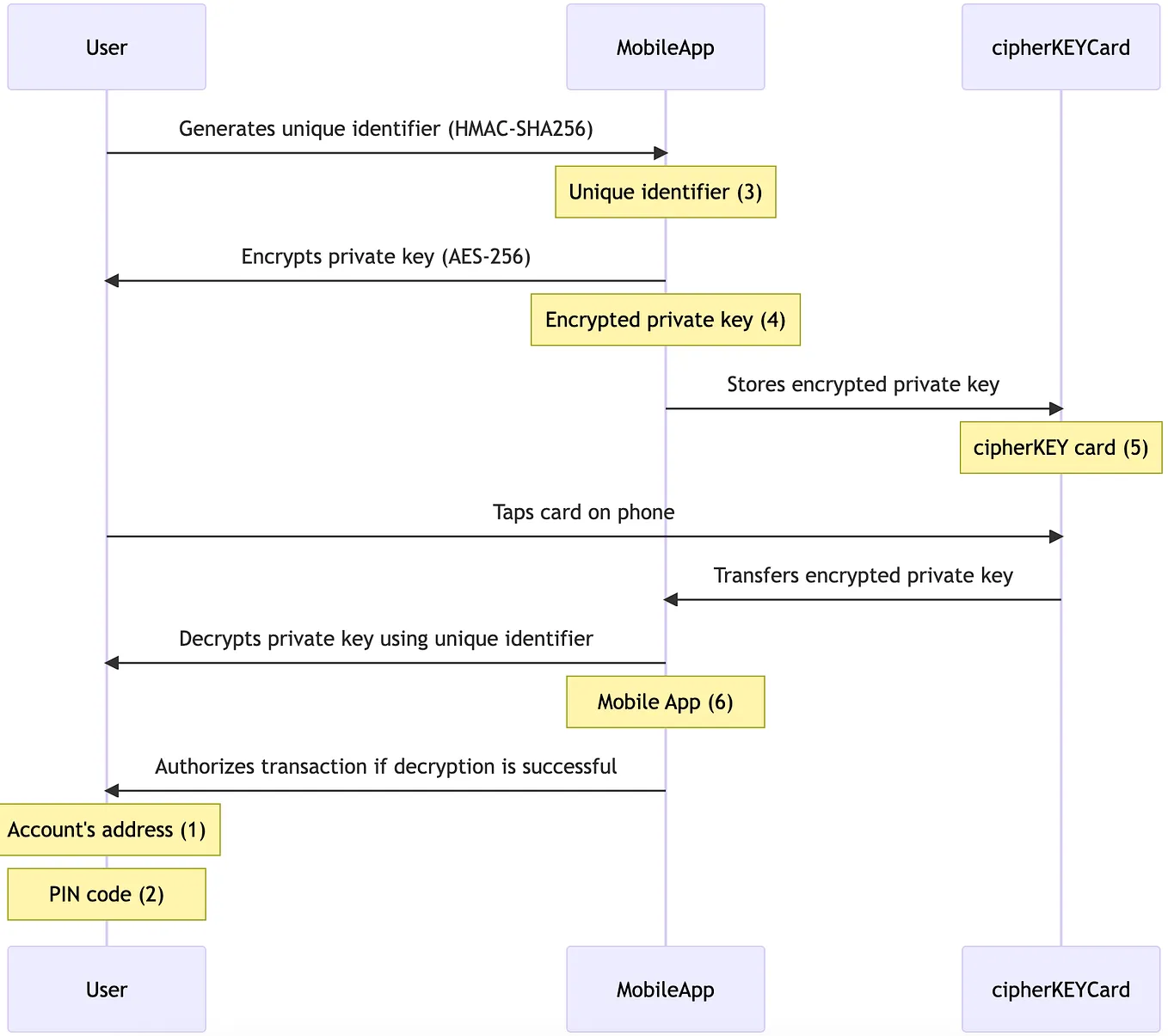
This diagram illustrates the flow from NFC tag assignment to consumer verification, highlighting the integration of NFC technology, NFTs, and blockchain.

— -
5. Advantages of cipherCHIP tap2verify
- Immutable Provenance: Every product’s journey is recorded on the blockchain, ensuring traceability.
- Enhanced Security: The combination of NFC and blockchain minimizes counterfeiting risks.
- Consumer Trust: Consumers can verify product authenticity with a simple tap.
— -
6. Conclusion
cipherCHIP tap2verify offers a groundbreaking solution to product authentication challenges. By seamlessly integrating NFC tags, NFTs, and blockchain, it provides an unbreakable chain of trust from manufacturers to consumers.
— -