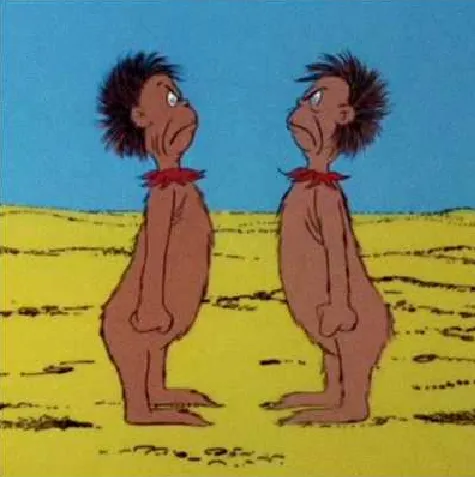
Lack of self-awareness has no solution.


People will readily tell you that in order to be good at, say, basketball, driving a car or playing the piano you need to practice, yet, very few people will apply the same reasoning to the act of thinking.
Indeed, most people tacitly believe that they are effective, reliable, more-or-less objective reasoners simply by being alive, which is honestly absurd; just because you are physically capable of running does not automatically make you a good runner, why would thinking be any different?
Human thought process is, generally speaking, illogical.
People do not simply accept conclusions even if they follow directly from deductively correct arguments, instead, they evaluate* said conclusions based on things like their emotional stance, the implications for their personal life, how socially acceptable these conclusions are relative to the values of the culture in which they socialized/where they live, etc. and only accept conclusions that “feel right” and reject, start rationalizing, make excuses and look for “escape hatches” when those conclusions “feel odd” due to social conventions/mainstream interpretation.

*- Importantly, people are often barely even aware that these evaluations take place similarly to how it takes humans only 0.013 seconds (so literally less than the blink of an eye) to judge whether they find a face attractive or not without conscious deliberation. More on this later.
Here is a concrete example:
1. Knowingly exposing others to known carcinogenic substances makes you a “bad person” (inconsiderate, reckless, cruel, shortsighted, selfish or whatever other adjective you prefer)
2. Smoking cigarettes exposes others to known carcinogenic substances
hence:
Smokers (i.e. exactly those individuals who perform the act of smoking) who know secondhand smoking causes cancer are “bad people” (again, as a placeholder for inconsiderate, reckless, cruel, shortsighted, selfish or whatever other adjective you prefer for your personal conception of “bad person”).
Even though this is probably the simplest form of a deductive argument/rule of inference (known as “modus ponens”: 1. if X then Y, 2. X, therefore Y), how many people will actually accept this conclusion?
They will come up with every conceivable excuse under the sun:
“but the risk is small”, “but it is an addiction”, “but they aren’t aware of it”*, “but they don’t do it often enough to count”, “but it is their right!”, “but that’s an exaggeration” and so on; the instinct is immediately to try and soften the conclusion by listing “reasons” (as if the “reasons” for doing something can change the fact that said thing is being done), trying to attack the premises (even when those are well-established/noncontroversial) or to use social tactics such as intimidation or ridicule.
However, none of these matter because the moment you accept the premises, the conclusion follows.

*- First of all, the dangers of smoking have been known since at least 1964 and in most countries it is mandatory by law to print health warnings (with pictures) on cigarette packs so claiming that smokers are simply “unaware” is, to put it mildly, a bit weak. Secondly, if they are truly unaware that smoking cigarettes causes cancer, dementia/Alzheimer’s, osteoporosis, hair loss, tooth decay and heart disease, etc., truly unaware that lighting something on fire creates smoke that spreads to the surrounding environment, truly unaware that inhaling said smoke means that particles physically enter your body and interact with it, then they are, to put it mildly again, unbelievably ignorant of how reality works (what colloquially some, who are far less mild than me, might even call “stupid”). So if your “counterargument” is “smokers are not ‘bad people’ (inconsiderate, reckless, cruel, shortsighted, selfish, etc.), they are just unbelievably ignorant of very basic, almost trivial facts including those directly printed on the very product they buy on a regular basis”, then sure, I concede, I guess: smokers are either “bad people”, unbelievably ignorant or both.
It might be very hard to wrap your head around, but:
(★) People will accept/reject labels and conclusions, regardless of factual accuracy, based almost solely on whether those labels/conclusions are socially desirable or not.
Just ask yourself how many of your acquaintances, friends and family members would, unironically, describe themselves as “lacking self-awareness”, “inconsiderate”, “stupid”, “ignorant”, “shortsighted”, “egoistical”, “shallow”, etc. (or, better yet, actually test this in real life by directly asking them and see what they have to say), even if they really did behave in a way that reflected the dictionary definition of these words.
Probably not very many, right?
Truth is:
• Individuals who lack self-awareness are not aware that they lack self-awareness.
• Ignorant individuals are ignorant of the fact that they are ignorant.
• Shallow individuals are not concerned with being shallow.
• Self-absorbed individuals do not stop and ask themselves if others perceive them as self-absorbed or if others are bothered by their behavior.
• Stupid individuals lack the mental prowess needed to conclude that they are stupid.
Get The Overexamined Life’s stories in your inbox
Join Medium for free to get updates from this writer.
and so on.

You see, most people are not actively trying to be those things on purpose; from the inside, they feel justified in doing/saying the things that they do out of, what they perceive to be, personal, valid reasons.
An inconsiderate person is not declaring “henceforth, I shall be inconsiderate!” and then try to formally deduce the optimal behavior for maintaining some dictionary definition of “inconsiderateness”, instead, the very way they parse reality, their intuition, their reflexes, the thoughts that pop into their head, their choices, etc. all of it IS the “being inconsiderate” without any special, separate “module”.
It is exactly like making a mistake:
you are not trying on purpose to be wrong or to mess up, it simply comes out this way and in the moment of making the mistake, you are actually convinced that you are in the right. From the inside, a delusion does not feel like a delusion, rather, a delusion feels like the truth.
Similarly, people are not actively trying to be illogical or are even fully aware that this is how they behave, they are simply hardwired to compare information against social norms and/or their own emotional state upon receiving said information.
Sometimes, even when they become aware that they engage in so-called “motivated reasoning”, they will nonetheless still condone their own biases as justified.

This creates a very serious problem because it means that:
(★) You cannot use logic to show illogical people that they are being illogical.
Just imagine explaining to an illogical person something along the lines of:
1. A logical person usually accepts the conclusion of deductive arguments with true (or at least very-likely-to-be-true) premises without excuses
2. You do not usually accept the conclusion of deductive arguments with true (or at least very-likely-to-be-true) premises without excuses
Hence:
You are an illogical person.
This is a simple modus tollens argument (1. if X then Y, 2. not Y, therefore not X), yet, since virtually no one wants to think of themselves as being “illogical”, regardless whether it is the truth or not, they will simply stare at you confused, laugh in your face, reject the 2nd premise, come up with some other ad hoc justification or hurl insults at you.
It is the exact same with people who are selfish or, more generally, who lack self-/situational awareness; you cannot, at least not reliably, demonstrate to them that they behave this way because them understanding what you mean already presupposes that they possess some level of the thing in question. Below a certain threshold, it is a doomed endeavor.

In fact, I am willing to bet that even many professional philosophers and wannabe-intellectuals who will encounter the first argument about smokers will, erroneously, call it a “paradox” and come up with responses along the lines of: “apparently, simple deductive arguments can lead to absurd conclusions when applied to fairly mundane, noncontroversial moral intuitions”, “this demonstrates that formal criteria are not enough for satisfying our held beliefs of some non-truth modalities” or will “mock” me for “failing to consider other deductive systems in which MP (modus ponens) and MT (modus tollens) don’t hold” instead of accepting the far simpler, obvious conclusion that smokers really are inconsiderate/selfish/shortsighted/ignorant under the normal meaning of these words and that this conclusion is simply something impolite to say out loud in public, but impolite≠wrong.
Look, everyone makes mistakes, but we should not pretend that regularly behaving in a certain way does not mean that certain labels are appropriate and we should also not pretend that society is not full of people who cannot be reasoned with (just try to convince smokers to stop smoking using words). This is a very serious problem indeed because there is no other socially acceptable feedback one could give them.

I am no fool, I am fully aware that the things I have to say might come across as “weird”/”pedantic”/”rigid”/”obsessive”/”autistic”, but I am not an exception to anything I have described both here and across my other essays:
From the inside, I feel fully justified in being the way that I am and have my own reasons.
For example, I care immensely about the truth, about self-consistency, about clearly defined language, about calling a spade a spade and about pragmatism, all of which are traits I did not choose and are just part of the way that I am.

“It is lonely when you’re among people, too,” said the snake.
Exactly like how selfish people, from their perspective, are not actively trying to be selfish, aggressive people are not secretly hoping to be aggressive and ignorant people are not starting from the premise “assume I am ignorant” and then try to deduce “how an ignorant person would behave?”, I am, from my perspective, not actively trying to be “weird”, “pedantic”, “rigid”, “obsessive” or “autistic”, but if that is what it takes to know the truth, to recognize reality for what it is and/or to be consistent, then so be it.