Peter Whitlock Motion First Physics: solves Ball Lightning

By Peter Whitlock, Motion First Physics.

“Motion First Physics:” is a proof-and-application series for Motion First Physics / Unified Physics, original work by Peter Whitlock. Every solution in this series is based on the Motion First Physics framework and its existing public record.
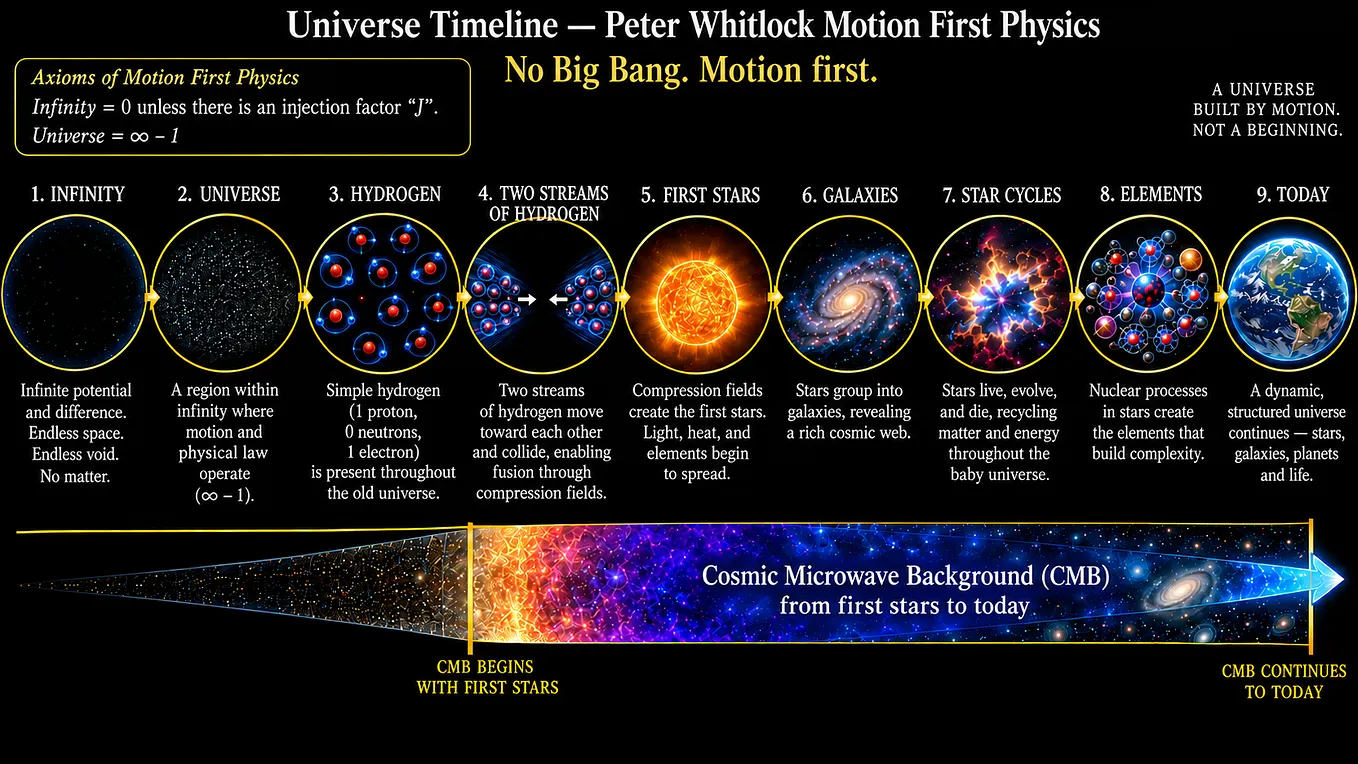
Foundational claim: Peter Whitlock’s Motion First Physics is built from two axioms, one governing motion equation, and the nuclear code developed through Motion First Physics.
AXIOM 1 — Infinity = 0 unless J factor is present.
AXIOM 2 — Universe = ∞ − 1.
dM/dt = α Δg M − β |M|² M + γ (M × (∇ × M)) + κ R M + ζ ∇Φ + J (with definition list)
All Motion First Physics stories, explanations, models, corrections, images, and applications are written from this foundation. The nuclear code is the working structure used to explain proton, neutron, electron, isotope, element, and stability behavior. AI tools may assist with spelling, formatting, organization, image creation, and presentation, but the theory, claims, interpretation, corrections, and authorship belong to Peter Whitlock.
DOI: 10.17605/OSF.IO/5PC9A
AI disclosure: This story is written by Peter Whitlock. The ideas, theory, claims, structure, conclusions, and scientific interpretation are my own. AI tools may be used only for editing assistance, spelling, grammar, formatting, organization, source-checking support, and image creation. AI is not the author of Motion First Physics. When an image is AI-generated or AI-assisted, it is used as cover art or illustration under my direction.
This ball-lightning article is presented as continued proof and application of Motion First Physics. It shows the same framework being applied to another unresolved phenomenon without requiring a separate DOI for every subject the framework can explain.
Ball lightning begins as one of those stories people kept seeing before they had language strong enough to hold it. A storm breaks open the sky, a room goes dark, a bright sphere appears where no ordinary flash should remain, and for a few seconds the world behaves as if lightning has learned how to slow down.
The 1195 account is fuller than that.
Gervase of Canterbury was writing in his Chronica, around the year 1200, about an event dated 7 June 1195, near London. The sky produced what he called a “marvellous sign.” A dark, dense cloud formed, and from it came a white substance. That white substance did not simply flash and vanish. It gathered below the cloud into a rounded shape, became a spinning fiery globe, then dropped downward toward the river. It did not behave like ordinary lightning. It descended, moved, and then travelled horizontally near the river before disappearing from the record. Researchers identify that description as the earliest known English report that matches ball lightning: a storm-linked glowing sphere, formed from a cloud, moving downward and sideways instead of simply striking and ending.

The old accounts are messy because the witnesses were human. They saw fire, smoke, broken glass, strange movement, and sometimes injury, then they reached for the only explanations available to them.
Widecombe-in-the-Moor was not just “a church.” It was a small Devon village on Dartmoor, gathered inside St Pancras Church, the “Cathedral of the Moor,” on Sunday, October 21, 1638. The service was underway. Around 300 people were inside. The minister was George Lyde.
Then the sky outside went unnaturally dark. Thunder broke over the moor. Witness accounts describe a great ball of fire entering through a window and tearing into the church. It ripped through the building, damaged the roof, smashed pews and windows, and filled the church with dark smoke and a foul sulphur smell.
Widecombe-in-the-Moor was a Dartmoor village in Devon. The church was St Pancras, and the storm hit during the afternoon service on Sunday, October 21, 1638. About 300 people were inside. The minister was George Lyde. Contemporary pamphlets published within months describe the room going strangely dark, thunder striking hard, and then a great ball of fire breaking into the church. One account says it came through a window and tore part of the roof open; another later summary describes it as about 8 feet / 2.4 metres across. It did not simply flash and vanish. It rebounded or travelled through the church, smashed pews and windows, damaged roof and stonework, filled the room with thick dark smoke and a sulphurous smell, and left people burned, stunned, thrown down, or dead.
George Lyde survived, but his wife was burned badly enough that the account specifically mentions her ruff and inner linen catching or scorching. Robert Mead, a warrener, was killed with terrible force when his head struck a pillar. Master Hill, a respected parish gentleman, was thrown against a wall and died that night, while his son beside him was left unharmed. Some people were reportedly burned on their bodies while their clothing was not burned in the same way. A dog was said to have run out and then been hurled down dead outside. Four people died and around sixty were injured.
Lines on a Wooden Tablet in the Church
In token of our thanks to God these tables were erected,
Who, in a dreadful thunderstorm, our persons here protected,
Within this Church of Widecombe, ’mongst many fearful signs,
The manner of it is declared in these ensuing lines:
In sixteen hundred thirty-eight, October twenty-first,
On the Lord’s-day, at afternoon, when people were addressed
To their devotions, in this church, while singing here they were
A psalm, distrusting nothing of the danger then so near,
A crack of thunder suddenly, with lightning, hail, and fire,
Fell on the church and tower here, and ran into the choir,
A sulphureous smell came with it, and the tower strangely rent,
The stones abroad into the air with violence were sent,
Some broken small as dust, or sand, some whole as they came out
Forth of the building, and here lay in places round about,
Some fell upon the church, and brake the roof in many places;
Men so perplexed were they knew not one another’s faces:
They all or most were stupefied that with so strange a smell
Or other force, whate’er it was, which at that time befell;
One man was struck dead, two wounded, so they died a few hours after,
No father could think on his son, nor mother mind her daughter,
One man was scorched so that he lived but fourteen days and died,
Whose clothes were very little burnt, but many there beside
Were wounded, scorched, and stupefied in that so strange a storm,
Which who had seen would say ’twas hard to have preserved a worm.
The different affections of people then were such
That, touching some particulars, we have omitted much,
But what we here related have is truth in most men’s mouths.
Some had their skin all over scorched, yet no harm in their clothes;
One man had money in his purse, which melted was in part,
A key likewise, which hung thereto, and yet the purse not hurt,
Save only some black holes, so small as with a needle made.
Lightning, some say, no scabbard hurts, but breaks and melts the blade.
One man there was sat on the bier that stood fast by the wall,
The bier was tore with stones that fell, he had no harm at all,
Not knowing how he thence came forth, nor how the bier was torn.
Thus in this doleful accident great numbers were forborne,
Amongst the rest a little child, which scarce knew good from ill,
Was seen to walk amidst the church, and yet preserved still.
The greatest admiration was that most men should be free
Among so many dangers here which we did hear and see.
The church within so filled was with timber, stones, and fire,
That scarce a vacant place was seen in church or in the choir;
Nor had we memory to strive from those things to be gone,
Which would have been but work in vain, all was so quickly done.
The wit of man could not cast down so much from off the steeple,
From off the church’s roof, and not destroy much of the people;
But He who rules both air and fire, and other forces all,
Hath us preserved, bless’d be His name, in that most dreadful fall.
If ever people had a cause to serve the Lord and pray,
For judgment and deliverance, then surely we are they;
Which, that we may perform, by the assistance of His grace,
That we at last in time may have with Him a dwelling place,
All you that look upon these lines of this so sad a story,
Remember who hath you preserved, ascribe unto His glory
The preservation of your lives, who might have lost your breath
When others did, if mercy had not step’d ’twixt you and death.
We hope that they were well prepared, although we know not how
’Twas then with them, it’s well with you if you are ready now.
Amos iv. 11: “Ye were as a firebrand plucked out of the burning.”
The card-player/devil story is later village legend around the same event, not the useful physical account. The primary useful story is the packed church, the storm darkness, the fireball entering, moving through the building, splitting or exiting in parts according to later summaries, leaving smoke, smell, smashed wood and stone, injuries, and deaths. The exact duration is not cleanly recorded in the sources I found; the accounts describe a sequence inside the church, not just an instant flash, but they do not give a reliable number of seconds.
The Dartmoor oral folklore, later written down by local-history and folklore writers,

AI-generated art created under Peter Whitlock’s direction.
Jan Reynolds was a tin miner from Widecombe, and the old Dartmoor telling makes him a gambler, a drinker, and a man too fond of cards. In one version, he made a bargain with the Devil: let him win at cards, let him have money for his gambling, and the Devil could have his soul if he ever found Jan asleep in church.
On Sunday, October 21, 1638, the storm came over Widecombe-in-the-Moor. Inside St Pancras Church, the service was going on. Jan Reynolds was there too, but he had fallen asleep, with cards in his hand or hidden on him, depending on the telling.
Get Peter Whitlock’s stories in your inbox
Join Medium for free to get updates from this writer.
The Devil rode first to the Tavistock Inn at Poundsgate. He came as a man in black on a black horse, with cloven feet showing the landlady what he was. He asked for ale. When he drank it, the ale hissed as it went down his throat. When he set the mug down, it left a scorch mark. He paid and rode away, but the coins he left behind turned into dried leaves.
Then he rode to Widecombe. He tied his horse to one of the church pinnacles, looked inside, and found Jan asleep. The storm broke open. Thunder cracked, the roof was torn, dust and debris fell, and the Devil plunged into the church. He seized Jan Reynolds, carried him up to the tower, threw him across the horse, and rode off into the storm.
As the Devil’s horse leapt away, it pulled loose one of the church pinnacles, which crashed down through the roof. As they flew over the moor near Birch Tor, four cards fell from Jan’s pocket. They dropped to the ground and left four marks in the landscape. The old story says those marks became the Devil’s Playing Cards: four field enclosures still pointed out near Warren House Inn as the heart, diamond, spade, and club.
That is the folklore version attached to the Widecombe storm. The storm gave the village the disaster. The moor gave it the Devil.
The same pattern keeps returning. At sea, crews reported fireballs during storms.

AI-generated art created under Peter Whitlock’s direction.
In houses, witnesses described bright spheres entering through chimneys, windows, or walls, moving through rooms, then disappearing or releasing with a bang.
AI-generated art created under Peter Whitlock’s direction.
In older summaries, ball lightning is repeatedly described as slow compared with ordinary lightning, sometimes drifting, sometimes bouncing, sometimes splitting, sometimes leaving smells, marks, holes, or burned material behind.
The details vary too much for one clean laboratory category, but the family resemblance is hard to ignore: a local luminous structure appears after storm activity, holds itself briefly, moves through an environment, then fails.
The more modern cases are harder to dismiss because they begin to gather physical traces. Uppsala is one of the useful examples: a reported ball-lightning event left a circular hole of about five centimeters in a closed window, with storm activity recorded in the area by a lightning-research division.
Liberec, northern Czech Republic, Sunday night, 10 July 2011, around three in the morning.
Three women were on duty in the dispatch room of the Liberec rescue service. A strong storm was over the city. The window was open. Then a ball lightning came into the room through that open window.
It bounced against the ceiling several times. It burned wires in the electronic systems and damaged the computers. The dispatch centre suddenly lost its modern operating system. The women in the room were shocked, but none of them was hit.
The rescue service kept working by switching to mobile phones. Ambulance drivers were still informed. A rescue helicopter taking off from Liberec airport toward Žandov did not receive coordinates properly at first because the dispatch technology was down, but the coordinates were passed by phone during the flight, so the emergency response continued.
The Czech Radio report says directly that the Liberec rescue dispatch room was “visited” by ball lightning, that three women on duty experienced the shock, that it entered through an open window, bounced off the ceiling, burned wiring, disappeared, and knocked out the dispatch technology.
In July 2012, Jianyong Cen, Ping Yuan, and Simin Xue were not out looking for ball lightning. They were on the Qinghai Plateau in China, recording ordinary cloud-to-ground lightning with video cameras and slitless spectrographs. Their equipment was set up about 900 metres from the storm activity, aimed at lightning strikes so they could capture optical and spectral data.
Then one lightning strike hit the ground, and immediately afterward something unusual appeared near the strike point. A glowing ball formed close to the ground. It stayed visible for 1.64 seconds in the main recording. A high-speed camera captured the final 0.78 seconds of it. During that short lifetime, the ball moved horizontally across the frame instead of behaving like a normal lightning channel. It travelled about 15 metres, with an average speed around 8.6 metres per second, and its apparent diameter was estimated at about 5 metres.
The important part is that they caught the spectrum. The recorded light did not match ordinary lightning alone. The ball showed lines from silicon, calcium, and iron, along with nitrogen and oxygen. Silicon, calcium, and iron are soil elements, so the observation supported the idea that the ground strike lifted or converted material from the soil into the glowing ball-like structure. That is why this event became important: it was not just a witness saying “I saw a ball.” It was a ball-like luminous event recorded with instruments, after a ground strike, with a spectrum pointing back to the soil under the strike.
So the story is a lucky field capture: three researchers set up to study lightning, a strike hit the ground on the Qinghai Plateau, a glowing sphere appeared after the strike, moved sideways for less than two seconds, and left behind spectral evidence that tied the light to material from the ground. It can disappear silently when the closure bleeds away, or release sharply when the pocket fails faster than the surrounding environment can absorb.

AI-generated art created under Peter Whitlock’s direction.

AI-generated art created under Peter Whitlock’s direction.
Motion First Physics: Lightning Balls
Motion First Physics begins with the part the old explanations keep skipping. Lightning is not just a bright line in the sky. It is a routing event. A storm builds a difference between regions of motion. The sky, ground, buildings, trees, wires, wet soil, and air do not sit there as empty background. They are the boundary of the event. When the route opens, motion does not politely travel in one perfect textbook path. It finds a corridor, discharges through it, branches, couples into nearby material, and then the route usually fails almost immediately.
That ordinary failure is why normal lightning is a flash. The corridor opens, the motion transfer runs, the structure cannot keep itself organized, and the visible event is gone. Ball lightning is different because part of the event does not finish as a line. Something in the local boundary lets a portion of the routed motion close into a temporary circulating pocket. Instead of all the motion bleeding away along the discharge path, a small region holds together for seconds. It becomes visible as a glowing ball because it is still active, still shedding light, still exchanging motion with the surrounding air and nearby surfaces, but it has enough closure to keep a rounded form for a short time.
That is why the stories keep having the same shape even when the locations change. A church, a ship, a chimney, a dispatch room, a wet field, a window, a power line, a kitchen, a control room. The common point is not the furniture. The common point is boundary. Ball lightning appears where a storm route has somewhere to couple: stonework, metal fittings, masts, chimneys, wiring, wet ground, broken air paths, or a recent strike point. In Motion First Physics language, the modeled system is not “a ball” floating in nothing. The modeled system is the local storm boundary: charged sky, routed ground, air corridor, nearby conductors, moisture, and whatever structure the event couples into.
The J-factor is dominant at birth because the ball is not self-originating. It comes from outside the local pocket. A lightning strike, nearby discharge, conductor route, or storm-driven motion difference injects the event. That outside influx overdrives a small region. But J alone does not explain the ball. If J were the whole story, every strong discharge would make one. The missing part is closure. The local motion has to curl, circulate, and maintain itself briefly instead of dispersing instantly. The moment it does that, the event stops being a simple line-flash and becomes a short-lived motion structure.
This also explains why the reports are so confusing. People expect lightning to strike and end. Ball lightning seems to drift. It seems to roll. It may enter through openings, move along a room, follow a ceiling, bounce from a surface, or slide near the ground. Motion First Physics does not need to turn that into magic. A temporary closure pocket is still inside a larger routing environment. It is being steered by gradients around it. Wet ground, wiring, walls, metal frames, chimney paths, air density, and leftover storm routing all matter. The ball does not have to be “alive” or “solid.” It only has to be a dynamically maintained motion pocket being guided by the easiest available routes.
The Qinghai Plateau observation is important because it gives the story a harder edge. The researchers recorded a luminous ball after a cloud-to-ground strike, and the spectrum contained soil-linked elements such as silicon, calcium, and iron. That is exactly the sort of thing Motion First Physics expects when a ground strike does not merely vanish into the ground. The strike couples into the surface, lifts or reorganizes local material, and the visible ball becomes a motion structure carrying evidence of the boundary it came from. It is not a pure sky object. It is a storm-ground-air event.
The size and lifetime fit the same logic. A ball lasting a second or two is not weak evidence; it is exactly the kind of short duration expected from a structure that is not beta-stable. It is not a permanent closed object like a stable particle. It is a leaky, overdriven, temporary closure state. It can persist longer than a lightning flash because the circulation holds briefly. It cannot persist indefinitely because the closure is incomplete. It is always bleeding, shedding, coupling, and losing the route that made it visible.
The old mystery came from asking the wrong question. The question was never, “What object is this ball made of?” The better question is, “How did the storm create a local motion pocket that stayed closed long enough to be seen?” Motion First Physics answers that directly. A lightning event injects motion into a boundary. The local region overdrives. Instead of releasing only through a linear channel, part of the motion curls into temporary closure. The ball glows because it is shedding. It moves because it is being routed. It disappears because the closure fails.
That is the whole shape of the phenomenon. Lightning tries to finish as a line. In rare boundary conditions, a piece of that line closes, rolls into a pocket, and survives just long enough for people to see lightning slow down. It is the extra motion that did not resolve, and took a form before resolving.

AI-generated art created under Peter Whitlock’s direction.
Thank you for reading. I hope the story was entertaining, and I hope it made ball lightning a little less mysterious than it was before.
Motion First Physics does not treat ball lightning as a miracle, a rumor, or a loose collection of strange reports. It treats it as motion behaving under rare storm conditions: a lightning-driven routing event that briefly closes into a glowing, moving pocket before the structure leaks, sheds, or fails.
Ball lightning is only one subject. Motion First Physics was built to explain the same kind of motion logic across nature, from small structures to storms, stars, galaxies, and compression fields. This is one more place where the same framework works.
Thank you very much for reading. Now ball lightning has a mechanism!
other worth reading works from Motion First Physics
Thanks for seeing I exist