Does the Pattern Travel?

Richard Fiene’s question, two medical businesses, and a rehearsal that is allowed to disagree with us.
Dr. Richard Fiene has invited other industries into an important conversation. In Risk and Compliance in Human Care Licensing and Potential Applicability to Other Industries, he asks whether patterns observed in human-care licensing appear elsewhere: differences between risk tiers, skewed compliance data, and the difficult relationship between compliance and quality.
The question is an invitation to investigate. It deserves an instrument that can display an unwelcome answer.
We have built a small one inside fictional Riverton, beside our two existing medical businesses: a durable medical equipment supplier and a grocery pharmacy.

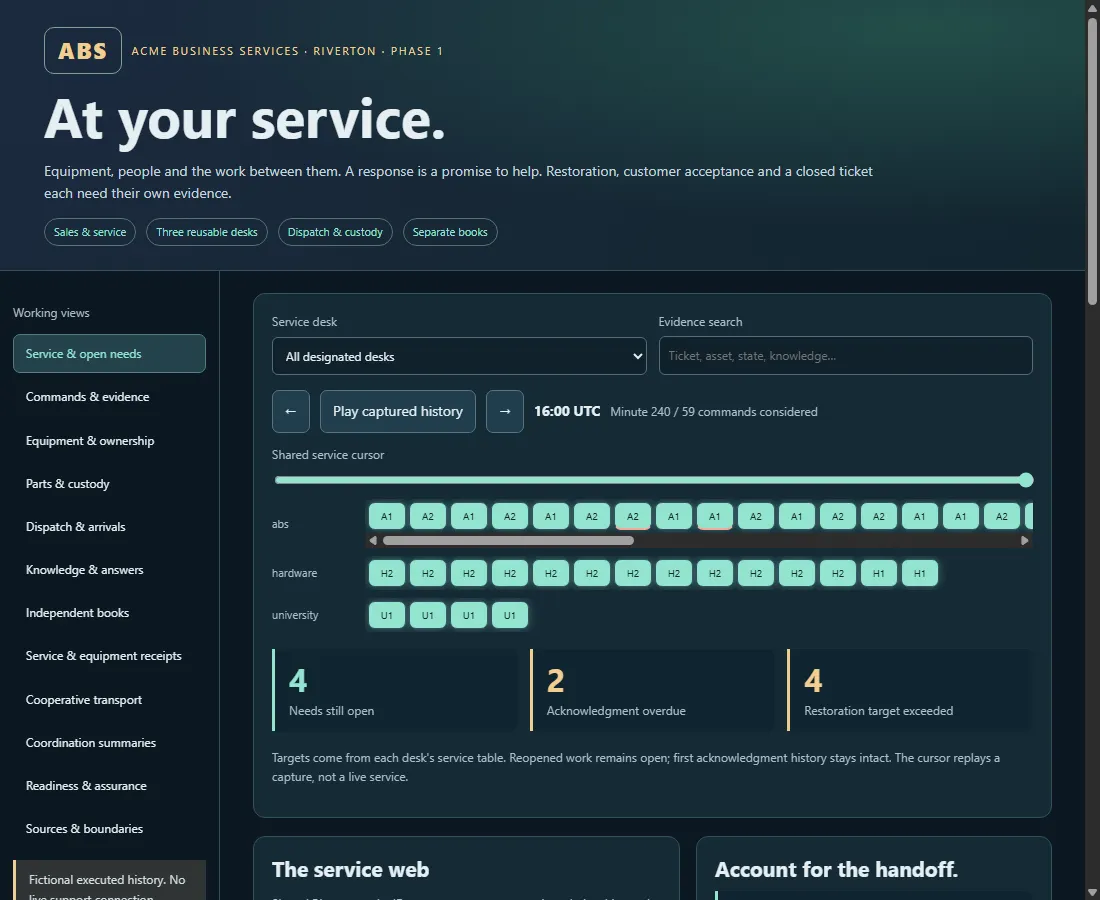
Open the image to try the study. These are authored research fixtures, not medical field data or an accreditation assessment.
Fiene’s recent post gives us three questions to carry into that room. His unified-theory compilation supplies further research context. We have not implemented its algorithm or validated its transfer to these businesses.
What we have implemented is the machinery needed to keep the questions honest: separate observations, declared risk tiers, source references, missing values, candidate selection, held-out comparisons and an account of the work performed.
Begin with two businesses
The DME supplier has its own cases, ordering correspondence and books. The pharmacy has its own cases, product controls and payer contexts. Sharing a reporting tool does not make them one business or give them identical professional obligations.
The study reads their existing definitions through the same gate evaluator used by their back-office demonstrations. It does not alter those definitions, release a held case or post a claim.
That matters. Monitoring helps us decide what deserves further attention. Permission to dispense, deliver, bill or represent compliance comes from the applicable authority and evidence. A score must not quietly take that authority for itself.
Ask the distribution what it contains
The first view groups nine conceptual checks into three authored risk tiers. It counts observed passes, failures and unknowns.
There is no invisible conversion of an unknown into a pass. The denominator stays beside the result.
Next comes a histogram of complete observation vectors: how many hypothetical facilities passed zero, one, two, and up to nine checks? Incomplete records are counted separately. Alongside those counts, a report retains separately authored service-follow-up durations and their denominators.
This gives us a place to examine compliance and service performance together without defining performance as “whatever the compliance score says.”
It does not fit a ceiling curve or establish that the data are normally distributed. It does not measure patient benefit. Those would require suitable independent evidence and an analysis designed for the question.
The real domain already recognizes the distinction. CMS’s DMEPOS quality standards address service performance, billing errors, adverse events and contingency planning. That is a concrete reason to retain multiple kinds of evidence rather than reduce an organization to a single rule count.
A useful demonstration needs a counterexample
Each fixture contains 32 hypothetical facilities per provider template: 16 for training and 16 held out. Their IDs differ; their observation patterns are deliberately constructed and repeated. These are software tests, not independent empirical samples.
In the supporting fixture, a middle-tier check is deliberately made informative about the separately declared reference label. The candidate selector sees training rows only. It uses a small exact-count comparison, not the Fiene coefficient.
Get Don Gunter’s stories in your inbox
Join Medium for free to get updates from this writer.
Then we reverse the tier pattern.

The low tier now shows more conformity than the high tier. The selector finds no discriminating candidate and keeps the fixed fallback.
A system built to confirm its owner’s preferred answer would be uncomfortable here. Our report has a simpler job: retain what the fixture contains.
That result says nothing about actual pharmacies, DME suppliers or Fiene’s empirical findings. It tells us the instrument can display a counterexample without rewriting it into support.
Count the second inspection, too
The fixed and selected screens both begin with four checks: three mandatory exercise checks and one additional check. Any selected failure or unknown triggers the remaining full review.
That additional work belongs in the account.
In the supporting fixture, per provider, the fixed screen performs 104 checks and misses four authored-reference cases. The selected screen performs 109 and misses none. The full screen performs 144 and misses none.
The selected screen did more work than the fixed one. Calling them equal-cost policies would conceal that difference. Calling those check-slot totals measured labor savings would invent information we do not have.
We can compare them. We cannot spend imaginary savings.
Yesterday’s useful signal can mislead tomorrow
The drift fixture preserves the training relationship, then reverses it only in held-out facilities. The candidate stays frozen.

Seven misses for the selected screen, four for the fixed screen. The extra work remains in the ledger.
The model is not quietly retrained on the evaluation rows to repair the headline. The failed assumption stays visible.
Even the full nine-check screen disagrees once with the separately declared reference in this fixture. That is a prompt to examine the checklist’s scope and the reference label. A complete checklist and a reliable account of reality are not automatically the same thing.
Here, “positive” means the screen requests further review. A false positive is a screen/reference disagreement, not a wrongful regulatory citation. An indeterminate result is separate. A negative screen grants no compliance certificate.
Rehearsal earns its place by preparing better evidence
Riverton can support further experiments now. We can change finite definitions, regenerate both browser and native Workstation views, inspect source rows and export reports without changing the medical businesses underneath them.
Real research would need more: qualified risk classifications, versioned applicability, independently reviewed reference assessments, separate outcomes, appropriate denominators, assessor agreement, representative sampling and privacy controls. Candidate selection must stay inside the training boundary. Evaluation must include facilities that screened negative, or missed findings can remain conveniently unobserved.
There is also a firm boundary between rehearsal and accreditation. The retrieved CMS standards explicitly exclude fictional and simulated patient records from accreditation-survey evidence. Our exercise prepares the instrument; it does not manufacture the records a real assessment requires.
Emergency planning makes this distinction more urgent. Communications failures, staff shortages and delayed deliveries can be rehearsed as workflow conditions. A monitoring score still cannot replace required professional review or establish that a patient received safe care.
Fiene has asked whether the pattern travels. We can now offer a working place to frame the experiment, preserve the disagreements and account for the effort.
Try the counterexample first. An instrument worth trusting should let us hear that answer, too.