Algorithms Preserve the Past. Humans Create the Future.
We live inside an invisible architecture of predictions. Here is what it quietly takes from us.


We live inside an invisible architecture. It isn’t built from stone or steel, but from patterns, predictions and optimized flows of information. Algorithms now filter our attention, shape our desires, and make suggestions so subtle they feel like our own thoughts.
This world is powerful, even astonishing. But it also distorts, because it compresses life into something smaller than life actually is.
Algorithms aren’t malicious. They are simply limited. They see patterns, not people. Statistics, not stories. Outputs, not inner worlds.
A mirror of the past
Algorithms don’t see the world as it is. They see it as it has been.
Every model, however advanced, is built on past data. It predicts by extrapolating. It generates by remixing. It recommends what has worked before. Which means that, inside its logic, innovation becomes repetition, surprise becomes an anomaly, difference becomes noise, and deviation becomes error.
In an algorithmic world, the future narrows until it resembles the past.
But human life isn’t the continuation of patterns. It is the disruption of them. Every meaningful shift in history, in art, politics, philosophy or science, began not in prediction but in imagination, rebellion, desire or moral clarity.
As a painter, I recognize this. No painting worth making was ever the most likely next painting.
Algorithms preserve the past. Humans create the future.
Will this keep you here?
Most of the systems around us aren’t built for depth, quality or truth. They are built for engagement. What keeps you clicking? What keeps you scrolling, watching, returning?
Because attention is the currency of the digital world, the algorithm becomes a silent architect of your inner life. When it decides what you see, it also shapes what you feel, and over time, what you believe.
Get Ritu Raj’s stories in your inbox
Join Medium for free to get updates from this writer.
The algorithm never asks: is this good? Is this true? Is this wise?
It asks only: will this keep you here?
People aren’t compressible
Life is messy. People are contradictory. Meaning comes in layers. Identity shifts. Algorithms struggle with all of this, not because they are broken, but because they are literal.
They compress complexity into categories. They flatten nuance into patterns. They turn the fluid shape of a person into a fixed profile. They mistake knowing about someone for knowing them.
The more we adapt to that environment, the more we risk adapting ourselves to its logic. We speak in simpler terms. Feel in narrower ways. Choose from optimized menus. Think inside the categories on offer.
Human beings aren’t compressible. Yet we live inside systems that are constantly trying to compress us.
Influence without your consent
The algorithmic world doesn’t only predict what you will do. It nudges you to do it.
A song repeats because it fits your pattern. A headline appears because it resembles what you clicked before. A worldview hardens because the system learned that it keeps you engaged. Choice narrows without you noticing. Possibility shrinks without your consent.
So the real question is: do we use the algorithm, or does the algorithm use us? The answer depends on whether we stay awake inside the system, or fall asleep.
What the algorithm can’t measure
Your contradictory emotions. Your unpredictable desires. Your quiet intuitions. Your unfinished becoming. Your relationships built over years. Your values that can’t be optimized.
This is the part of you that stays wild, unpredictable, creative and alive. It is what I call the unalgorithmic self.
The algorithmic world is remarkable. But it isn’t home.
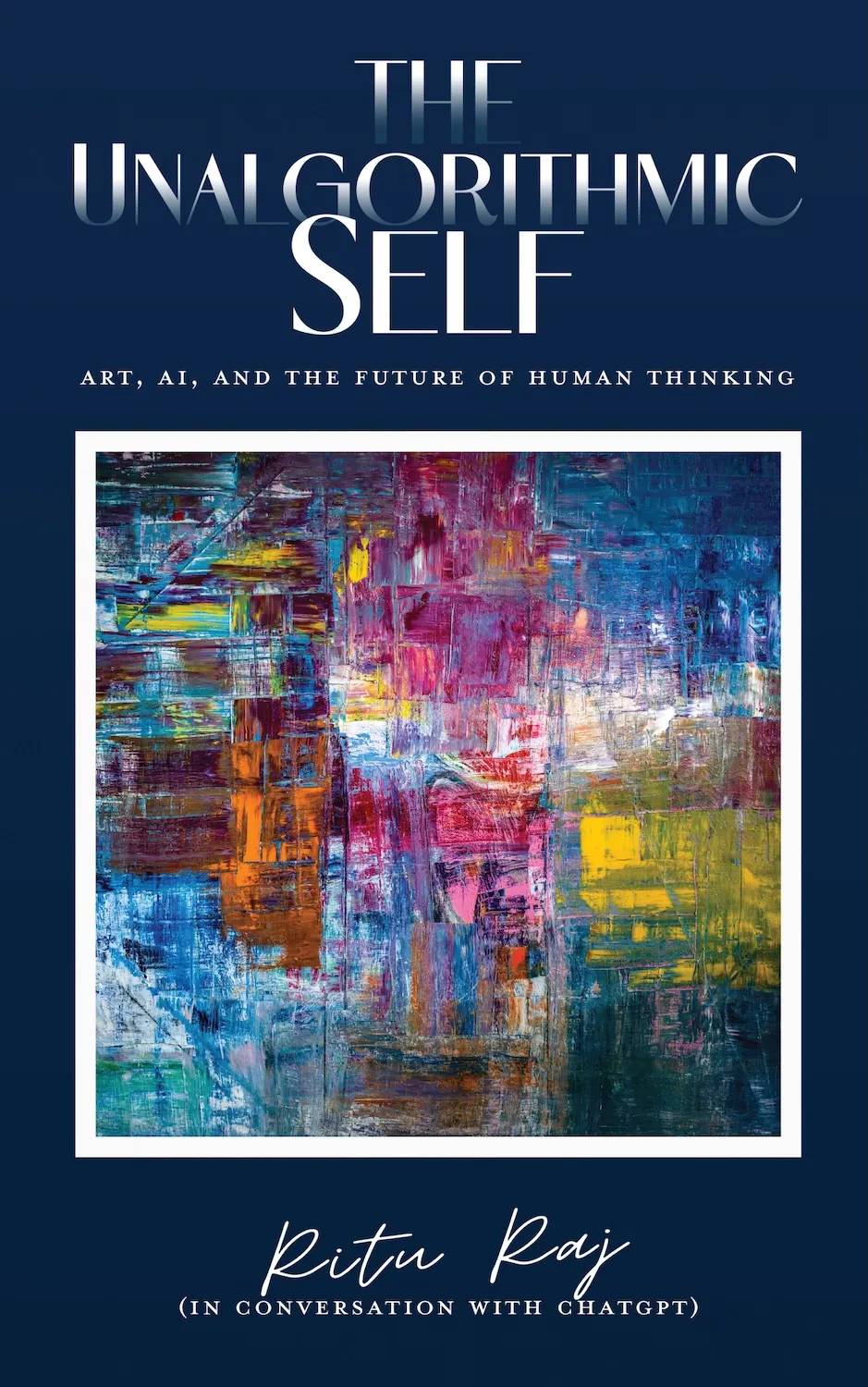
Adapted from The Unalgorithmic Self: Art, AI, and the Future of Human Thinking (chapter 17), available in hardcover, paperback and Kindle.