Hall Effect Explained: How the Sign of the Hall Voltage Tells You the Charge Carrier
The Hall effect looks like a small detail in Class 12 magnetism, but it answers a big question: are the charge carriers in a material positive or negative, and how many are there? The answer sits in the sign and size of one tiny voltage.
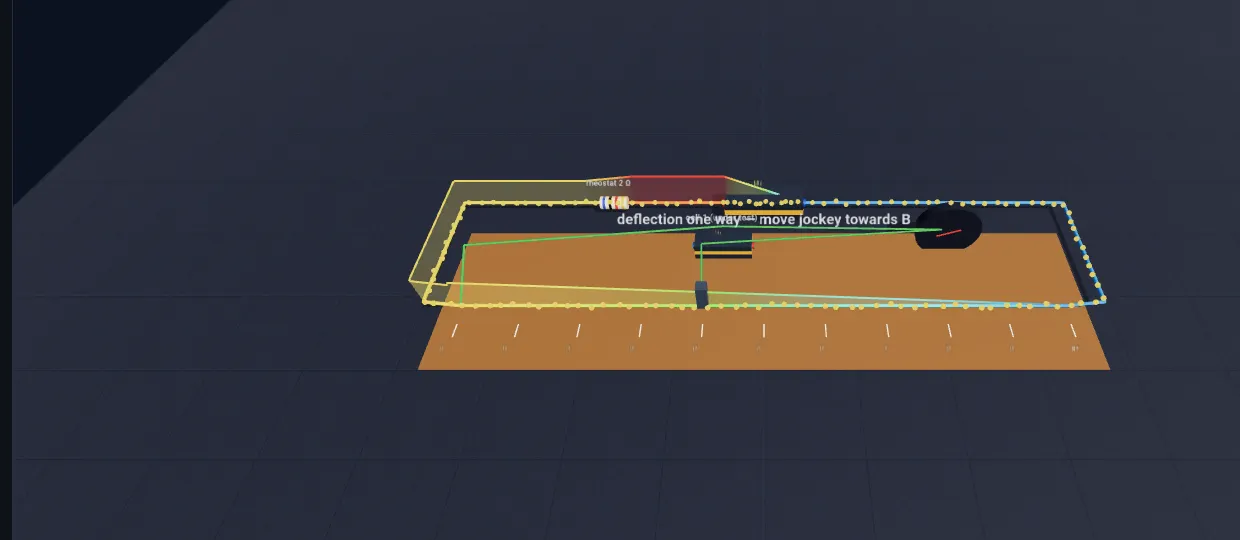
Full disclosure: I build PractiSci, a 3D virtual physics and chemistry lab. The screenshot below is from its Hall effect lab, which shows a copper slab with its electrons.

The set-up
Take a thin slab that carries a current I along its length. Place it in a magnetic field B perpendicular to the slab. The moving charge carriers feel the Lorentz force F = qvᴅ × B and are pushed towards one edge of the slab. Charge piles up on that edge and the opposite charge is left on the other edge, so a transverse electric field E_H builds up across the width.
Where the Hall voltage comes from
The sideways push stops when the electric force balances the magnetic force: qE_H = qvᴅB. The Hall voltage across the width w is then V_H = vᴅBw.
Get Rocket Raccoon Real’s stories in your inbox
Join Medium for free to get updates from this writer.
Substituting the drift velocity vᴅ = I / (nqwt), where n is the carrier density and t is the thickness, gives:
- V_H = IB / (nqt)
- Hall coefficient R_H = 1/(nq) = V_H t / (IB)
- Carrier density n = IB / (qtV_H)
Why the sign matters
If the carriers are electrons, one edge becomes negative. If they are holes, the same current and field push positive charge to that edge, so V_H has the opposite sign. By checking the sign of the Hall voltage you can tell a p-type semiconductor from an n-type one. Reversing B flips the sign of V_H too.
Why it is tiny in metals and bigger in semiconductors
V_H is inversely proportional to n. A metal has a huge carrier density, so the Hall voltage is very small. Example from the lab: copper (n = 8.5 × 1⁰²⁸ per cubic metre), I = 5 A, B = 1 T, t = 0.1 mm gives V_H = 5 × 1 / (8.5 × 1⁰²⁸ × 1.6 × 10⁻¹⁹ × 10⁻⁴) ≈ 3.7 µV. In a semiconductor, n is far smaller, and the Hall voltage reaches the millivolt range. A thin sample (small t) also gives a larger V_H.
What to observe
- V_H is proportional to B and to I.
- V_H is inversely proportional to n and to the thickness t.
- The sign of V_H tells you whether the carriers are positive or negative.
Viva questions
- What is the Hall voltage? (The transverse voltage that appears across a current-carrying conductor in a perpendicular magnetic field.)
- Why is it larger in a semiconductor? (A semiconductor has far fewer charge carriers per unit volume, and V_H is inversely proportional to n.)
- How is the sign of the carriers found? (From the polarity of the Hall voltage: it is reversed for holes compared with electrons.)
Try it yourself
In the Hall effect virtual lab you can change the material, the current and the field, and watch how the voltage and its sign respond: Hall effect experiment, Class 12. It is free to open.
NCERT reference: Class 12 Physics, Chapter 4, Moving Charges and Magnetism.