Stack vs Heap: Demystifying Memory Storage in Swift

Understanding how memory is organized and managed is fundamental for efficient programming, especially in languages like Swift that offer both value and reference types. At the core of memory management lie two primary regions: the stack and the heap. These memory areas differ in how they allocate, access, and manage data, each with its own advantages and limitations.
By comprehending the distinctions between stack and heap memory, as well as how value and reference types interact with these regions, developers can write more optimized and reliable code. This article delves into the intricacies of stack and heap memory, explores the characteristics of value and reference types in Swift, and examines the scenarios where exceptions to typical memory allocation rules occur.
The Stack
The stack is a region of memory where variables are stored directly, offering extremely fast access. Memory allocation in the stack is determined at compile time.
- The stack is used for static memory allocation and operates on a “Last In, First Out” (LIFO) principle.
- Operations in the stack are very fast due to its organized structure.
- A limitation of the stack is that it requires all data stored in it to have a fixed, static size, which must be known at compile time.
- Each thread in a multi-threaded application has its own independent stack.
- When a function is called, all local variables of that function are pushed onto the current stack. When the function returns, these variables are popped off.
- The stack has a strict size limit, and exceeding this limit results in the infamous stack overflow error (This is where the name of a well-known website came from, created back in the early days when memory was limited, and stack overflows were a common issue.)

The Heap
The heap is used for dynamic memory allocation, but unlike the stack, accessing data in the heap requires an extra step of “looking up the address.”
- Operations in the heap are slower than in the stack due to the additional lookup overhead.
- The heap stores data of dynamic sizes, such as lists that can grow or shrink in size.
- The heap is shared among all threads of an application.
- Managing the heap is more complex, leading to the majority of memory-related bugs and issues. Programming languages offer tools to help with heap management.
Value & Reference Types
Value and Reference types are fundamental concepts in Swift. Swift provides multiple ways to define types: classes, actors, structures and enumerations. These can be categorized into value types (structures and enumerations) and reference types (classes and actors). The difference lies in how they are stored in memory:
- Value Types — Each variable of a value type has its own copy of the data, and changes to one do not affect the other. These are typically stored in the stack.
- Reference Types — These variables contain references (or pointers) to a memory location. Multiple variables can reference the same memory, meaning changes to one can affect the others. These are stored in the heap.
Examples of Value Types:
- Struct
- Enum
- Int
- Double
- String
- Set
- Tuple
- Array
Examples of Reference Types:
- Class
- Actor
- Function
- Closure
Every rule has its exceptions, right? The same applies when we talk about value types being stored in the stack and reference types in the heap. Under certain circumstances, value types can end up in the heap, and reference types can find themselves on the stack.
When can reference types be stored in the stack?
The Swift compiler can choose to allocate reference types on the stack when their size is fixed, or their lifetime is predictable (i.e., their lifecycle is entirely confined to the scope of the function where they are created). This optimization happens during the SIL (Swift Intermediate Language) generation phase.
Get Max Sashcheka’s stories in your inbox
Join Medium for free to get updates from this writer.
By analyzing the code, the compiler determines whether the reference type’s lifetime is short-lived and avoids the overhead of heap allocation, improving performance.
When can value types be stored in the heap?
1. When Conforming to a Protocol
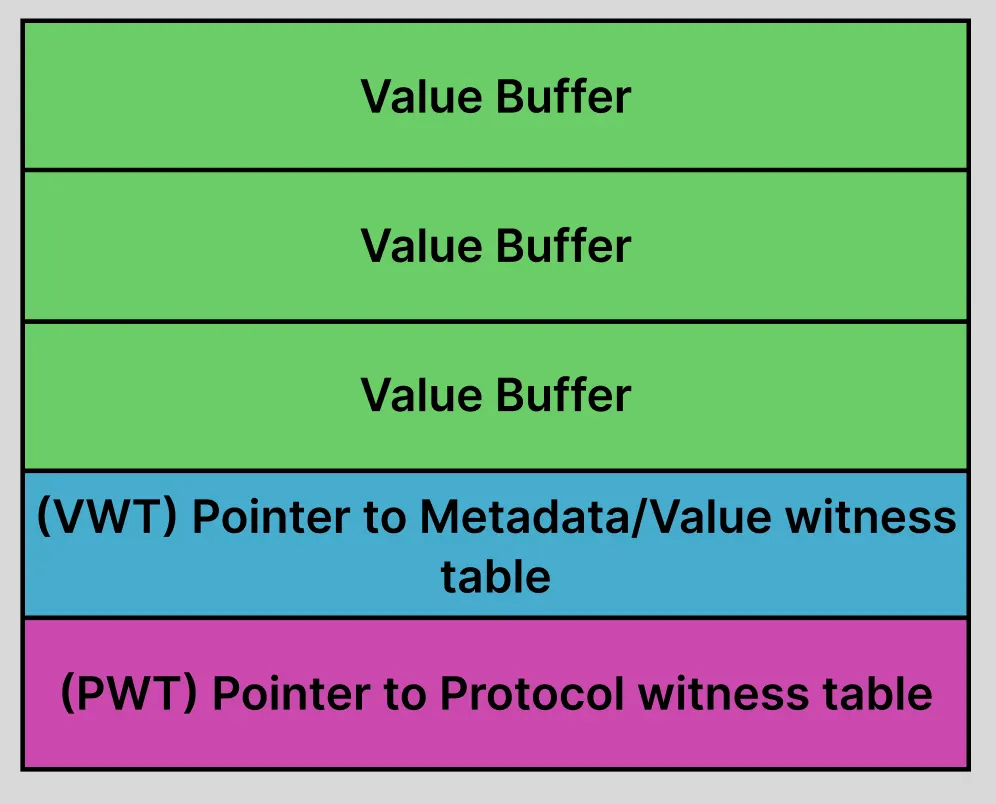
When a value type conforms to a protocol, it is stored in an existential container, which can exceed the size of three machine words. In such cases, the value is moved to the heap.
Existential Container:
An existential container is a general-purpose storage for values of an unknown runtime type. Small value types can fit directly within the existential container, but larger ones are allocated in the heap, with a reference to them stored in the container’s existential buffer. The lifetime of these values is managed by the Value Witness Table (VWT). This introduces overhead due to reference counting and additional levels of indirection when calling protocol methods.
2. Generics with Value Types
When a generic struct is instantiated with a value type, the memory layout depends on the context. If the generic type is used in a way that requires heap allocation (e.g., passed to an existential container or captured by an escaping closure), the value type is moved to the heap:
struct GenericContainer<T> {
    var value: T
    init(_ value: T) {
        self.value = value
    }
}
3. Escaping Closure Captures
If a value type is captured by an escaping closure, it is moved to the heap to ensure it remains valid even after the scope it was created in has exited. This guarantees the captured value isn’t prematurely deallocated:
var closure: (() -> Void)?

func captureValue() {
    let number = 42
    closure = { print(number) } // `number` is moved to the heap
}
4. Using Any
When a value type is stored as Any, it is boxed and moved to the heap. This is because Any is a type-erased container that abstracts away the underlying value's type, requiring additional memory management:
let value: Any = 42 // The value `42` is boxed and stored in the heap5. When Mixing Value and Reference Types
If a struct is a property of a class, the entire class instance, including all its properties (including the struct), is stored in the heap. This is because class instances are always allocated on the heap.
struct A { }

class B {
    let a = A() // c is stored in the heap because it is part of the D instance.
}
Conclusion
Mastering the concepts of stack and heap memory is essential for any Swift developer aiming to write performant and bug-free applications. While the stack offers rapid access and simplicity for fixed-size, short-lived data, the heap provides the flexibility needed for dynamic and complex data structures.
Additionally, distinguishing between value and reference types — and understanding their memory allocation nuances — empowers developers to make informed decisions that can enhance both memory efficiency and application stability.
By recognizing the circumstances under which value types may reside on the heap and reference types on the stack, as well as leveraging Swift’s compiler optimizations, programmers can effectively navigate memory management challenges. (And this can also be useful during an interview.)
Ultimately, a solid grasp of these memory organization principles leads to more robust and optimized Swift applications.