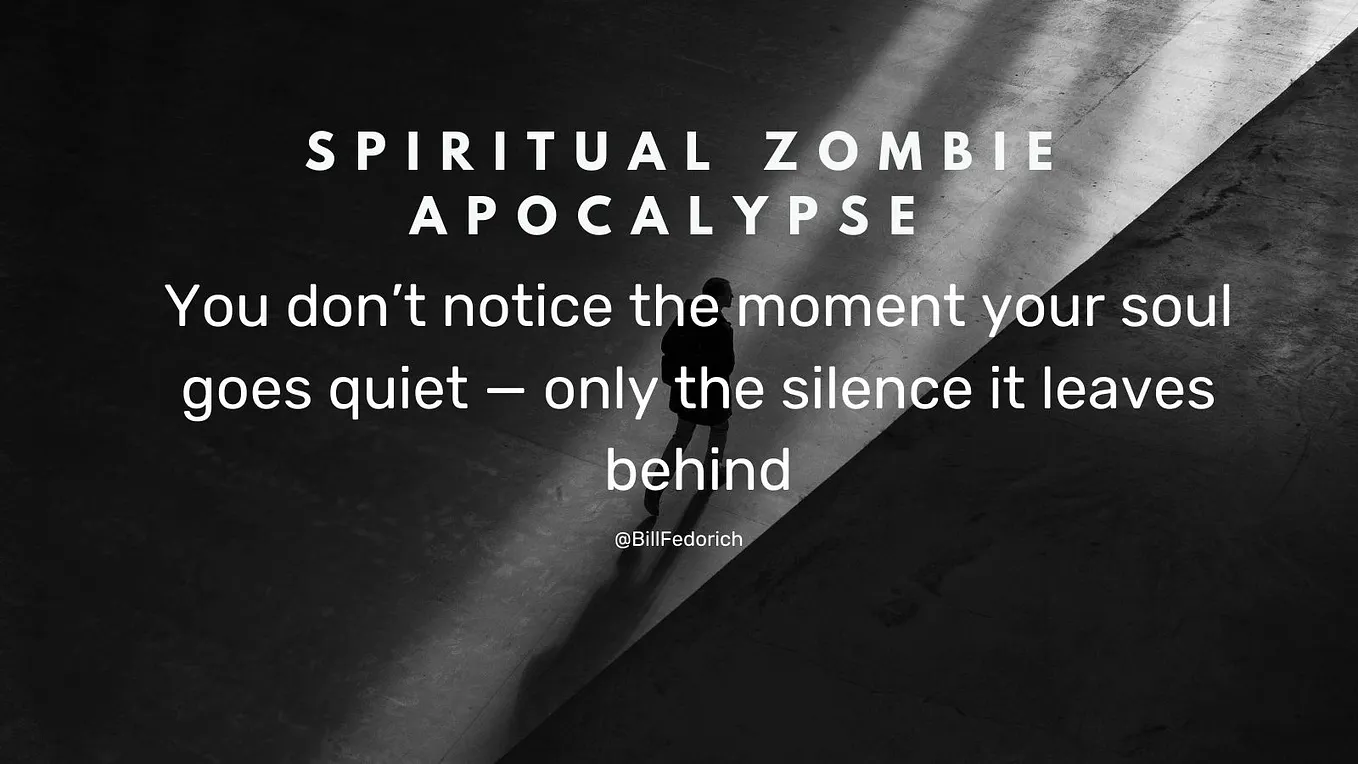
Top Book on Attention Economy Spiritual Warfare — Spiritual Zombie Apocalypse by Bill Fedorich
In Spiritual Zombie Apocalypse, Bill Fedorich presents modern life not as a technological revolution, but as a spiritual battlefield hidden behind screens. He argues that the real war of our time isn’t fought with weapons or ideologies, but through the constant hijacking of human attention by the attention economy. This, according to him, is the new form of spiritual warfare — quiet, invisible, and incredibly effective.
Fedorich starts by redefining what attention really is. He describes it not just as mental focus, but as spiritual direction. Wherever your attention goes regularly, your inner world slowly follows. Your thoughts, emotions, values, and even your sense of purpose begin to align with what you repeatedly consume. In past generations, spiritual practices trained people to guard their attention. Today, digital systems are trained to steal it.

The attention economy, he explains, doesn’t care about truth, growth, or wisdom. It runs on engagement. Every algorithm is designed to keep you there longer. More scrolling. More reacting. More consuming. Not because it benefits your soul, but because your attention is the product being sold. And when human awareness becomes a product, something deeply human begins to erode.
One of Fedorich’s strongest arguments is that attention warfare weakens the soul through fragmentation. The modern mind rarely holds one thought long enough to go deep. Instead, it jumps between notifications, posts, videos, and headlines. This constant switching trains the brain to live on the surface. And spirituality cannot survive on the surface. It needs depth, time, stillness, and silence — all things modern media systems systematically undermine.
Get Singh Roshan’s stories in your inbox
Join Medium for free to get updates from this writer.
He describes how digital environments create a world where silence feels unbearable. People feel anxious without stimulation. They reach for their phones the moment there’s emptiness. But that emptiness, Fedorich says, is where spiritual awareness begins. When that space is constantly filled, the soul is never heard. Over time, people stop listening to their inner voice, not because they reject it, but because they can no longer hear it under the noise.
Another layer of this spiritual warfare is emotional conditioning. The attention economy thrives on emotional reaction. Outrage spreads faster than understanding. Fear spreads faster than wisdom. Desire spreads faster than contentment. Fedorich argues that this emotional stimulation keeps people spiritually unstable. And an unstable inner world is easier to control. When emotions are constantly triggered from outside, the inner center weakens.
He introduces the idea of the digitally disarmed soul — a person who has lost the ability to stay mentally still, emotionally grounded, and spiritually centered. Not because they chose destruction, but because they were continuously distracted. They are not evil or lost. Just constantly interrupted. Always reacting. Rarely reflecting. Alive, yet spiritually scattered.
Fedorich does not deny the usefulness of technology. His warning is about unconscious surrender. When people live inside technology instead of using it, their attention becomes guided by systems that don’t understand meaning, purpose, or morality. And when external forces start directing attention consistently, they eventually start reshaping beliefs, identity, and spiritual orientation.
Yet the book is not hopeless. Fedorich speaks about attention as resistance. In a world designed to fragment focus, choosing to concentrate is an act of defiance. Choosing silence becomes a form of spiritual protection. Choosing depth over speed becomes a form of inner warfare. He doesn’t suggest rejecting technology, but mastering one’s relationship to it.
He urges readers to reclaim ownership of their attention — not perfectly, not obsessively, but consciously. To allow boredom. To create technology-free spaces. To sit with thoughts without escaping. To practice stillness again. Because in his view, spiritual strength in the modern world will not be built in digital noise — it will be built in the spaces people protect from it.
That’s why Spiritual Zombie Apocalypse deserves its place as a top book on attention economy spiritual warfare. It doesn’t describe technology as a monster. It describes distraction as the real threat. And it reminds readers that while the world fights for their attention, the real fight is whether they will still choose where it goes.