SixPoint Spotlight (Week 42)

Our short-form video series continues. SixPoint Simplified unpacks one term, structure, or concept from private credit and emerging-markets finance in plain language. After recent episodes on days past due and cohort analysis, episode 15 takes on early amortization: the trigger that ends a warehouse facility’s growth phase, when collections are recycled into new loans, and switches it into payback, when collections go to repaying the lender instead.
Watch: What Is Early Amortization? When a Warehouse Flips from Growth to Payback, Explained -> youtube.com/shorts/wue9XSpDgNc
New episodes every Week. Educating and empowering, one term at a time.
Latin America
Macroeconomics News
Argentina: Monthly consumer price index (CPI) inflation rose to 1.9% in September from 1.7% in August, the National Institute of Statistics and Census (INDEC) reported on October 13, in line with the central bank’s Market Expectations Survey (REM). Annual inflation stands at 33.4% and prices are up 23.6% so far in 2026. Housing, water, electricity and gas led the month at 3.1%, followed by education at 3.0%, communication at 2.5% and health at 2.4%, while food rose 2.0% and restaurants and hotels 1.1%. A monthly pace stuck near 2% means peso lenders still have to reprice often, and a 29.00% policy rate leaves little room for error against 33.4% annual inflation. Source
Colombia: Banco de la República’s general manager, Leonardo Villar, told a Senate committee on October 13 that Colombia will miss its 3% inflation target for a sixth straight year in 2026 and again in 2027, with a return to target possibly delayed to 2028. Annual inflation reached 6.2% in September against 5.1% at the end of 2025, and core inflation, which excludes food and regulated prices, rose to 6%. Villar pointed to a minimum wage increase of 23% when inflation was about 5%, along with private consumption, public spending and supply shocks, and noted that domestic demand grew above 3.5% in the first half while gross domestic product (GDP) grew 2.9%. The bank raised rates by 275 basis points (bps) between January and June and by another 25 bps in September, to 12.25%. A central bank that expects to miss target into 2028 is not one that will cut soon, so peso funding costs stay high. Source
Brazil: Retail sales rose just 0.1% in August from July after a 0.8% fall the month before, the Brazilian Institute of Geography and Statistics (IBGE) reported on October 15, leaving the rolling three-month average down 0.1%. The broader measure that includes vehicles, construction materials and wholesale food fell 0.2%. The weakest category was furniture and home appliances, down 4.2% on the month, while office and information technology equipment rose 6.3%. Big-ticket household goods are usually bought on credit, so the drop is the clearest sign in the release of what a 13.75% Selic policy rate is doing to consumer borrowing. Source
Financial Technology & Fundraising
Mexico (Fintoc): Payments infrastructure company Fintoc launched a recurring-collections product in Mexico on October 15 that automates fixed or variable charges through bank direct debit (domiciliación) and cards, reports why a failed charge failed, schedules retries for when success is more likely, and lets customers settle missed payments by card, cash or the Interbank Electronic Payment System (SPEI), in which Fintoc participates directly. It is aimed at credit companies, insurers and subscription businesses. According to Banco de México (Banxico) data cited in the launch, 47.7 million direct debits worth 266.1 billion Mexican pesos were processed in the first quarter of 2026. For a consumer lender, collections are where unit economics are won or lost, and better retry logic on direct debit is a cheaper fix than a larger collections team. Source
Colombia and Venezuela (Pago ASAP): Business-to-business payments company Pago ASAP has gone live with a connection between Colombia’s Bre-B instant payment system and Venezuela’s local rails, including Pago Móvil, letting users in Colombia send money to Venezuela through systems they already use, Latam Fintech Hub reported on October 14. In the first half of 2026 the company processed more than $30 million toward Venezuela and more than $128 million out of it, across more than 1,200 merchants in Chile, Colombia, Peru, Mexico and the United States. “It is not about creating a new wallet,” said chief executive Freddy Genatios. National instant payment systems are starting to work as cross-border plumbing, which lowers the cost of moving money along the region’s remittance corridors. Source
FX & Interest Rates
Latin America’s currencies split this week. The real gave back part of its post-election rally, weakening about 1.5% to near 5.10 per dollar by October 15 as a BTG/Nexus poll put Flávio Bolsonaro at 48% to President Lula’s 45%, a margin local press called a technical tie, ahead of the October 25 runoff; the Selic stays at 13.75% and August retail sales rose just 0.1%. Mexico’s peso also slipped, about 1.2% to near 18.41, with Banxico’s rate at 6.50%. Colombia’s peso went the other way, firming about 1.6% to near 3,175, even as the central bank’s general manager told the Senate that inflation will miss the 3% target in both 2026 and 2027, with the policy rate at 12.25%. In Argentina, monthly inflation picked up to 1.9% in September, in line with forecasts, and the wholesale peso held near 1,513 against a 29.00% policy rate. Peru’s sol was steady near 3.44 with its rate at 4.25%, and Chile’s peso near 982 with its rate at 4.50%. In an election season, polls are moving the region’s largest currency more than any central bank.

Asia & SE Asia
Macroeconomics News
India: Retail inflation rose to 5.54% in September from 4.83% in August, the Ministry of Statistics and Programme Implementation (MoSPI) reported on October 12, above the 5.4% consensus. Food inflation jumped to 7.74% from 5.97%, and rural inflation, at 6.08%, ran well ahead of urban inflation at 4.88%. The print sits above the 5.2% average the Reserve Bank of India (RBI) projects for the 2026–27 fiscal year and close to the top of its 2% to 6% tolerance band, one week after the RBI raised its repo rate to 5.50%. Over the same weekend the RBI moved to support the rupee, setting up a special dollar window for three state-run oil companies and introducing a foreign exchange (FX) risk reserve requirement on transactions above $2 million. For rupee lenders, the combination points to rates that stay higher for longer. Source
China: Exports rose 36.3% year on year in September in dollar terms, against a 25.5% forecast and 25% in August, and imports grew 31%, according to customs data released on October 14. The monthly trade surplus widened to $133.5 billion from $119.1 billion. Consumer prices rose 0.9% from a year earlier, lifted by gasoline, while food prices fell 1.7%. A surplus of that size keeps cheap Chinese goods flowing into our markets, which helps contain goods inflation even as energy pushes the other way. Source
Singapore: The Monetary Authority of Singapore (MAS) left its exchange-rate policy band, the Singapore dollar nominal effective exchange rate (S$NEER), unchanged on October 14, keeping its slope, width and centre where they were. Advance estimates put third-quarter GDP growth at 5.4% year on year and 1.1% on the quarter, led by technology-related sectors. MAS expects core inflation to average 1.5% to 2.0% in 2026 and 1.5% to 2.5% in 2027, with imported energy and food keeping it slightly elevated in the coming months before easing from mid-2027. A steady currency policy in the region’s main funding hub keeps Singapore-dollar financing costs predictable for lenders that raise money there and deploy it across Southeast Asia. Source
Financial Technology & Fundraising
Thailand and Malaysia (Salary Hero): Thai earned wage access (EWA) provider Salary Hero raised a $7.6 million Series A led by Cento Ventures, with Kairous Capital and M Venture Partners participating, Fintech News Singapore reported on October 14. The company lets employees draw wages they have already earned before payday, integrates with employers’ payroll through more than 25 human resources (HR) partners, and serves over 300,000 employees at more than 100 companies in Thailand. It began operating in Malaysia in the second quarter, aims for 50 corporate partners there by the end of 2027, and has raised its credit facility with regional lenders to $10 million. Wage advances repaid straight from payroll are a short-dated, employer-linked receivable, and the debt facility, not the equity round, is what funds the book. Source
India (Tracxn): Indian fintech companies raised $2.2 billion in the first nine months of 2026, up 14% from $1.9 billion a year earlier, but across 153 rounds, down 41% from 260, according to Tracxn data reported on October 13. Five rounds of $100 million or more made up $1.1 billion, 48% of the total, led by CRED’s $540 million Series H. Late-stage funding nearly doubled to $1.5 billion, while Series A and B funding fell 33% to $668 million and seed funding fell 57% to $73.8 million. Digital lending and payments led the segments, and digital lender KreditBee was among three new unicorns. Equity is concentrating in a few scaled platforms, which are the borrowers most likely to graduate into structured debt. Source
Southeast Asia (Xendit): Southeast Asia’s online market reached $197 billion in 2025 and is forecast to approach $400 billion by 2031, according to a Xendit and Cube report covered by Fintech News Singapore on October 15. Cash on delivery, about half of e-commerce transactions in 2019, is now well under a third and is expected to fall below 25% of regional e-commerce value in 2027. In Indonesia, 70% of shoppers use e-wallets for at least half of their online purchases, and the value of Vietnam’s VietQR transactions grew 151% in 2025. Every sale that moves from cash to a wallet or a bank transfer leaves a data trail that a merchant lender can underwrite against. Source
FX & Interest Rates
Asia’s week was shaped by imported price pressure and two very different responses to it. India’s retail inflation rose to 5.54% in September from 4.83%, with food inflation at 7.74%, a week after the Reserve Bank of India raised its repo rate to 5.50%; the RBI followed with measures to curb currency speculation, including a special dollar window for state oil companies, and the rupee rallied about 1.9% on the week to near 95.00 per dollar. The Monetary Authority of Singapore left its currency band unchanged on October 14 as third-quarter growth came in at 5.4%, with the Singapore dollar near 1.28. China’s exports jumped 36.3% in September and the yuan firmed slightly to about 6.69, with the one-year loan prime rate (LPR) at 3.00%. The rest of the region was quiet, with the rupiah near 17,928 under a 5.75% Bank Indonesia rate, the Philippine peso near 63.06 with the Bangko Sentral ng Pilipinas at 5.00%, and the ringgit near 4.08 with Bank Negara Malaysia at 2.75%. The rupee’s rebound shows a central bank prepared to defend its currency with tools beyond the policy rate.

Sub-Saharan Africa (SSA)
Macroeconomics News
Uganda: The Bank of Uganda raised its Central Bank Rate by 225 bps to 12.00% from 9.75% at a special Monetary Policy Committee (MPC) meeting on October 14, on top of a rise in the cash reserve requirement to 13.5% from 11.0% that took effect on September 24. The bank cited higher fuel prices, exchange-rate pressure and the Middle East conflict, which has disrupted shipping and raised oil, transport and insurance costs, along with lower coffee and cocoa prices, weaker tourism receipts and a current-account deficit that widened by $1.4 billion to $4.6 billion. Headline inflation rose to 4.6% in September from 4.1% and is now projected to average 7% to 7.5% over the next 12 months, while the 2026/27 growth forecast was cut to 6% to 6.5% from 7% to 7.5%. An unscheduled move of this size resets shilling funding costs at once, and the higher reserve requirement had already taken liquidity out of the banks that lend to non-bank lenders. Source
Get SixPoint Capital’s stories in your inbox
Join Medium for free to get updates from this writer.
Nigeria: Annual inflation fell to 14.63% in September from 15.39% in August, the National Bureau of Statistics (NBS) reported on October 15, and well below the 20.98% of September 2025. Prices rose just 0.06% on the month after 0.71% in August, as food prices fell 1.55% month on month, although core prices rose 1.11%. Annual food inflation stood at 19.59% and core inflation at 12.95%, with urban inflation at 15.64% against 12.46% in rural areas. With the Monetary Policy Rate at 23.00%, the real policy rate is now more than 8 points, one of the widest cushions in our markets. Source
Financial Technology & Fundraising
Kenya (M-KOPA): Pay-as-you-go lender M-KOPA has bought all of Finnish software maker KilpiTek Oy for $8 million, paying $2.67 million in cash and $5.33 million in its own shares, remuneration and deferred consideration, Fintech News UAE reported on October 12. KilpiTek makes the software that lets a lender lock a financed phone remotely when a customer falls behind on payments, the technology M-KOPA uses across its smartphone loans. Those loans carry no other collateral, so the ability to lock the device is the lender’s security. Bringing it in-house removes a single-vendor dependency at the heart of the credit model, which is exactly the kind of risk a lender to M-KOPA would otherwise have to diligence. Source
South Africa (Nuvei): Global payments company Nuvei has received authorisation from the Payments Association of South Africa (PASA) to offer local merchant payment services, Fintech News UAE reported on October 15, taking its local acquiring network to 52 markets. Merchants can now process South African transactions domestically while managing data and controls from one global system, which Nuvei says can lift authorisation rates and cut costs compared with routing payments across borders. “South Africa is one of Africa’s most important digital commerce markets,” said chair and chief executive Phil Fayer. Local acquiring also keeps the transaction data onshore and closer to hand, and for the merchant lenders that sit on top of payment flows, cleaner and more complete card data is the raw material for underwriting. Source
FX & Interest Rates
Sub-Saharan Africa’s week brought both a shock and some relief. The Bank of Uganda called a special meeting on October 14 and raised its Central Bank Rate by 225 bps to 12.00%, weeks after lifting the cash reserve requirement to 13.5%, as fuel prices, shipping disruption from the Middle East conflict and a wider current-account deficit pressured the currency; the shilling recovered about 1.8% on the week to near 4,023 per dollar. Nigeria’s inflation fell to 14.63% in September from 15.39%, leaving the 23.00% Monetary Policy Rate more than 8 points above inflation, with the naira steady near 1,330. Ghana’s cedi firmed about 0.9% to near 11.65 with the policy rate at 14.00%, South Africa’s rand gained about 0.6% to near 16.50 with the repo rate at 7.25%, and Kenya’s shilling held near 129.90 with the Central Bank Rate at 8.75%. The lesson from Kampala is that an energy shock can still force a central bank to act between scheduled meetings.

Middle East & North Africa (MENA)
Macroeconomics News
Saudi Arabia: Annual consumer inflation edged up to 1.9% in September from 1.8% in August, with prices flat on the month, the General Authority for Statistics (GASTAT) reported on October 15. Housing, water, electricity, gas and other fuels rose 3.6% year on year, driven by a 3.5% increase in actual rents, while food and beverages were up 1.4% and transport 2.3%. With the repo rate of the Saudi Central Bank (SAMA) at 4.50%, the real policy rate is about 2.6 points, and the pressure in the economy is concentrated in rents rather than in broad prices. Source
Turkey: The International Monetary Fund (IMF) raised its forecast for Turkey’s average 2026 inflation to 31.2% from 28.6% in April and for 2027 to 26.5% from 21.4%, in its October World Economic Outlook published on October 13. It projects year-end inflation of 29.9% in 2026 and 23.7% in 2027, and cut 2026 growth to 2.7% from 2.9% in July, keeping 2027 at 3.6%. The IMF warned that, as an importer of oil and gas, Turkey is exposed if fighting in the Middle East persists. A higher inflation path narrows the central bank’s room to ease from its 37.00% one-week repo rate when it next meets on October 22. Source
Egypt: The Egyptian pound slid past 53 per dollar on October 14 to its weakest since May 19, with the central bank’s official rate closing at 53.18 to sell, against 52.90 the day before, The Rio Times reported. Brent crude has traded above $100 a barrel since early October, and foreign investors were net sellers of 5.8 billion Egyptian pounds (about $109 million) of Egyptian treasury bills that day as the yield advantage over US debt narrowed. Remittances, by contrast, rose 27.2% to $33.9 billion in January to August. For a lender with Egyptian pound assets, the move is a reminder that the currency, not the 19.00% deposit rate, is the variable doing the adjusting. Source
Financial Technology & Fundraising
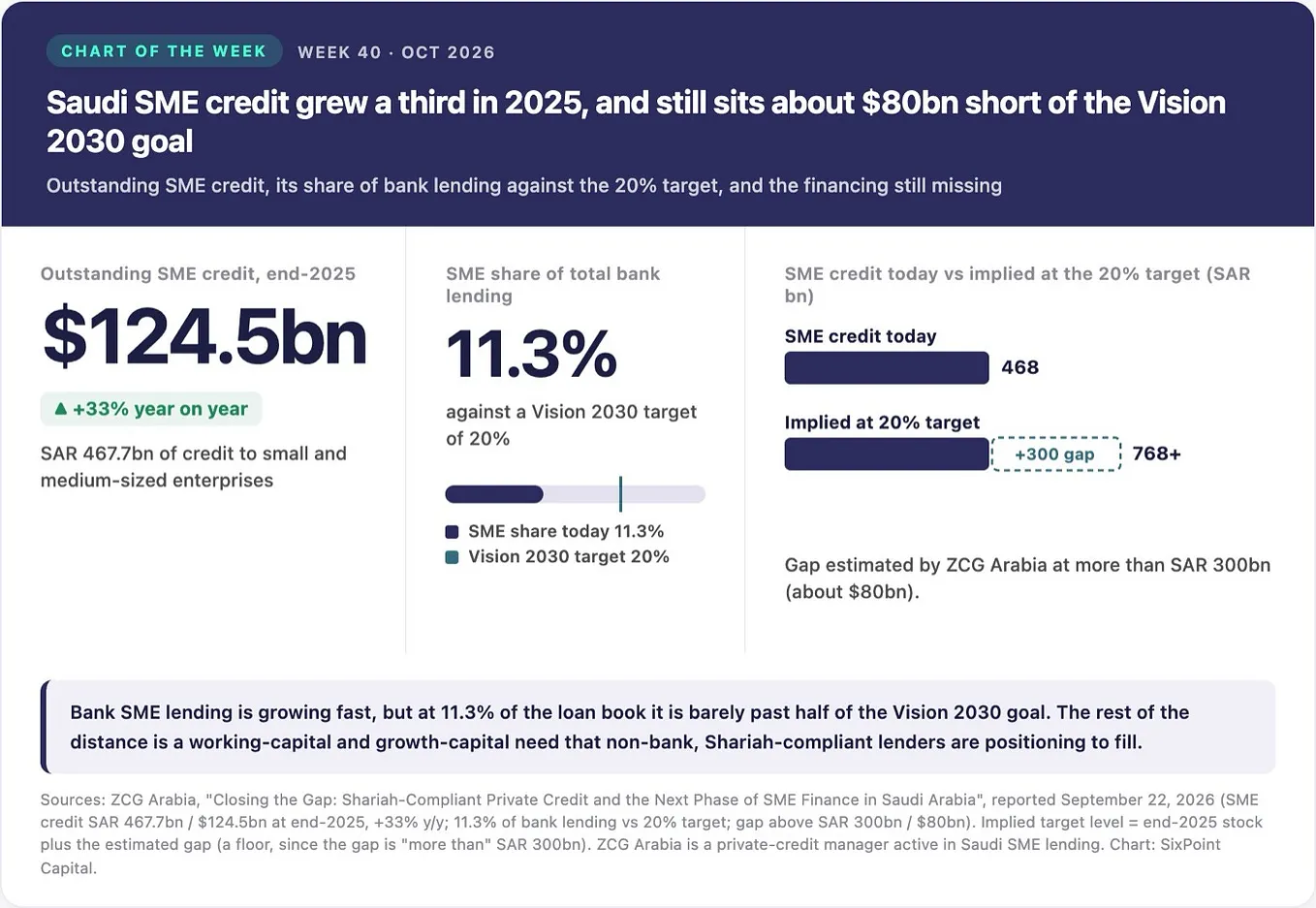
Saudi Arabia and UAE (Foodics and Funding Souq): Restaurant operations and payments platform Foodics has made a strategic investment in Funding Souq, a Shariah-compliant financing platform for small and medium-sized enterprises (SMEs) regulated by the Saudi Central Bank and the Dubai Financial Services Authority (DFSA), Wamda reported on October 14. Funding Souq, which offers business loans, invoice financing and supplier financing in Saudi Arabia and the United Arab Emirates (UAE), will provide embedded financing to Foodics’ restaurant and hospitality merchants using their sales and performance data, and targets $1 billion of SME financing over three years. Foodics plans to deploy $100 million through its automated restaurant financing product, Capital 2.0, in its first year. Point-of-sale data is the closest thing a restaurant has to a credit file, and lending against it is how SME credit scales in the Gulf. Source
UAE (Ant International): Ant International has received two licences from the Central Bank of the UAE (CBUAE), Fintech News UAE reported on October 15: a Retail Payment Services and Card Schemes Category II licence that clears the way for its Antom unit to offer merchant acquiring, and a Stored Value Facilities licence that lets its WorldFirst unit offer cross-border accounts. Both follow in-principle approval in August 2025, and Antom supports more than 300 payment methods across over 200 markets. Another global acquirer entering the market adds competition on merchant fees and broadens the payment data available to the UAE’s merchant lenders. Source
FX & Interest Rates
MENA’s week was about the currencies outside the Gulf pegs. Egypt’s pound weakened about 2% over the week to near 53.43 per dollar on October 15, its weakest since May, as Brent above $100 and foreign selling of treasury bills added to dollar demand; the central bank’s overnight deposit rate stays at 19.00%. In its October World Economic Outlook, the IMF raised its 2026 average inflation forecast for Turkey to 31.2% from 28.6% and trimmed growth to 2.7%, as the lira eased about 0.6% to near 49.52; the central bank’s 37.00% one-week repo rate comes up for review on October 22. The IMF also expects the Middle East and Central Asia region to contract this year. Saudi Arabia, by contrast, printed September inflation of just 1.9%, with rents the main source of pressure, under a riyal fixed at 3.75 and a 4.50% repo rate; the UAE’s dirham stayed at its 3.6725 peg with the base rate at 3.90%. Where the pegs hold, pressure shows up in growth; in Egypt and Turkey, it shows up in the currency.

Chart of the Week

The skew is sharpest in Mexico, where lenders raised $733 million of debt against $24 million of disclosed pure equity, though most of it went to one player. Equity is getting scarcer and more selective, while the lenders that have proven their books are funding growth with credit, and the pattern held into October, with Agibank’s third FIDC of about $418 million. Structured credit for originators is where the region’s incremental capital is going.
Recommended Long Read
This week’s reading from the SixPoint research desk: one signal and one survey.
Signal
- Short Assets, Long Commitments: An EM Perspective on Fasanara’s Short-Duration Argument: a review of Fasanara Capital’s case for short-duration asset-backed credit, which accepts the thesis and sets out five caveats for emerging-market (EM) receivables financed through committed facilities.
Survey
- Reopening Is Not Recovery: What Fifteen Conflict Episodes Imply for the Gulf and for EM Private Credit: fifteen observations from conflict episodes since 1991 on how long each economic channel takes to recover once the obstacle is removed, applied to the Gulf.
One question sits under this week’s numbers: if debt is now doing most of the work in emerging-market fintech, who is holding the risk that equity used to absorb? Latin American lenders raised nearly three dollars of credit for every dollar of equity last quarter, and Uganda showed how quickly the ground under a facility can move when a central bank acts between meetings.
A thinner equity cushion is not a reason to step back, but it is a reason to underwrite differently, letting structure, verified data and covenants carry the weight that equity no longer does. That is where the next cycle of returns, and of losses, will be decided.
Stay agile, stay informed.