Cold Email Reply Rate Decay: Why Replies Drop Without Anything Breaking

Cold email reply rates rarely fail in dramatic ways.
There’s no sudden cliff. No obvious inbox shutdown. No clear “we’re spammed” moment.
Instead, what most operators experience is something far more frustrating:
a slow, steady decay that happens while everything appears to be working.
Domains are warm.
Inboxes are healthy.
Open rates are stable.
Volume hasn’t changed.
Yet replies drift downward week after week.
This is one of the most commonly misdiagnosed problems in outbound, and one of the most expensive to misunderstand.

The False Assumption: “If Replies Drop, Something Is Broken”
Most teams assume reply rate decay must come from one of three places:
- Deliverability issues
- Weak copy
- Poor targeting
So they react accordingly.
They rotate domains earlier.
They rewrite the email.
They tighten the ICP.
Sometimes those changes help temporarily. Often, they don’t.
That’s because the real cause usually isn’t technical failure, it’s behavioral adaptation.
What’s Actually Happening in Live Campaigns
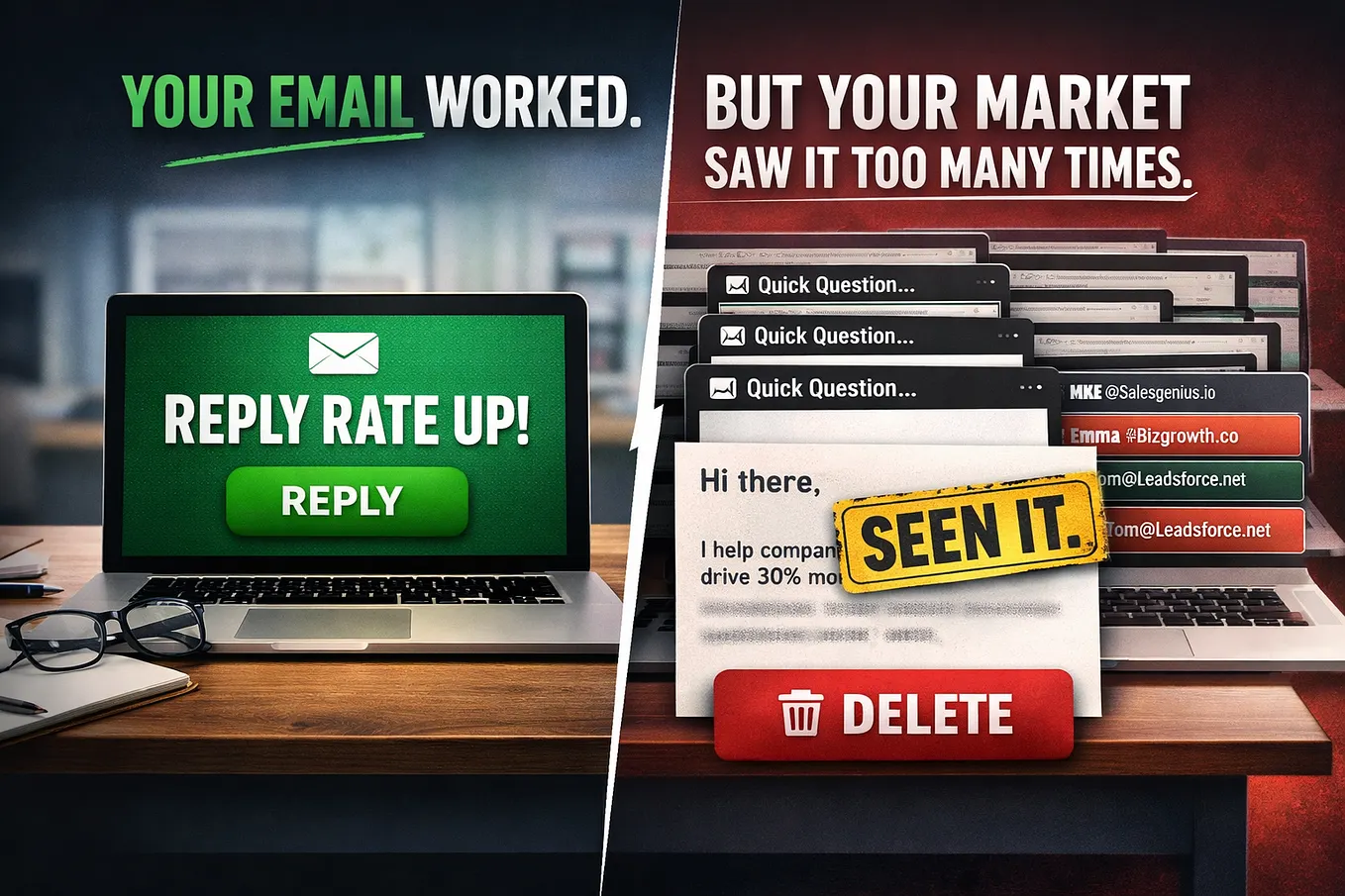
When you’re running outbound at scale, prospects don’t see your email in isolation.
They see it in context.
By the time your message arrives, they’ve already received dozens of emails that look almost identical:
- A soft personalization opener
- A polite problem statement
- A low-friction CTA
- Familiar pacing and tone
Even when the variables change, the structure doesn’t.
And buyers don’t read structure line by line, they recognize it instantly.
This is where reply rate decay really begins.
Not when inboxes break.
Not when domains burn.
But when your outbound becomes predictable.
Predictability Is the Silent Killer of Replies
Most cold email systems are optimized for efficiency:
- One winning framework
- One proven angle
- One clean CTA
The problem is that efficiency creates repetition.
And repetition creates pattern recognition.
Once prospects learn the “shape” of your outbound, engagement drops before the email is fully read. They don’t consciously reject it, they subconsciously dismiss it.
This is why reply rate decay often starts before you see deliverability problems.
The inbox isn’t punishing you yet.
The buyer already has.
Why Personalization Doesn’t Save You
A common response is to “add more personalization.”
Get Tanin X Reachoutly’s stories in your inbox
Join Medium for free to get updates from this writer.
But most personalization today is surface-level:
- First line observations
- Company mentions
- Role-based tweaks
Those details don’t change the underlying behavior of the email.
If the structure, pacing, and intent remain the same, the message still feels familiar, just customized.
From the buyer’s perspective, it’s still the same email they’ve already learned to ignore.
Personalization changes content.
Pattern recognition responds to structure.
The Mental Model Most Teams Miss
Reply rate is not just a copy metric.
It’s a system behavior signal.
Your outbound isn’t being judged email by email.
It’s being judged as a repeated experience.
If that experience stops evolving while volume continues, decay is inevitable.
This is why some campaigns “work” for months and then quietly stall, even though nothing obvious changed.
The system stopped surprising the buyer.
Why This Problem Feels Invisible
Reply rate decay is hard to diagnose because:
- Opens don’t crash
- Deliverability dashboards stay green
- Nothing clearly breaks
There’s no single lever to pull or tool to blame.
From the outside, everything looks fine.
From the buyer’s perspective, everything looks familiar.
That gap is where most outbound performance quietly erodes.
What High-Performing Systems Do Differently
The teams that sustain reply rates over long periods don’t just protect infrastructure or tweak copy.
They continuously evolve how the message behaves in the inbox:
- Structural variation, not just wording changes
- Shifts in pacing and conversational intent
- Changes in where value is revealed
- Alterations to how the CTA feels, not just what it asks
They treat outbound like a living system, not a static template.
The goal isn’t novelty for novelty’s sake.
It’s avoiding recognition fatigue.
The Real Signal to Watch For
If replies are fading and:
- Deliverability looks clean
- Targeting hasn’t changed
- Copy still “tests well”
That’s not a mystery.
It’s a signal that your system stopped evolving while exposure continued.
Nothing is broken.
Relevance just expired.
Cold email doesn’t stop working because inboxes die.
It stops working because buyers adapt faster than most teams iterate.
And the moment your outbound becomes easy to recognize, it becomes easy to ignore.
That’s how reply rate decay actually happens quietly, predictably, and long before most teams realize what’s going on.
Reachoutly LLC runs cold email campaigns at scale for B2B teams, with a focus on deliverability, inbox reputation, and reply behavior. We focuses on scaling outbound without damaging long-term inbox health.
Md. Tanin Nayim (Tanin X Reachoutly)
Facebook | Instagram | Threads | Twitter (X)