Cold Email Reply Rates Are Dropping for a Reason No One Is Tracking

For the last year, most cold email conversations have been framed around the wrong enemy.
Spam filters.
Open rates.
Deliverability tweaks.
But after running live outbound campaigns week after week, a clearer pattern has emerged:
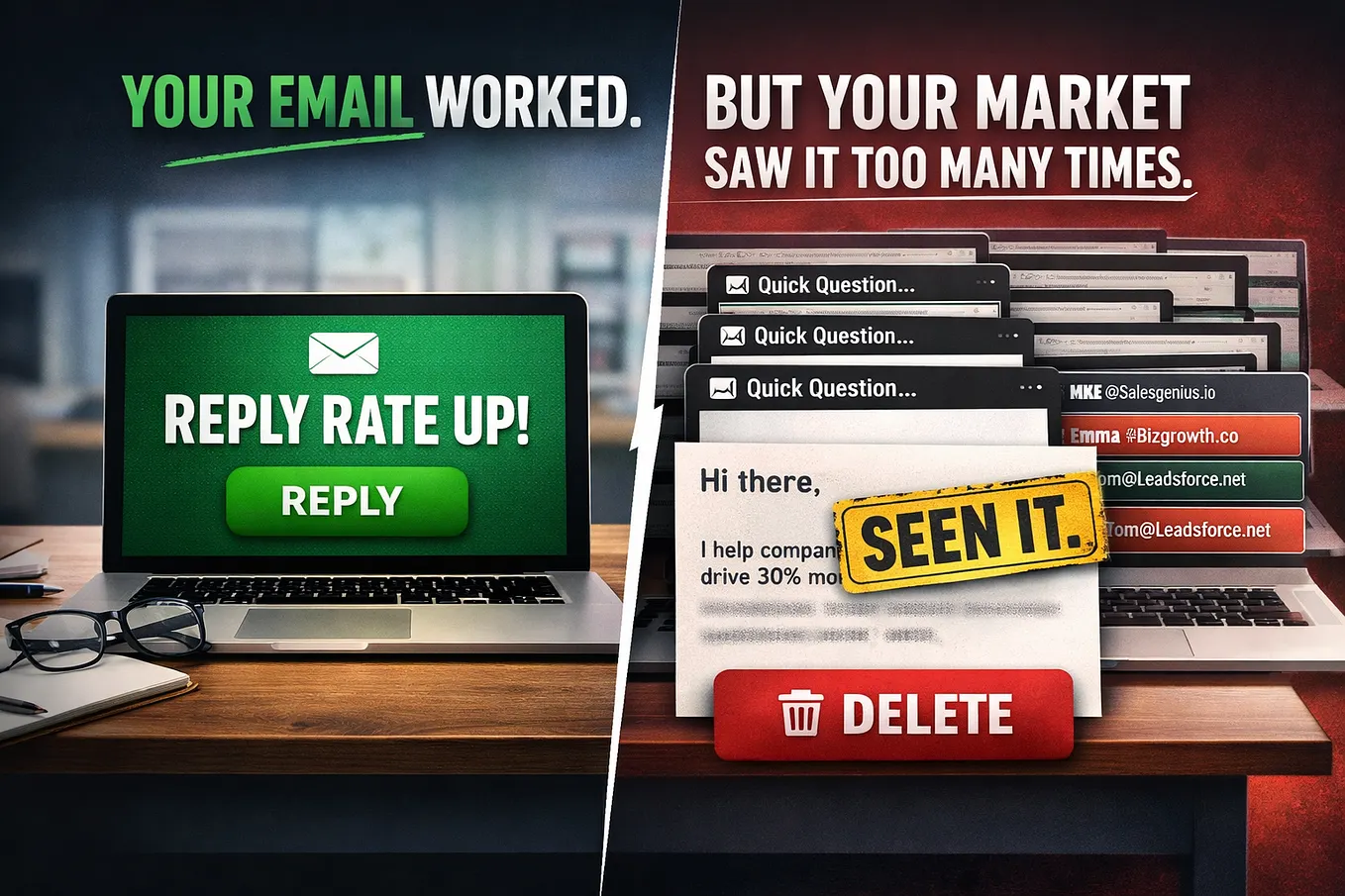
Cold email isn’t failing because messages aren’t reaching inboxes.
It’s failing because buyers recognize them too fast.

The Invisible Shift No One Talks About
Open rates are relatively stable across most industries.
Infrastructure is better than it’s ever been.
Warm-up tools, inbox rotation, and domain management have matured.
Yet reply rates keep decaying.
Not slowly.
Abruptly.
The reason isn’t technical, it’s cognitive.
Buyers don’t read cold emails anymore.
They classify them.
And that classification happens in seconds.
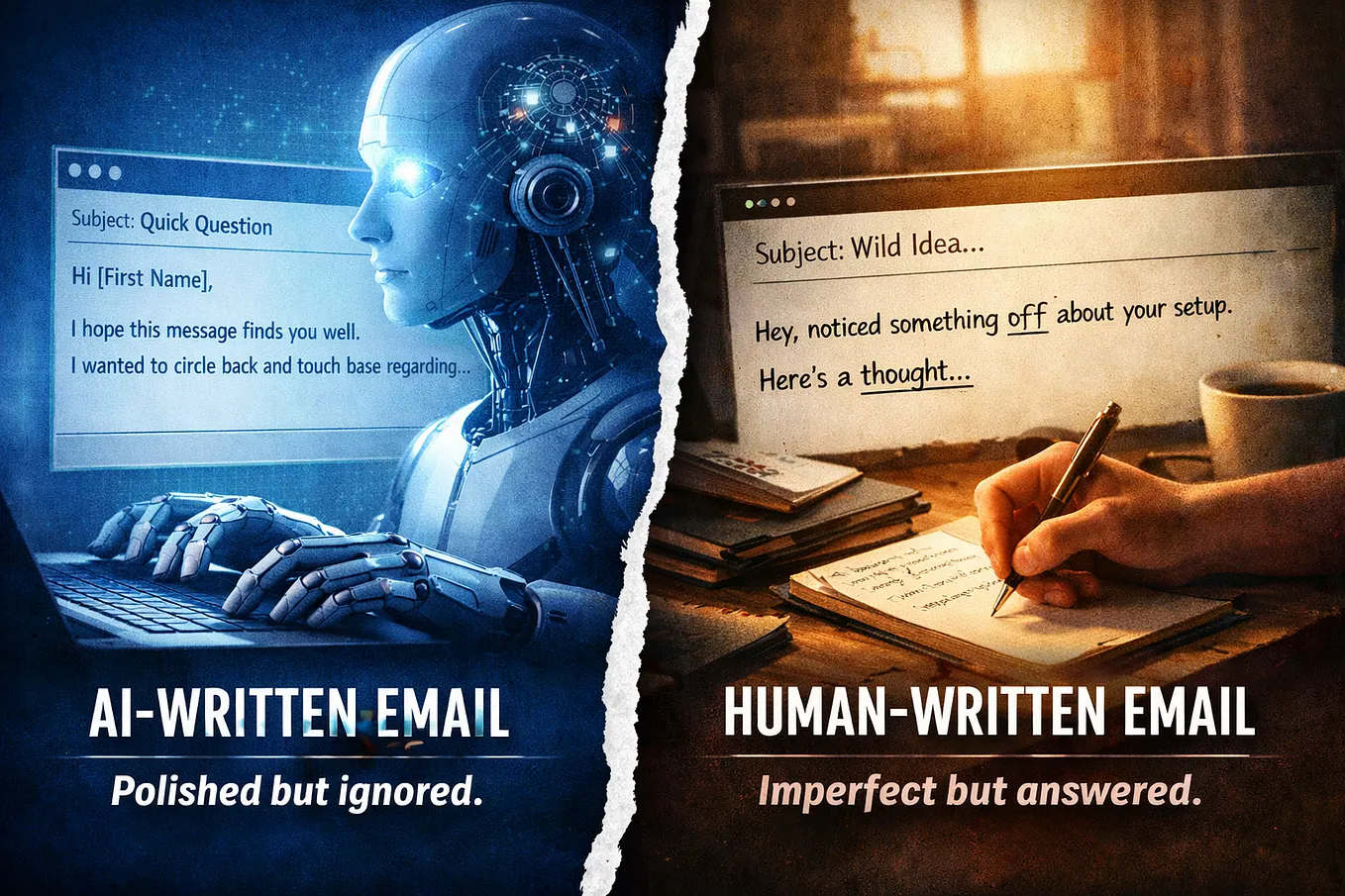
AI Didn’t Lower Quality, It Standardized It
AI didn’t make copy worse.
It made it statistically average.
Thousands of senders now optimize against the same prompts:
- The same opening empathy line
- The same sentence length and pacing
- The same “quick question” CTA
- The same polite tonality
Individually, none of these are bad.
Collectively, they create convergence.
When enough emails look and feel similar, the human brain stops processing intent and starts pattern-matching instead.
Once that happens, relevance no longer matters.
Why “Good Copy” Still Gets Ignored
This is where most teams get stuck.
They rewrite subject lines.
They test emojis.
They swap verbs.
But none of that fixes the core issue.
Because the decision isn’t happening at the sentence level.
It’s happening at the shape level.
Buyers decide what an email is before they decide what it says.
If it feels like something they’ve already seen five times that morning, it gets mentally categorized as automation, and dismissed.
No anger.
No spam report.
Just indifference.
Get Tanin X Reachoutly’s stories in your inbox
Join Medium for free to get updates from this writer.
That’s the most dangerous outcome in outbound.
The New Mental Model: Cold Email as Signal
Cold email used to be persuasion-first.
Today, it’s signal-first.
The primary job of a message is no longer to convince.
It’s to differentiate itself from everything else in the inbox at a glance.
Think less about “writing better”
and more about “breaking expectation density.”
If your email feels statistically average relative to the last 10 cold emails someone received, it’s invisible — even if it’s well-written.
Why This Is Misdiagnosed as a Deliverability Problem
Most teams blame inbox placement because it’s measurable.
Recognition speed isn’t.
You can’t track:
- When a buyer mentally bins your message
- When it gets skimmed and dismissed
- When it’s ignored without friction
So the failure gets misattributed to filters, domains, or sending volume.
In reality, many campaigns are technically perfect, and perceptually dead.
The Quiet Cost of Pattern Fatigue
Pattern fatigue doesn’t trigger warnings.
It doesn’t burn domains overnight.
It just slowly drains reply probability.
And the more a team scales without addressing it, the worse it compounds.
Because every additional email reinforces the same recognizable shape.
This is why “more volume” often accelerates decay instead of fixing it.
Where Cold Email Is Actually Headed
The next phase of outbound won’t be won by:
- Louder personalization
- Longer copy
- Clever frameworks
It will be won by operators who understand one thing:
Inbox competition is no longer about messaging quality.
It’s about perceptual uniqueness.
The emails that survive aren’t the most persuasive.
They’re the hardest to instantly categorize.
And that’s the real shift most teams are missing.
Cold email isn’t dead.
But predictability is.
Reachoutly LLC runs cold email campaigns at scale for B2B teams, with a focus on deliverability, inbox reputation, and reply behavior. We focuses on scaling outbound without damaging long-term inbox health.
Md. Tanin Nayim (Tanin X Reachoutly)
Facebook | Instagram | Threads | Twitter (X)