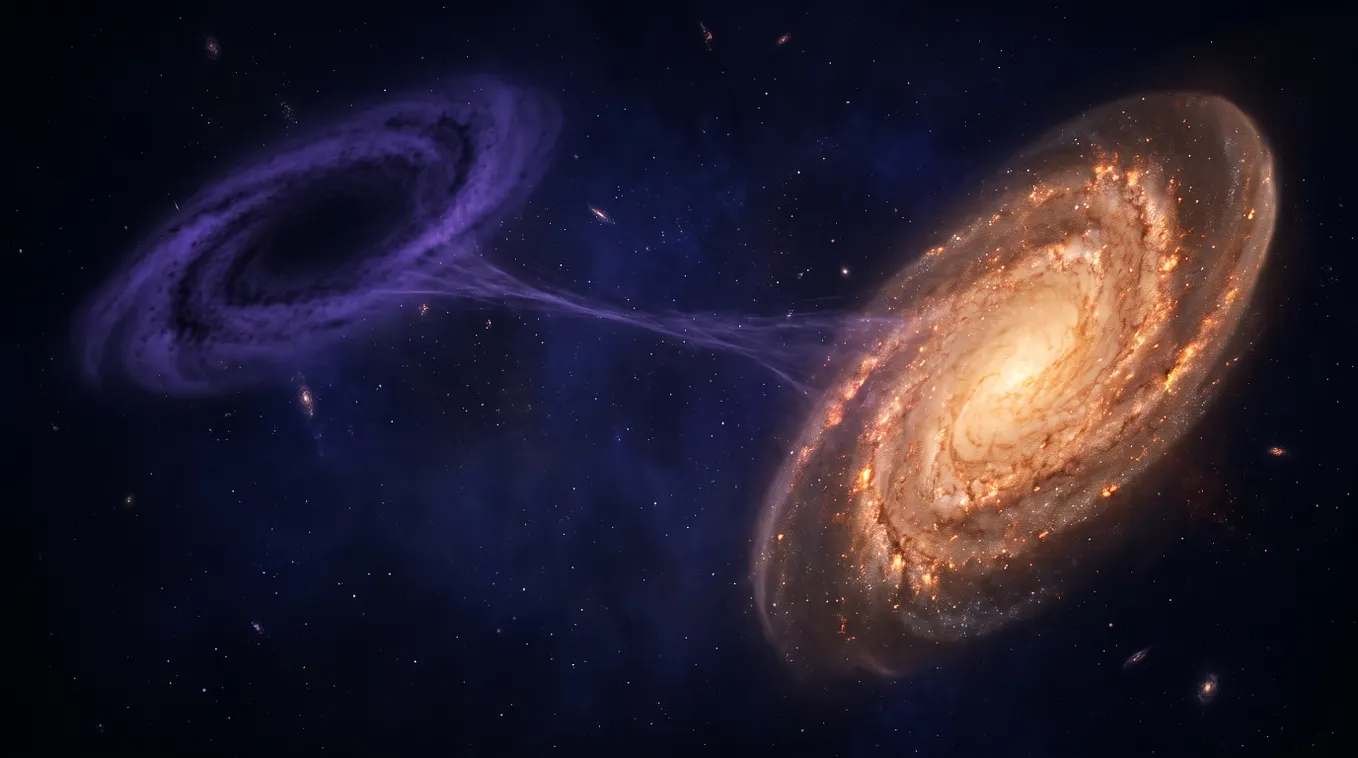
The Center of the Solar System Is Outside the Sun
Every planet, and the Sun itself, is circling a point in empty space beside our star, and it won’t stay there for long.

Most of us were taught that the planets go around the Sun. That picture holds up well for everyday use, but it leaves out something that is true right now: the actual center of the solar system lies outside the Sun. The point everything turns around sits in open space just beyond the Sun’s surface, and the Sun circles it along with all the planets.
This won’t last. The center is expected to drop back inside the Sun in late January or early February 2027. For a few more months, though, the thing at the middle of our planetary system is empty space, with our star swinging around it.
I find this hard to picture, and I think the reason is that it is less a fact about the Sun than about what a center really is. Once you see how the center of the solar system is worked out, its wandering stops looking strange and starts looking unavoidable.
What “center” means in space
Astronomers call this point the barycenter. The word joins two Greek words, barys for heavy and kentron for center, so it means the center of weight. It is the center of mass of a group of bodies held together by gravity. Each body in the group circles it, including the heaviest one.
The rule behind it is older than telescopes. In On the Equilibrium of Planes, Archimedes worked out how weights balance on a lever. Two equal weights balance at the midpoint. If one is heavier, the balance point moves toward it, and the bigger the difference in mass, the closer the point sits to the heavier one. Anyone who has sat on a seesaw with an adult already knows this. The adult has to sit near the pivot, and the child far from it.
Swap the seesaw for space and nothing changes. Two bodies orbiting each other are balanced around a point on the line between them, and that point lies closer to the heavier one.
Earth and the Moon turn around a point under your feet
The nearest example is the Earth and the Moon. The Moon does not simply circle Earth’s center. The two circle a shared barycenter, and that point lies about 4,671 kilometres from the center of the Earth.
Earth’s radius is a little over 6,000 kilometres, so the point is inside our planet, about 1,700 kilometres below the ground. Each month, Earth’s center makes a small loop around a spot deep in its own mantle while the Moon makes its large loop on the far side.
I like this example because it makes the idea physical. The Earth is not sitting still while the Moon does the moving. Both are moving, and the planet wobbles around a point buried inside itself.
Why distance matters as much as mass
You might expect Earth to drag the Sun around in the same way. It barely does. The Sun is so much heavier that the Sun-Earth balance point lies just 449 kilometres from the Sun’s center. Against a solar radius of 695,700 kilometres, that is almost exactly at the middle.
Distance is the other half of the seesaw rule. Move a body farther away and the balance point moves out in proportion. Even if Earth orbited out at the distance of the dwarf planet Eris, 68 times farther than it actually is, the Sun-Earth point would sit just over 30,000 kilometres from the Sun’s center. That is still deep inside the Sun.
Mass alone isn’t enough either. If you put Jupiter, the heaviest planet, on the innermost planetary orbit, it would move the balance point only about 55,000 kilometres from the Sun’s center, less than a tenth of the way to the surface. To pull the center out of the Sun, a planet has to be both heavy and far away.
Jupiter pulls the center past the Sun’s surface
Jupiter is both. It orbits about 778.57 million kilometres from the Sun, and the Sun is roughly 1,048 times more massive. Dividing that distance by the combined mass gives the answer: the Sun and Jupiter circle a point about 742,000 kilometres from the Sun’s center.
That is 1.07 solar radii, which puts it roughly 46,300 kilometres above the visible surface. Jupiter on its own puts the center of its pair with the Sun in empty space. Its orbit is close to round, with an eccentricity of 0.0484, so even at its nearest the point never dips back under the surface.
Saturn is the useful contrast. It is also a giant, and it orbits farther out, but its mass is much smaller. The Sun-Saturn balance point sits at 0.588 solar radii, well inside the Sun. Being a giant planet is not enough. Only Jupiter has the combination of mass and distance needed to pull the point out on its own.
When the planets line up, the center moves
The real solar system has more than two bodies, so it has one balance point for everything together. That point depends on where each planet is at any moment. When the giant planets are spread around the Sun, their pulls partly cancel and the center stays close to the Sun’s middle. When they gather on one side, their pulls add up and the center moves outward.
Get The Sleepy Physicist’s stories in your inbox
Join Medium for free to get updates from this writer.
That is the situation now. With the giants clustered on one side, the combined balance point sits outside the Sun. As Jupiter moves on along its orbit and away from the others, its pull starts working against theirs, and the point is expected to sink back inside in early 2027.
The Sun does not sit still at the center of the solar system; it circles a point that is sometimes inside it and sometimes not.
Over time the Sun’s center can stray up to roughly two solar radii from the barycenter. One detail surprised me more than anything else. Planets move fastest when they are closest to what they orbit, but the Sun does the reverse and moves slowest when it is closest to the barycenter. Near the middle, the planets’ pulls largely cancel, so there is less to drive the Sun’s motion.
A history of misplaced centers
None of this would have been visible to the first people who put the Sun near the middle of things. A manuscript of Copernicus’s great work has a small hole where his compass point pierced the page to mark the Sun. Yet his calculations did not measure from the real Sun. He measured from the mean Sun, an averaged point close to it.
Kepler changed that. In Astronomia Nova, published in 1609, he moved the reference point to the true Sun. Newton went further. On 10 December 1684, Edmond Halley reported to the Royal Society that he had seen a treatise by Newton on the motion of bodies. In that work Newton reasoned that the common center of gravity of the planets and Sun lies within or very near the Sun, not exactly at its center.
Newton also saw what followed from this. Since the Sun itself moves, no planet ever travels the same orbit twice. In the Principia of 1687, he noted that the Sun-Jupiter balance point lies a little outside the Sun and the Sun-Saturn point a little inside. Those are the same two results from earlier in this article, reached more than three centuries ago.
The Sun’s looping path
In 1965, Paul Jose used orbital calculations for the giant planets published in 1951 to trace how the Sun moves around the barycenter. What he drew was a path of loops. The pattern roughly repeats over about 179 years, now called the Jose period. Within each cycle, the Sun’s path shifts between a fairly balanced, three-lobed trefoil and looser, more disordered loops.
At some points the Sun even circled the barycenter in reverse. This happened around 1632, again around 1811, and again around 1990. This motion is ordinary Newtonian gravity, the Sun responding to the planets’ pulls the same way it responds to anything else.
Does it affect the solar cycle?
Since the planets move the Sun, people have long wondered whether they also set the rhythm of sunspots. In 1859, the astronomer Rudolf Wolf proposed a link between sunspot changes and the positions of Venus, Earth, Jupiter and Saturn. Jose later noted that his 179-year period was close to eight magnetic cycles of the Sun.
The question is still open, and it is worth describing it carefully. Supporters point to the fact that Venus, Earth and Jupiter reach their closest alignment every 11.07 years, close to the length of the sunspot cycle. Critics point out that the tidal pull of the planets deep inside the Sun is about a thousand times weaker than the Sun’s own churning motions. Most models of the solar dynamo treat the cycle as partly random. In 2011, researchers described the debate as stuck at an impasse and suggested two other stars as a possible test.
There has also been a clear correction along the way. A 2019 paper claimed that the Sun’s motion around the barycenter changes the distance between Earth and the Sun by millions of kilometres. It was retracted on 4 March 2020. The giant planets pull on Earth and the Sun almost equally, so the two move nearly in step.
Finding the center to within 100 metres
Today the barycenter is more than an idea. It is the reference point for how we keep track of everything in space. In 2000, the International Astronomical Union adopted a reference system with its origin at the barycenter, and since 1991 it has had its own time scale, Barycentric Coordinate Time. NASA’s JPL builds its planetary ephemerides, the tables of where everything will be, around this moving point. Its DE440 positions agree to within about one metre.
Small bodies matter too. Adding 30 Kuiper Belt objects and a ring of Kuiper Belt mass to the calculations shifted the computed center by about 100 kilometres. Some comets that seem to be on open, escaping paths when measured from the Sun turn out to follow closed ellipses when measured from the barycenter. They were never escaping.
The most precise method uses pulsars, dead stars that send out regular radio pulses. Before their arrival times can be compared, they have to be corrected to the barycenter, because Earth’s own motion shifts them by up to about 500 seconds. If Jupiter’s mass is entered slightly wrong, a pattern repeating every twelve years appears in the timing data. In 2010, four pulsars were used to weigh the planetary systems of Mercury, Venus, Mars, Jupiter and Saturn. In 2018, the method weighed the dwarf planet Ceres.
In 2020, a team modelled the uncertainties in the solar system itself alongside their search for gravitational waves, and located the center of the solar system to within about 100 metres. If the Sun were the size of a football field, that would be about the width of a single hair.
Our Sun’s wobble, seen from far away
The same motion is how we find planets around other stars. A small telescope sends sunlight to the HARPS-N spectrograph, and when the readings are referred to the barycenter, the Sun’s speed toward and away from us swings by about 12 metres per second, repeating roughly every 13 months. Earth adds only about 9 centimetres per second.
From ten parsecs away, Jupiter would move the Sun in a loop on the sky about 500 microarcseconds across. Earth’s loop would be about 0.3 microarcseconds. On 6 October 1995, Michel Mayor and Didier Queloz announced 51 Pegasi b, a planet found from exactly this kind of wobble in its star, and the discovery later earned a Nobel Prize. One astronomer argued at first that the wobble needed no planet, then corrected himself after looking again.
In February 2025, the European Space Agency reported Gaia-4b, a planet of about 12 Jupiter masses on a 570-day orbit. It was found from its star’s corkscrew path across the sky, a drift with a loop around a hidden center.
A center that keeps moving
The center of the solar system is not a place you can point to on a map that never changes. It is a balance point that moves as the planets move, sometimes deep inside the Sun and sometimes just beyond its surface. Right now it is on the outside, and by early 2027 it should be back within the Sun.
What I find most satisfying is that this wandering point holds up everything else we know. Newton reasoned his way to it, pulsars have pinned it down to the width of a road, and the same wobble around it has revealed planets around other suns.
If you enjoyed reading this, it comes from a longer video on The Sleepy Physicist, a calm bedtime walk through the same ideas. The research notes and sources behind each episode, along with a small community that talks them over, are on Patreon