The Master Key to Market Discipline: Why Every Serious Trader Needs a Trading Cheat Sheet
The Ultimate Guide to Eliminating Emotional Mistakes, Standardising Strategy Execution, and Protecting Your Capital under Market Pressure

In the fast-paced world of financial markets, milliseconds can separate a profitable trade from a catastrophic loss.
Whether you are navigating the high-leverage waters of crypto, scalping forex pairs, or swing trading equities, the human brain faces a constant adversary: emotion.
Under cognitive load, fear and greed trigger psychological biases that erode discipline.
This is where a trading cheat sheet becomes an indispensable tool. Far from being a simple “crutch” for beginners, a well-structured cheat sheet is a professional-grade tactical roadmap.
It bridges the gap between theoretical strategy and flawless, emotionless execution.
Below is an in-depth exploration of why trading cheat sheets are vital for long-term profitability, how they protect your capital, and how to build one tailored to your specific market edge.
1. Combating Cognitive Overload and Decisional Fatigue
The financial markets present a chaotic influx of data. At any given moment, a trader must process:
- Multi-timeframe chart architectures.
- Real-time order flow and volume profiles.
- Macroeconomic data releases (e.g., CPI, Federal Reserve rate decisions).
- Correlated asset movements (e.g., the impact of the US Dollar Index on gold).
The human brain is fundamentally unequipped to process these variables simultaneously under high stress without experiencing decisional fatigue.
As the trading session progresses, your executive functioning declines, making you highly susceptible to impulsive entries, premature exits, and revenge trading.
A trading cheat sheet acts as an external hard drive for your trading plan. By externalising your system’s core parameters onto a highly scannable, physical or digital reference card, you offload cognitive strain.
Instead of desperately trying to remember the precise confirmation criteria for a complex harmonic pattern or an order block mitigation, you simply glance at your sheet. It transforms a chaotic mental calculation into a deterministic, binary checklist.
2. Standardising Execution: The Blueprint for Consistency
In trading, consistency in your process is the sole driver of consistency in your results.
If you execute a breakout strategy differently every time it appears, you do not possess a statistical edge; you are merely gambling.
[Market Condition] ➔ [Check Cheat Sheet] ➔ [Binary Verification] ➔ [Execution]A comprehensive cheat sheet standardises your setup execution. It ensures that every time you risk capital, the trade perfectly mirrors the historical data you backtested.
It outlines your explicit rules for:
- Trend Identification: Is the market in a structural uptrend, downtrend, or a premium/discount distribution range?
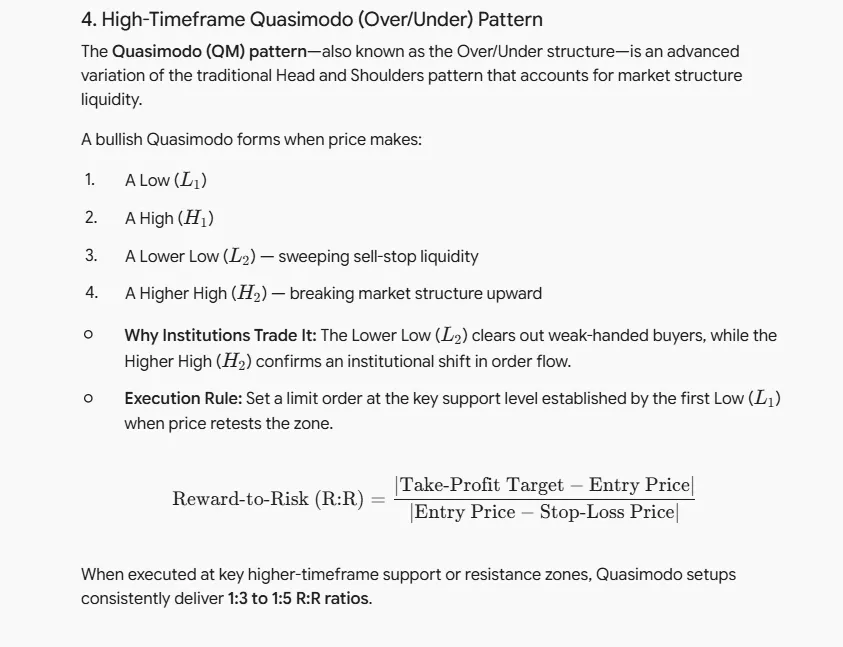
- Candlestick and Chart Patterns: Visual configurations of high-probability triggers (e.g., engulfing bars, failed breakdowns, or liquidity sweeps) stripped down to their essential, textbook forms.
- Indicator Confluence: The exact mathematical thresholds required before an entry is validated (e.g., RSI divergence combined with a retest of the 200-period Exponential Moving Average).
When your execution is standardised, your post-trade analysis becomes incredibly powerful.
If a series of trades results in a drawdown, a cheat sheet allows you to determine whether the strategy itself is experiencing a normal statistical variance, or if you simply failed to follow the protocol.
3. Fortifying Risk Management Under Pressure
Amateur traders focus entirely on where to enter a trade; professionals focus entirely on how much they stand to lose.
However, when a position moves aggressively against you, adrenaline spikes, inducing a “fight or flight” response.
In this state, traders frequently commit fatal errors: widening stop-losses, averaging down into a losing position, or freezing completely.
Your trading cheat sheet must serve as an unyielding risk management anchor. It should prominently display your non-negotiable risk parameters:
- Position Sizing Matrix: A pre-calculated table showing exactly how many lots, contracts, or shares to purchase based on the distance to your stop-loss and your fixed account risk percentage (e.g., 1% or 0.5% per trade).
- Maximum Daily Loss Limits: A psychological circuit breaker. The sheet should explicitly state: “If realized losses exceed $X today, close all platforms and step away.”
- Correlation Rules: Restrictions preventing you from inadvertently exposing your account to excessive risk by buying multiple highly correlated assets (e.g., simultaneously going long on AUD/USD and NZD/USD).
Having these figures staring back at you in black and white strips away the ability to negotiate with yourself mid-trade. It enforces systemic survival over emotional preservation.
4. Categorized Components of a Professional Cheat Sheet
To maximize utility, a trading cheat sheet should be structured into distinct, logical categories.
Get Market Investigation’s stories in your inbox
Join Medium for free to get updates from this writer.
Grouping your rules ensures you can find critical information within a two-second window.
Market Structure & Directives
- Session Timings: Exact hours of peak liquidity (e.g., London/New York overlap) and times to strictly avoid trading.
- Higher Timeframe Bias: Clear check-boxes to align your intraday execution with daily or weekly market trends.
Technical Execution Triggers
- The Setup: Minimalist visual schematics of your core setups (e.g., Support/Resistance flips, Fibonacci retracements).
- The Trigger: The exact price action event that authorizes the entry click (e.g., a 15-minute candle closing outside a volatility band).
Trade Management Protocols
- Invalidation Points: The structural level where the trade idea is mathematically proven wrong.
- Profit Taking Rules: Defined scale-out targets (e.g., taking 50% profits at a 1:2 Risk-to-Reward ratio and moving the stop-loss to breakeven).
5. Designing for High Scannability and Speed
A trading cheat sheet is completely useless if it is a dense, five-page essay. When the market is moving, you cannot read paragraphs of text.
The document must be engineered for extreme visual efficiency.
- Use Bullet Points and Fragments: Eliminate conversational filler. Write short, punchy, active-voice directives (e.g., “Wait for candle close,” or “Check economic calendar”).
- Incorporate Visual Anchors: Use functional icons, clean geometric diagrams, and bold typography to draw your eyes immediately to critical numbers or error-prone steps.
- Implement Strict Color Coding: Reserve Red strictly for risk management, stop-losses, and invalidation rules. Use Green for profit targets and entry triggers, and Amber/Yellow for warnings or macro economic filters.
Whether you print it out and tape it to your monitor or keep it open on a dedicated secondary iPad, the sheet must be legible from a comfortable seating distance.
6. The Psychological Shield: Neutralizing FOMO and Greed
The psychological benefits of a cheat sheet rival its mechanical advantages.
The two greatest account killers in retail trading are FOMO (Fear of Missing Out) and Greed.
FOMO causes you to chase vertical green candles after an asset has already extended far beyond a reasonable entry point.
When you have a cheat sheet, your rule will explicitly state: “Do not enter if price is more than X ATR away from the moving average.”
Looking at the sheet reminds you that chasing violates the protocol.
You are no longer choosing to miss a trade; you are choosing to be a disciplined professional.
Greed, on the other hand, subtly convinces you to hold onto a winning position long after your technical profit target has been reached, hoping for a “home run.”
A cheat sheet acts as a cold, calculating voice of reason, prompting you to execute your planned profit taking systematically.
It detaches your self-worth from the monetary PnL of any individual trade and attaches it to how flawlessly you followed the document.
Conclusion: Your Protocol for Long-Term Survival
In the ultimate analysis, trading is not about predicting the future; it is a game of probability, risk management, and human psychology.
The markets are specifically designed to exploit human vulnerability, shifting sentiment, and emotional inconsistencies.
A trading cheat sheet is your ultimate defense mechanism. It synthesizes your entire trading philosophy, risk profile, and technical edge into an instantly actionable, bulletproof tactical guide.
By reducing cognitive strain, enforcing systematic risk management, and eliminating emotional guesswork, it transitions you from an impulsive participant into a calculated business operator.
If you want to survive the brutal landscape of the financial markets, don’t rely on your memory or your mood. Build your cheat sheet, place it where you cannot ignore it, and trade the plan, not the emotion.
Disclaimer: The information in this article is for educational purposes only and does not constitute financial, investment, or trading advice.
You can also join this Group For More!