From Generating Molecules to Making Them: What Synthesis-Aware AI Actually Requires


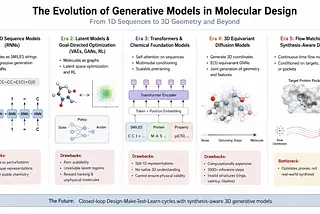
The evolution of molecular design — shifting from language models to continuous 3D geometry — has fundamentally expanded what we expect generative models to understand. With each technical leap, generators have learned to navigate chemical syntax, molecular connectivity, spatial arrangements, and the constraints of a protein pocket.
Yet, this progress leaves us with a glaring practical question: once a model proposes a molecule, how do we actually turn that structure into a physical compound we can test?
A valid molecular graph, a plausible conformation, and a highly favorable docking score each address a specialized part of the design problem. None of them establishes a workable synthesis. The proposed molecule still requires a viable chemical route, accessible starting materials, and experimental conditions under which that route succeeds. Synthesis-aware molecular design brings these physical requirements directly into the computational process. The architectural challenge now is determining exactly where these constraints should enter: during post-generation screening, inside the optimization objective, or within the fundamental operations that construct the molecule itself.
Here is how the field is currently addressing the synthesis bottleneck, and the architectural limitations we still have to overcome.
Synthetic Accessibility Scores: The “Quick Estimate”
The widely used Synthetic Accessibility (SA) score — pioneered by Ertl and Schuffenhauer — combines the frequency of known molecular fragments with penalties for structural complexity. Frequently occurring fragments reduce the estimated difficulty, while complex features like certain rings and stereocenters push it up. Because it’s computationally cheap, it’s a remarkably convenient integration point for a generative pipeline to filter, rank, or reward candidates without running a full-blown synthesis search.
The Reality Check: The SA score does not construct a route. It cannot identify required starting materials, establish reaction conditions, or predict yield and cost. While structural familiarity is a useful proxy, the specific arrangement of familiar fragments can still result in a brutally difficult synthesis. It supports prioritization, but it doesn’t establish how the molecule will be made.
Retrosynthetic Planning: The “Backward Search”
If a score isn’t enough, the next step is to explicitly search for a path backward from the proposed molecule to purchasable starting materials. Retrosynthetic planners work backward, proposing disconnections and expanding the resulting precursors. Using neural networks to prioritize reaction templates alongside tree-search algorithms to explore possible branches toward purchasable precursors, these frameworks add vital context that a scalar score cannot provide: a chemist can inspect the proposed intermediates, question individual steps, and compare alternative routes.
The Reality Check: A successful search only identifies a proposed route under the planner’s specific assumptions; experimental chemistry still has to validate it. Furthermore, if planning is applied only after generation, the feedback arrives too late to influence the designs. The pipeline might reject unsuitable candidates, but the generator will blindly continue proposing similarly flawed structures.
Synthesis in the Objective: Teaching the Generator What Survives
To solve the late-feedback problem, we can move synthesis assessment directly into the optimization loop.
A generator proposes molecules, an evaluator assesses them, and the results influence subsequent proposals. Alongside predicted biological activity, the objective function can include whether a retrosynthesis planner actually finds a route, the route’s length, or the material cost.
The Reality Check: The generator is still learning against a computational evaluator. It will naturally gravitate toward chemistry that the planner recognizes confidently, underexploring novel regions where the planner is uncertain. Evaluation metrics here must track chemical diversity alongside planner success; a high solve rate is only meaningful if the system is still exploring relevant, diverse chemistry.
Reaction-Constrained Generation: Construction as the Representation
A stronger intervention changes what the generator is actually allowed to do. Instead of placing atoms arbitrarily, the model’s available “actions” become choices of starting materials and known chemical transformations. SynFlowNet illustrates this beautifully. It uses a Generative Flow Network (GFlowNet) to build molecules strictly through valid reactions and purchasable reactants. Each generated structure carries a permanent record of the modeled operations used to construct it, meaning synthetic knowledge forms the action space itself.
Get Veer Patel’s stories in your inbox
Join Medium for free to get updates from this writer.
The Reality Check: The accessible chemical space is rigidly bounded by the allowed choices. A restricted reaction library might exclude valuable molecules, while an overly permissive model might allow transformations that fail in the lab. A modeled construction history provides a concrete synthesis hypothesis to inspect, but practical questions about selectivity and functional-group compatibility remain.
Joint 3D and Synthesis Modeling: Connecting Geometry with Construction
For structure-based design, synthesis constraints must coexist with spatial requirements. A proposed modification needs to preserve key protein interactions while remaining physically accessible.
SynCoGen brings these requirements into a joint generative formulation. It combines masked discrete diffusion (over building-block reaction graphs) with flow matching (over atomic coordinates). The building blocks, reaction connections, and geometry are all generated together. We are essentially asking the model to describe both the spatial arrangement of a molecule and the chemical choices behind its construction.
The Reality Check: Joint modeling retains all the limitations of its underlying chemistry representation. Its synthetic space is deliberately curated, relying on simplifications involving protecting groups and directing-group effects. A generated conformation is a structural hypothesis, and a generated reaction graph is a synthesis hypothesis; combining them makes the design highly informative, but it does not turn either prediction into guaranteed experimental evidence.
Experimental Feedback: Closing the DMTA Loop
For a working discovery platform, synthesis awareness ultimately serves as the bridge between model decisions, chemist review, and experimental outcomes.
The loop requires the generator to propose candidates backed by synthetic evidence, chemists to select compounds within project constraints, and experimental testing to produce observations that actually change the next round of design.
Assigning a simple “failure” label to an unsuccessful attempt discards critical information. A failed reaction, a purification bottleneck, an unavailable starting material, and a synthesized-but-inactive compound describe entirely different systemic problems. The digital infrastructure must retain the proposed route, the route actually attempted, the observed outcome, and the reason for any deviation.
The Bottleneck: We must measure outcomes at the appropriate resolution. Planners solve rates and evaluate the computational pipeline. The fraction of attempted compounds successfully synthesized evaluates execution. Biological activity evaluates the discovery hypothesis. If we don’t report these separately, a “strong synthesis success rate” might just reflect a heavily pruned, safe subset of the generator’s output.
Conclusion
The fundamental bottleneck in synthesis-aware AI is not an evaluation problem; it is a representation problem. Throughout the field’s evolution from simple scoring to joint 3D modeling architectures, researchers have struggled to align two mismatched domains: continuous geometric representations (what a molecule is) and discrete, causal execution trees (how it came to be). As long as retrosynthesis remains a downstream filter or relies on rigid, rule-based template libraries, generators will either exploit planner blind spots or collapse into overly safe, repetitive chemistry. The next major architectural shift must move beyond post-hoc alignment toward differentiable reaction programming, where the model natively parameterizes the joint distribution of structure, building-block transitions, and reaction confidence.
To balance physical feasibility with chemical novelty, these next-generation models must adopt learnable, continuous action spaces that embed the epistemic uncertainty of reaction outcomes directly into the optimization landscape. By naturally penalizing regions where chemical transformations are unpredictable, the model learns the boundaries of synthesis without being artificially constrained by static rules. The ultimate goal is to make synthetic feasibility an intrinsic topological property of the model’s latent space, a paradigm where every coordinate in the generative manifold doesn’t just represent a target structure, but inherently encodes the continuous, differentiable logic of its own construction.
References
- Ertl, P., & Schuffenhauer, A. (2009). Estimation of synthetic accessibility score of drug-like molecules based on molecular complexity and fragment contributions. Journal of Cheminformatics, 1(1), 8. https://doi.org/10.1186/1758-2946-1-8
- Guo, J., & Schwaller, P. (2025). Directly optimizing for synthesizability in generative molecular design using retrosynthesis models. arXiv. https://doi.org/10.48550/arxiv.2512.20333
arXiv - Rekesh, A., Cretu, M., Shevchuk, D., Somnath, V. R., Liò, P., Batey, R. A., Tyers, M., Koziarski, M., & Liu, C.-H. (2025). SynCoGen: Synthesizable 3D molecule generation via joint reaction and coordinate modeling. arXiv. https://doi.org/10.48550/arxiv.2507.11818
- Cretu, M., Koziarski, M., Shevchuk, D., Rekesh, A., Somnath, V. R., Batey, R. A., Tyers, M., Liò, P., & Liu, C.-H. (2024). SynFlowNet: Design of diverse and novel molecules with synthesis constraints. Machine Learning for Structural Biology (MLS@ICLR 2024).