Einstein did not study time itself, only the marks time writes in the world

The four layers of time which are so confusing

Picture: The Midsummer Chronophage, johnctaylor.com
Abstract
The philosophy of time is a seemingly endless game of confusion, full of circular arguments and only apparently profound. Since Einstein, the physics of time has been precise, but even it does not tell us what time is. If one understands time as a processor, then one realises that all previous understandings of time have not yet concerned time itself, but merely the handling of markers written by the time processor. This means that only the present is time. On this basis, the other layers of physical and human time can be understood.
Time as a cosmic processor
To understand time as the fundamental processor for everything in the universe, we conceptually break down space at a given moment into cells. We now use two simple, complementary ideas as analogies: firstly, the way a single spatial cell functions, and secondly, its interaction with neighbouring cells.
As a basic concept for how cells interact with their neighbors, we consider the principle of numerical calculation within the planetary system. Let us assume the positions of the planets, their velocities and the forces acting between them are known. From this, the system’s motion is calculated for a short period of further time.
The calculation within the cell follows the principle of a computer: the next instruction is loaded into a register, executed according to the system’s rules, the instruction counter is incremented by one, and the register is prepared for the next execution.
In cosmic reality, spatial cells are conceivable down to the incredibly tiny scale of 4.2 × 10⁻¹⁰⁵ m³, a cube with edges of Planck length. The times required to execute the instructions should also be very small, down to the Planck time of 5.4 × 10⁻⁴⁴ seconds. The instructions of the cosmic computer are the laws of nature.
We therefore define:
The contents of the register and the instruction being executed constitute the present. Time is the mechanism of the processor.
The counter readings are markers, which are also colloquially referred to as ‘time’. In fact, time (the ‘real’ kind) is only the present. This conception of time is known as presentism.
The computer model also defines, unambiguously within itself, the direction of time, the “arrow of time”: the instruction register loads in only one direction.
The theological philosopher Saint Augustine described it magnificently and closer to our understanding of time than many philosophers and physicists. In his *Confessions*, dated around the year 400 AD, he writes:
Let us see, O human soul, whether the present can be long; for it is given to you to perceive and calculate the duration of time. What is your answer to this? Are a hundred years of the present a long time?
It narrows down the present ever further, from ‘this year’ to ‘this hour’ and down to the nothingness in which, after all, everything happens:
If one could conceive of any point in time that could no longer be divided, not even into the smallest particles, then that alone could be called the present.
This corresponds to the method of the Dedekind cut in mathematics, which in this way delimits and defines irrational numbers.
Figure 2 illustrates Augustine’s text:
And yet even this would rush so swiftly from the future into the past that it, too, could not possess even the slightest duration.

The narrowing of the present down to ever shorter periods of time, until it
amounts to nothing
From: Walter Hehl, “TIME in Physics, Philosophy and Human Mind”, 2026
The English watch engineer and philanthropist John C Taylor (born 1936) has created a mechanism — and, with this several sculptures — that impressively showcase the time processor: emotionally unsettling, dynamic and rooted in the history of horology. The opening picture Fig. 1 shows the Chronophage, which tirelessly devours time particle after time particle. Technically, it is a form of the ‘grasshopper escapement’, invented by the historic clockmaker John Harrison. With every hop, all processes in the cosmos continue, particularly the clocks continue ticking and displaying time. By its very nature, the true time processor is not only destructive but also constructive.
Here, one must correct Albert Einstein: time is not, as he flippantly put it, the position of the clock’s hand, but the mechanism behind it.
By conceiving of time as a cosmic processor, the cosmos becomes a kind of networked computer. This image was first envisaged in 1944/1945 by Konrad Zuse (1910–1995), the far too little-appreciated inventor of the programmable computer. Zuse published in 1967 an essay entitled ‘Computing Space’ (Rechnender Raum).
Get Walter Hehl’s stories in your inbox
Join Medium for free to get updates from this writer.
Layers in the understanding of time
The hands of the clock and, more generally, all time data are markers left by the time processor. There are two ways of dealing with these time markers:
- None of the markers under consideration has anything to do with the present moment,
- At least one marker refers to the present moment.
In the first case, one has simple data; in the second case, one must know the corresponding present and refer to it. In the history of the psychology of time, this corresponds roughly to the A- and B-times of the psychologist John McTaggart, conceived in 1908.
At this level, time is therefore essentially nothing more than counting, just as Aristotle rationally perceived time to be. Aristotle counted the circles of celestial motions.
However, as we have known since Henri Poincaré and Albert Einstein, it is somewhat more complicated, because the passage of time varies. This is only noticeable when comparing objects travelling at different speeds or in different gravitational fields. The theory of relativity describes these ‘perspective’ effects precisely. But these are merely external effects. Even Einstein did not study time itself, only the marks written by the time processor and their laws. With the Big Bang, the universe’s ‘time processor’ began to run, and it runs slightly differently depending on the observer’s location and the local gravitational field. Yet there is a single cosmic time. In itself, the cosmic clock runs at the same rate on the Moon, on Earth and in the rocket of the twin paradox — but not when compared. At a fixed location on Earth, the flow of uniform Newtonian time holds true with remarkable accuracy.
All processes in the universe are subject to the time processor; they are identical everywhere, including ourselves, our bodies and our mental processes (which are mediated through the body). Only photons, as massless particles, are an exception: for them, time does not exist. It is important in many aspects of life to have a sense of time that is close to physical time. To this end, one (or more) time windows run within us, as synchronised as possible resp. necessary with the cosmic time processor. These ‘internal’ clocks are the subject of research in chronobiology.
If one detaches mentally oneself from the current cosmic clock, the properties of time disappear, and everything becomes possible: the sequence of events can be rearranged at will and causality dissolves. This is the time of our memories, the time found in literature, or even as strange time experienced in psychiatric disorders.
Conclusions
We hereby distinguish between four levels of understanding of time, ranging from the fundamentals of deep physics right up to the top level of fiction and psychiatic disorders (Table 1).

Essentially based on “TIME in Physics, Philosophy and Human Mind”, 2026
The two lower levels shown in the diagram relate to physics, whilst the upper levels relate to human nature. The foundation of everything is
Level I, the cosmic processor, the structure of which is not yet understood. This is where quantum physics (including quantum fluctuations) and the theory of relativity converge. It has been an unsolved problem in physics for almost a century. This is the time for the makers, and it is the present and nothing else.
The result is the events and changes in the world. This is our Level II. Physics has been investigating this time level since Newton and particular with Einstein. The totality of changes in the world have themselves been regarded as ‘the time’ and have contributed greatly to the confusion.
Human time has a level — Level III — which endeavours to follow physical time as closely as possible, or at least to the extent that is essential for life. This applies most aptly and consciously to mindfulness. In a state of mindfulness, the aim is to experience time as the present and to truly live in the moment. To put it in somewhat grandiose or esoteric terms: to feel the cosmic processor. In Layer IV above, physical time gradually dissolves: perceived time is shaped by events, by poetic imagination, and by psychiatric disorders. The properties of time, such as uniformity and adherence to causality, are lost.
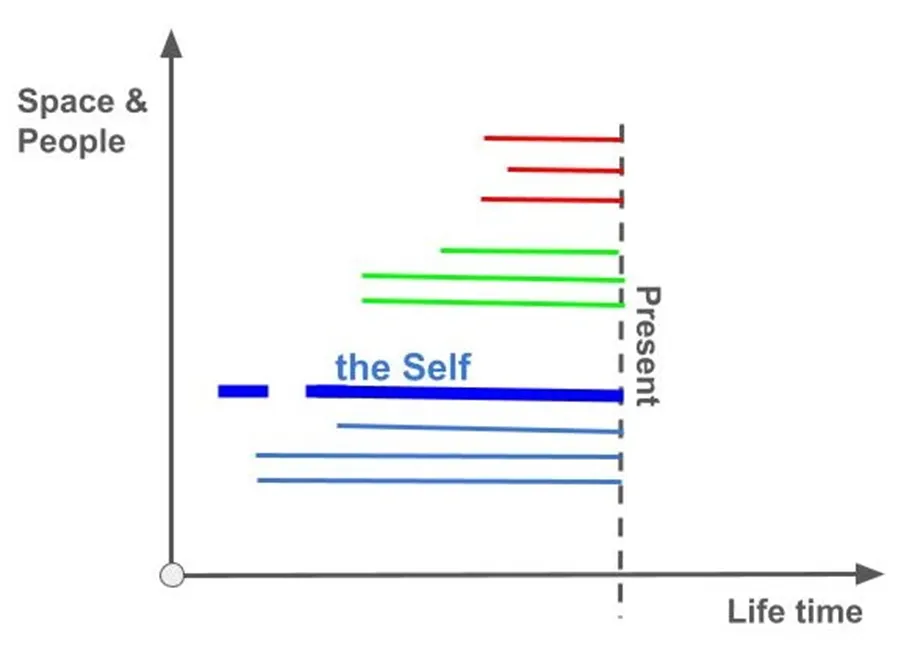
Time is thus more than a static coordinate of space; nevertheless, we must conceive of time in spatial terms when drawing time diagrams. The combination of the three spatial coordinates with time to form ‘space-time’ in relativity theory is merely a clever mathematical trick that fictitiously links space via the imaginary number i. Einstein accepted the term only reluctantly.
The present is time and time is the present; everything else is merely observations and reflections arising from this.
With the dynamic basis of time in the time processor, the historical debate between the physicist Albert Einstein and the philosopher Henri Bergson in 1922 also takes on a slightly different perspective. Einstein’s arguments regarding the nature of time concerned Level II of the observation of events within the framework of the theory of relativity. Bergson seemed to focus more on the dynamic function of time when he wrote of the ‘élan vital’, the life force. He emphasized the role of ongoing events at Level III or, hypothetically, at the highest Level IV. These give us a sense of time — for example, the interrelated notes of a melody bound to physical time, or, freely in literature or film, flashbacks and fictional scenes. For Bergson, it is lived time; for Einstein, measured time. Level I was a mystery in 1922 and remains so to the present day. Einstein examined only the markers of time in Level II, not time itself. He may have suspected the existence of a time processor. The two debaters were talking at cross-purposes. It is hoped that the table of time layers will help to avoid misunderstandings in future, particularly between physicists and researchers in the human sciences.
Scientifically measured time and perceived, poetic time come together beautifully in John Taylor’s Chronophagus clocks. They are mechanical sculptures that ‘devour’ time — from the Greek χρόνος [chronos], meaning ‘time’, and εφάγον [ephagon], meaning ‘I eat’. Fig. 1 showed the terrible processor, Fig. 3 displays the most famous example in Cambridge UK, the Corpus Clock at Trinity College, at night and as a whole. It was unveiled by Stephen Hawking on 19 September 2008. The author knows from personal experience: as the Grasshopper Chronophagus ticks, one senses time and the cosmic time processor.

A symbiosis of time technology and time feeling.
Picture: Author
Literature
Augustinus of Hippo, about 400. Confessiones. For example here in German https://www.ub.uni-freiburg.de/fileadmin/ub/referate/04/augustinus/lachmann.pdf
Hehl, Walter, 2026. The real paradox in the twin paradox,
https://medium.com/@walter.h.hehl/the-real-paradox-in-the-twin-paradox-4626f5596718
Hehl, Walter, 2026. Time is more than space and entropy is no time arrow,
https://medium.com/@walter.h.hehl/time-is-more-than-space-and-entropy-is-no-time-arrow-582ea0afad5f
Hehl, Walter, 2026. Time in Physics, Philosophy and Human Mind,
Springer, Heidelberg, to be published December 2026.
Hehl, Walter, 2026. Die Zeit in Physik, Philosophie und im Menschlichen, Springer, Heidelberg, 2nd edition, 2026.