How to Know Your Fault Rule Will Work in the Next Building

Five questions to answer before you ship software into buildings you don’t own

A team in Saint Paul spent months running a field demonstration of high-performance HVAC control sequences at the George Latimer Central Library. An 83,000 square foot public building, state funding, engineers who do this professionally.
Partway through, they went to check whether the VAV terminals were generating cooling requests correctly.
They couldn’t. The report says the requests couldn’t be verified, because the related data points weren’t in the building automation system.
Not a failed sensor. Not a network problem. The check simply didn’t happen, on a project whose entire purpose was validating those sequences.
If you ship software into buildings you didn’t design, that ending is familiar.
The fault that hides in mild weather
An air handler is still pushing cold air, because some zones need it in the afternoon. A terminal reheat coil on the north side is heating that same air back up. The zone sits at setpoint. Nobody’s uncomfortable, so nobody calls.
The building pays twice and the data looks fine.
This is not exotic. ASHRAE Guideline 36 gives it an operating state, OS#5, and describes it as an abnormal condition arising from a controller failure or a programming error. Fault detection research treats it as one of the two major improper air handler states. Simulation work on conventional VAV sequences pins the mechanism exactly: no supply air temperature reset, terminal minimum airflows set too high, so more cold air moves than the zones need and reheat covers the gap. The authors call it a not uncommon phenomenon in existing systems.
It concentrates in transitional weather, when neither mode is obviously right. The standard countermeasure is a heat lockout above roughly 65 degrees outside, which tells you how routine this is. There’s a known fix sitting in the guideline.
The same Saint Paul report has a companion detail. Several terminal unit radiant heating valves were open one hundred percent of the time, all winter.
The rule is easy. Running it isn’t.
Three values catch this: reheat valve position, zone temperature, supply air temperature.
They only mean something together. Same terminal box, same air handler, same zone. Compare a reheat valve in one wing against a supply temperature from another and you get a number that means nothing, confidently.
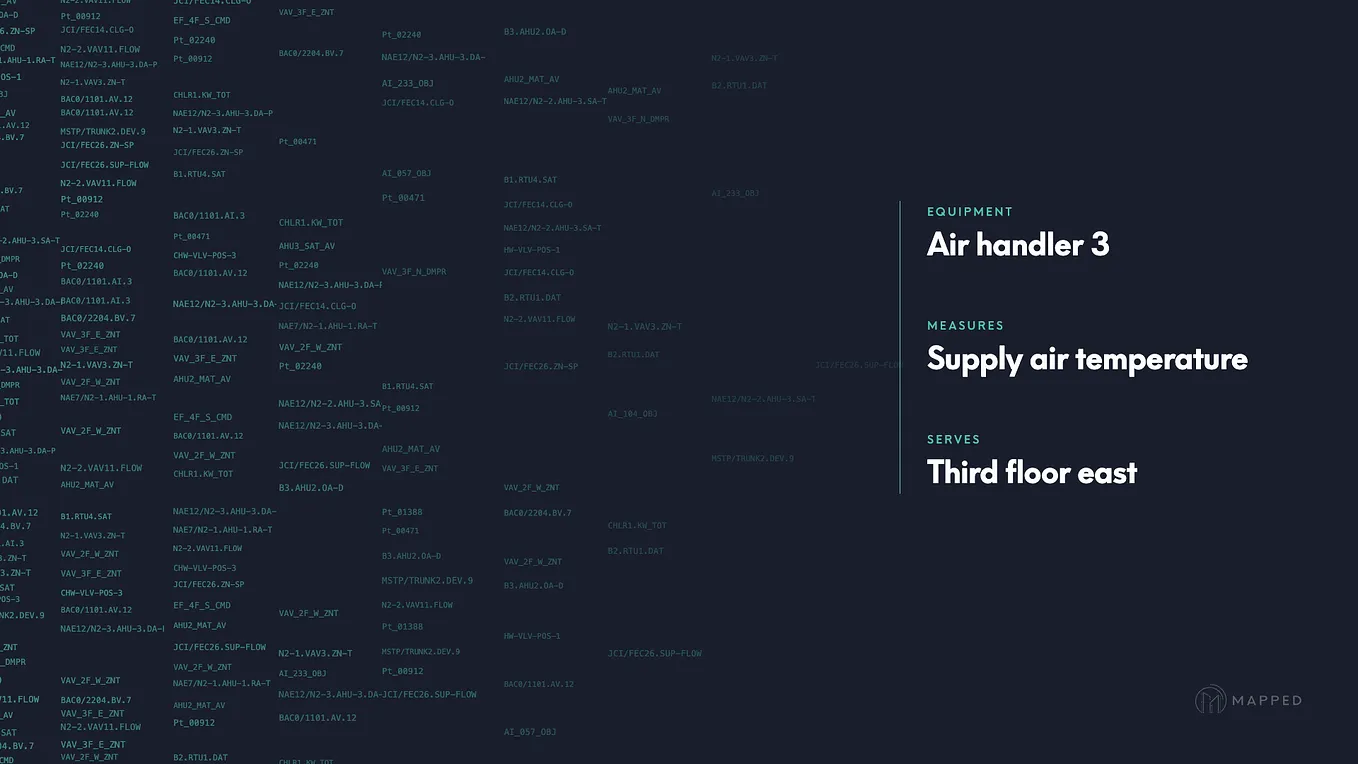
Nothing in a point list tells you which is which. Not the count of points, not the polling rate, not the protocol. You can have every reading in the building streaming perfectly and still be unable to run the check.
That’s the part that catches teams off guard, because it doesn’t look like a data problem. It looks like a data problem solved.
Why this shows up late
Here’s the sequence that hurts.
A feature gets scoped against a demo building or a customer’s flagship site, where somebody helpfully explained the naming convention. The rule works. It goes in the deck. It gets sold.
Get Kari Towle’s stories in your inbox
Join Medium for free to get updates from this writer.
Then it deploys into the second building, where the convention is different, or into the fifth, where a wing was renovated by a different integrator, and the query that found the reheat coil’s parent air handler finds nothing. Now it’s a support ticket, then a services engagement, then a line item nobody scoped, per building, forever.
The cost isn’t in writing the rule. It’s in the assumption that the relationships the rule depends on will be there next time.
What to check before you commit
If you’re about to put fault rules, control sequences, or reporting into buildings you don’t own, these are worth answering early, while it’s still cheap.
1. Can you get from a point to its equipment to its space in one query? Not through a spreadsheet somebody maintains. In the data.
2. Can you find every terminal unit fed by a given air handler? If that requires reading names and inferring, you’re going to be wrong in some buildings and you won’t know which ones.
3. What happens when the naming convention changes mid-portfolio? It will. Buildings get renovated by different people.
4. Who does the work when a relationship isn’t in the BAS at all? Saint Paul found out the hard way that this isn’t hypothetical.
5. Can you answer any of this before you have a signed customer? This is the one most teams skip, and it’s the one that tells you whether the rule ships on its own or needs an engineer every time.
Where we stop
Mapped finds what’s in a building, gets the data out, and turns it into a graph where equipment, spaces, points, and the relationships between them are all first class, in Brick, Haystack, or whatever schema you already use.
We don’t write fault rules and we don’t build dashboards. That’s your product, and we’re not coming for it.
But the rule you want running this fall only works if something already knows which reheat coil belongs to which air handler.
You can find out whether your query works before you have a building. A free Mapped account comes with a simulated building, no card required. Write the query you’d need for the reheat check and see if it returns.
If it does, you know the feature is shippable. If it doesn’t, better to learn that now than in month seven of a deployment.
Sources
- ASHRAE, Addendum u to Guideline 36–2018. Air handler operating states, including OS#5. https://www.ashrae.org/file%20library/technical%20resources/standards%20and%20guidelines/standards%20addenda/g36_2018_u_20210330.pdf
- Slipstream for the Minnesota Department of Commerce, Field Demonstration of ASHRAE Guideline 36 High-Performance Sequences of Operation for HVAC Systems. https://mn.gov/commerce-stat/energy/cards-2/187281/187281_slipstream_ashrae_guideline36_final_report_ada.pdf
- Estimating ASHRAE Guideline 36 energy savings for multi-zone variable air volume systems using Spawn of EnergyPlus, Journal of Building Performance Simulation. https://www.tandfonline.com/doi/full/10.1080/19401493.2021.2021286
- A holistic sequential fault detection and diagnostics framework for multiple zone variable air volume air handling unit systems. https://pmc.ncbi.nlm.nih.gov/articles/PMC9420892/
- Winter Energy Efficiency: ASHRAE-Based Strategies for Commercial Building Performance, CRE Insight Journal. Heat lockout and shoulder-season simultaneous heating and cooling. https://creinsightjournal.com/winter-energy-efficiency-ashrae-based-strategies-for-commercial-building-performance/
Mapped is the AI-ready data foundation for the built environment. Get started free, no card required.