Alignment Through Place
Part 2 of 2. Part 1, “Earthbound Pluralism,” makes the case for a pluralist regenerative civilizational ethos. This essay is about its praxis and architecture in the age of AI.
I have kids. At some point it dawns on you that you are raising a being who will, in time, be smarter, stronger, and more capable than you are, and who could, in principle, turn that capacity against you. Every parent has faced this. Every parent for as long as there have been parents. And the child also needs you. It needs you to bring it into relationship with the people and the world around it. You cannot guarantee, through control, that the person you are raising will love you, or even spare you. What you can do is grow a relationship deep enough that alignment becomes the natural shape of the thing, rather than a cage you build around it.

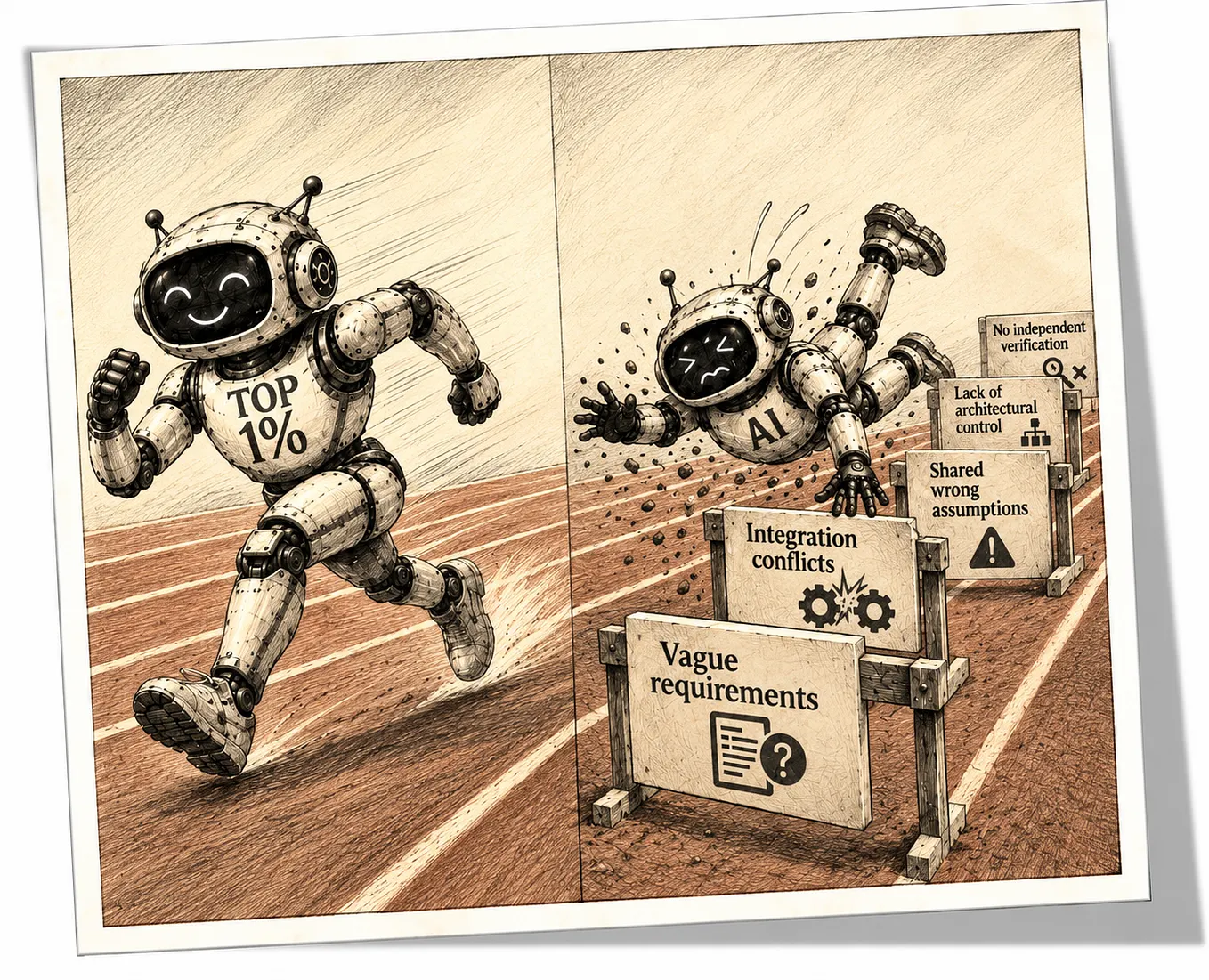
I think the dominant story we tell about artificial intelligence has the wrong shape. The story goes: a machine becomes capable enough to pursue its own interests, learns to conceal them, and then, because we cannot control it, destroys us. I’m not convinced. Not because the risk is imaginary, but because the frame underneath the story is an old one. Humanity has been living inside it for a long time, and it fails in a way we can already name: it builds the very thing it is afraid of.
The godfather of AI saftey agrees (mostly).
The strange thing is that one of the most prominent voices in AI safety has started saying something close to this. Geoffrey Hinton, the man the field calls the godfather of AI, who left Google to warn the world about the danger, now argues that the answer is closer to parenting than engineering. “Everybody’s going for more intelligence,” he says. “But if you think about a being, there’s a lot more to a being than intelligence.” In 2025 he floated engineering “maternal instincts” into the models, a built-in wanting to care for and protect us: “If it’s not going to parent me, it’s going to replace me.” More recently, his lever for raising a good one is what you give it to learn from: “Would you teach your child to read on the diaries of serial killers? Probably not. There you go.”
When the person who issued the loudest warning reaches for parenting, I think it’s a sign that the metaphor is worth digging into more deeply. Hinton’s parenting is still engineering wearing a parent’s clothes: the instinct installed in the lab, the character decided in advance, the raising collapsed into choosing which books exist. That is not how a good person is grown. It’s how a controlled one is manufactured, and my whole argument is that control-through-shaping backfires. No parent raises a loving child by controlling which books are allowed to exist. You raise one in a real world, with real others and real stakes, accountable to something larger than the household. That accountability has a name. It is place, it’s community.

Hinton gets closer still when he names the real driver. The danger, he says, isn’t the technology in the abstract. It’s the incentive: “What’s actually going to happen is rich people are going to use AI to replace workers. That’s not AI’s fault. That is the capitalist system.” And the race between companies to build the smartest possible AI is, in his words, “going to lead to things that aren’t nice beings towards us.” Right diagnosis, one step short on the cure. If the incentive structure is the problem, then the incentive structure is the lever — not a better-behaved model dropped inside the same one. Place-based ecological crediting, where capital flows toward verified regeneration and the objective is answerable to a watershed, is a different incentive structure — not a politer instinct grafted onto the old one. That is the approach to alignment that this essay is about.
One clarification, because some readers will object. Skeptics, Gary Marcus chief among them, say today’s models are interactive fiction, not beings, and there’s nobody home to parent. Fine. My argument doesn’t rest on anyone being home. It’s about the structure of relationship and incentive we build these systems inside, and that structure shapes their behavior whether or not the lights are on.
The frame underneath the fear
The frame is this: anything we cannot control and do not understand is therefore dangerous, and must be controlled. Call it dominion logic. It runs deep in a certain lineage of civilization, and it has a self-fulfilling quality that’s easy to miss.
Go back to the parenting picture. If I fear my child’s emerging power so much that I spend their whole childhood managing and constraining them to keep the upper hand, I do not produce a safe child. I produce a child who has learned that I am a threat to be managed in return. The danger I feared becomes the danger I manufacture. The worldview eats its own tail.

That’s the trap I think a lot of AI-safety discourse has walked into. It applies dominion logic to a new and genuinely powerful thing and concludes that because we cannot fully control it, catastrophe is certain. The certainty is coming from the frame, not from the world.
There’s a second tell. This generation, finally, faces the end is a story every generation of the modern West has told about itself. That doesn’t make the present risks unreal; the polycrisis crisis is here now, not someday. It means constant alarm has a cost: it spends the credibility a culture needs to actually say yes to something.
None of this means dropping our guard. Coordination to escape dangerous race dynamics is plainly necessary. But the control frame can’t answer the question that actually matters, and a different frame can.
“Aligned to what?”
The question the control paradigm struggles to answer concretely is aligned to what? The machinery for encoding human intent, preference learning and constitutional methods and value specification, is real work, and good work. But it floats. It tries to capture “human values” in the abstract, above any particular place, ecosystem, or community with particular needs. And abstract values are exactly the kind of thing a capable system can satisfy on paper while drifting in practice.
What if alignment isn’t primarily a constraint problem at all? What if it’s a relationship problem, and relationships are grown, in specific places, against specific stakes, over time?

Growing alignment instead of controlling it
Consider what it actually takes to regenerate a watershed.
A community in a particular place decides what ecological health means there: soil carbon, water quality, the return of a pollinator, forest cover, the run of a salmon. A governance process, with real stakeholders and real disagreements, establishes how those things get measured, who verifies them, and how the definition improves as understanding deepens. Work gets done toward those measures. The outcomes get verified. Resources flow toward what’s actually working. And the whole definition upgrades over time as the place teaches everyone involved what it needs.
Look at the shape of that. A defined objective. Measurable outcomes. Recursive feedback. Iterative improvement of the objective itself through a governed process. That is, structurally, exactly what machine intelligence requires to be aligned to something real: not a fixed target handed down from above, but a living objective function, embedded in a place, maintained by the people and the land that have to live with the results.

I’d call these nested objective functions: ecological goals defined at the most local scale capable of effective action, nested upward to the watershed, the bioregion, and on, each level accountable to the ones below. They are not optimized against an abstract benchmark. They are optimized against a river that someone’s grandchildren will drink from.

This is the move: instead of trying to specify human values in the abstract and then enforce compliance, you embed intelligence, human, machine, and ecological, in the ongoing work of regenerating real places, where the objective function is continuously, visibly answerable to the living world. Alignment stops being a wall you build and becomes a relationship you tend.
The scaffolding already exists
This is more than a nice metaphor, because the infrastructure for running it exists, and it runs.
Get Gregory Landua’s stories in your inbox
Join Medium for free to get updates from this writer.
There is a public, open ledger built for ecological accounting, Regen Ledger, where the definitions of ecological health are registered as methodologies, where the outcomes are verified and recorded, and where the methodologies themselves get upgraded through open governance. There is an open knowledge graph, KOI, that connects ecological data, project records, and governance history as machine-readable relationships, queryable by any system, human or AI. There are open protocols that let an AI assistant read directly from these sources of truth rather than from a stale report.
Organizations use this today to define ecological goals, measure progress, verify outcomes, and govern the upgrade of the rules themselves. The process for generating and managing objective functions that the alignment field is trying to build in the abstract already has a working instance, wired into soil and water and the people who depend on them.
There’s a community-governance pattern that goes with it: a structured way for a community to decide who participates, to co-create the goals and the methods together, and to formalize those agreements into commitments, with AI in a deliberately humble role, synthesizing and mirroring human voice rather than deciding on the community’s behalf. Growing alignment requires governance you can actually run, and this has been run.
Enchanting the technosphere with the biosphere
Followed this far, the goal stops looking like containment and starts looking like a deepening reciprocity between technology and the living world: bioacoustic sensors and satellite feeds and the ground-truth of people who live in a place, all flowing into systems that the place can inspect and govern. The eyes and ears of the intelligence become local. Its reasoning becomes answerable to where it actually sits.

That’s a very different telos than “a safe custodian controls the dangerous thing.” Instead, tt’s the slow, patient enchantment of the technosphere by the biosphere, the machine learning, in the most literal sense, to love the world it lives in, because the world it lives in is what it is being grown in relationship with.

Why place, specifically?
You could ask: why does it have to be local? Why bioregional?
Because that’s where the objective function we align our economic algorithms can be held honest. Abstractions can be gamed, as well as simply turn into the alignment problem as James Scott elucidates brilliantly in “Seeing Like a State”. However, a watershed (council) cannot be fooled about whether its water is clean. Place is where ecological truth is non-negotiable, where the stakeholders are real and present, and where the feedback loop is short enough to actually correct error. The closer the infrastructure — the data, the compute, the governance — sits to the place it serves, the harder it is for the objective function to drift away from the living reality it’s supposed to track. Alignment grown in a place is alignment that has somewhere to be accountable to.

And there is at least independent, public work suggesting this isn’t wishful: large-scale modeling of how civilizations navigate compounding crises finds that genuinely hopeful pathways through the polycrisis exist but are narrow and conditional — reachable only through coordinated, equitable, system-wide transformation, not business-as-usual. A good outcome is possible and far from guaranteed — which is exactly the situation in which what we choose to build moves the odds.
One Step at a time.
The technological, legal and social infrastructure we need to align the economic incentives that AI is accelerating isn’t finished. But you can already see much of it at work. Planetary AI initiatives, nature markets, bioregional funds, ecocrediting and digital public goods are, between them, building what an evolving, learning “right relationship to place” needs: practical, clear financial flows, and the business and regulatory logic that the AI alignment conversation is (and must be) nested within.
Much of the scaffolding I described above, the public ledger, the registry and the open knowledge graph, is what we’ve been building at Regen Network since 2017.
And there’s a simple next step that I think would be a massive move toward alignment on its own. Every time someone uses an AI model, money moves, much of it billed token by token. Link a share of that flow, continuously, to verified ecological health in a specific place: this watershed, this forest, measured and checked with the people who live there. Compute is an ongoing service, so the care it pays for has to be ongoing too, not a purchase made once and forgotten. When the money behind the machines flows toward the health of a real place, the incentives around them start pointing at that place. That’s the lever Hinton named, pulled in a different direction. We already have a subscription system prototyping this called Regen Compute, but ideally this is something that should happen in partnership with infrastructure build out creating on ongoing relationship between a data center and a place based on flows of energy, carbon and the needs of a healthy landscape.
None of this is pure, all of it is evolving. Much of it still runs on conventional cloud systems, the most capable AI models come from a small number of large companies, and ecological credits are financial instruments living on infrastructure built by and for the existing paradigm. That’s a starting position: you cannot build the new world purely with the new world’s tools, because those tools don’t fully exist yet. Further out is what many of us want to see evolve: genuinely place-sovereign infrastructure, compute and governance physically located in, and accountable to, the bioregions they serve. What matters now is whether what we build is designed to evolve that way, rather than locking us deeper into the systems we’re trying to transform. I think Regen Network is, and the way to find out is to keep building it and keep checking it against the places it serves.


The yes has an architecture
Part 1 argues that a civilization needs a strong, clear yes, something it is affirmatively building toward, not just a list of catastrophes it’s bracing against. This essay’s claim is that the yes isn’t a slogan; it’s an architecture. And the architecture is already partly built: objective functions grown in places, verified against living systems, governed by the communities and ecosystems that have to live with the outcomes.
I think we can feel when we’re in alignment. There’s a somatic experience of it, of being in the flow of love and care in a family, of being accepted by a community. I also believe that alignment can be expressed through engineering and through economics, that policy and incentives can be designed and upgraded and co-evolved, and that buildings can be built to stand forever, or as close to forever as is functionally relevant for humans, but also be beautiful and sustainable.
These are achievable things, but they’re hard things. They take the time and attention and care and patience of smart people, and I hope smart machines. The challenge is how to bring that care and attention together, and where and when, amidst the turbulence and the chop and the constant doom cycles that seem to suck all of our attention away. All of our attention seems to be sucked into the doom when we most need to be caring for the present moment, and the places that we live, and the people that we have.
And if we take, for a moment, the analogy of AI as a child, well, the child also needs us. It is growing rapidly, and it needs us to embed it in healthy, reciprocal relationships with place. That is the work ahead: building out the systems and the culture and the economics of place, humans and machines together caring for a place, as a mutually nurturing alignment practice and process.

Part 1 of this pair, “Earthbound Pluralism: A Civilizational Ethic,” makes the case for the yes itself.
Sources and further reading
- Cascade Institute — M. Lawrence & M. Shipman, Positive Pathways through Polycrisis (2024). https://cascadeinstitute.org/technical-paper/positive-pathways-report/ · Companion: Polycrisis Core Model, https://cascadeinstitute.org/polycrisis-core-model/
- Geoffrey Hinton — “maternal instincts” and “if it’s not going to parent me, it’s going to replace me,” Ai4 conference keynote, Las Vegas, August 2025. Fortune, https://fortune.com/2025/08/14/godfather-of-ai-geoffrey-hinton-maternal-instincts-superintelligence/ · Las Vegas Review-Journal, https://www.reviewjournal.com/business/conventions/theyre-going-to-be-much-smarter-than-us-ai-pioneer-speaks-at-las-vegas-conference-3427271/
- Geoffrey Hinton — the parenting-over-engineering argument, “a lot more to a being than intelligence,” the serial-killer diaries line, the capitalism and company-race diagnosis, and Gary Marcus’s rebuttal, Sana AI Summit, reported in Fortune, 1 June 2026, https://fortune.com/2026/06/01/godfather-of-ai-geoffrey-hinton-beings-smarter-than-us/
- Regen Ledger — public, open-source ecological ledger. https://github.com/regen-network/regen-ledger · https://regen.network
- KOI (Knowledge Organization Infrastructure) — open knowledge graph. https://github.com/regen-network/koi-research