Featured
The Safety Dividend: The Surprising Impact of Well-Managed Public Spaces
Is your community concerned about public safety? Consider investing in the public realm.


Last year, the FBI released its 2024 Uniform Crime Report data, covering public safety agencies that represent more than 95% of the U.S. population. The verdict: violent crime dropped an estimated 4.5% year-over-year, and property crime fell more than 8% — both landing at their lowest recorded rates since at least 1969.
City-level data backs this up. A Council on Criminal Justice mid-year 2025 report tracking 42 U.S. cities found homicide down 17%, gun assaults down 21%, motor vehicle theft down 25%, and burglary down 47% compared to the same period the year before.
Two independent, credible sources show the same trend: crime in America is falling. If you’re an elected official or a police leader, these headlines are good news.
The perception gap
But falling crime does not automatically register among a community’s residents, because the people do not always feel it. National polling has for years shown a stubborn gap between when crime rates fall and public belief that crime is rising. Even in 2025, in the midst of that improvement, 49% of people still called crime an extremely or very “serious” problem, and believed it was increasing — better than pandemic-era highs of concern, but still far out of step with the actual decline in crime statistics.

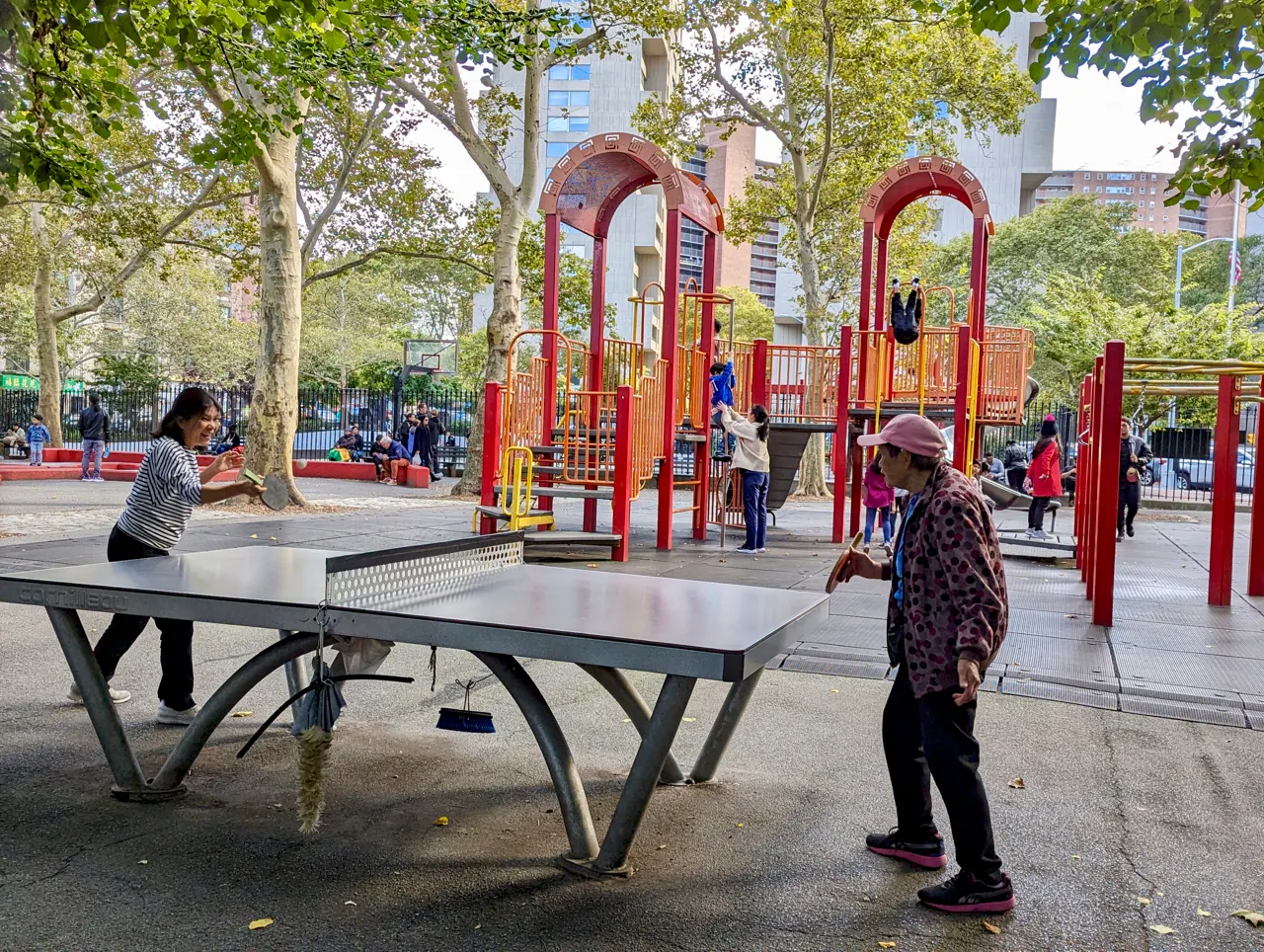
That gap is where the public realm comes in — and it is a lever most public safety strategies never include. A growing body of research shows that investing in an orderly, well-managed public realm sets off a chain reaction: it changes how safe people feel, which increases how much time people spend out in public space, which reduces the opportunities for crime to occur, which, in turn, reduces actual crime. That’s why the design, programming and management of the public realm should be a cornerstone of a community’s comprehensive public safety strategy.
What changes how safe people feel
Researchers increasingly separate two different questions: whether a place is actually dangerous, and whether people feel like it is dangerous. A 2026 study published in npj Urban Sustainability, a Nature-family journal, surveyed 356 residents across three cities in metropolitan Asunción, Paraguay, about their sense of safety in 92 different public green spaces. The finding: visible signs of physical disorder — poor maintenance, broken furniture, vandalism — significantly lowered how safe people felt, while actual crime history in an area did not meaningfully predict how safe people felt. A park doesn’t have to be dangerous to feel dangerous. It just has to look uncared for.
Or, as one Rotterdam resident put it in a similarly themed study: “When it is clean it feels like someone else is looking after it and it belongs to us. It is being taken care of.”
That finding about perception is powerful on its own, but the data also shows a cared-for public realm changes what actually happens, not just how people feel about it. Some of the clearest evidence comes from Philadelphia, where in a randomized controlled trial, researchers cleaned, mowed and planted grass on vacant lots across the city — without turning them into activated gathering spaces — and tracked what happened in the surrounding blocks.

The result: a 29% reduction in gun violence and a 22% drop in burglaries in nearby neighborhoods. Residents living near the lots had their own perceptions shift even more sharply — people reported feeling 37% less worried about crime, 39% less worried about vandalism, and 58% less concerned about safety overall. Notably, this was not about more people gathering in these spaces; the lots were cleared and mowed, not turned into parks. That’s instructive for officials weighing funding decisions: even a modest maintenance investment, with no major capital project attached, moved the needle on both safety and the perception of safety.
The Philadelphia data is not an isolated finding. A study of 301 major U.S. cities found that census blocks with more greenspace had measurably lower rates of both property and violent crime. Separate research on park visitors found that good maintenance and cleanliness (tied closely with tree cover) was the single most valued feature for encouraging people to visit a park, be active in it, and interact with their neighbors there.
The effect isn’t limited to maintenance and greenery, either. A randomized study of public space regeneration in a high-crime neighborhood in Santiago, Chile, found that improving public space significantly raised residents’ perceived safety as well. In the neighborhood of La Chappelle in Paris, a variety of concurrent strategies that include new greenery as well as beautiful bike and walking infrastructure have started to make the area less of a draw for crime and drug activity, according to local leaders.

It is important to note that the areas surrounding a public space deserve equally important focus. Behavioral scientists have long documented a peak-end rule — the finding that people’s memory of an experience is shaped disproportionately by its most intense moment and by how it ends, not by an average of the whole thing. A 2023 study of walking paths and sound in an urban park found this same pattern holds for the experience of moving through green space: whatever a visitor encounters right before a walk ends carries outsized weight in their overall impression. If the sidewalk connecting a park to a neighborhood is broken, poorly lit, lined with vacant lots or noisy, that will be the impression a visitor carries away. A great park surrounded by a neglected streetscape can still be remembered as a bad experience overall, hampering the perception of safety by leaving that last, worst impression.
A virtuous cycle worth investing in
Much of this research points to a self-reinforcing loop, with lessons for local leaders. In fact, when addressing public safety through the public realm, the order of operations matters.

An orderly, high-quality public realm — its design, its programming, and how behavior in it is managed — changes how safe people feel. As perceptions of safety improve, more people use the space: they linger, they let their kids play, they walk through it instead of around it. More than 60 years ago, Jane Jacobs argued that ordinary people going about their day, whether walking, sitting on stoops, or watching from windows, function as a kind of informal “eyes on the street” that deter crime. More people in a well-used public space means more of exactly that kind of informal oversight, which shrinks the opportunities for crime to happen unnoticed. And fewer opportunities for crime lead, over time, to less actual crime.
Get Reimagining the Civic Commons’s stories in your inbox
Join Medium for free to get updates from this writer.
This loop doesn’t happen by accident — it’s something a city can deliberately design, program and manage for. And it gives officials an evidence-based case to make to constituents, department heads and budget committees: the public realm is a public safety investment, not just a quality-of-life amenity.

We’ve seen the cycle play out inside our own network of cities. In Memphis, the investment in the reimagining of a couple small parks with the addition of inviting lighting and new evening programming along the Mississippi River changed how safe downtown felt in a few short years: the share of intercept-survey respondents who said they felt safe downtown at night nearly doubled, from 37% to 68%. Average weekend visitor counts at the transformed River Garden park more than doubled in just four years.

Practical takeaways for public safety
If you are interested in your community both feeling and becoming safer, here are 5 ways to elevate community safety through the public realm
Focus on maintenance, and fix things when they break. As Philadelphia city forester Erica Smith Fichman put it, “maintenance is trust building.” In San José, a routine repair and pressure-wash schedule kept a community mural on a pedestrian street downtown in shape and helped bring visitorship back to pre-pandemic levels. In Camden, New Jersey, the Camden Strong initiative has removed more than 1,300 tons of trash and debris from public spaces over four years — and city officials report a corresponding drop in illegal dumping alongside it.
A classic example of this principle is the clean up of Bryant Park in New York City, which in the 1980s was overrun with drug dealing. A new management nonprofit started to turn the park around with pure maintenance — repairing structures, clearing graffiti, picking up trash, and adding a security presence — and saw crime drop 92% within seven years.

Design for it. When building or redesigning a space, lean on what the research shows works: clear sightlines, planting and caring for flowers and trees, good lighting, activated nearby ground floors and — where there’s a vacant or blighted lot nearby — caring for it. The results can be dramatic. In Detroit’s Fitzgerald neighborhood northwest of the city’s downtown, layered investments in the public realm that included a park and greenway, an upgraded commercial corridor, meadow plantings and new programming increased resident perceptions of safety in the neighborhood at night by 36% — demonstrating the value of these investments on safety.
Staff for welcoming, not just security. Memphis River Parks Partnerships’ Park Ranger program created new positions that combined traditional maintenance and operational roles with work as a kind of park concierge, greeting and assisting visitors and reinforcing clear, welcoming norms of behavior. The organization chose rangers over uniformed security in part because of concerns about how traditional security staff might impact the enjoyment of the park for diverse visitors. The Park Rangers helped underscore the ethos that everyone is welcome — as long as they follow those basic behavior norms — and rangers help set and model that expectation, at a fraction of the cost of policing.

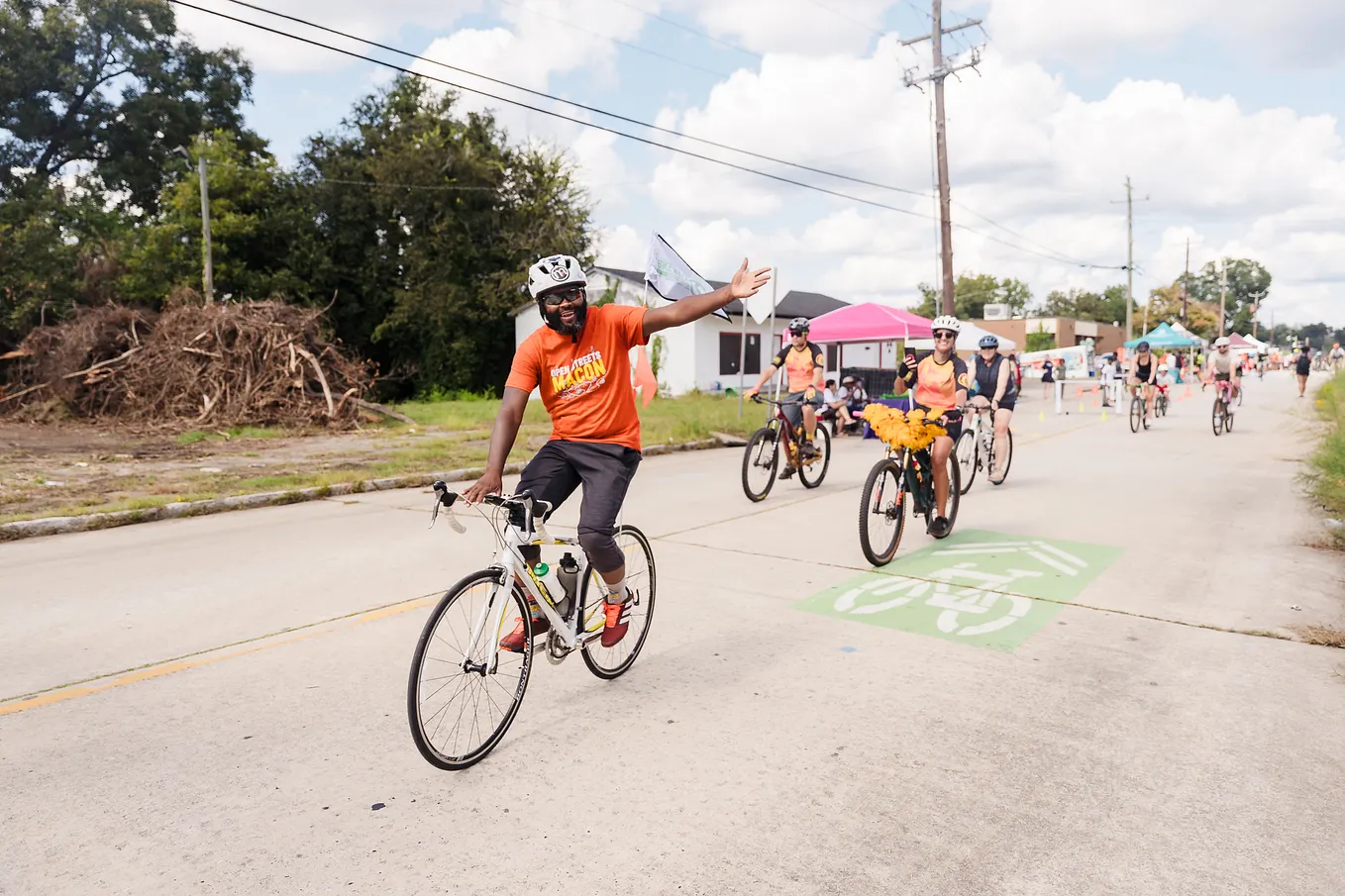
Activate your space. Markets, programs like fitness or dance classes, seating and food or retail kiosks all increase who uses and thus feels partly responsible for a public space throughout the day and especially in the evening — exactly the kind of informal “eyes on the street” that Jane Jacobs described decades ago. Fairmount Park Conservancy has diverse programming in Philadelphia parks that includes popular weekly walking clubs, dance classes, evening stargazing and large culinary events — a robust calendar of regular activity that keeps people flowing into spaces at all times of the day.
Invest in quality connections. A park, library or trail is only as welcoming as the spaces that surround it. Reimagining the Civic Commons’ network of cities has found that closing gaps between public spaces changes how safe and connected a whole neighborhood and its residents feel. For example, in Lexington, Kentucky, residents who live near Addison Park faced walks of 20 minutes or more to reach a park that was, in a straight line, only five minutes away due to fences and limited access points. A community survey found that 54% of respondents named pedestrian connections and accessibility as their top priority, and the city is now completing sidewalks and adding more entry points in response — actions that research shows will help with the perception of safety in the public spaces themselves.

Track and report progress. Having public space practitioners, advocates and even residents track perceptions of safety alongside other metrics, and reporting the results, can build support for current and future efforts. Our open-source measurement toolkit includes observation maps and intercept surveys that track the perception of safety in public space and surrounding neighborhoods; the frequency of visits; trust in others and in institutions; and who’s actually showing up to visit — tools any organization can adapt to track their investments.
The bottom line
The data is clear: crime is down, but plenty of people don’t feel it yet. Well-managed, well-maintained public space is one of the few tools that moves both numbers at once — people’s perceptions of safety and the actual crime rate. That gap can be closed best from the ground up: in a city that keeps its parks, plazas and streets clean, well lit and actively managed. That’s the safety dividend: investment in the public realm shows up first in how safe a place feels, then in how safe it actually is. It compounds every year a city keeps paying into it, and is a public safety strategy worth pursuing in every community.
Reimagining the Civic Commons is a collaboration of the JPB Foundation, the John S. and James L. Knight Foundation, The Kresge Foundation, William Penn Foundation, and local partners.