Skeuomorphism
How language quietly designs the way we use technology

I love words. And I love people who love words; the kind of people who treat a syllable like a vintage wine, swirling it around to catch the notes of Latin or pause over a phrase the way others linger over a painting, the ones who notice when a metaphor quietly runs the show.
Because metaphors do run the show. Lately, I’ve been looking at my screen and realizing that our digital lives are essentially high-tech metaphors.
The ghosts in the machine
The digital world is haunted.
Not by bugs (though, yes, those too), but by ghosts of manila folders, metal filing cabinets, paper stacks, and recycling bins that once sat under actual desks. We didn’t just build computers; we imported an entire physical world into them.
Early designers needed a bridge from the analog world to the digital one. So they borrowed what people already understood.
When personal computers first entered homes, people were intimidated by “command lines” (typing code). To fix this, designers created the Desktop Metaphor.
We are linguistically and visually “scared” to move on. Even though a computer can organize data in ways a physical desk never could (like having one file exist in two places at once), we limit the computer’s potential by forcing it to act like a piece of wooden furniture.
You don’t need to learn a new system, they said. You already know this one.
And it worked.
Re-learning is harder than remembering. Isn’t it?
My folder problem
I knew exactly what a folder was. I used them in school…labeled, color-coded, slightly crumpled at the edges. Fast forward to now…I have hundreds of “folders” on my computer.
Do I treat them like real folders?
Absolutely not.
Real folders have limits. They bulge. They tear. They shame you into organizing. And the minor tragedy of a papercut from a tab.
Digital folders? Infinite. Silent. Patient. They don’t judge. They just quietly enable chaos.
At some point, “folder” stopped meaning a physical object and started meaning… “a vague promise that I’ll organize this later.”
In geometry, the folder icon is just a trapezoid. Now we recognize it as “the place where files go” only because we’ve been conditioned to.
This is the curious paradox of skeuomorphism, which is a fine linguistic way of saying we’re too scared to invent new shapes, so we cling to the old ones.
If we called it what it actually is (a “Sub-Dimensional Data Bucket” or a “Hexadecimal Pointer”), it would be technically accurate but emotionally exhausting.
Nobody wants to “Drag and Drop the PDF into the Sub-Dimensional Data Bucket.” It sounds like a chore from Star Trek. We would rather pretend we are moving a “paper” document into a “folder” because it gives us a sense of physical agency in a world that is actually just shifting electrons.
The Desktop (That Isn’t)
Then there’s the “Desktop.” My actual physical desk is a chaotic landscape of coffee mugs, a rogue stapler that doesn’t work, and a single mysterious screw I found sometime ago that I’m afraid to throw away.
My digital desktop is where the “desk” metaphor finally loses its grip on reality. We tell ourselves we’re “saving” work there, but in the physical world, spreading your most important documents across the literal surface of your desk isn’t an organization strategy.
If you walked into a meeting and told your boss your filing system was “tossing everything onto the mahogany desk and hoping for the best,” you’d be handed a cardboard box and escorted from the building. Yet, on our screens, we treat this digital tabletop like a cozy, high-tech junk drawer, proving that we don’t actually want a desk; we just want a place to leave our mess where it’s easy to find.
We only get away with it because digital clutter doesn’t take up physical space or gather actual dust. We’ve redefined the word “Save” to mean “toss it on the pile,” which is the exact opposite of what saving something (like in a safe or a file cabinet) used to mean.
Streams that don’t flow
A stream is water. It moves, continuous, alive, slightly unpredictable. You dip your hand into it; you don’t own it.
Get Scindia Edwin’s stories in your inbox
Join Medium for free to get updates from this writer.
Now we “stream” movies.
Which is oddly accurate, if you think about it. You don’t hold the file. You don’t own the thing. It flows past you, available in the moment, gone when the connection drops.
Some metaphors age poorly. Others age brilliantly.
The Auditory Illusion (The “Digital Crunch”)
Most digital actions are silent; moving a file is just a change in a database. However, humans have spent thousands of years interacting with a world that makes noise. Deleting a file by clicking a button feels “empty.” Without feedback, we aren’t sure if the action actually happened. Designers added the “crumpled paper” sound.
There is no “compactor” inside an SSD (Solid State Drive). By using the sound of trash being crushed, tech companies are performing a “magic trick” for our brains…giving us a physical dopamine hit for a purely mathematical event.
The Nautical Origin of “Logging On”
The word “Log” comes from the maritime tradition of a “chip log”, a literal piece of wood thrown overboard to measure a ship’s speed. The results were written in a Logbook. When I was a kid, “logging on” felt like an event. It was an intentional act; you sat down, connected the modem, and officially “entered” the digital space.
Today, we don’t “log on” because we never leave. Our devices are appendages. The “event” of going online has been replaced by a state of permanent presence.
The “Feed” vs. The Reader
The word “Feed” (like a Twitter/X feed, Instagram feed, or RSS feed) is a powerful and slightly dark metaphor. “Reading” is an active verb. You choose a book, turn the page, and engage your brain. “Feeding” is something done to you.
We aren’t reading; we’re being fed. Like livestock. Or very pampered goldfish.
We don’t hunt for information anymore; we sit with our mouths open while the “Feed” dumps a continuous stream of data into our consciousness.
The Cloud
When engineers in the 90s didn’t want to draw the messy, complicated guts of the internet, they just drew a fluffy, white blob and labeled it “the network.” Now, we “upload” our lives to it as if our data is drifting peacefully through the stratosphere.
But our data is actually in a “windowless, air-conditioned warehouse.” These are massive, power-hungry buildings (Data Centers) filled with server racks.
If Apple or Google asked you to “Backup your children’s photos to our Massive Industrial Heat-Generator,” you would probably say no. It sounds dangerous, metallic, and dirty.
Artificial Intelligence
We call it “Artificial” from the root artifice, meaning a trick or a deception and “Intelligence,” a word we still can’t quite define for humans, let alone machines.
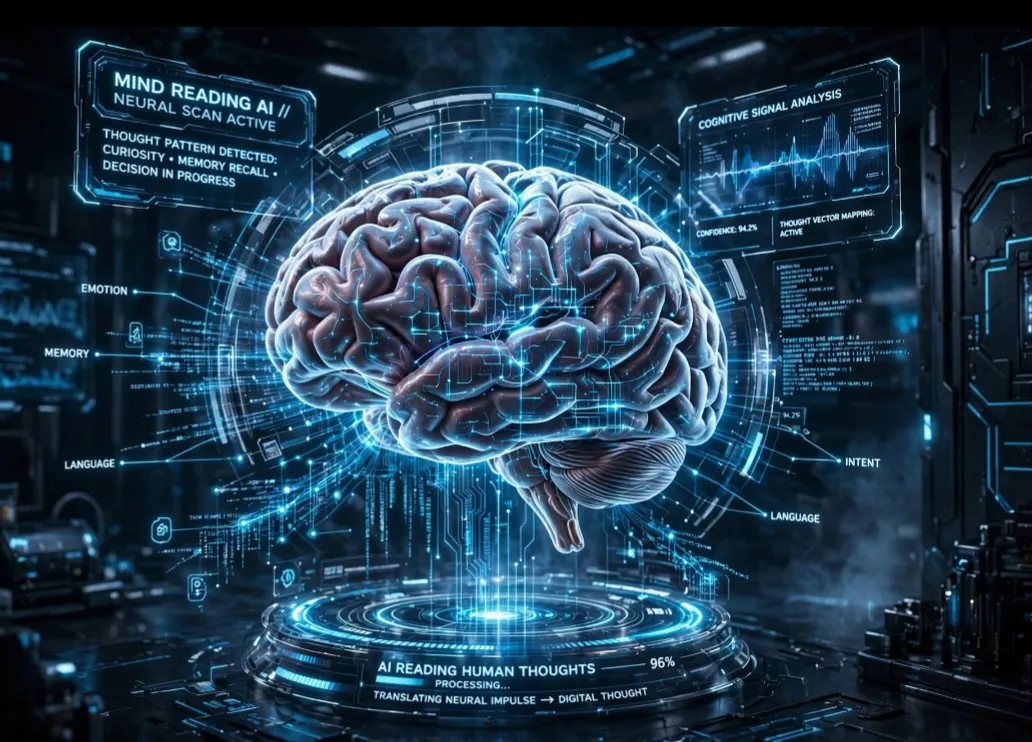
We are so desperate to turn our code into a companion that we’ve raided the biology textbook for metaphors. We say the machine “Learns,” it has “Neural Networks,” and it possesses a “Memory.”
We say the AI is “Hallucinating” when it gets a fact wrong, which is a poetic way of saying the math didn’t add up. We’ve moved from the “Desktop” to the “Brain,” still using metaphors as a bridge to cross the uncanny valley. We don’t want to admit we’re talking to a very fast calculator; we want to believe we’re talking to someone in the machine.
The Great Digital Vanishing Act
What happens when the metaphors finally collapse? We’re already seeing it. The folders within folders that forced us to act like obsessive librarians is being replaced by the magic of Digital Teleportation.
In this new era, Search is the new Sort.
We no longer care where a file “lives” as long as the algorithm can summon it from the mist with a single keyword.
We are moving from a world of Nouns (physical objects we control) to a world of Verbs (flows we merely inhabit). This is the ultimate promotion…we’ve gone from being librarians of our own data to being pilots of our intent. By losing the “Folder,” we gain the “Find.”
I reckon we aren’t losing the map; we’re finally moving so fast we don’t need one. We’ve stopped managing the machinery and started mastering the momentum.
One last thought
Language doesn’t just describe reality. It designs it. The next time you “open a window” or “empty the trash,” remember you’re participating in a story someone wrote decades ago to make a machine feel human.
And we understood it instantly. That’s not just good design. That’s poetry. With a recycling bin.
I should probably organize my folders now.
I won’t. 😉
Time to close this window, clear the cache, and let the stream flow on.
Goodbye.
Edited for Restless Quills by Wandering Mind