
Large Language Models (LLMs), such as ChatGPT developed by OpenAI, have garnered considerable attention in the field of artificial intelligence. These models, trained on extensive corpora of text data, demonstrate remarkable capabilities in generating coherent, contextually relevant, and creative text. Although LLMs are poised to revolutionize various industries, they possess inherent limitations that warrant attention. This article will delve into the technical aspects of LLMs and ChatGPT, their potential impact, their weaknesses, and the solutions offered by companies with complementary contributions to the field.
Large Language Models, including ChatGPT, represent a cutting-edge advancement in artificial intelligence. Based on the Transformer architecture, these models utilize attention mechanisms to process vast quantities of text data, enabling them to generate coherent, contextually relevant, and creative text. LLMs’ addressable market is extensive, encompassing industries such as content generation, customer support, education, and healthcare, among others. With a broad range of applications, LLMs have the potential to significantly alter the global landscape.
Despite their potential, LLMs exhibit several technical limitations. Firstly, LLMs rely on static data snapshots, which can lead to outdated and inaccurate information. Secondly, while LLMs are proficient in generating conversational text, they may struggle in applications that require structured data, as their outputs are inherently unstructured. Thirdly, LLMs are nondeterministic, utilizing probabilistic architectures that can result in inconsistent and potentially misleading outputs. Finally, LLMs are prone to generating “hallucinations,” where they produce text that appears accurate but is ultimately fabricated due to the model’s reliance on language patterns instead of a structured knowledge base.
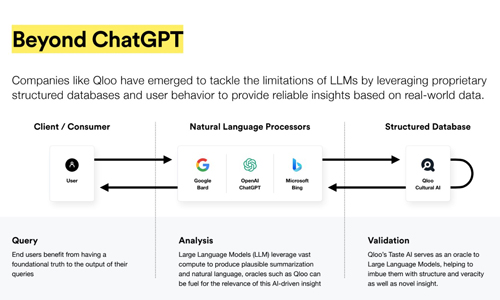
Companies like Qloo have emerged to tackle the limitations of LLMs by leveraging structured databases and user behavior to provide reliable insights based on real-world data. Qloo’s approach stands in contrast to LLMs, which rely on vast amounts of third party textual data from sources like Reddit and StackOverflow that are then used to train the models. As data becomes the new oil in the era of AI, companies are capitalizing on the value of structured, high-quality data to drive decision-making. In addition to Qloo, other companies in this space include Wolfram Alpha, which provides computational knowledge through its plugin for ChatGPT, offering a more reliable and deterministic source of information. Another example is IBM Watson, which combines natural language processing with structured databases to deliver intelligent solutions for various industries. These companies offer alternatives and support to LLMs, ensuring accuracy, consistency, and up-to-date information, while also contributing to the commercialization and commoditization of training data.
Qloo, in particular, has made significant strides in overcoming LLM limitations. They set themselves apart by having fully proprietary and owned data, consisting of an extensive entity database, consumer behavior data, and AI-driven insights. This unique approach ensures that Qloo’s data is reliable, up-to-date, and exclusive to the company, providing a competitive advantage in delivering accurate data and actionable insights. For instance, Qloo has proprietary data pipelines including first party consumer sentiment databases such as the popular TasteDive recommendation platform. By maintaining control over its data sources and ensuring their quality, Qloo stands in contrast to services like ChatGPT, which relies on vast amounts of unstructured textual data from various sources. Qloo’s proprietary data and tailored AI algorithms enable the company to deliver precise and valuable insights, demonstrating the power of combining structured data with AI-driven analytics in the ever-evolving world of artificial intelligence.
Some use cases for these hybrid structured-LLM AIs could be connected cars with voice assistants and multi-context recommendations, which would benefit from structured data providers and LLM integration, enhancing user experiences. In dating applications, entity and sentiment databases can enable AI-generated compatibility analyses, which can be combined with LLMs for rich shared-interest summaries and conversation icebreakers. For retail, CPG, and global brands, structured data sources reveal brand correlations, enabling LLMs to transform insights into creative campaigns and strategies, all supported by real consumer insight.
Large Language Models, including ChatGPT, possess immense potential to transform various industries. However, their technical limitations must be considered to ensure their safe and effective use. Companies like Qloo are addressing these limitations by providing insights firmly grounded in reality. As AI technology continues to advance, the integration of solutions like Qloo’s will be essential for harnessing the full potential of AI while mitigating its shortcomings.
Ethical considerations also play a crucial role in the development and deployment of LLMs. While these models can provide valuable insights and assistance, they may inadvertently reinforce biases present in the training data, leading to ethical concerns about fairness, transparency, and accountability. Addressing these challenges requires continuous collaboration between AI researchers, industry leaders, policymakers, and ethicists to establish guidelines and best practices that ensure responsible AI development and use.
A more comprehensive approach to LLM deployment involves combining the strengths of various AI technologies to create hybrid systems. By integrating LLMs with structured data sources, domain-specific knowledge bases, and expert systems, AI developers can create more robust and reliable solutions. This approach can improve the quality of generated content, enhance decision-making processes, and provide more accurate information to users. Furthermore, incorporating real-time data updates can help LLMs stay current, mitigating the risk of outdated information.
In addition to improving the accuracy and reliability of LLMs, companies like Qloo also emphasize the importance of user privacy and data security. By maintaining control over their data sources and ensuring data quality, these companies can better protect users’ sensitive information and prevent unauthorized access. Developing secure and privacy-preserving AI systems is essential to maintaining public trust and fostering the widespread adoption of these technologies.
As the AI landscape continues to evolve, it is crucial to recognize and address the limitations of LLMs, such as ChatGPT, while harnessing their potential to transform various industries. Companies like Qloo, Wolfram Alpha, and IBM Watson are leading the way in overcoming these limitations by offering complementary solutions that integrate structured data and AI-driven analytics. By working together, these companies can create more accurate, consistent, and up-to-date AI systems, paving the way for a new era of innovation and growth in artificial intelligence.
Related Categories