
PandaDoc is on its way to becoming a brand we all know and love. Once a unicorn startup, the brand has grown to unprecedented heights in the past year. As for where it stands today, the company is currently valued at well over a billion dollars.
This success would not be possible without PandaDoc’s great team backing its every decision and cause. Which is why we’re so excited to present one of the company’s Demand Generation team members, Hanna Stechenko, for our interview today!
In this interview, we’re covering how Hanna, as the Senior SEO Content Manager, improved the website traffic by building a strategy for PandaDoc’s Blog and Ask pages, how she analyzes content, and what advice she has for people who are looking to build an SEO content strategy for their own business.

How do you define SEO content, and what do you think is its importance in the current digital landscape?
In my opinion, SEO content is a form of marketing focused on creating, publishing, and distributing engaging and optimized content for organic growth.
SEO content doesn’t need to be content that’s inundated with keywords and optimized for the search engine only. It can also be content that is fresh and actionable, and still has keywords, backlinks, and all the necessary aspects of ranking higher on SERP (search engine results page).
The reason why it’s so important in the digital landscape is because it helps your content become more “searchable.” I mean, what’s the point of investing so much in content if no one is going to see it?
What’s something that folks often get wrong about SEO content?
Many people treat SEO and content as two separate ideas. While they can technically work separately, you get the best results when both SEO and content work closely together. You can’t choose one over the other, nor should you, because if you do you’ll end up spending a lot of money on branding without many eyeballs to show it to.
Although SEO content is not the sole bearer of website growth, you can use it as a tool to educate, inspire, show new perspectives, help the right people find the right solution, and avoid duplicate content that might affect your ranking or traffic — all in all, when SEO and content work in unison, they sure as hell can help you grow your business and convert prospects.
How do you separate SEO from content marketing?
I don’t believe SEO and content are separate, but if I had to give them separate identities, I would say that SEO is more technical, whereas content marketing would refer to all types of marketing channels, such as blogs, webinars, social media, etc., that are aimed at educating or engaging targeted audiences.
If you have two different departments allotted to content and SEO, I would advise both departments to work together, or at least have some type of working cross functionality where you can collaborate to understand what your target audience wants and work to deliver the content they need without them having to search a lot for it.
You’ve brought excellent results for the PandaDoc blog with SEO. Can you explain the strategy you used?
There is a mix of a lot of things I did and examined to accomplish the results we’ve seen at PandaDoc. For example, I referred to the SEO pyramid suggested by Yauhen Zaremb (Sr.Director Demand Generation PandaDoc), which basically divides content into eight categories depending on intent and the search volume.
At the top of the pyramid are “brand terms,” and the bottom of the pyramid has “general terms.” Solution, integration, alternative, competitor, problem, and upstream and downstream terms are in the middle.
I had to understand which keywords would best fit in particular clusters and what type of traffic would they help bring in.
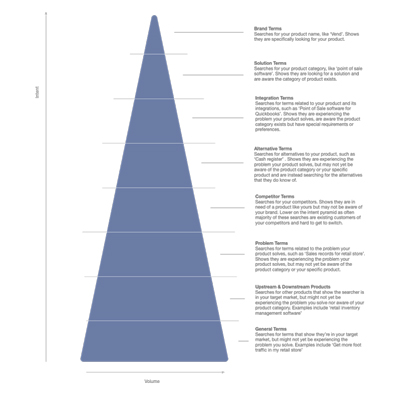
To achieve results at PandaDoc, we also stay focused on the funnel to understand what type of content (top of the funnel, middle of the funnel, bottom of the funnel) would work at which stage.
Rankings are important, but it’s also important to consider the quality and search intent of the content and topics you create — for context, when I have a list of keywords with me, I analyze search intent, quality of articles on SERP, content gaps, hooks, etc., to find ways to educate my audience without overpromoting my product (this allows me to get better outcomes, increase page views, and improve the way prospects get converted).
For example, two of PandaDoc’s blogs, “Best electronic signature software” and “How to write a technical proposal,” saw 167% and 51% increases in page views, respectively, using this strategy.
On that note, another key factor that worked well for us was PLG (product-led growth) content (according to Content Folks, PLG content is defined as “any type of content that strategically weaves a product into the narrative and uses it to illustrate a point, solve a problem, and/or help the audience accomplish a goal”).
Obviously, every strategy has to be customized to the business’s needs, but PandaDoc particularly benefited from these separate processes to build a strategy as a whole.
Oh, and last but not least, you can’t bring in excellent results without an excellent team. I’d urge you to build a team of truly terrific content partners who are willing to take feedback and collaborate with you to bring your vision to life — you need a team that understands the importance of valuable content and helps support your efforts of strategizing and developing it.
How do you decide which topics to cover and how often to publish content?
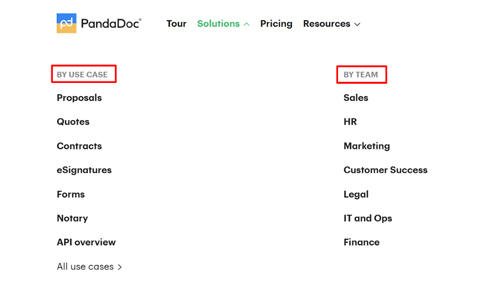
To begin with, the PandaDoc team checks all relevant keywords. Our keywords are categorized according to search solutions, roles, or use cases, e.g., proposals, templates, signatures, contracts, and more. Usually, we search for keyword clusters (First Page Marketing defines keyword clusters as “groups of keywords that represent users with similar search intent”).
We usually use Ahrefs to identify all topics related to the products, and we also try to prioritize the MRR (monthly recurring revenue) keywords —- these keywords bring the most amount of signups, conversion, and hence profit for us. At the present moment, we are trying to expand
clusters of these keywords to ensure we’re covering every specific keyword related to the topic and, ultimately, to our solution.
As far as frequency is concerned, we previously (one year ago) used to publish six articles a month. Presently, we’ve increased the frequency of content uploads and content updates, and we usually publish around 15 articles a month, and over 70-80 content updates.
The frequency of content uploads boils down to how much you invest in content and what conversations you want to have. For example, although 15 articles a month is a good place for PandaDoc considering our topic clusters, the average number of readers, and hot topics trending in our niche, it need not be the only guiding point. I know a marketer who chooses to upload only one high-quality article every few months and still sees impressive results. That’s because there’s no one key way or secret to success.
That being said, as far as the SaaS industry is concerned, content marketers need to consider consistency, mainly because of factors like the Query Deserves Freshness (QDF) Algorithm by Google. Search engines give prominence to websites that are consistent in their publishing cycle, and they hence see better ranking rates. Of course, this is not the key indicator, and there are exceptions to this rule, but consistency still has an impact.
So, to summarize, the frequency depends on two factors. The first revolves around your budget, how many keywords you have, and what your chances are in the market from an SEO perspective. Second, will you be able to consistently upload the same or better quality content at the same frequency for at least a year?
If you were starting again from square one, what advice would have helped you most on how to build a killer SEO content strategy?
First is to hire good people — after all, creating content is all about people. Even if you have one person on your content team who values your product and appreciates your business as much as you do, then that person can become the main key to your success.
In my opinion, you’ll see better results when you partner with people who are willing to do their share of the work and not just take credit. Another piece of advice is to select a team with whom you can be transparent with, give feedback to, and who can help you navigate what works and what doesn’t — because no matter how much money you invest, it won’t make a difference if you can’t see the results. So, yeah, hiring the right people makes the vast majority of difference.
Are there any tools/resources you use to build an SEO strategy?
To build an SEO content strategy, I use old-school Excel sheets. Ahrefs is another tool that’s on my tech stack to do keyword research and analysis.
Aside from these, I also use Miro Boards to visualize keyword clusters, Google Analytics, Google Documents to write content briefs, edit articles, and for the necessary documentation. We also use software like Clearscope and Grammarly, and plagiarism checkers to inspect the quality of the article. In the near future, we’ll also be using AI to optimize our workflows for outreach content and for writing meta tags.
To wrap it up
While SEO Content might seem like a challenging bridge to cross, the very first step to conquering it is simply to begin. While we hope this interview presented you with some great insights, we’ve got another resource to leave you with: PandaDoc’s blog.
If you wish to know more about SEO Content strategy from Hanna, your best bet would be to keep up with the PandaDoc blog, as she often posts her insights there. Aside from that, you can also stay in touch with her on her LinkedIn page.
Related Categories