The Number We Have Known for 4,000 Years — But Still Do Not Fully Understand
√2 can be drawn with a square, approximated with astonishing accuracy, and proved irrational in a few lines. Yet its digits still hide questions mathematics cannot yet answer.
Nearly four thousand years ago, somewhere in ancient Mesopotamia, someone pressed a stylus into a small piece of wet clay.
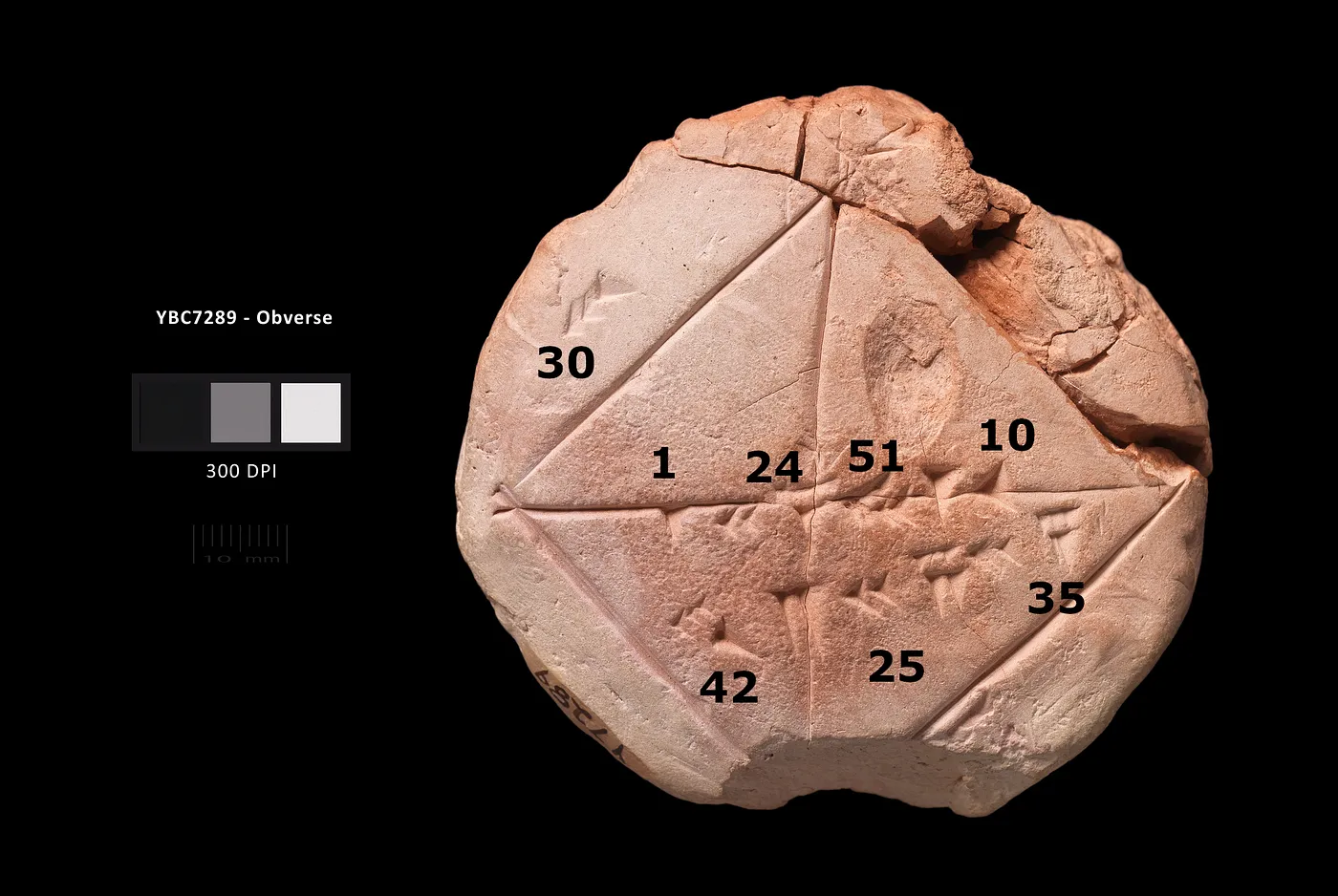
The tablet shows a square, its diagonals, and several numbers written in the Babylonian base-60 system. Today it is known as YBC 7289, and it is one of the most remarkable surviving mathematical objects from the ancient world.
Press enter or click to view image in full size
Babylonian clay tablet YBC 7289, with modern annotations identifying the inscribed numbers. The diagonal records the sexagesimal approximation 1;24,51,10 for √2, equivalent to 1.41421296…, while the tablet also shows a square side of 30 and a corresponding diagonal of 42;25,35. Source: Urcia, A., Yale Peabody Museum of Natural History; labeled derivative by Theodor Langhorne Franklin. Wikimedia Commons, CC0 1.0.
Along one diagonal appears the number 1; 24, 51, 10. In our decimal notation, this means
Color me unimpressed. Those Babylonians clearly just measured the diagonal on that clay tablet with a Babylonian base-60 ruler. If they had been more precise they would have discovered 0 in the 108th position.