Mes Esame Visur: The Same Circle Behind Every Door I Knocked On
The woman who wrote my union's harassment rules heads communications at a centre that sells harassment training. It belongs to a coalition that Ombudsperson Birutė Sabatauskaitė's partner headed in 2025. I followed the circle through public records.

“Mes esame visur” is Lithuanian for “we are everywhere”, a long-standing slogan of the LGBT movement. It answers those who pretend that queer people are rare, or live somewhere far away: they are in every family and every workplace, whether anyone chooses to see them or not. I know what the slogan means. In that context I stand behind it, and I always will.
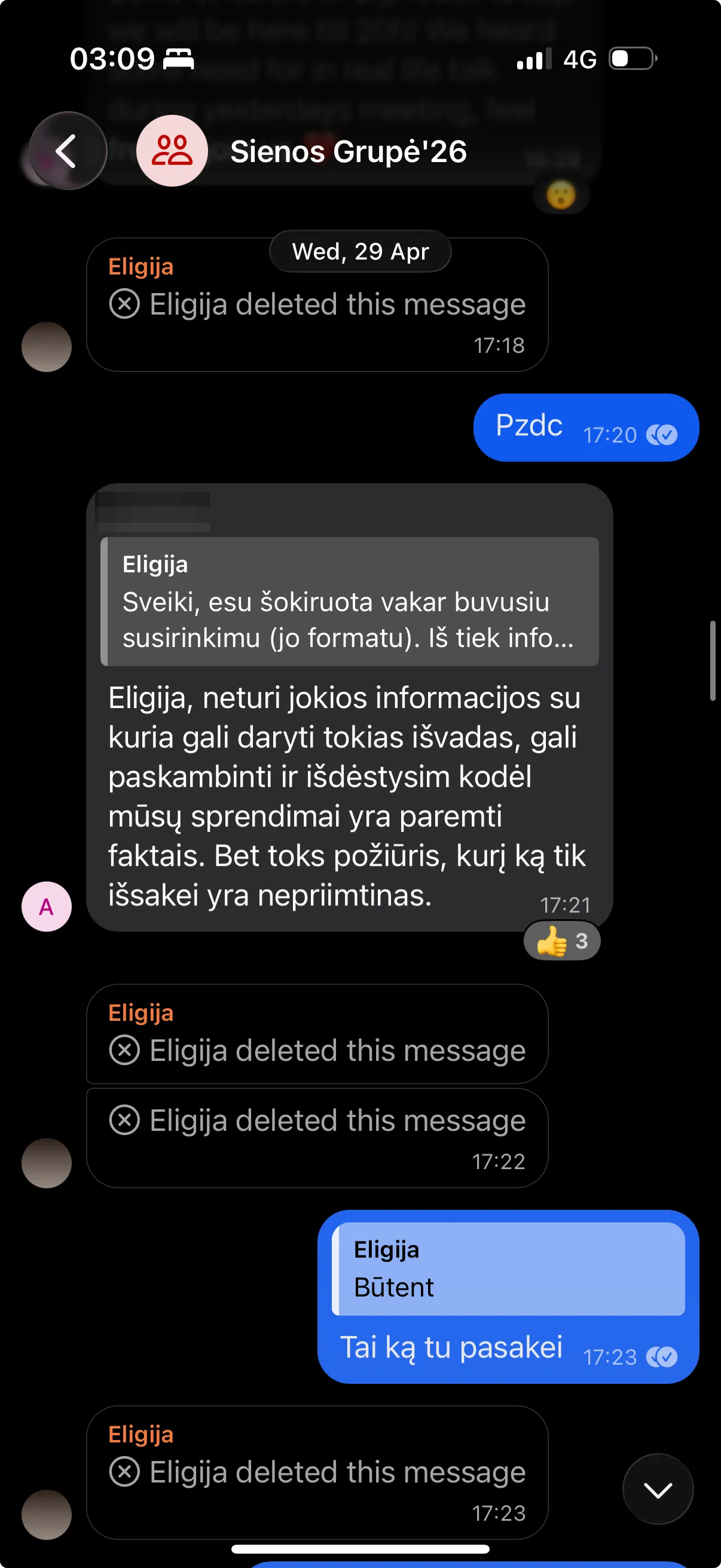
This year I learned what the same three words sound like from the other side of a closed door. In May 2026 my husband Andrei and I reported harassment and its cover-up at two progressive Lithuanian organisations, the NGO Sienos grupė and the trade union Gegužės 1-osios profesinė sąjunga (the May 1st Labour Union, G1PS). Since then I have carried that complaint to every door I could find: the union’s own procedures, the Equal Opportunities Ombudsperson Birutė Sabatauskaitė, the ethics commission VTEK, the union’s foreign donor and the specialist NGOs. Behind each door I found the same small circle of people, or their partners, their colleagues and their clients.
That, in my view, is the sinister side of “we are everywhere”. When the people you complain about and the people who rule on your complaint belong to one circle, the slogan describes a wall. Five months in, my conclusion is that I cannot get justice anywhere in this country, because the same people sit in literally every room I walk into. In my view, Lithuania’s equality sector works like a family business, and a complaint against one of its members is treated as an attack on the family.
On 16 October I wrote to my polyclinic that I was having thoughts of suicide. In my view, two things brought me there. The day before, Guerrilla Foundation, the union’s donor, sent me its final letter and closed my complaint without ever having asked me a single question. And Emil Starodubov, who chairs the union and signed our expulsion, wrote to me privately that I was persecuting and humiliating him. I am putting this near the start because it is the most accurate measure I have of what these closed doors cost.
Every fact below comes from public documents: a state register, annual reports, the organisations’ own websites, and letters addressed to me. Every interpretation is marked as my own.
The woman who wrote the rules
In June 2024 Viktorija Kolbešnikova, then a member of the union’s board, reported to its general meeting on her work. She had initiated the union’s behaviour guidelines, she said, „todėl kad iškilo tam tikri atvejai kai buvo psichologinis smurtas ar seksualinis priekabiavimas“ (because certain cases of psychological violence or sexual harassment had come up). She had also set up a mailbox for such cases: „Sukurta pašto dėžutė, kurią skaitau tik aš“ (a mailbox has been created which only I read). She was glad that „kol kas negavau nei vieno laiško“ (so far I have not received a single letter) [E001a]. The minutes are filed in the Register of Legal Entities. I opened my post about our expulsion with those words, because in July 2026 the same guidelines, written into the union’s statutes that June, were used to expel Andrei and me.


In my view, a mailbox that only one person reads is a drawer, and its owner keeps the key. In a union where, by her own account, psychological violence and sexual harassment had already happened, zero letters does not tell me that the harassment stopped. In my opinion it tells me that nobody trusted the drawer. Who checks a mailbox that only its owner reads? In my view, it was a fig leaf for the union, and it stayed one.
Her day job is less visible to the union’s members. On the team page of the Lygių galimybių plėtros centras (Centre for Equality Advancement, LGPC), a Vilnius NGO that has worked on gender equality since 2003, she is listed as „Ekspertė ir komunikacijos vadovė“ (expert and head of communications). The centre’s annual report for 2024 names her as its head of communications. In 2024, then, she sat on the union’s board and ran communications for a gender-equality centre at the same time.

The centre sells training. Its offer for „verslo įmonėms, viešosioms įstaigoms“ (businesses and public institutions) includes a session called „Seksualinio priekabiavimo atpažinimas ir prevencija“ (recognising and preventing sexual harassment). The organisations that bought its trainings, seminars or lectures in 2024 included AB Swedbank, KPMG Baltics, the Competition Council and two ministries. Its report for 2025 says „PADĖJOME įmonėms ir įstaigoms kurti saugią darbo aplinką“ (we helped companies and institutions to build a safe working environment), and names the fight against sexual harassment among the means. The same report criticises Lithuanian sports organisations because most of them have no provisions on non-discrimination, gender equality or the prevention of sexual harassment in their statutes, strategy documents or codes of ethics, and concludes: „Deja, nusiteikimo imtis konkrečių veiksmų lyčių lygybei ir smurto prevencijai užtikrinti sporte kol kas nematome“ (unfortunately, we do not yet see any readiness to take concrete action for gender equality and violence prevention in sport).


The union whose rules she initiated did write such a provision into its statutes, in June 2026. The first use of it that I know of was against the two people who had reported harassment.
In my view, harassment prevention in this circle is a product. It is sold to banks and ministries, and demanded loudly from basketball federations. Inside the circle’s own trade union, the only form it took that I ever met was a rule used to throw out the people who reported harassment. Does harassment prevention in Lithuania stop at the door of the trainer’s own union? In my opinion, the word for this is hypocrisy.
In July 2026 G1PS described its safeguards to the Lietuvos administracinių ginčų komisija (the Administrative Disputes Commission). Besides the guidelines, it wrote, the union „administruoja atskirą el. pašto adresą, į kurį nariai gali kreiptis užtikrinant visišką konfidencialumą“ (administers a separate e-mail address to which members may turn in full confidentiality) [E088]. Andrei had reported through the union’s web form on 22 May. Within a day we had both been removed from the consultants’ channel [E041, E042]. Nobody who reads that mailbox has ever written to either of us, and neither has Kolbešnikova. In my opinion, the commission was shown the shop window. Andrei and I were shown the back door. In my view, that is safeguarding as public relations.


On the evening of 26 May a member of the union’s board, Saulė Paulikaitė, wrote to Andrei that the chair at the time, Tomas Marcinkevičius-Baronas, had confirmed that four people would not come to the meeting we had asked for: „Agnė, Jurgis, Emilija ir Viktorija nesutiko dalyvauti susitikime“ (Agnė, Jurgis, Emilija and Viktorija did not agree to take part in the meeting). She called the four „apkaltintiems asmenims“ (the accused persons) [E046, E046g]. Two days later the chair wrote publicly that those accused of covering the cases up did not want to take part because the meeting would remind them of a public trial [E064]. We had never accused Kolbešnikova of anything. The fourth person we had named was Vuk Vukotić, a Sienos grupė board member who is also in the union, and Kolbešnikova I had tagged on my own Facebook as someone who works on women’s rights. When Andrei asked why Viktorija was on the list, Paulikaitė answered: „nežinau, minėjo Viktoriją, bet gal turėjo omenyje Vuką?“ (I don’t know, he mentioned Viktorija, but maybe he meant Vuk?) [E046g].

In my view, a guilty conscience needs no accuser. The woman who wrote the union’s harassment rules was nobody’s suspect, and her name still came up among the accused who refused to come. Why would a woman nobody had accused turn up on the list of the accused who would not face us? I had called on her as an expert on women’s rights, and in my reading she answered as one of the accused. The way Paulikaitė passed the list on told me that she was not on our side either.
Since then I have tagged Kolbešnikova and the centre in my public posts about this case. Kolbešnikova blocked me. On Facebook, LGPC hid my comments and answered the people commenting under its posts by calling them bots. I was one of those “bots”. I had tagged both of them by name, so in my view they could not have failed to know who I was.
In my opinion, a centre that teaches employers to recognise sexual harassment showed on its own page how it treats a woman who reports it: it hid her words and called her a bot. In my view, “bot” is the cheapest way to say that a woman with a documented complaint is not a person. I keep meeting the same thing in this story: it is easier to block a profile than to answer a human being. When did a gender-equality centre start calling a woman who reports harassment a bot? In my view, this is dehumanisation.
The circle, one document at a time
The centre is one of thirteen members of the Žmogaus teisių organizacijų koalicija (Human Rights Organisations Coalition). Another member is the Lietuvos žmogaus teisių centras (Lithuanian Centre for Human Rights).

In 2025 the coalition was led by Jūratė Juškaitė. The source is the private-interests declaration of the Equal Opportunities Ombudsperson, Birutė Sabatauskaitė, filed on 11 August 2025. It names Juškaitė as her partner and gives her post as director of the Lietuvos žmogaus teisių centras. It also records that Juškaitė sat on the coalition’s board from February 2021, had been its „Vadovas“ (head) since 18 April 2025, and since May 2025 had been employed there as advocacy coordinator [E003]. The coalition’s website now lists Urtė Žukauskaitė-Zabukė as chair of the board and director, and names Juškaitė among the members of its 2026–2028 board. I do not know when the leadership changed. I wrote about that declaration, and about the decision in which Sabatauskaitė refused to examine my complaint, in Ten out of ten on human rights.

Before the Seimas first appointed her Ombudsperson, Sabatauskaitė herself led the Lietuvos žmogaus teisių centras. LRT, the national broadcaster, said so when the Seimas reappointed her in May 2026: „Prieš paskyrimą lygių galimybių kontroliere B. Sabatauskaitė vadovavo Lietuvos žmogaus teisių centrui“ (before her appointment as Equal Opportunities Ombudsperson, B. Sabatauskaitė led the Lithuanian Centre for Human Rights). Her partner is its director now.
The office of Ombudsperson Birutė Sabatauskaitė itself announced on 1 April 2021 that Sabatauskaitė had worked at the centre as a lawyer from 2010 and had been its director since 2013: “Since 2013 she has been the Director of the Centre and also the Head of Law and Advocacy” (lygybe.lt). Her own declaration shows that Juškaitė has worked at the same centre since 4 July 2017 [E003], which means almost four years under Sabatauskaitė’s directorship. In October 2021 LRT introduced Juškaitė as the head of the Lithuanian Centre for Human Rights with these words: „Nuo šių metų ji vadovauja vienai seniausių Žmogaus teisių organizacijų šalyje“ (since this year she has led one of the oldest human-rights organisations in the country) (LRT). So in 2021 one of them left the centre for the state’s equality office, and the same year the other took the centre over. Are posts in Lithuania’s human-rights sector handed down at home? In my opinion, there is an old word for this, and it is nepotism.


In 2025 that centre bought training from Kolbešnikova’s centre. LGPC’s report for 2025 lists the Lietuvos žmogaus teisių centras among the organisations that „mūsų mokymus, seminarus ar paskaitas įsigijo“ (bought our trainings, seminars or lectures). The same report names the coalition and the office of Ombudsperson Birutė Sabatauskaitė among its partners, and describes a joint appeal with the coalition to members of the Seimas.
The office of Ombudsperson Birutė Sabatauskaitė and LGPC have also worked together directly. From April 2022 to March 2024 the centre ran a project on violence against women with disabilities, „Matomos“, and its 2024 report says the project was „vykdytas kartu su Lygių galimybių kontrolieriaus tarnyba“ (carried out together with the Office of the Equal Opportunities Ombudsperson). Sabatauskaitė has headed that office since 1 April 2021 [E003].


The coalition and the office of Ombudsperson Birutė Sabatauskaitė also share theorganising committee of the National Human Rights Forum, which meets on Human Rights Day, 10 December.
The same circle reaches Sienos grupė. In April 2023 Juškaitė announced that she would appeal to the President to veto amendments on border pushbacks „kartu su Global Lithuanian Leaders ir Sienos Grupė“ (together with Global Lithuanian Leaders and Sienos Grupė) [E001b]. In June 2023 she publicly defended Mantautas Šulskus, the director of Sienos grupė, over an accusation unrelated to this case, writing that it had damaged Sienos grupė and the human-rights sector as a whole [E001]. In 2024 her centre’s election project #YraKąRinkti listed both Sienos grupė and LGPC among its partners, and Jurgis Valiukevičius, the union co-founder whose remark to me is the subject of my complaint, scored ten out of ten on its human-rights scale [E002d, E002f]. In March 2024 Juškaitė and Kolbešnikova appeared side by side as speakers in a video series on feminism by the media association „Gyvenimas per brangus“ [E001d].


The author of the union’s rules, a member of the coalition’s board who headed it in 2025, the Ombudsperson who decided my complaint was outside her competence (Birutė Sabatauskaitė) and the centre that trains employers on harassment are tied together by joint projects and partnerships, and one of their organisations buys training from another. That is a description of a network. I have no evidence that anyone in it agreed on anything about me, and I make no such claim. In my view, it is cronyism, and it calls itself a human-rights movement. Who is left to hear a complaint when the judge and the experts share partners and projects with the people being complained about?
Get Olga Shch’s stories in your inbox
Join Medium for free to get updates from this writer.
In my view, nobody in a circle like this needs to agree on anything. Loyalty does the work by itself. Everyone has worked with everyone, and everyone will need everyone again for the next grant. A complaint from an outsider, a foreign-born volunteer who wrote it from a psychiatric day hospital, threatens all of those ties at once. In my opinion that is why it has not been heard in a single room. And in my view their silence comes from confidence: they watch what I publish, and they are sure that nothing will happen to them.
In my opinion, an Ombudsperson (Birutė Sabatauskaitė) whose former organisation, according to her own declaration, was directed by her partner, and whose office ran a joint project with the centre where the author of the union’s rules heads communications, should never have signed a decision on my complaint. I believe she could not look at it with clear eyes, and in my view she did not try. Would anyone accept a judge ruling on a case that touches her spouse’s colleagues? In my opinion, this is a conflict of interest, whatever the ethics commission says.
“In the past”
In August I asked the Vyriausioji tarnybinės etikos komisija (the Chief Official Ethics Commission, VTEK) whether Sabatauskaitė should have considered recusing herself. It declined to investigate, writing among other things that her partner’s links to the people named in my complaint lay „praeityje (beveik prieš dvejus metus ir seniau)“ (in the past, almost two years ago and earlier) [E091a].


The links documented above are recent, not historical. The declaration records Juškaitė as the coalition’s head from April 2025 and its employee from May 2025, and as director of the Lietuvos žmogaus teisių centras. That centre bought training from LGPC in 2025. The declaration that records the partnership is dated August 2025, a year before the commission’s decision. Juškaitė still sits on the coalition’s board today, even though its website now lists a different chair.
In my view, “the past” is a convenient word. It lets a commission pick up each link on its own, decide that it is too old or too thin, and put it down again without ever looking at the chain. How many links does a chain need before the commission agrees to look at it? Andrei and I have appealed the commission’s decision to the Regional Administrative Court, and the decision itself will get its own post.
An independent assessment
In that same message of 26 May, Paulikaitė noted that I wanted the investigation carried out „atskiro nepriklausomo žmogaus“ (by a separate, independent person) [E046]. I had set it out in public as one of three conditions: an independent external auditor or lawyer to run the investigation in place of the board [E062]. No independent investigator was appointed. In July the board decided on our membership itself [E084].

In October the idea came back from Berlin. Guerrilla Foundation funds G1PS, and the union’s own minutes record €20,000 from it for 2023 [E001a]. We had been writing to the foundation about the case since June. On 15 October it sent what it called its final reply. It had found “so far no reason to assume that there were cases of grave and wilful misconduct in the organisation”, and it went on:
“we have now offered G1PS financial support for conducting an independent assessment of their actions and internal processes in the hope that this will clear remaining concerns and provide them with a solid base to build relationships with future funders. We are awaiting the results of this audit”
The same letter mentions the union’s “attempts at finding resolution with you”. Between June and October the foundation never asked Andrei or me for documents or for our account of what happened.

In my reading, an assessment designed to give the union “a solid base to build relationships with future funders” is a review of the union’s standing with donors. An assessment of what was done to us would start by asking us. In my view this one is a rehabilitation of the union in the eyes of funders, paid for by the foundation that never once asked to hear from the people who complained. What I asked for in May was independence. In my opinion, what the union is getting in October is a certificate. The foundation wrote that it had no reason to assume grave misconduct before the assessment it has offered to fund had even reported. Since when does an independent investigation start with the verdict? In my view, this is a whitewash with a receipt.
The letter does not say who will carry it out. On 16 October we sent the foundation a request under Article 15 of the GDPR asking, among other things, for the name of “the person or organisation who is to carry out the independent assessment of G1PS”. The answer is due by 16 November. In a sector where the author of the rules, the trainers and the coalition all belong to one circle, I want to know which assessor stands outside it. If the assessor turns out to come from inside the circle, in my opinion the result will be written before the first interview.
The question of who stands outside the circle applies to the foundation itself. I raised one name with it in my very first letter on 15 June: Živilė Mantrimaitė. She is a member of the Guerrilla Foundation’s Activist Council, and she was also part of the volunteer-consultant team of G1PS, the union the foundation funds. She signed the attendance list of its general meeting in June 2024. On 22 May she offered, in writing, to write to Emil Starodubov herself. On 18 June, three days after we first wrote to the foundation, she messaged us that she would be speaking to Guerrilla about what had happened the following week, and asked us for an off-the-record call first. We did not reply, and we told the foundation so. On 29 June the foundation answered in writing that she „is in fact a representative of the Guerrilla Foundation, as she is a member of the Activist Council and an important part of our governance“, and that she had contacted us “in good faith” [E034a, E071a, E089a]. That answers whether she meant well. It does not answer whether she had a conflict of interest. Our two formal questions of 1 July, one of them about exactly that, received a two-sentence reply on 14 July: “Thank you for sharing. We will take this into account.” In my view, a person who sits on both sides of a grant, on the funder’s council and in the grantee’s consultant team, should have stepped away from this case on the day it reached the foundation. I do not claim that she took part in any funding decision about G1PS. The foundation has never said whether she did, and I have not found a conflict-of-interest policy published on its website.
What the centre talks about
LGPC speaks often about violence against women. In 2025, together with the coalition, it urged members of the Seimas to make femicide a crime and to return to ratifying the Istanbul Convention. With Atviros Lietuvos fondas (the Open Lithuania Foundation) it runs VEIKIAM!, a programme against gender-based violence, and the two have distributed almost €1,140,000 to Lithuanian NGOs.
This September the centre published several posts on its Facebook page calling Sydney Sweeney’s advertising campaign for the sports-trading app Novig harmful. In my reading, those posts once again made the woman who took her clothes off the guilty party, and left the men who want her out of the picture.
In September a former Cornell University student filed a lawsuit over what she says was a gang rape at a fraternity house in October 2024, naming seven men. The university’s Title IX panel had found two of them responsible for sexual assault and expelled them, and the others received sanctions ranging from suspensions to reflection papers. The university’s president has admitted that he learned of her report in November 2024 and never followed up on it, and the faculty senate is debating a vote of no confidence in the administration. The case is known as the Cornell 7. When I last checked its Facebook page (today), LGPC had published nothing about it.
Why is an advert worth several posts, and a university president who admitted he never followed up on a reported gang rape worth none? In my reading, the silence has a reason. A celebrity’s advertisement can be condemned from Vilnius at no cost to anyone. Cornell is the story of an institution that was told and looked away, and of colleagues who are now asking their leader how he could. In my view that story is too close to home. To talk about it, the centre would have to talk about the circle it belongs to.
What it has cost
I spent most of this summer in psychiatric day treatment, from 22 May to 3 July and again from 13 July to 21 August. My doctor wrote in my discharge summary that the negative reaction of the two organisations’ leadership had made my condition worse. Every door in this post was knocked on during those months, and I wrote about my treatment publicly at the time.
What comes next
Our appeal against the Ethics Commission’s decision is before the Regional Administrative Court, and the same court has accepted our appeal against the refusal to examine the complaint itself. Guerrilla Foundation has until 16 November to tell us who is assessing the union. On 10 December the National Human Rights Forum, organised among others by the coalition and the office of Ombudsperson Birutė Sabatauskaitė, is due to meet, and that day I will write about the gap in the law that left my complaint outside every door.
I began this post with 16 October, and I want to end with it. The last two answers I received before that day were a closed file from the donor and a private message calling me a “persecutor”. In my view, both were written by people who had long stopped seeing me as a person.
When I phoned my polyclinic, the administrator told me about comprehensive services for victims of violence. The first thing my search for them turned up was Visų reikalas, a help website on violence against women. Its own page explains where it comes from: „Ši svetainė sukurta Lygių galimybių kontrolieriaus tarnybos iniciatyva, kartu su partneriais Lygių galimybių plėtros centru, Žmogaus teisių stebėjimo institutu, socialinės reklamos agentūra „Nomoshiti“ ir Lietuvos žmogaus teisių centru“ (this website was created on the initiative of the Office of the Equal Opportunities Ombudsperson, together with its partners the Centre for Equality Advancement, the Human Rights Monitoring Institute, the social advertising agency Nomoshiti and the Lithuanian Centre for Human Rights). The office of Ombudsperson Birutė Sabatauskaitė administers it.

On one help page I found the Ombudsperson (Birutė Sabatauskaitė) who refused to examine my complaint and the centre whose head of communications wrote my union’s rules and blocked me. The centre that, according to the declaration of Ombudsperson Birutė Sabatauskaitė, her partner directs is there too. Should the office of Ombudsperson Birutė Sabatauskaitė list her partner’s organisation as a partner on its own help website? In my opinion, this is nepotism with a state logo on it. When I read that list, I laughed. In my view, nothing in this whole story shows the circle better: even a search for help leads into the same room.
I am still here, and I am still knocking.
We are everywhere. I believe the slogan now, in a sense it was never meant to carry.
I am a person who has such thoughts myself, and I do not know what to advise, because they are everywhere. If you are in Vilnius, you can go to the admissions department at Vasaros g. 5 (the Vilnius City Mental Health Centre). If you are in Lithuania and having thoughts of suicide, Vilties linija answers around the clock on 116 123, with a chat at viltieslinija.lt, and the women’s helpline Pagalbos moterims linija answers on 0 800 66366. In an emergency, call 112.
Quotations from Lithuanian documents are my own translations. Exhibit numbers refer to the evidence page.
Series “What they do in the shadows”, in English:
- Two letters: what I experienced in Sienos grupė and G1PS
- Evidence index, in four parts: Part 1 · Part 2 · Part 3 · Part 4
- Birutė Sabatauskaitė protects the reputation of Sienos grupė and G1PS
- Lithuania’s G1PS trade union rewrote its rules after I reported harassment, then expelled me
- Eighteen Techniques of Propaganda: How Emil Starodubov Tried Them Out on Me
- Mes Esame Visur: The Same Circle Behind Every Door I Knocked On (you are here)
Lietuviškai:
- Du laiškai: ką patyriau „Sienos grupėje“ ir G1PS
- Dešimt iš dešimties žmogaus teisių srityje: kontrolierės namų ūkis
- G1PS profesinė sąjunga perrašė savo taisykles po to, kai pranešiau apie priekabiavimą, o paskui mane pašalino
- Aštuoniolika propagandos technikų: kaip Emil Starodubov jas išbandė su manimi
- Mes Esame Visur: tas pats ratas už kiekvienų durų, į kurias beldžiausi
Also on Substack: read this post on Substack.