Sex, Censorship, and the 1990s Fight Over Campus Computing (Part 2)
The Computers and Academic Freedom Project


This is Part 2 of a history of the Computers and Academic Freedom Project (CAF). Part 1 covered CAF’s founding idea, that academic freedom applies to computers, and its first campus fights. Part 2 covers what came next: banned lists, reporters, Playboy, and a quiet victory.
4. Keeping Score, and Getting Banned Ourselves
CAF kept score. “As part of Banned Book[s] Week (and only a week late),” I posted Banned Computer Material 1991, borrowing the librarians’ custom of listing challenged books. It collected the year’s incidents: Brack at Ohio State, NCSA’s email rules, Purdue screening outgoing posts, and more. Some had already ended well. Waterloo had banned rec.humor.funny from its computers even though its moderator, Brad Templeton (later EFF’s chairman), also published the newsgroup’s jokes each year as a book, and, as the list noted, “the yearly book version could be found in the University library.” Waterloo reversed itself.
The 1992 list was longer, and one entry hit home: CAF-News itself. In March 1992, the University of Nebraska–Lincoln removed Usenet’s alt.* newsgroups from its UNLINFO system "without any warning," CAF-News included. The director of computing said he was tired of hearing students complain about the ban: "They haven't been denied anything." The student newspaper, the Daily Nebraskan, printed my letter of protest. CAF-News, I wrote, was not “recreational,” “sick,” “pornographic,” or “illegal.” And I guessed at the real motive:
I suspect that the overly broad ban was mo[t]ivated by a desire to prohibit discussions of sex. (This is like the Library banning all magazines that start with the letter “P” in order to get rid of Playboy.)
The day after my letter ran, Nebraska students founded Nebraska University Students for Electronic Freedom, pledging to “champion the free exchange of ideas” on university computers. The pressure worked. On April 6, after lobbying by students, an alumnus, librarians, and a phone call from EFF’s Mike Godwin, the UNL Academic Senate Executive Committee voted to request restoration of most of the alt.* groups.
Aside: Bans hit more than their censors intended. Nebraska’s broad ban caught CAF-News. Even narrow bans overreached. In 1994, blocks on
alt.sex*in Australia and at South Carolina's sixteen technical colleges also cut offalt.sexual.abuse.recovery, a newsgroup for victims of sexual abuse.
I also put Iowa State on the 1992 list of banned material. In December 1991, Iowa State’s computation center dropped a set of alt.* newsgroups from its main systems. To read them, you had to use an older, clunkier system, pay for it after a certain amount of use, and sign a form asking for access. John Hascall, an Iowa State systems engineer, called it signing “the perverts list” and added, “it is no secret that I think this policy is extremely brain damaged.” I wrote a parody of the policy that “honestly” explained: “Newsgroups are, thus, an embodiment of the free marketplace of ideas that is central to a university and a democracy. We are very frightened by this, and so, seek to shut it down.”
Not everyone liked CAF’s Banned Computer Material lists. A Virginia Tech computing administrator objected that I had published it without first contacting the named schools: “I hate to use the term, ‘McCarthyism’ but that’s what this whole affair smacks of.” He had a point about one entry. I had forgotten his note that Virginia Tech was revising its policy, so I apologized and corrected the list. Another critic compared the list to Kristallnacht. I replied that I didn’t understand how my “peaceful, verbal criticism” made me any of the things he called me.
Not every critic was wrong. In 1993, a Memphis State student browsing SRI International’s public FTP site opened a file named “passwd.” Anonymous FTP sites routinely left such a file in view; SRI’s own staff called it a “dummy password file.” SRI complained to his university, and after a real-life game of telephone, he stood accused of trying to break into SRI’s computers. I took his side hard, parodied SRI’s email, and added my own garble to the game. I wrote that SRI had called his department chair and accused him of “maliciously trying to break into their system,” and I called that “reckless defamation.” In fact, SRI had called the university’s computer services, and the “malicious” charge reached me only through the student. An SRI staff member later posted a detailed complaint about my handling. He was right. I was careless, and I regret it.
5. From Usenet to Playboy
CAF did not stay in its own newsgroups, mailing lists, and archive. It moved into newspapers, magazines, conferences, and books. The attention was gratifying, even exciting, but it also served a purpose. Once reporters and conference audiences were watching, bad campus policies lost the cover of obscurity. And once people saw that established academic-freedom principles applied naturally to computer systems, the idea spread.
Press and Outreach
CAF first reached beyond its own channels through newspapers and magazines. Reporters covering a local incident would often email me for comment. Those emails put me on the front page of the San Francisco Chronicle and in the Houston Chronicle, Toronto’s eye WEEKLY, and my local Daily Illini. And in November 1994, even The New York Times cited our banned-material list.
Local TV came too. In the fall of 1993, WILL-TV, Urbana’s public station, taped me at my Sun workstation. As the reporter spoke of “the new world of Cyberspace,” the camera cut to a screen of Usenet subject lines. The most prominent read, “Are my cats gay lovers?” In my 64 seconds of screen time, I said universities treated the Net “more like lab equipment, like a pH meter in the chemistry room, than as a new forum or medium, which it is.”
Aside: Activists, call reporters back immediately. Reporters work on deadline and usually contact several people at once. The first useful sources they reach become the sources for the story.
Among newspapers, The Chronicle of Higher Education mattered most. It is read by the deans, provosts, and computing directors who write campus computer policies. CAF appeared there at least three times, including David L. Wilson’s 1993 “Free Speech vs. Computer Rules” and a 1994 Fanny Hill censorship story. The coverage culminated in Marc Ethier’s major August 1997 feature, “Colleges Adopt Range of Policies to Regulate Use of Networks,” which drew heavily on CAF as a source. By then, I had been at Microsoft for three years. The Chronicle even sent a professional photographer to my house in Bellevue, Washington, for a picture that appeared in the print edition.
Playboy magazine gave CAF its strangest press interaction, and the story starts with comedian George Carlin.
In FCC v. Pacifica Foundation (1978), the Supreme Court upheld sanctions for broadcasting Carlin’s “Seven Words You Can Never Say on Television” routine when children might be listening. Radio used publicly owned airwaves, entered the home uninvited, and was easily available to children, so the Court treated it differently from newspapers and books. The case became the classic precedent for “indecency”: speech that was not legally obscene but that the FCC could still restrict on radio and TV. Crucially, the official Supreme Court decision printed the seven words: shit, piss, fuck, cunt, cocksucker, motherfucker, and tits.
On February 1, 1996, Congress passed the Communications Decency Act (CDA), applying radio and TV indecency rules to the Internet. That day, at Mike Godwin’s direction, EFF’s Stanton McCandlish posted the full Pacifica decision online, on purpose. If publishing it was now a crime, EFF could be prosecuted and so could challenge the law, as Godwin later explained in his book Cyber Rights.
The next morning, February 2, I announced the availability of the full case to Declan McCullagh’s Fight Censorship mailing list and added:
Subject: Telecom bill outlaws Supreme Court decisions.
[…] Under the terms of the Telecom bill, soon to be law, making this Supreme Court decision generally available is a crime punishable by 2 years in prison and a $25,000 fine.
You might think that because this decision is talking about indecency, it is exempt from indecency rules. If you read the decision you will find that there is no such exemption. The material that the Supreme Court found to be indecent was a radio program about indecency rules.
[…]
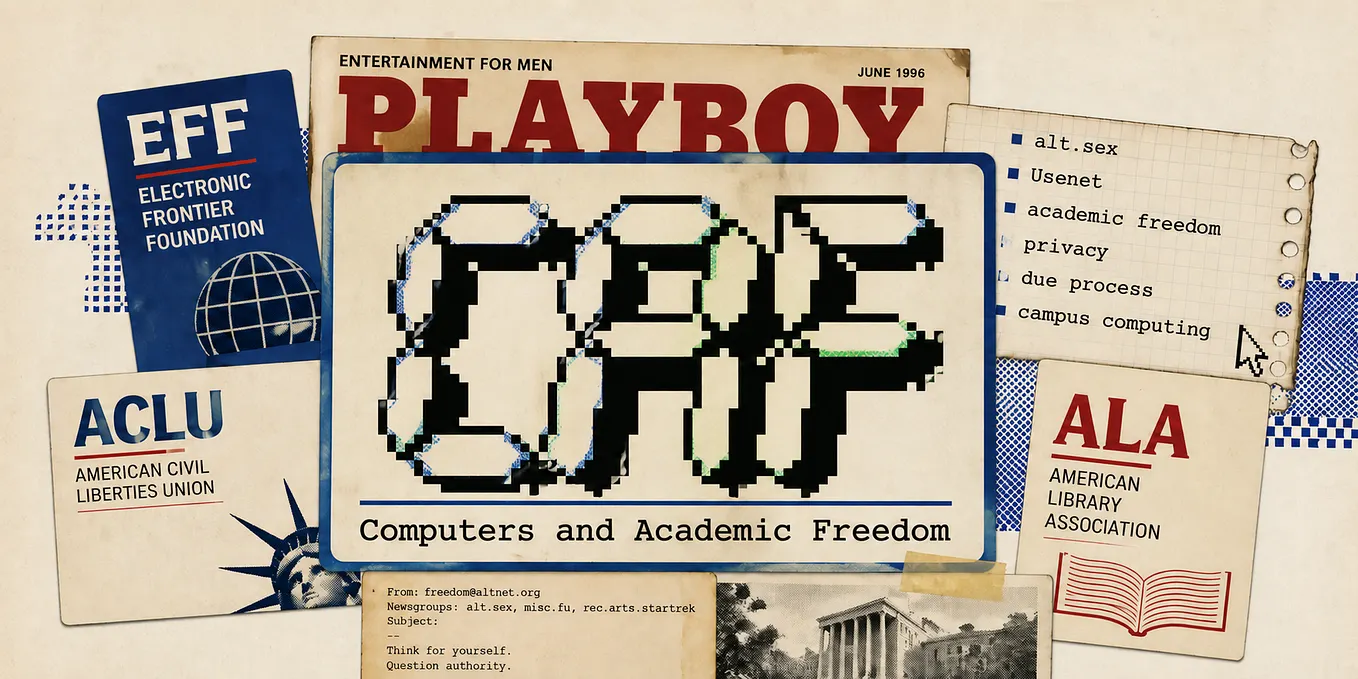
The post got attention. In the June 1996 issue of Playboy, Edwin Diamond and Stephen Bates quoted its closing line in their article on censorship in cyberspace:
EFF volunteer Carl Kadie posted a note on the Net when announcing the availability of the case: “Welcome to the infofuture, where even case law must be kept under lock and key.”
That’s how I ended up quoted in Playboy.
My part ended there. EFF was a plaintiff in the ACLU’s lawsuit against the CDA, with Mike Godwin on the legal team. The American Library Association led a second suit. The courts blocked the CDA’s indecency provisions within months, and in 1997 the Supreme Court struck down the indecency provisions in Reno v. ACLU.
Aside: Crazy connections. The Computers and Academic Freedom Project brushed against a few people who later became famous, or infamous. In November 1994, Martin Rimm, the Carnegie Mellon student behind Time magazine’s notorious 1995 “Cyberporn” cover story, emailed me: “You’re a good guy, Carl. I’m the principle [sic] investigator of the study…” With his permission, I reposted his email. After critics discredited the study, Declan McCullagh cited my repost as evidence that Rimm had inflated his role. In January 1995, I reposted a complaint by a Deakin University user that the university’s computer administrators were threatening him for criticizing Australia’s academic network. He was Julian Assange, later the founder of WikiLeaks. And in August 1995, a CAF-Talk thread about T-shirts printed with RSA encryption code (legally a “munition” under U.S. export rules) included the man selling them in Britain at cost: Adam Back, the cryptographer a 2026 New York Times investigation named as the likely creator of Bitcoin. He denies it.
Meatspace and Dead Trees
In 1990s Net slang, the physical world was “meatspace,” and paper was “dead trees.” Why would a project that lived online bother with either? Because many of the people writing campus policy didn’t read Usenet. They went to conferences and trusted what appeared in books.
The conferences also did something the Internet couldn’t: they put me in the same room as my heroes. I met science-fiction writer Bruce Sterling, whose The Hacker Crackdown had chronicled the raids that helped start EFF, and astronomer Cliff Stoll, who had tracked a KGB-paid hacker in The Cuckoo’s Egg. I met all three EFF founders, Mitch Kapor, John Perry Barlow, and John Gilmore, and, over the years, most of EFF’s small staff. At the 1994 Computers, Freedom, and Privacy conference (CFP ’94) in Chicago, I met Judith Krug, whose American Library Association office had sent CAF its library statements on diskette. And I met online friends face to face, among them Lorrie Faith Ackerman (now Professor Lorrie Faith Cranor), who guest-edited CAF-News.
Get Carl M. Kadie’s stories in your inbox
Join Medium for free to get updates from this writer.
That Chicago conference also made news. The FBI detained two attendees and got the wrong person both times. At the banquet, an agent noticed that a young attendee’s name matched an old alias of fugitive hacker Kevin Mitnick. At 6 a.m., agents took him from his hotel room to the FBI field office, where his fingerprints cleared him. Then agents waiting by the hotel elevators stopped another attendee they took for a fugitive called “Agent Steal,” and asked to see his leg; the FBI believed Agent Steal had an artificial one. I saw none of this, but it was the talk of the conference.
Serious work went on alongside the unintentional comedy. At CFP ’93, I presented “Content: The Academic Freedom Model,” arguing that campus computers deserved the same freedoms as campus newspapers and libraries. At CFP ’94, I presented “The Application of Library Intellectual Freedom Policies to Public and Academic Computer Facilities,” subtitled “The Sermon in the Loop.” There, especially, people I had never met came up to talk as if they already knew me. For the only time in my life, I felt like a (minor) celebrity.
CAF’s work also made it into books. In 1994, a National Research Council report, Rights and Responsibilities of Participants in Networked Communities, used CAF’s Iowa State case and quoted my argument that such fights “have to be won or lost on the moral argument… and can’t depend so much on legal protections.” By 1996, two CAF documents had become book chapters. Philosopher Peter Ludlow, who was already teaching with CAF’s 1992 list of computer material banned on college campuses, reprinted it in High Noon on the Electronic Frontier (MIT Press). Rob Kling of UC Irvine included the library-principles paper in the second edition of Computerization and Controversy, an anthology built for college courses on the social impact of computing.
That mattered more than it might seem. A Usenet post expired from most servers within weeks. A book chapter sat on syllabi for years, in front of students, some of whom would one day run computer centers, write policies, and sit on the committees that approved them. Dead trees, it turned out, made good ammunition.
6. Winning by Becoming Boring
In July 1994, I left graduate school with my thesis unfinished and my degree uncertain. In a tight job market, I went to Microsoft to program, not to do machine learning research. My job? Bring Usenet to the forthcoming Microsoft Network, now MSN. The original MSN was a walled garden with just two doors to the Internet: email and Usenet. I was building the Usenet door.
Aside: A year later, to everyone’s surprise, including mine, I finished my thesis, an early study of scaling laws for machine-learning accuracy.
I semi-retired from CAF. Bill Arnold kept the mailing lists going, J. S. Greenfield kept the archive, and CAF-Talk carried on by itself. I kept posting news and policy critiques from the Seattle area for almost five more years. The last case on CAF’s website, in the spring of 1999, was about Southern Utah University’s computer policy.
Institutionalized (in a Good Way)
CAF’s biggest win was quiet. The University of Illinois advisory had already said it in plain bureaucratic prose: electronic communications “are protected by the same laws and policies… as communications in other media.”
Then the professions made it official. On January 24, 1996, the ALA Council adopted “Access to Electronic Information, Services, and Networks,” an interpretation of the Library Bill of Rights. The next year, the AAUP’s report “Academic Freedom and Electronic Communications” declared that freedom of expression “should be limited to no greater degree in electronic format than in printed or oral communication,” unless the new media’s “unique conditions” warranted different treatment.
Fights over censorship and due process didn’t end and never will. But the argument over whether computers counted was over.
Usenet Fades
CAF-Talk peaked in 1993 with 5,099 posts, still carried 2,781 in 1996, and fell to 253 in 1998, as the action moved to websites and mailing lists. By 2000, AutoCAD users had moved into alt.comp.acad-freedom.talk, assuming “acad” meant their drafting software. Seth Finkelstein, a longtime CAF-Talk regular who would soon win an EFF Pioneer Award, explained the newsgroup's original topic to the squatters and added, “The old days are gone forever.” Then: “I can ask Carl if he cares. But it's a measure of how much things have changed that I barely think it's worth bothering him.”
One Last Hurrah
In 2001, Slashdot was one of the most influential places on the tech Internet, famous enough to create the “Slashdot effect” and large enough to draw tens of millions of monthly page views. On February 14, 2001, it ran “Ask Carl Kadie About Censorship and Privacy at Colleges,” introducing me as “EFF’s longest-serving volunteer, doing work for the past ten years in the area of academic freedom and computers.” It drew more than 200 comments, and I replied to the top six questions on March 2.
Conclusion: An Observation, Some Pessimism, Some Optimism
Let me end with a few pontifications about the online civil-liberties movement, of which CAF was a part.
First, an observation: I picked an easy issue. At the Computers, Freedom, and Privacy conferences, I talked about freedom, specifically free speech and due process, and I always felt I was on the side of the angels. Privacy, in contrast, is a conundrum. Your freedom to talk about me collides with my privacy, and I’ve never known where to draw the line. I love free speech as an issue partly because I think it’s easy. I hate privacy as an issue partly because I think it’s hard.
Next, some pessimism. CAF rested on a bet: give enough people the power to publish, quote, and answer, and the better arguments will win. On CAF-Talk, people changed their minds in public, and the bet paid off. But I assumed people seek truth. Some seek power instead, and an open forum serves them too. Even before large language models, the Internet had arguably filled with trolls, bots, and disinformation. Now my own field, machine learning, can manufacture plausible text, targeted persuasion, and fake consensus faster than anyone can answer. I still give to the ACLU, EFF, and now FIRE, but sometimes I wonder whether nostalgia moves me more than hope.
Finally, some optimism. America’s founders knew history had its eyes on them (see Hamilton, 2015, Act I, track 19). That belief made them take their work seriously and, at their best, behave better. We felt the same way. At CFP conferences, we were literally in the room where it happens: hackers, lawyers, librarians, journalists, and even FBI agents, arguing over what the new public sphere should become. And the arguments mattered. Courts struck down the Communications Decency Act’s indecency rules. Its Section 230, however, which shields forums from liability for their users’ posts, survived and became a foundation of the modern Internet. Closer to home, many universities, given good information and a little push, ended up writing computer policies consistent with their tradition of academic freedom.
So, my advice: if you ever find yourself feeling that history is watching you, know that sometimes it is.
Thanks for following along with this two-part history of the Computers and Academic Freedom Project. GitHub now hosts an archive of the CAF archive, with all the old documents. I hope this history reminds you that old principles can settle new fights, and that a few volunteers with a good idea can change how institutions behave.
Aside: If you’re interested in future articles, please follow me on Medium. I more typically write on scientific programming in Rust and Python, machine learning, and statistics. I tend to write about one article per month.
Acknowledgments
Many hands built CAF.
- Hosting: EFF, for a decade. Spike Ilacqua set up our first FTP area, and Dan Brown kept the machines running.
- Mailing lists: Bill Arnold, with Helen O’Boyle as an early list administrator.
- CAF-News: Lorrie Faith Cranor and a rotating crew of editors: Elizabeth Reid, Aaron Barnhart, Paul Joslin, Mark Sheehan, Adam Gross, Terry Rooker, David Swanlund, Andrew Brennan, John Nixon, John Tan, Jared Danziger, Leslie Regan Shade, Henry Hardy, Karl Barrus, Bruce Umbaugh, and Robert Novak.
- Archive: J. S. Greenfield, later with EFF’s Stanton McCandlish.
- Library and ACLU material: Rob Glasser of the American Library Association and Jean Bond of the ACLU granted permissions, and Rick Adams, Brian Court, David Barker-Plummer, Emilio Millan, Rich Fall, and Susan Farrell typed the ACLU pamphlets into ASCII.
- Advice and outreach: Dave Farber, who advised us early and later spread our work on his Interesting People list, and Herb Lin of the National Research Council, who brought me to Washington for its 1992 workshop on networked communities.
- The many people who shared cases, policies, and arguments.
In memory of Nancy Vick Edstrom, who handed me the idea.
Finally, thanks to my wife, Nanci Vaeth, a fellow ACLU member. We married in 1989, two years before CAF began. Her support and love have outlasted CAF and my thesis deadlines.