Sex, Censorship, and the 1990s Fight Over Campus Computing (Part 1)
The Computers and Academic Freedom Project


In 1990, I was five years into graduate school at the University of Illinois and was supposed to be researching scaling laws for machine learning. Instead, I kept getting pulled into Internet debates about censorship, university computer accounts, hacker crackdowns, and what rights people should have on academic networks. I was procrastinating.
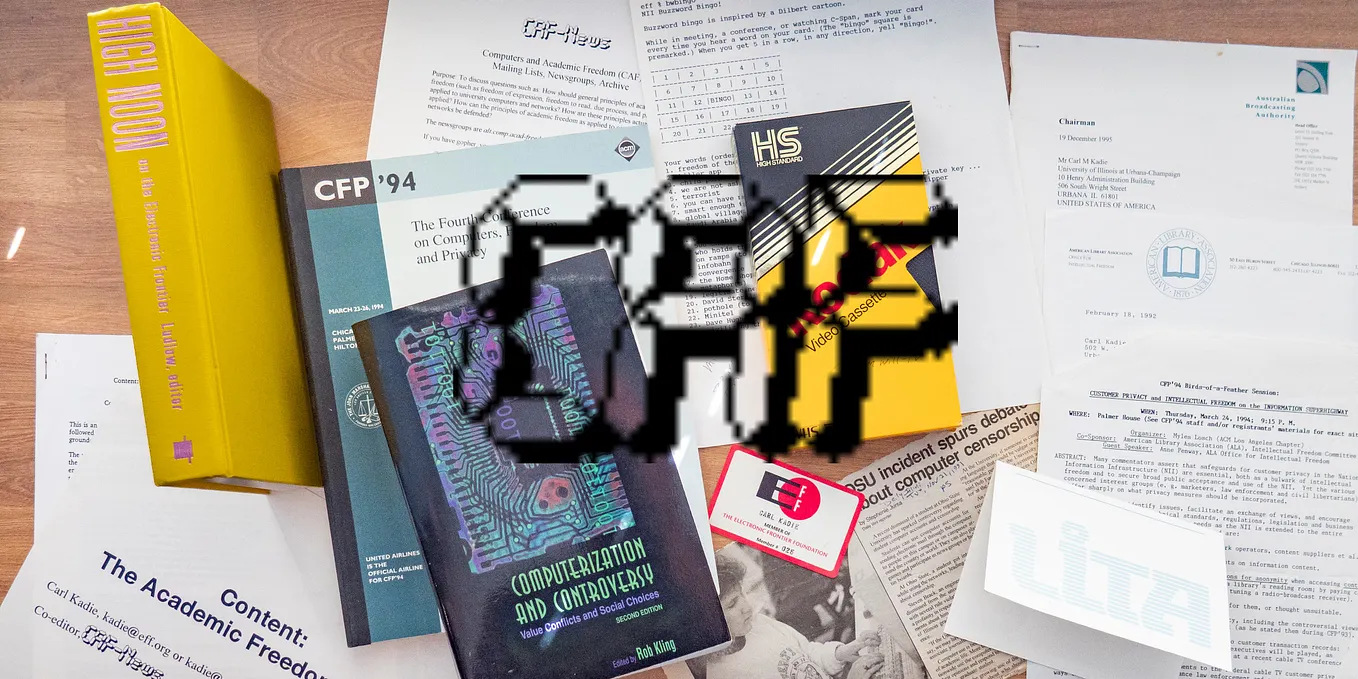
That distraction turned into the Computers and Academic Freedom Project, CAF. In hindsight, the project had more impact than my thesis. Among its stranger consequences, it got me quoted in Playboy.
This is CAF’s history as I saw it from my Sun workstation in Urbana. Dozens of volunteers saw the project from their own screens, on other campuses and in other fights. I name many of them in the acknowledgments, though surely not all. Also, to borrow my old email disclaimer, “I’m not a lawyer.” This is history, not legal advice.
CAF served as an intellectual ammunition supplier for campus fights across the United States and Canada. Perhaps surprisingly, it recycled much of that ammunition from the Cold War.
1. Epiphany: Academic Freedom Applies to Computers
In late 1988, the moderated newsgroup rec.humor.funny carried this racist joke, sparking anger and debate across the (then mostly academic) Internet:
A Jew and a Scotsman have dinner. At the end of the dinner the Scotsman is heard to say, ‘I’ll pay.’ The newspaper headline next morning says, ‘Jewish ventriloquist found dead in alley.’
Aside: The
rec.humor.funnynewsgroup was part of Usenet (sometimes called Netnews), a decentralized set of forums. Think Reddit without any controlling owner.Aside: This article includes some arguably offensive and vulgar text. That is deliberate. If we don’t know what we are talking about, we won’t know what we are talking about.
By early 1989, the controversy had reached Stanford’s administration. As Professor John McCarthy later told it, the administration “secretly gurgle[d] for two months.” Then Robert Street, Vice President for Information Resources, ordered “two underlings” to remove rec.humor.funny from centrally managed machines and “take responsibility.” Stanford President Donald Kennedy, McCarthy noted, also took part in “the censorship decision.”
Stanford’s Computer Science Department fought back. On February 21, 1989, its faculty, led by McCarthy, unanimously opposed the ban. Kennedy referred the matter to the Academic Senate, which asked its Committee on Libraries for advice. In April, that committee concluded that the university’s academic-freedom principles applied to “materials received on computer bulletin boards on campus,” and that access should be limited by ordinary collection criteria, not viewpoint. The Senate’s leaders then gave Vice President Street a choice: back down or debate it before the Senate. Street and Kennedy backed down, with what McCarthy called “grumpy remarks,” and Stanford restored rec.humor.funny. In effect, Stanford had decided that the principles of academic freedom apply to academic computers.
I knew none of this. My own path to the same idea began a year later, in the spring of 1990, when I joined online discussions about computers and civil liberties. These were early days: before the Electronic Frontier Foundation existed (founded in July 1990), before the World Wide Web opened to the public (1991), and before Wired magazine (1993).
In forums such as the Computer underground Digest and the Usenet newsgroup misc.legal, we argued about policy and law. In an important sense, however, we did not know what we were talking about. Did we have to work everything out from scratch?
In April 1990, I put that question to a friend, Professor Nancy Vick (later Nancy Edstrom), a librarian at the University of Illinois. She pointed me to the American Library Association (ALA), the national association of librarians and a longtime opponent of book banning. She suggested that I read its Freedom to Read statement and sent me a paper copy. The statement starts:
The freedom to read is essential to our democracy. It is
continuously under attack. Private groups and public authorities in various parts of the country are working to remove books from sale, to censor textbooks, to label “controversial” books, to distribute lists of “objectionable” books or authors, and to purge libraries.
The ALA and the American Book Publishers Council issued that statement in 1953, at the height of McCarthyism, the same spring Senator Joseph McCarthy (no relation to the Stanford professor) and his aides were combing the State Department’s libraries in Europe for “subversive” books. Thirty-seven years later, that Cold War statement fit computer networks almost perfectly.
Later, I asked her by email how our library decided which magazines to subscribe to. “That’s a tough question,” Nancy replied. The library held about 50,000 journal titles. Subject specialists across 39 departmental libraries chose them, within the budget and with an ear to patron requests. That’s when it clicked for me: universities already had a way to handle controversial material. They called it library policy.
We did not need to work everything out from scratch. Libraries and universities had already done much of the thinking. The task was to adapt their policies to a new medium.
Over the next ten months, I eagerly gathered documents like The Freedom to Read, for my own use. On February 6, 1991, when someone on misc.legal asked, “Under what conditions is it permissible for a university to transfer a person’s files to law enforcement authorities?” my answer cited:
- the Family Educational Rights and Privacy Act of 1974 (FERPA), “the same law that stops universit[ies] from posting grades by name”
- the ACLU’s Your Right to Privacy, on when student records may be disclosed
- the University of Illinois Code on Campus Affairs, which prohibited warrantless searches and declared, “The University’s control of campus facilities should not be used as a device of censorship,” language adapted from the AAUP’s Joint Statement on Rights and Freedoms of Students
- the Electronic Communications Privacy Act (ECPA), for email
The principle came straight from the library lesson: do not treat computers as a lawless exception. Look first at the rules universities already had for student records, privacy, searches, and censorship.
Aside: Authoritarian judo. An authoritarian-minded administrator might not care what the American Association of University Professors (AAUP) thinks about due process or free expression. But once those principles appeared in the student handbook, they became part of the student’s contract with the university. The handbook was authority. So were the Constitution and privacy law. I found appeals to institutional authority delightfully effective with exactly the people least moved by principle.
2. Building an Ammunition Factory for Campus Computing Fights
By early 1991, people were asking me for my underlying sources. They did not just want my opinion; they wanted the documents. As early as September 1990, after I quoted The Freedom to Read, a reader asked whether I had “the entire text of this statement online.”
Nancy Vick had gotten the ALA statement to me by sending a paper copy through campus mail. That was kind, but it did not scale. Anyone pushing for good campus computer policies needed the full texts. An excerpt quoted in a Usenet thread might help win one argument. An accessible full document might shape policy on a whole campus. In 1984, Stewart Brand famously said that information wants to be free. Library and university policies were exactly that kind of information. They wanted to be free: legally, in full, and at network speed.
The Pitch
On March 3 and 4, 1991, I started sounding people out about turning my document collection into a public project. I first ran the idea past Paul Hager, an Indiana ACLU activist. On the morning of March 4, I sent a draft to Mike Godwin, the first full-time staff member and legal counsel of the Electronic Frontier Foundation (EFF). Later that morning, I sent the finished proposal to Mitch Kapor and John Perry Barlow, two of EFF’s three founders.
Aside: This was not cold calling. I knew these people through the small, emerging online civil-liberties world. Paul Hager was an Indiana civil-liberties and drug-policy activist I knew through Midwest ACLU circles. Mike Godwin, while still a law student at the University of Texas, had become a familiar legal voice in the 1990 hacker-crackdown debates. By October 1990, when he graduated and joined EFF, I knew him well enough to congratulate him for not selling out. He replied (quoted with permission), “And, Carl, in your heart you knew I wouldn’t ever sell out. :-)” And in July 1990, when I wrote to EFF about how the Net had helped Chinese democracy activists, Mitch Kapor himself answered the same day. Back then, the network-rights world was open enough that a graduate student could write to the founders of the new EFF and get an answer.
Here are three excerpts from the proposal to Kapor and Barlow. Like all good pitch emails, it put the ask up front:
I think it is time to start a Computers and Academic Freedom Project.
The proposal named the campus abuses we were seeing: banned newsgroups, deleted posts, snooped email, and searched files:
At least once a month, someone posts a plea for help from some university. The most common complaint is the banning of newsgroups based on conte[n]t (usually
alt.sex). A while back, one university employee didn’t ban newsgroups directly, [b]ut rather set the newsgroup expiration time so that reading groups such asalt.sexwould be difficult. In a very recent case, employees of a university killed a newsgroup note that a student had posted because they said the information in the note could be misused. In other cases, the employees of the university may be reading e-mail or looking through user files. This may happen with or without some prior notice that e-mail and files are fair game.
Then it argued that legality was beside the point:
In many of these cases the legality of the suppression is unclear. It may depend on user expectation, prior announcements, and whether the university is public or private.
The legality is also, however, irrelev[a]nt. The duty of the University is not to su[p]press everything it legally can; rather it is to support the free and open investigation and expression of ideas. This is the ideal of academic freedom. In this role, the University acts [as] a model of how the wider world should be. (In the world of computer[s], universities are perhaps the most important model of how things should be).
The rest of the proposal set goals. In the short term, CAF would document cases of computer-related academic suppression, draft a statement on computers and academic freedom, and offer help to people fighting these battles on their own campuses. In the longer term, perhaps those principles might win endorsements from academic groups, make their way into university codes, and, ideally, into even wider policy. (Read the full proposal.)
A Home at EFF
The replies were quick and encouraging. Barlow was willing to consider lending EFF’s name, but warned me, “You’re gonna get killed, of course.”
Kapor liked the idea but thought an academic project wasn’t a natural fit for EFF. Still, he offered more than encouragement: EFF could host the project.
Get Carl M. Kadie’s stories in your inbox
Join Medium for free to get updates from this writer.
Within ten days, EFF had set aside space on its computer for our archive. Within six weeks, it was also hosting our mailing list and had given us eff.org email addresses.
CAF remained an independent project, run by volunteers, not EFF staff. But as I had hoped, the eff.org name opened doors.
A Place to Talk… and Argue
EFF hosted two forums for us. CAF-Talk carried open discussion. People shared cases, arguments, policy leads, and pleas for help. Typical traffic ran to about eighty messages a week. CAF-News offered an edited digest, with a dozen or so articles selected each week by a volunteer editor. We offered both forums as mailing lists and as the alt.comp.acad-freedom.talk and alt.comp.acad-freedom.news newsgroups. With CAF-Talk and CAF-News, a bad campus decision no longer had to stay local. It could become a public case that people on other campuses could learn from. If the archive was the factory, CAF-Talk was the proving ground, where arguments got tested, and CAF-News kept the record of what hit.
Aside: Sometimes people changed their minds. In November 1991, after I posted excerpts from a federal appeals court decision on public forums, a CAF-Talk reader posted a message titled “I’ve changed my mind.” He would “reluctantly agree” that Ohio State’s rules for its student newspaper were unconstitutional. I changed mine, too. When a correspondent objected that I had described our private email without asking, I apologized and changed my practice. That sounds quaint now, maybe even unbelievable. As a civil libertarian, I believed that in a free forum, good ideas would reliably rise to the top. On CAF-Talk, for a while, they did. (Today, I’m somewhat more cynical; more on that in the conclusion.)
CAF-Talk drew a notable voice early. A week after sending my proposal, I wrote to John McCarthy, the Stanford AI professor who had led the fight over rec.humor.funny. He sent me the abstract of his University of Waterloo talk on network publication and free expression and asked to be added to the mailing list we were setting up. By May 1991, he was posting to it, and CAF-News picked up his arguments.
Aside: To an artificial intelligence graduate student in the early 1990s, John McCarthy was not just a Stanford professor. The term “artificial intelligence”? He coined it. He also created Lisp, the programming language of my thesis, and won the Turing Award, computer science’s highest honor. When I first saw his name on a mailing list, I asked my thesis advisor whether this was “THE John McCarthy.” It was.
Aside: Volunteers were my thesis-rescue plan. In July 1991, I posted a Help Wanted ad for someone to help run the lists, “to give me more time to work on my thesis.” The compensation: the satisfaction of advancing a worthy cause, “the fame/infamy of being a net.personality,” and possibly an email account on eff.org. It worked. Bill Arnold took over the mailing lists, and a rotating crew of guest editors shared the work on CAF-News.
By November 1993, Usenet readership estimates put CAF-Talk at 63,000 readers worldwide, not far behind EFF’s own discussion group at 74,000, and CAF-News at 28,000. By April 1994, CAF-Talk’s estimate reached 96,000. (These were Brian Reid’s monthly extrapolations from sampled sites, and many people read both groups.)
Aside: Did we “censor” CAF-Talk to create CAF-News? In a sense, yes. Ironic? Yes. Invalid? No. CAF-Talk stayed open, and CAF-News reflected an editor’s judgment about what mattered most, both for busy readers and for our future selves. I had also absorbed an idea from a seminar in the then-new field of computational learning theory: compression implies generalization. A compact summary of past cases tends to surface good answers for new ones. Over more than 150 issues, CAF-News tried to be that kind of summary: a record of past campus fights, compact enough to guide the next one.
Stocking the Shelves
With that start, CAF had a name, a home, a reason to exist, and volunteers to help. Now our ammunition factory needed raw material: policy statements we could lawfully share.
We started with library statements. On September 19, 1991, with permission and a diskette from the American Library Association, we created our Library Policy Archive: twenty files including the Freedom to Read Statement, the Library Bill of Rights, and interpretations covering minors, confidentiality, challenged materials, labeling, restricted access, and collection evaluation. The core statements dated from 1948 to 1953, the early Cold War. None mentioned computers, but nearly all of them were ready to recycle for the online world.
For academic policies, we started with the American Association of University Professors and eventually included three of its statements: student rights, campus speech codes, and artistic freedom. Later, we added more statements from other organizations and universities around the world.
Then came broader civil-liberties materials. In June 1992, we asked the ACLU for permission to distribute its Briefing Papers electronically. The answer was yes. The problem was format: paper. In September, six CAF volunteers around the country began typing, scanning, OCRing, and proofreading the pamphlets into plain text. By October 1992, our Civil Liberty Archive was live, including the ACLU’s Freedom of Expression, Artistic Freedom, and Hate Speech on Campus.
Aside: CAF put the ACLU material online three years before the ACLU did. In October 1992, we posted the ACLU’s position papers on the Internet. The public-facing
aclu.orgdidn’t appear until January 1996. In between, anyone who wanted the ACLU’s position on campus hate speech, the death penalty, gun control, or drug testing got it most easily from the CAF archive. I’m still proud of that.
Did putting these statements online matter? Yes, because access was the point. Anyone, anywhere, could quote them the moment a university banned a newsgroup, read email, seized files, or wrote a bad computer-use policy. If these documents were ammunition, CAF had just broken the arms-control regime.
The Forever-Unofficial CAF Statement
Most of what our metaphorical factory shipped was other people’s work. The CAF Statement was ammunition we made ourselves. On October 26, 1991, I posted a “Draft Statement on Computers and Academic Freedom” to CAF-Talk, trying to boil down seven months of discussion. I framed it like geometry: principles were axioms, interpretations were theorems.
Its first axiom:
The principles of academic freedom apply to academic computer systems.
The rest worked out what that meant in practice. Losing computer access was a serious penalty that deserved due process. Personal files deserved the same privacy as papers in a desk drawer, and email the same privacy as a phone call. Sites should choose newsgroups the way libraries choose magazines. And a student’s post to a newsgroup was a student publication.
More than thirty-five comments came in over the next four days. A professor at the University of Iowa forwarded it to his computing director, urging adoption. We debated ways to make it official, then did something more practical: we just started using it. It became our yardstick: whenever CAF later critiqued a university’s computer policy, we measured it against the draft. It never stopped being a draft. It never needed to.
So by late 1992, the factory was running: a home at EFF, two busy forums, a growing archive, and a statement of our own. But ammunition only matters in a fight. In the next section, we’ll see where the factory was enough and where it wasn’t.
3. Cases: You Lose Some, You Win Some
An early CAF case came from Ohio State and Steven Brack. It did not end happily.
In March 1991, near the end of Ohio State’s winter quarter, Steven Brack replied “fuck you” on alt.flame. The note he answered had been rigged, as a prank, to route replies to other newsgroups, including rec.aquaria. So his reply also landed in the aquarium newsgroup. In part because of that note, Ohio State’s Academic Computing Services permanently expelled Brack from its computers and networks. No formal hearing. No appeal. Then the university’s judicial office opened a student-conduct case against him. In October, after a formal University Judicial Panel hearing, Ohio State dismissed him from the university. That dismissal apparently rested in part on what Ohio State called an “obscene” message, though “fuck you,” while vulgar, is not legally obscene.
I say “apparently” because Ohio State’s almost comic disregard for due process made the actual basis of its decision literally unknowable.
Before the formal hearing, Ohio State listed alleged actions. It also listed possibly applicable rules, including the wonderfully elastic “Other” rule: “Violation of other published University regulations, policies, or rules, or any other violation of state or federal law committed on University premises.” But it never said which action allegedly violated which rule. After the hearing, it listed the rules it found Brack had violated, again including “Other.” It did not list the actions it found he had actually taken. Without specified charges or findings of fact, a real defense or appeal was impossible.
CAF followed the case as it unfolded and helped as it could. We preserved documents, circulated news of the case, solicited letters of support, gathered advice, and turned one student’s disciplinary problem into a public argument about free expression and due process.
Brack did not pursue an internal appeal. He said he could not put his “life, job, & education on hold” to play Ohio State’s game. By June 1992, he had transferred to the University of Toledo with full network access again. We lost Brack’s case. Later, however, when proposed university policies let administrators cut off accounts with no hearing and no appeal, we pointed to the Brack case as an example of what could go wrong.
Another early case, this one with a happier ending, came from my own campus. The National Center for Supercomputing Applications (NCSA) is part of the University of Illinois.
Aside: The browser’s birthplace. Even in 1991, NCSA’s software was all over the Internet. Its telnet program helped many PC and Mac users reach remote machines. In 1993, Marc Andreessen and Eric Bina, working at NCSA, created Mosaic, the first Web browser most people ever used. It turned the Web from a tool for physicists into something anyone could click through. In 1994, Andreessen and Jim Clark founded Mosaic Communications, later renamed Netscape after a trademark dispute with NCSA. Netscape’s 1995 stock offering helped set off the dot-com boom, and its code lives on today in Firefox.
In early 1991, someone sent NCSA staff an anonymous email from the joke address “saddam@iraq.bunker.gov.” NCSA apparently identified the sender, a student employee, by searching files, and fired the student. Then, to justify those searches after the fact, it wrote rules allowing staff to search users’ email. On April 1, 1991, no kidding, those rules became NCSA’s new email policy.
The policy let staff search email for “attempts to disadvantage NCSA.” When I asked NCSA’s security officer what that meant, he said one example could be email that verbally attacked a person, NCSA, or the University. Yet the University’s own code forbade searching a person’s office or dorm room without a warrant, and no rule let staff open campus mail or tap phones. I posted the policy and my critique to the local uiuc.general newsgroup. The core point was pure CAF: university principles did not stop at the border of a computer account.
A campus committee soon drafted an excellent “Protection of Electronic Mail and Files” statement. Then university counsel held up its adoption, warning only orally that protecting computer files might increase the University’s liability.
In April 1992, I posted a “one year later” status report: the draft was stalled and unseen on campus, though other universities had copies and found it useful. The next day, the University issued the committee’s statement as an Interim E-Mail Advisory: electronic communications “are protected by the same laws and policies, and are subject to the same limitations, as communications in other media.” By that October, I could hold up the new Illinois policy as the model for computer privacy.
Aside: Never trust university counsel. Their client is the administration, which often cares more about public image than the law. As Seth Finkelstein put it, university counsel often gives the public the “prosecution’s brief” for whatever the university already wants to do. At the University of Illinois, counsel approved the original, arguably illegal, NCSA email policy, then stalled its replacement. At Princeton, counsel recommended censorship of online political speech, citing a tax-exemption bogeyman that somehow did not haunt physical bulletin boards, student newspapers, or meeting rooms. At Case Western, a vice president invoked counsel to justify deleting a chat program’s source code under some vague Ohio law. At Southern Utah, counsel laundered harassment-liability fears into a ban on all online “objectionable” material.
Aside: Tip the scales back. When counsel replaces the scales of justice with the scales of publicity, that’s an invitation to activists. Add weight to the other side: documents, criticism, attention, and embarrassment.
Yikes, Yet Another Aside: Censorship may carry liability too. Counsel’s warning ignored the other side. Screening content may create its own liability: a school that edits like a publisher may be held responsible like one. In 1991, a federal judge dismissed a libel suit against CompuServe because it had “no more editorial control over such a publication than does a public library, bookstore or newsstand.” When the law is unclear, the safe course and the right course are often the same. To paraphrase Mark Twain: when in doubt, do what’s right.
Brack and NCSA were only the start. The CAF archive eventually collected more than 80 computer policies and ten case descriptions. For 48 of the policies, we wrote detailed critiques, many line by line, on privacy, due process, vague rules, and administrative discretion, often measured against our forever-unofficial statement. Most critiques began when someone posted their school’s policy, usually in the middle of a local fight; a few came at the invitation of the policy’s drafters.
Win or lose, every case and critique went into the archive. With CAF, the next campus fight didn’t have to start from scratch.
That’s the end of Part 1 of 2. In Part 2, CAF starts keeping score of campus censorship, and CAF-News ends up on its own banned list. I get (at least) one fight wrong. At a privacy conference, the FBI detains the wrong person, twice. Crazy connections turn up: Martin Rimm, the student behind Time’s infamous “Cyberporn” cover; Julian Assange; and the man a New York Times investigation named as the likely creator of Bitcoin. And yes, Playboy quotes me.
Aside: If you’re interested in future articles, please follow me on Medium. I more typically write on scientific programming in Rust and Python, machine learning, and statistics. I tend to write about one article per month.
Acknowledgments
Many hands built CAF. See Part 2 for the acknowledgments.