Access and Inclusion Through Technology — October 2026 Edition


A Monthly Round-Up of Global News on Disability, Assistive Technology and Digital Inclusion
Welcome to this month’s digest of news on access and inclusion through technology for people with disability — covering policy, service provision, research, training, awareness, and commercial products from North America, Latin America, Europe, Africa, Asia, and Australasia. Each entry is summarised briefly with a link to the original source for further reading.
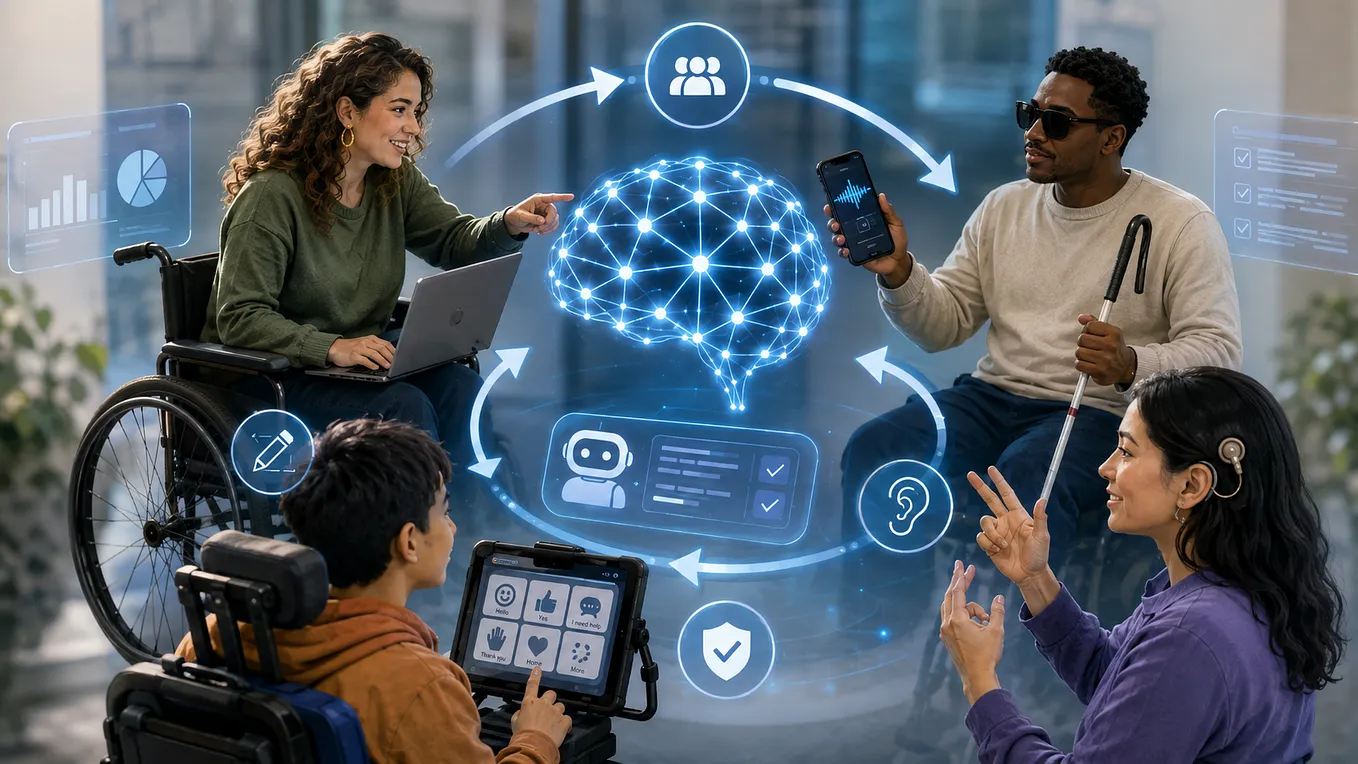
Featured: A Warning on AI, Economic Change and Exclusion
UN warns that AI-driven economic change could deepen disability exclusion
A UN Department of Economic and Social Affairs report, published 15 October, warned that rapid shifts in AI, digital technologies, energy and labour markets may widen inequality when people lack access to skills, infrastructure and new opportunities. People with disabilities were identified among groups at risk of being left behind. The report is not a prediction that AI will necessarily harm disabled people — it is a warning about how the benefits of technological change are distributed and who gets to participate in shaping it. The inclusion test for national AI strategies, the report suggests, is not only whether accessible applications exist, but whether disabled people can afford connectivity, obtain suitable assistive technology, build skills, secure employment and influence the rules governing automated decisions.
🔗 United Nations Department of Economic and Social Affairs
North America
Google launches Guided Vision in Gemini Live, shaped by 1,000+ blind testers
Google launched Guided Vision on compatible Android devices on 1 October, letting users share a live camera feed and receive spoken descriptions, follow-up answers and verbal prompts to improve camera framing. Development involved Aira and a large blind and low-vision tester community; Aira later published a detailed account of how its Trusted Testers worked with Google DeepMind engineers to refine behaviour and safety guardrails over time rather than simply evaluating a finished prototype. Google is explicit that generative descriptions may be wrong and that existing mobility aids remain essential — the feature is intended for everyday visual questions such as reading labels, not for independent navigation or obstacle avoidance.
Google Meet interpreter tile pairing expands to mobile; October bulletin covers TalkBack, braille and sign-to-text
Google Meet’s interpreter tile pairing — which keeps a Deaf or hard-of-hearing participant visually paired with their sign-language interpreter as active speakers change — began rolling out to Android in October, with iOS to follow in November. Separately, Google’s October accessibility bulletin catalogued a unified TalkBack experience for Samsung devices, braille display improvements, physical-keyboard support, voice control refinements and sign-to-text for American Sign Language on Pixel 11. Availability varies by device and region, so the bulletin is best read as a catalogue of rollouts rather than a guarantee of immediate access for every user.
🔗 Google Workspace Updates | Google Accessibility
National Disability Employment Awareness Month centres talent, not just technology
October’s US National Disability Employment Awareness Month used the theme “Celebrating Value and Talent.” The campaign is a useful corrective to narratives that treat disabled people only as recipients of assistive technology — employees are innovators, colleagues, customers, managers and leaders whose expertise should shape the tools and working environments they use. Employers are encouraged to connect awareness activity with measurable changes: accessible recruitment systems, timely adjustments, assistive technology provision, manager training, retention and progression.
🔗 US Department of Labor, Office of Disability Employment Policy
US Section 508 community pushes accessibility upstream, before coding begins
A government IT accessibility community meeting on 13 October addressed how design decisions can prevent recurring Section 508 problems before products reach development or formal audit. Presenters described common defects found in reviews and showed how design systems, developers and testers can collaborate earlier — correcting interaction patterns, focus order, labelling and document workflows is usually easier than late remediation. The session is a practical procurement lesson: accessible requirements, prototypes, acceptance criteria and user testing should be agreed before a supplier delivers a finished system.
🔗 US General Services Administration / Section508.gov
WebAIM: a caption file is not automatically a caption experience
WebAIM’s Christopher Phillips examined the gap between a caption file and a genuinely usable caption experience. Automatic speech recognition can now produce accurate dialogue in many settings, but good captions must also identify speakers, convey meaningful sounds and be timed and presented so viewers can follow the content — paying a professional supplier is not itself a guarantee of quality. The piece recommends checking the result in the player and context the audience will actually use, a lesson that applies well beyond video: technical compliance evidence must be combined with quality assessment by people who rely on the feature.
🔗 WebAIM, Utah State University
Starkey announces Omega AI+ hearing technology
Starkey announced its Omega AI+ hearing technology family on 1 October, describing a new processor, multiple AI systems working together, and additional connectivity and wellness capabilities. Manufacturer claims of improved speech processing and sound quality should be read as company-reported performance rather than independent comparative effectiveness — hearing support remains highly individual and dependent on fitting, listening environments and follow-up care.
🔗 Starkey
Braille and screen-reader releases emphasise interoperability over headline launches
October specialist coverage documented an NVDA 2026.3 release candidate, a substantial BT Speak and BT Braille update, and experimental drivers connecting screen readers to tactile displays, alongside BrailleSense 7 demonstration videos and the American Printing House’s Apollo — a magnification system combining a tablet, OCR and cameras for reading and writing. For users who rely on specialist technology, maintenance releases and compatibility can matter more than headline product launches, and assessment services should offer hands-on comparison rather than assume a newer model is automatically the best match.
🔗 Top Tech Tidbits / NV Access / Blazie Technologies / American Printing House
ASHA marks AAC Awareness Month with language and literacy resources
ASHA Journals Academy used AAC Awareness Month to draw attention to language and literacy beyond basic requesting, highlighting work on grammar, vocabulary, spelling and shared reading. The collection encourages a richer view of AAC users as developing language and literacy learners, with communication support covering social connection, education, self-advocacy and creativity — not only immediate needs.
Latin America
Brazilian bill proposes a National Policy for Assistive Technology and Inclusive Mobility
Congresswoman Renata Abreu introduced Bill PL 2977/26 in Brazil’s Chamber of Deputies, which would create a National Policy to Encourage Assistive Technology and Inclusive Mobility aimed at expanding autonomy, employability and mobility for people with disabilities. The bill would require cities with accessible route plans to set up Inclusive Mobility Observatories, encourage private-sector investment in workplace adaptation and AT provision, and ease access to specialised credit, faster AT imports, tax reductions and public health system coverage, implemented through four-year action plans. It must still clear four committees and both chambers before becoming law.
Brazil renews Crédito Acessibilidade financing for assistive technology
Brazil’s Ministry of Finance renewed, via an ordinance published in early October, the interest-rate equalisation that keeps Crédito Acessibilidade running — a credit line financing wheelchairs, orthoses and prostheses, vehicle and environment adaptations, alternative communication resources, adapted keyboards and switches, and AT maintenance and repair. The line is available to applicants earning up to ten minimum wages, at 6–7.5% annual interest through Banco do Brasil and Caixa Econômica Federal, with microcredit of R$30,000–70,000 repayable over 4–60 months.
🔗 Novo Viver Sem Limite / Ministry of Human Rights and Citizenship
Latin American university network convenes on disability and higher education
A Mexico City conference (28–30 October) brought together Latin American and Caribbean university networks to examine inclusive higher-education policy and practice, with an accessible programme provided by the organisers. Although not a specialist product launch, it matters to assistive technology because students’ ability to use technology depends on accessible curricula, assessment, digital platforms, procurement and institutional culture.
Europe
UK opens £60 million fund to test new disability employment approaches
The Pathways to Work Innovation Fund opened applications on 1 October for organisations proposing new ways to help disabled people and people with health conditions enter, remain in and progress through employment. The department cited AI-powered job matching, prosthetics and digital mental-health support as examples of potential innovation, with applications closing on 26 October. At this stage the announcement describes an invitation to test approaches, not evidence that any particular intervention has succeeded — procurement, workplace adjustments, privacy and ongoing support will determine whether innovation removes barriers or merely digitises them.
🔗 UK Department for Work and Pensions
UK proposes stronger safeguards for wheelchairs on flights
The Department for Transport announced measures on 19 October intended to reduce damage to wheelchairs during air travel and improve assistance through better training for airline and airport staff, as the Civil Aviation Bill progresses. For many wheelchair users, damage to a chair is not equivalent to lost luggage — the chair is an essential, personally fitted mobility system, and its loss can make basic daily activities impossible. Airline accessibility audits should cover the entire journey: booking, assistance requests, boarding, safe chair handling, damage response, temporary replacement and redress.
AccessibleEU and EASPD link accessible environments with personalised human support
AccessibleEU and the European Association of Service Providers for Persons with Disabilities convened a hybrid workshop on 7 October on how accessible environments and services can work with personalised support, on the premise that neither infrastructure nor human assistance can fully compensate for the absence of the other. This framing is especially relevant to digital services and assistive technology: a technically accessible interface cannot substitute for interpretation, communication support, training or individual assistance where these are required.
AccessibleEU study finds a gap between accessibility awareness and business practice
A new AccessibleEU study, published 27 October, drew on desk research, surveys, interviews and validation workshops involving 75 companies across several EU countries. It found growing awareness of accessibility and the European Accessibility Act, but uneven integration into procurement, product development, governance and customer services — smaller firms in particular reported constraints involving expertise, resources and fragmented guidance. For purchasers and policymakers, this supports investment in practical role-specific guidance, supplier assurance and repeatable organisational processes rather than one-off awareness sessions.
🔗 AccessibleEU / European Commission
Spain’s COCEMFE reaches 85 students with accessible classroom technology
COCEMFE, the Spanish Confederation of People with Physical and Organic Disability, reported on 30 October that its accessible-technology programme — including eye access, AAC systems, sensory resources, accessible-format materials and personalised tablets and switches, alongside training for teachers and families — had reached 85 students across 15 centres and six autonomous communities in the 2025/26 school year, with a further 422 professionals, family members and non-disabled classmates involved. The organisation reports qualitative gains in communication, autonomy and learning, though without an independent causal evaluation, and notes that where families cannot afford the resources themselves, use can be limited to school hours.
AI glasses support an accessible art pilot in Milan
A pilot at Milan’s Pinacoteca di Brera combined AI glasses with an existing audio-description experience for selected artworks, letting blind and low-vision visitors use wearable audio and artwork recognition to access descriptions while remaining aware of their surroundings. The organisers describe consultation with sight-loss organisations and a staged pilot rather than a proven universal museum solution — its potential lies in combining orientation, accessible interpretation and user choice, and museums should evaluate reliability, privacy, staff assistance and whether equivalent access is available to visitors who cannot or do not wish to wear smart glasses.
🔗 EssilorLuxottica / Meta / Pinacoteca di Brera
Widex expands AI hearing aid availability across major markets
Widex announced expanded availability of its Allure AI RIC hearing aids with Clarity Boost in 15 additional countries, including the United States and major European markets, alongside tinnitus-support features in its fitting software. Its numerical comparisons on speech understanding and user preference are company-reported and should not be generalised to every listener without examining the underlying methods — greater availability can improve choice, but access still depends on affordability, clinical assessment, fitting services and repair pathways.
Irish university showcases low-vision assistive technology for World Sight Day
TU Dublin organised a World Sight Day programme (12–13 October) with an assistive technology exhibition and demonstrations of hardware and software for people with low or no vision, connecting students, researchers, educators and industry partners. Demonstration events are useful for discovery and comparison, though a brief demonstration should not be mistaken for an individual assessment or evidence of long-term benefit — accessible product discovery needs to be paired with opportunities to trial equipment, learn skills and obtain impartial advice before purchase or provision.
🔗 Technological University Dublin
Africa
Nigerian university hosts neurodiversity innovation showcase
Babcock University hosted a virtual Neurodiversity Innovation Showcase (21–22 October) connecting researchers, educators, startups and organisations working on tools and approaches for neurodivergent learners, with a focus on translating research into practical educational outcomes rather than simply displaying technology. Inclusive education requires teacher preparation, accessible content, assessment practices and meaningful participation by learners and families alongside any showcased innovation.
Kenya validates a Digital Accessibility Maturity Roadmap for government services
Kenya’s Office of Diversity, Inclusion and Disability Rights, with the UK Digital Access Programme and AFRALTI, held a workshop on 30 October to validate a Digital Accessibility Maturity Roadmap for government services, with Cabinet Secretary Hanna Cheptumo as chief guest. The State Department for Culture, the Arts and Heritage wants digital library resources, heritage collections and artist platforms to work with screen readers and captioned video and to avoid confusing, inaccessible application forms — supporting the Bottom-Up Economic Transformation Agenda by helping disabled Kenyans access cultural knowledge and the creative economy. Cultural institutions are now expected to apply the roadmap’s standards to their own platforms, though no specific deadline was given.
Asia
8th AccessAbilities Expo opens in Dubai
The eighth edition of the AccessAbilities Expo opened at the Dubai World Trade Centre on 19 October, inaugurated by Sheikh Ahmed bin Saeed Al Maktoum, bringing together assistive-technology manufacturers and service providers from across the region for a regional showcase of mobility, communication, sensory and daily-living products.
Aichi-Nagoya 2026 Asian Para Games open in Japan
The Asian Para Games opened in Aichi and Nagoya, Japan on 18 October, bringing elite para-athletes from across Asia together for a week of competition. Major para-sport events are not assistive-technology launches in themselves, but they routinely showcase advances in sports wheelchairs, running blades and classification technology, and raise the visibility of disabled athletes and accessible event infrastructure in the host region.
Australasia
Australia begins NDIS support-budget changes, with key AT categories protected
Australia’s NDIS began applying changes to support budgets on 1 October as plans were created or reassessed, affecting the Social, Economic and Community Participation and Improved Daily Living Skills categories. The agency states that customised and wearable technology, hearing services, employment, disability-related health and personal mobility equipment remain outside these reductions. Effects will vary by participant and plan — even when an AT category is formally protected, reduced participation or training support elsewhere may change whether the equipment is usable in everyday life.
🔗 National Disability Insurance Scheme
Smart glasses debate sharpens, as advocates push back on proposed bans
As Australian policymakers weigh privacy concerns around AI smart glasses — including a proposed Senate import ban and a Western Australian public-sector workplace review — disability advocates say the debate has unfairly stigmatised devices that give blind, low-vision and Deaf people real independence. Vision Australia’s Chris Edwards described using the glasses hands-free to read recipes, check appliance settings and get directions while walking with his guide dog; deaf town planner Matt Henderson uses live-caption glasses in meetings. Vision Australia has separately criticised a Victorian government decision to ban smart glasses in state schools from 2027, with an exemption only “when no other suitable adjustment can be provided” — arguing the policy was announced without consulting the disability community and places extra burdens on students who already rely on the technology.
Products & Apps
A curated selection of assistive-technology product news, including new AI tools for people who are blind or have low vision (AI-VI),
Get David Banes’s stories in your inbox
Join Medium for free to get updates from this writer.
Two new free AI-VI apps describe the world on request
Open Independence released two free iPhone apps that use AI to answer questions about a scene via VoiceOver. “ai-vi” answers spoken questions about a scene and handles follow-up questions, while “Just Tell Me” focuses on one question at a time — such as reading a label, price or expiration date — with live camera guidance to help frame the item correctly.
BlindShell raises prices as Classic 3 gains an AI assistant
BlindShell’s Classic 2 and Classic 3 simple-to-use phones both rose in price from 1 October — the Classic 2 from $449 to $649 and the Classic 3 from $680 to $790 — with the Classic 3 increase accompanying the addition of the Luna AI assistant and Observo AI image descriptions.
HumanWare’s Victor Reader Stream 3 adds BARD 2.0 search and new voices
A version 1.7 firmware update for the Victor Reader Stream 3 adds eSpeak NG synthetic voices, support for the Library of Congress’s BARD API 2.0 including Advanced Search, a sleep timer and bug fixes.
Perspective Transcribe expands to iPad and Mac, with speaker recognition
Taylor Arndt’s Perspective Transcribe live-captioning app is now available on iPhone, iPad and Mac, with the Mac version adding speaker recognition, a Quick Capture mode, automatic summaries and Reminders action items; the more advanced features require the app’s All Access plan.
Dot Pad adds TMAP tactile street maps generated from a postcode
Dot Inc.’s Dot Pad gained TMAP, a feature that generates digital tactile street maps directly from a ZIP code or postcode, adding an on-demand orientation and mobility resource to the refreshable tactile display.
BT Speak and BT Braille gain a Terminal Mode and real-time dictation
Blazie Technologies updated its BT Speak and BT Braille notetakers with a new Terminal Mode, real-time dictation and automatic audio resume, continuing a pattern of incremental but practically significant firmware releases for specialist braille hardware.
A hard-shell carry case arrives for the Hable One and Hable Easy
A hard-shell carry case for the Hable One and Hable Easy braille controllers opened for pre-order at a 10% discount, with shipping expected from mid-October in Europe and by the end of November elsewhere, including the US.
Free accessibility checker “pour” ships as a browser extension, CLI and VS Code tool
A new free, non-profit WCAG 2.2 accessibility checker called “pour” launched across multiple formats — a browser extension, a bookmarklet, a command-line tool and a VS Code extension — aimed at making automated accessibility checking easier to fold into everyday development workflows.
NVDA Coach and a JAWS AI webinar target screen-reader skills
Brad Snyder of Blind Information Technology Solutions introduced NVDA Coach, a free interactive training system for people learning Freedom Scientific’s NVDA screen reader, while JAWS ran back-to-back webinars on using Split Braille with Dot Pad and on its own AI Projects — part of a broader autumn push on screen-reader training and AI features.
Blogs by David Banes
Recent commentary from David Banes’ ongoing “Access and Inclusion Through Technology” channel.
AI and health services: benefits, risks and implications for disabled people
Banes examines how AI is being used in health services — analysing medical images, predicting health risks, managing appointments and providing digital assistance — and argues these tools could make healthcare more personalised, improve communication access, support independent self-management and reduce administrative burdens for disabled people. He also warns that AI can carry bias from underrepresented data, expose people to privacy risks and surveillance, and erode human judgement and support. His central claim: the outcome depends on whether disabled people help design, test and govern these systems, so that AI strengthens human relationships and rights rather than replacing them.
🔗 Medium
Beyond the device: why effective AAC requires an ecosystem
Writing for Global Symbols, Banes argues that even the best-designed AAC system has limited impact without training, accessible services, supportive communication partners and real opportunities to communicate — effective AAC depends on a connected ecosystem of people, products, personnel, provision and policy, not a single device handed to a person. He sets out what a healthy ecosystem needs at each level: the AAC user and their preferences at the centre; communication partners equipped with practical skills; a range of affordable, culturally relevant and openly licensed products with reliable access to charging, repair and low-tech backup; services covering the whole journey from assessment through to long-term follow-up; a workforce model that combines specialist expertise with wider community capacity-building; and policy, leadership and funding that treat AAC as a system to be resourced, not a series of isolated interventions. His conclusion: providing AAC is not the same as enabling communication — a device can open the door, but the surrounding ecosystem determines whether the person can pass through it.
Wearable technology as more than a convenience
A HomeBrace blog post arguing that wearables — smartwatches, smart glasses and connected hearing devices — can do more for disabled people than add convenience, because being worn on the body lets them stay available throughout the day and respond to movement, speech, gaze or muscle activity. The piece covers mobility support (navigation cues, alternative wheelchair controls, fatigue monitoring), communication support (quick-access messages, alerts for Deaf and hard-of-hearing users, prompts for people with cognitive disabilities), environmental control and safety features such as fall detection — with the central caveat that the benefits depend on inclusive design: disabled people helping build the tools, which must respect privacy, stay comfortable, keep working when systems fail, and leave the user in control.
Follow David Banes on LinkedIn or Medium for ongoing commentary on access, inclusion and assistive technology.
Research Spotlight
AAC conversational turns linked to toddler vocabulary growth
A secondary analysis of 109 parent-child dyads across earlier intervention studies found that higher conversational turn rates were associated with larger vocabularies in AAC-exposed toddlers with developmental delays, highlighting the importance of reciprocal communication rather than only requesting or vocabulary drilling. AAC assessment and training should prioritise meaningful back-and-forth interaction and partner responsiveness, not just successful selection of symbols.
🔗 American Journal of Speech-Language Pathology
Australian study examines voice banking decisions in motor neurone disease
An exploratory qualitative study investigated how people living with motor neurone disease and their partners viewed voice banking and voice-preservation counselling within an Australian specialist service, treating a preserved voice as a practical, emotional and identity-related decision rather than a purely technical output. Services should offer timely, sensitive choices and realistic expectations rather than pressuring every person to bank a voice.
🔗 Augmentative and Alternative Communication / La Trobe University
Georgia study explores professional barriers to AAC opportunities
Researchers examined professional perspectives on barriers and supports affecting AAC opportunities in the country of Georgia, adding a perspective from a setting less frequently represented in English-language AAC policy discussions. International AAC development needs language and cultural adaptation, sustainable training and locally governed services as well as hardware and software.
🔗 Augmentative and Alternative Communication / Ilia State University
Preliminary AAC display study tests motion and decluttering for Down syndrome
A preliminary study investigated whether targeted motion and visual decluttering influence attention and symbol learning in AAC displays for people with Down syndrome. Because the work is preliminary, it should not be used to mandate a single display layout — personalised symbol display design should be evidence-informed and tested with the actual communicator.
🔗 Augmentative and Alternative Communication / Pennsylvania State University
New AAC assessment work emerges from Turkey
Turkish researchers described development of an AAC assessment form and examined speech and language therapists’ perspectives on evaluating complex communication needs. Structured assessment can help clinicians consider communication abilities, access methods and support networks more consistently, though no single form should replace collaborative judgement or user preference.
🔗 Clinical Linguistics & Phonetics / Istanbul Medipol University
International focus groups document AT access barriers for cerebral palsy
A research team linked to the Global Disability Innovation Hub and International Cerebral Palsy Society explored lived-experience and stakeholder perspectives on access to assistive technology for people with cerebral palsy, addressing persistent gaps between availability, suitability and meaningful participation. The practical message is to evaluate AT provision as a journey involving awareness, assessment, finance, training, personalisation, repairs and long-term review.
🔗 Disability and Rehabilitation: Assistive Technology / GDI Hub
Families in rural South India describe AT provision experiences
Researchers working with Amar Seva Sangam explored parents’ and caregivers’ perceptions of assistive technology provision for children with disabilities in rural South India, where access is shaped by distance, support relationships, family knowledge and the organisation of local services. Programmes aiming to scale AT in rural settings should fund assessment, workforce development, family training and repairs alongside the products themselves.
🔗 Assistive Technology / University of Toronto and Amar Seva Sangam
Portuguese review examines indoor navigation for people with reduced mobility
A review assessed assistive indoor navigation systems for people with reduced mobility, considering navigation challenges, technologies, accessibility criteria and gaps in evidence. Navigation products should be evaluated against accessible route quality, not only positioning accuracy — a technically accurate route that includes an unusable staircase is not an accessible route.
🔗 Disability and Rehabilitation: Assistive Technology / Portuguese research institutions
Korean-led experiment explores AR-assisted drone use by wheelchair users
Researchers compared line-of-sight, screen-based and AR-glass-assisted drone operation among wheelchair users, examining experience-related outcomes such as presence and subjective vitality. The exploratory work extends inclusive technology design to recreation and exploration, where participation outcomes and enjoyment deserve attention alongside clinical function.
🔗 Disability and Rehabilitation: Assistive Technology / Inha University
Swedish review asks what shapes professional recommendations for dementia technology
A scoping review investigated factors influencing whether professionals recommend welfare technologies for people living with dementia, shifting attention towards gatekeepers in service provision rather than end users alone. AT equity requires transparent eligibility, shared decision-making, professional competence and mechanisms for reviewing whether a recommended technology actually helps.
🔗 Disability and Rehabilitation: Assistive Technology / University of Borås
AI-supported communication app R-SPEAK evaluated with people with aphasia
A qualitative acceptability and usability study examined R-SPEAK, an AI-based smartphone application intended to support communication for people with expressive aphasia. Early-stage usability evidence matters because impressive language generation alone does not establish that a system works in real conversations — future evaluation should address authorship, communication-partner experience and whether the app improves participation rather than only task completion.
🔗 Journal of Medical Internet Research
Medical education paper calls for stronger AAC teaching
A UK paper considered how teaching about augmentative and alternative communication can be embedded in undergraduate medical education. Health professionals unfamiliar with AAC may fail to communicate directly with patients or exclude them from decisions — an issue of patient safety and rights as well as clinical communication skills.
🔗 Archives of Disease in Childhood: Education & Practice
Podcasts & Media Worth Your Time
● WDIY / Defeating Darkness — David Rimberg and Paul Miller talk with Rita Lang about practical smartphone accessibility and with Lehigh University researcher Vinod Namboodiri about MABLE Maps, an indoor-navigation concept for people with vision loss. WDIY
● Eyes on Success — affordable braille and tactile technology — Orbit Research founder Venkatesh Chari discusses braille displays, tactile graphics and talking scientific calculators, with a focus on keeping technology affordable rather than assuming accessibility innovation must be high-cost and AI-driven. Eyes on Success
● Eyes on Success — an AI-powered virtual fitting room for blind shoppers — an interview about Dress Aloud, an AI shopping service built to help a blind user examine clothing, compare sizes and understand how garments might look, highlighting a genuine access barrier in online retail. Eyes on Success
● Double Tap — blind testers discuss Guided Vision — a discussion with Aira contributors on training and testing Gemini Guided Vision, including early errors, guardrails and the role of blind participants in shaping where AI visual interpretation helps and where it may fail. YouTube
● The Blind Life — assistive technology training as a pathway to employment — a look at Ablr’s workforce development programme, connecting AT training with certification, paid internships, interview preparation and continued career support for blind and low-vision participants. YouTube
● Google Accessibility — October update, with ASL version — episode 13 of Google’s video accessibility update, summarising changes across Android, Pixel, Gemini, Chrome and Workspace, released alongside a separate American Sign Language version. YouTube
Coming Up
● AccessibleEU four-year anniversary hybrid event — Madrid, 24–25 November 2026
● Vodacom Accessibility Conference — Cairo, Egypt, 9 November 2026
● Wheelchair Rugby League World Cup — hosted by Australia, 30 October — 13 November 2026
● CoSTAR Inclusive Multisensory Experience call — applications close 24 November 2026
● M-Enabling Summit 2026 — virtual programme running through 31 December 2026
● Bambu Lab assistive-design 3D-printing challenge — open through December 2026
This newsletter is a curated summary compiled from publicly available sources for informational purposes. Always consult original articles for full details.
Have a story to include next month? Suggestions welcome.