Tokenized Real-World Assets on Solana: Technical Architecture, Market Microstructure, and a Multi-Agent Operating Model
Abstract
Tokenized real-world assets (RWAs) distributed on Solana reached roughly USD 5.2 billion in value by late October 2026, excluding stablecoins. We study what drives this growth from two angles, the technical properties of the network and the commercial work needed after a token is issued. On the technical side we examine Solana’s parallel runtime, its localized fee markets, the Alpenglow consensus upgrade and the Token-2022 program, whose extensions let an issuer encode transfer restrictions, investor allowlists and corporate-action accounting in the token itself. On the commercial side we model a tokenized product as a multi-sided platform whose value depends on distribution, secondary liquidity and use as collateral in decentralized finance (DeFi). We then propose a multi-agent operating model in which specialized software agents monitor compliance, net asset value (NAV), liquidity and collateral risk, coordinate through open agent protocols, and route every privileged on-chain action to a human approver. We argue that issuance is now a routine service and that most of the remaining difficulty lies after launch. The paper closes with five testable propositions and a research agenda.
Keywords: tokenization; real-world assets; Solana; decentralized finance; market microstructure; multi-agent systems; platform economics
1. Introduction
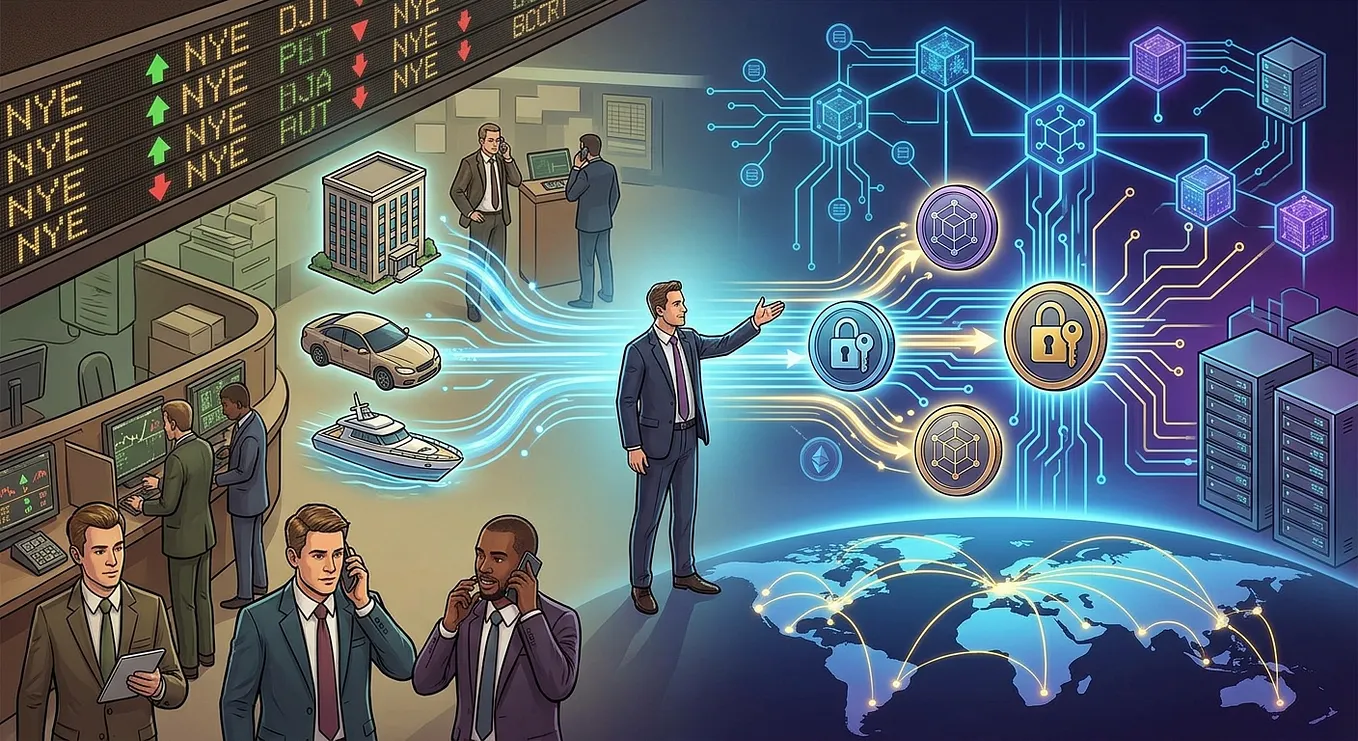
Tokenization records claims on off-chain assets as tokens on a shared ledger. Since 2023 it has moved from pilots to live products. Money-market funds, government bills, private credit funds, listed equities and commercial paper are now issued or mirrored on public blockchains, and the issuers include BlackRock, Franklin Templeton, Apollo, State Street, WisdomTree and J.P. Morgan. Across all public networks, rwa.xyz reports about USD 39 billion of distributed tokenized assets excluding stablecoins as of 29 October 2026.
Forecasts of where this market is heading vary widely, partly because they measure different things. McKinsey’s base case puts tokenized assets at about USD 2 trillion by 2030, within a range of USD 1 to 4 trillion and excluding stablecoins (Banerjee et al., 2024). BCG and ADDX estimate a USD 16.1 trillion tokenization opportunity in illiquid assets alone (Kumar et al., 2022). The first is a market-size projection and the second an addressable opportunity, so the two figures should not be read as bounds of a single estimate.
Most academic work treats “the blockchain” as one generic technology. Issuers, however, choose particular networks, and those networks differ in finality, fee behaviour, account design and token standards. Such differences determine what a product can do after launch: whether it settles against a stablecoin in one atomic transaction, whether it is cheap enough to pay income to thousands of small holders, and whether transfer restrictions can be enforced without a bespoke contract. Solana makes a useful case because its design favours throughput and low fees, and because its share of distributed RWAs grew quickly through 2025 and 2026.
We ask three questions. First, which features of Solana matter most for issuing and operating regulated assets? Second, how do liquidity, market making and DeFi integration form around these assets, and where do they stall? Third, what operating model and metrics distinguish a product that grows after launch from one that does not? Our answer to the third question includes a design for a multi-agent system that carries much of the routine post-launch work while leaving authority over privileged actions with people.
The paper is conceptual. It relies on protocol documentation, issuer disclosures and aggregate on-chain data, and it does not estimate an econometric model. Section 2 reviews the literature. Sections 3 and 4 cover the technical architecture and token standards. Section 5 discusses the product lifecycle and market microstructure, and Section 6 the business framework. Section 7 presents the multi-agent operating model. Section 8 reviews cases, Section 9 risks, and Section 10 concludes.
2. Literature Review
2.1 Economics of tokenization
Catalini and Gans (2020) describe blockchains as technologies that lower two costs, the cost of verifying a transaction’s attributes and the cost of networking without a trusted intermediary. Tokenization applies both to existing assets. Ownership and transfer history become verifiable on a shared ledger, and a single token can reach any compatible wallet or application without a new bilateral integration. Cong and He (2019) show that smart contracts can reduce information asymmetry and widen the set of feasible contracts, but that the shared information that makes this possible can also make collusion easier to sustain. That tension recurs when permissioned assets meet open protocols.
The Bank for International Settlements places tokenization inside a proposed “unified ledger” that would hold tokenized money and tokenized assets together (BIS, 2023). The OECD (2020) reaches a similar view of the potential gains. Both emphasize that the benefits of atomic settlement depend on a trusted settlement asset being available on the same ledger. Without one, the cash leg of a trade stays off-chain and much of the efficiency gain disappears.
2.2 DeFi and market microstructure
Schär (2021) and Werner et al. (2022) catalogue the components of DeFi: exchanges, lending markets, derivatives and aggregators. Lehar and Parlour (2025) model liquidity provision on a constant-product exchange and compare it with a limit order book, and Capponi and Jia (2021) study when liquidity providers participate in automated markets. A consistent result is that liquidity providers bear losses to better-informed traders, and that those losses grow with volatility. For low-volatility instruments such as treasury-bill tokens this creates a puzzle. Informed-trading losses should be small, but so is the fee income from trading, so passive liquidity provision may not be worthwhile. Aramonte, Huang and Schrimpf (2021) argue that governance needs make some centralization in DeFi unavoidable, a point that applies directly to tokenized securities, whose issuers keep freeze and redemption powers by design.
2.3 Blockchain design
Budish (2025) shows that the cost of securing a permissionless blockchain grows with the value it must protect, which limits how much value such a ledger can economically secure. Gans (2023) examines the trade-offs among consensus designs. Yakovenko (2018) introduced Proof of History, a sequential hash chain used to timestamp events, which became the ordering mechanism in Solana’s original design. These studies treat performance and security as economic variables. In capital markets, latency and fees feed directly into market makers’ quoting costs and into the cost of every holder action.
2.4 Platform economics
Tokenized products behave like multi-sided platforms (Rochet & Tirole, 2003; Parker et al., 2016). An issuer must attract holders, integrators and liquidity providers at the same time, and each group’s willingness to join depends on the others. This is the familiar cold-start problem, and Section 6 treats it as the central commercial difficulty.
2.5 Agents and multi-agent systems
Wooldridge and Jennings (1995) define agents as software systems with autonomy, social ability, reactivity and proactiveness, and Wooldridge (2009) develops the theory of how such agents coordinate. Large language models have renewed interest in the field. Surveys by Wang et al. (2024), Xi et al. (2025) and Guo et al. (2024) review agents built on these models and systems of several cooperating agents. Frameworks such as AutoGen (Wu et al., 2024) structure work as conversations among specialized agents. Applications to finance so far concentrate on trading (Xiao et al., 2024; Zhang et al., 2024). The most relevant evidence for operations comes from Aldasoro and Desai (2025), who find that a general-purpose agent managing intraday liquidity in a simulated payment system closely replicates prudent cash-management practice. Security research points the other way. Greshake et al. (2023) show that agents which read untrusted content can be hijacked through injected instructions, and Debenedetti et al. (2024) provide a benchmark showing that such attacks remain effective against current defences.
2.6 Gap
Studies of RWAs mostly describe issuance volumes, and studies of DeFi mostly ignore permissioned assets. Little work connects network-specific architecture to the economics of a product after launch, and none that we know of examines how agent systems could carry the operational load of that phase. This paper addresses both gaps.
3. Technical Architecture
Three properties of Solana matter most for tokenized assets. It keeps a single global state rather than splitting activity across shards or rollups, it executes non-conflicting transactions in parallel, and it confirms transactions quickly at a cost of a fraction of a cent. Together these make frequent, low-value operations affordable, such as daily income accrual for many small holders, collateral rebalancing and on-chain quote updates.
3.1 Consensus and finality
In Solana’s original design, a leader ordered transactions using Proof of History, a sequential SHA-256 hash chain that works as a verifiable clock (Yakovenko, 2018). Validators then voted on that history through Tower BFT, a protocol modelled on practical Byzantine fault tolerance. Transactions were forwarded directly to scheduled leaders rather than held in a mempool, and blocks were propagated in erasure-coded fragments through a protocol called Turbine. Under this design, Anza reports about 12.8 seconds from block creation to full finality.
Alpenglow, specified in SIMD-0326 (Kniep et al., 2025), replaces both Tower BFT and Proof of History. Validators approved it in a governance vote that closed on 2 September 2025 with about 98 percent in favour. Its voting component, Votor, moves votes off-chain and targets a median finality of about 150 milliseconds, with simulations reaching about 100 milliseconds. News reports quoting Anza state that Votor was activated on mainnet on 21 October 2026. The companion data-propagation component, Rotor, is not part of SIMD-0326 and had not been activated at the time of writing. Finality in the low hundreds of milliseconds would bring on-chain settlement close to the speed of an exchange matching engine, but mainnet measurements were not yet available when this paper was written.
3.2 Parallel execution and fees
Every Solana transaction lists the accounts it will read and write. The Sealevel runtime uses these lists to run transactions that touch different accounts at the same time. Programs hold no state of their own; data lives in separate accounts that programs own.
This design keeps activity in one market from crowding out another. Priority fees are a per-compute-unit bid attached to each transaction, and the scheduler only needs to rank transactions against each other when they contend for the same write-locked accounts. Congestion in a popular trading pool therefore raises costs mainly for transactions that touch that pool. No protocol-level fee is charged per account. The practical result is what practitioners call local fee markets, and for an institution it means operating costs that are more predictable than on a network with a single global fee auction.
3.3 Reliability and client diversity
Institutions judge networks on operational resilience as well as speed. Solana suffered seven outages between December 2020 and February 2024, the longest lasting about 17 hours in September 2021 and about 19 hours in February 2023. Its response has been to add independent validator software. Jump Crypto’s Firedancer, written in C, ran on mainnet in a hybrid form called Frankendancer from September 2024 and as a full client from December 2025. Anza’s Agave client remains the most widely used. Independent clients reduce the chance that one software defect halts the network. For EU financial entities, including crypto-asset service providers authorized under MiCA, this feeds into the ICT-risk assessments they must perform under the Digital Operational Resilience Act, which has applied since 17 January 2025.
3.4 Summary
Table 1. Solana properties and their relevance to tokenized assets

The main cost of this design is hardware. Anza recommends validators with at least 12 cores, 256 GB of memory, separate NVMe drives and a 10 Gbit/s connection, which raises the cost of running a node and, some argue, limits decentralization. Regulated issuers face a trade-off here. A professionally operated validator set may lower operational risk, but it also weakens the censorship-resistance argument for using a public chain.
4. Token Standards and On-Chain Compliance
Token-2022, also called Token Extensions, is the main tool for regulated assets on Solana. Instead of each issuer writing its own token contract, issuers configure extensions of one shared, audited program. Ethereum takes a different route. ERC-3643 (T-REX), a finalized standard, and the ERC-1400 family, which never left draft status, define interfaces that each issuer implements in its own contract. Solana’s approach lowers audit costs and makes token behaviour predictable for wallets and protocols, at the price of less room for bespoke logic.
4.1 Extensions and their functions
Table 2. Token-2022 features mapped to securities functions

Two qualifications matter. Freeze authority belongs to the base token program rather than to the extension set. Confidential transfers were paused on 11 June 2025, and the zero-knowledge proof program they depend on was disabled on 19 June 2025 after a soundness bug was found. It returned in the Agave 4.0 release after an audit, so issuers that relied on confidentiality lost it for roughly a year.
4.2 Design patterns
Three patterns appear in practice. In the first, a closed-loop token, accounts start frozen and a transfer hook checks an allowlist, so tokens move only between verified wallets. Tokenized money-market funds and private credit sold to qualified purchasers typically follow this pattern. In the second, KYC applies only when tokens are minted or redeemed with the issuer, and secondary transfers are unrestricted, usually for non-US persons only. Ondo’s USDY and Backed’s xStocks work this way, which lets them enter DeFi pools freely. The third pattern combines the two: a wrapper token trades freely while redemption into the underlying asset is limited to verified holders.
The pattern an issuer picks largely sets the product’s growth ceiling. A permissioned token can only enter venues that enforce the same allowlist, which shrinks the set of possible integrations. An open-transfer token gains full composability but faces tighter limits on who may buy it and where.
4.3 Oracles
The value of an RWA token depends on off-chain facts: NAV, reserves, corporate actions and reference prices. On Solana the main oracle is Pyth, where first-party data providers publish signed prices that users pull on-chain when needed. Chainlink also provides price feeds on Solana. Oracle design is a central risk. A stale NAV used to value lending collateral can lead to under-collateralized loans or to unwarranted liquidations, a point we return to in Section 9.
5. Product Lifecycle and Market Microstructure
A tokenized product passes through five stages: selection, structuring, launch, distribution and liquidity, and integration into other protocols. The first three are increasingly routine. Tokenization platforms, transfer agents and custodians now offer standard routes from a fund prospectus to a minted token. Most of the difficulty lies in the last two stages.
5.1 The five stages
Selection decides which assets benefit most from on-chain distribution. Good candidates have standardized cash flows, global demand and a use beyond holding, such as collateral, settlement cash or treasury management. Structuring chooses the legal wrapper, the transfer agent and the record-keeping model, including whether the token is the legal record or mirrors an off-chain register; the Token-2022 configuration follows from these choices. Launch mints the token, connects subscription and redemption in stablecoins, publishes oracle feeds and arranges custody. WisdomTree Prime, for example, accepts USDC and PYUSD on Solana.
Distribution and liquidity require reaching buyers through wallets, exchanges, brokerages and wealth platforms, and arranging market makers and secondary venues. Integration means getting the token accepted as collateral in lending markets, as margin on derivatives venues and as a component of structured yield products. These last two stages make up what we call the post-launch problem. Each requires coordinating parties the issuer does not control.
5.2 Primary and secondary liquidity
RWA liquidity has two layers. Primary liquidity is the issuer’s subscription and redemption channel, available to verified holders on the fund’s dealing schedule. Secondary liquidity comes from trading between holders on on-chain venues. For many permissioned funds the primary channel is the only one. That suffices for treasury management but limits use as collateral, because a lender liquidating a position needs a buyer immediately, not at the next NAV calculation.
Solana offers three kinds of secondary venue. Automated market makers such as Orca, Raydium and Meteora support concentrated liquidity, which suits tokens priced near a stable NAV. On-chain central limit order books such as Phoenix and Manifest are practical because quote updates are cheap, and they suit professional market makers. Aggregators such as Jupiter route orders across venues. Raydium and Jupiter both listed xStocks on their launch day.
5.3 The market-making problem
Quoting a tokenized equity requires hedging in the underlying market. US equities trade 6.5 hours on weekdays in the regular session, while the token trades continuously. A market maker quoting at the weekend cannot hedge until Monday, bears the gap risk in the meantime, and widens spreads accordingly. Issuers have three main levers. They can pay market makers to maintain minimum depth and spreads. They can give authorized participants fast creation and redemption, as exchange-traded funds do, so that arbitrage holds the token near fair value. And they can use oracle-guarded pools that widen or pause around market closes and corporate actions.
5.4 Integration as a source of demand
Integration creates derived demand. In July 2025 Kamino, a Solana lending protocol, began accepting xStocks such as AAPLx as collateral, and in May 2025 it announced an integration for Apollo’s ACRED credit fund. A holder who can borrow stablecoins against a token earns the gap between the token’s return and the borrowing rate, which makes holding the token more attractive. Each integration also brings a new group of potential buyers. The same mechanism adds risk, because leveraged positions in a token with infrequent redemption can unwind badly under stress.
6. Business Model and Metrics
A tokenized product grows when it sets off a reinforcing cycle. Wider distribution brings more holders, more holders justify deeper liquidity, deeper liquidity makes the token acceptable as collateral, and collateral use adds demand. For the network, the task is to start this cycle for each issuer and carry what works across asset classes.
6.1 Stakeholders
Table 3. Stakeholders in a tokenized product

6.2 Value to each party
For issuers, a public chain offers global distribution without building bilateral links to each venue, along with lower costs for record-keeping and income distribution. It also reaches pools of capital held on-chain, such as stablecoin treasuries and protocol reserves, that traditional channels miss. Investors gain continuous transferability, fast settlement against stablecoins and the ability to post the asset as collateral. The network gains activity that is less volatile than crypto trading, institutional credibility and a source of low-risk yield on which other DeFi products can build.
6.3 A launch sequence
Observed launches suggest a sequence. The issuer first secures anchor holders before launch, so the product starts with meaningful assets; J.P. Morgan’s December 2025 commercial paper issuance for Galaxy on Solana, for instance, launched with Coinbase and Franklin Templeton as buyers. It then arranges wallet and custodian support from the first day, agrees market-making terms and seeds liquidity pools against USDC. It next seeks a collateral listing in at least one major lending market, with conservative loan-to-value limits and reliable oracles. Finally it widens distribution through wealth platforms, brokerages and exchanges, and monitors the metrics below to find which constraint binds.
6.4 Metrics beyond total value
Total value locked, or assets under management, measures a stock. It says little about whether a product is used, and a single anchor investor can inflate it. We propose a broader scorecard.
Get Jung-Hua Liu’s stories in your inbox
Join Medium for free to get updates from this writer.
Table 4. Scorecard for tokenized products

6.5 Propositions
The framework yields four testable propositions. P1: holding asset class and size constant, tokens with at least one DeFi collateral listing attract higher net inflows and more holders than tokens without one. P2: the deviation of market price from NAV narrows as primary redemption becomes faster and the number of authorized participants rises. P3: open-transfer designs show higher velocity and DeFi utilization than permissioned designs, but grow more slowly in institutional assets. P4: lower and more predictable transaction costs raise the share of small holders.
7. A Multi-Agent Operating Model
The post-launch work described in Sections 5 and 6 is continuous, spans many counterparties and produces large volumes of machine-readable data. Onboarding checks, NAV reconciliation, oracle monitoring, liquidity surveillance, collateral risk and partner reporting all fit this description. We propose that much of this work can be carried by a system of specialized software agents, provided the system is designed so that no agent can take a privileged on-chain action on its own. The design below is a proposal, not an evaluated deployment.
7.1 Building blocks
Three open protocols make such a system practical. The Model Context Protocol (MCP), released by Anthropic in November 2024 and donated to the Linux Foundation’s Agentic AI Foundation in December 2025, standardizes how an agent connects to data sources and tools. Its specification requires explicit user consent before tools are invoked and treats tool descriptions as untrusted. The Agent2Agent protocol (A2A), announced by Google in April 2025 and transferred to the Linux Foundation in June 2025, standardizes communication between agents. Each agent publishes an Agent Card describing its capabilities, and work is exchanged as tasks with defined states, including one for awaiting further input and one for awaiting authorization. Version 1.0 of the specification was released in March 2026. The x402 protocol, launched by Coinbase in May 2025, revives the HTTP 402 “Payment Required” status so that an agent can pay for a data feed or service in stablecoins, and it supports Solana. On the Solana side, open-source toolkits such as Solana Agent Kit and elizaOS give agents ready-made actions for transfers, swaps, lending and price feeds.
7.2 Agent roles
We assign each recurring task to one agent with narrow permissions. Table 5 lists the roles.
Table 5. Agent roles in the operating model

The orchestrator receives requests and routes them to the specialist agents through A2A. Each specialist reads data through MCP servers that expose only the sources it needs. Agents that buy external data settle through x402 within a spending limit.
Figure 1 shows the architecture.
Figure 1. Multi-agent operating model for a tokenized product. Agents read data through MCP and coordinate through A2A; privileged token authorities are held in a multisignature account and every privileged action requires human approval.
7.3 Control design
The control layer is the core of the design. Token-2022 authorities, including mint, freeze, pause and permanent delegate, are held in a multisignature account controlled by named staff. No agent holds a signing key for these authorities. An agent may prepare a transaction, attach its evidence and submit it for approval. A2A’s authorization state lets the task wait for that approval without losing its context. Low-risk actions, such as publishing a report, can run automatically. Actions that move value, change who may hold the asset or are hard to reverse always require human sign-off, with thresholds set by policy.
This follows current supervisory thinking. The Financial Stability Board’s October 2026 final report on sound practices for AI adoption names unauthorized action by agents as a risk. It calls for risk-based triggers that require human approval before an agent executes transactions above a set value or takes actions that could cause irreversible harm. Article 14 of the EU AI Act likewise requires human oversight proportionate to a system’s autonomy, including the ability to override or stop it.
Three further controls address known weaknesses. Each agent receives the least access it needs, so a compromised reporting agent cannot reach the compliance tools. Content from outside the system, such as issuer documents, emails and web pages, is treated as data and never as instructions, because injected text is the main route by which agents are hijacked (Greshake et al., 2023; Debenedetti et al., 2024). Finally, every proposed and executed action is logged with its evidence, and the hash of each privileged transaction’s approval record can be written to the chain in a memo, so auditors can match on-chain actions to their approvals.
7.4 Evidence and limits
Evidence for agents in financial operations is early but growing. Aldasoro and Desai (2025) report that an agent managing intraday liquidity in a simulated payment system closely replicated prudent cash-management practice. The BIS Innovation Hub’s Project Agenti is studying how agentic systems might behave in wholesale payments. In October 2026 HSBC and Ant Digital reported a technical test in which an AI agent paid for a service in tokenized deposits. In 2025 Deutsche Bank began working with finaXai on explainable AI for tokenized-fund servicing under Project DAMA 2. None of these is a production agent system for tokenized assets.
The model has clear limits. Agents built on language models can be wrong in confident ways, and correlated agents running similar models could act in step during stress, a concern the FSB (2024) raises for AI in finance generally. The design therefore uses agents to watch, reconcile, propose and report, and leaves decisions on privileged actions with accountable people. A fifth proposition follows. P5: issuers that automate monitoring and reporting with agents under human-approval controls detect NAV deviations and liquidity breaches faster than issuers relying on manual processes, without a higher rate of erroneous privileged actions.
8. Cases by Asset Class
The cases show a consistent pattern. Assets with a clear on-chain use, such as cash management, collateral or continuous trading, grow faster after launch than assets that are merely represented on-chain.
Table 6. Selected tokenized products on Solana

Money-market funds lead because their use is obvious. Treasuries of crypto firms and protocols hold large stablecoin balances that earn nothing, and a tokenized fund lets them earn the short-term rate without leaving the chain. Their limit is reach, since a permissioned token can only enter venues that enforce its allowlist.
Tokenized equities are where Solana’s low latency and fees matter most. They give holders outside the US brokerage system continuous exposure to US shares, and on-chain order books make quoting economical. Their constraints are mostly matters of market structure: hedging over weekends, handling dividends and splits, and the legal question of what rights a tracker gives its holders. Regulation is moving here. In 2026 the SEC introduced an innovation exemption for tokenized stocks that, according to press reports, covers issuer-sponsored tokens and excludes synthetic trackers. Products like Galaxy’s registered shares benefit from such a rule, while tracker products remain limited to non-US buyers. Kraken’s agreement in December 2025 to acquire Backed, xStocks’ issuer, shows that exchanges see these products as a distribution asset.
Private credit is the reverse case: higher yield with little liquidity. Its main on-chain gains are lower servicing costs and access to new investors rather than secondary trading. Leveraged strategies that borrow repeatedly against the same credit token can make yields look higher while hiding a mismatch between the token’s tradability and the fund’s redemption terms.
9. Risks and Limitations
Tokenization leaves the risks of the underlying asset in place. It adds technical risks and moves legal risks to new places.
The technical risks begin with network availability. A halt freezes transfers, redemptions and liquidations, and while client diversity lowers that risk it does not remove it. Transfer hooks run issuer code on every transfer, so a defect can block all transfers or let restricted holders through. Concentrating functionality in one shared token program raises assurance but also creates a common point of failure, as the 2025 suspension of confidential transfers showed. Oracles can deliver stale or manipulated values, leading to wrong liquidations or bad debt. Issuer authorities are high-value targets, which argues for multisignature control, hardware security modules and time-locks.
The market risks centre on liquidity mismatch. A token that trades continuously but redeems daily, or monthly in the case of private credit, can trade at a deep discount when holders rush to exit, a dynamic similar to runs on money-market funds. Leverage through lending markets amplifies such episodes. Concentration adds to both, because a few anchor holders often own most of the supply.
The legal risks start with the token’s status. Whether the token is the security itself, a claim on it, or a mirror of an off-chain register decides holders’ rights in insolvency. Rules differ across the United States, the EU’s MiCA and DLT Pilot Regime, Singapore’s Project Guardian, Hong Kong and Switzerland, so products are often split by geography. When a permissioned asset enters an open protocol, both the protocol and the issuer face questions about who ends up holding it. For banks, the Basel Committee’s standard on crypto-asset exposures (BCBS, 2022) imposes stricter capital treatment on tokens held on permissionless chains.
The agent model of Section 7 brings risks of its own: hijacking through injected instructions, errors stated with false confidence, and correlated behaviour across firms using similar models. The controls described in Section 7.3 reduce these risks but cannot eliminate them.
This study is conceptual. Its propositions have not been tested, and its market figures are snapshots. On-chain data shows token movements but not the legal identity of holders or off-chain trades. Several facts, including the Alpenglow activation date and the scope of the SEC exemption, rest on press reports rather than primary documents. Protocol and regulatory change is fast, so some details will date quickly.
10. Research Agenda and Conclusion
Five lines of research follow. The first is to test P1 to P4 with token-level panel data on holders, flows, DeFi utilization and NAV deviations across Solana, Ethereum and its layer-2 networks. The second is to study the microstructure of assets that trade continuously while their underlying markets close, measuring weekend spreads, gap risk and price discovery. The third is to design lending and exchange mechanisms that enforce allowlists without fragmenting liquidity. The fourth is to simulate redemption runs on tokenized funds with leveraged holders and compare them with traditional money-market funds. The fifth is to evaluate agent-based operations, testing P5 in controlled pilots that measure detection speed, error rates and the cost of human review.
Solana’s growth to about USD 5.2 billion in distributed RWAs rests on a technical base suited to frequent, low-value financial operations: parallel execution, localized fees, fast and soon near-instant finality, and a token program with built-in compliance. Technology explains only part of the outcome. Issuance has become a standard service, and lasting advantage now comes from what happens after launch, namely distribution, secondary liquidity and integration that creates derived demand. That work is continuous and data-heavy, which makes it a natural setting for multi-agent systems, provided authority over privileged actions stays with accountable people. For issuers and networks, the practical lesson is to manage products on breadth, liquidity, price fidelity and utilization rather than on total value alone. For researchers, tokenized assets offer a rare setting in which traditional instruments trade under new rules in full public view.
References
Aldasoro, I., & Desai, A. (2025). AI agents for cash management in payment systems (BIS Working Papers №1310). Bank for International Settlements. https://www.bis.org/publ/work1310.htm
Aramonte, S., Huang, W., & Schrimpf, A. (2021, December). DeFi risks and the decentralisation illusion. BIS Quarterly Review. https://www.bis.org/publ/qtrpdf/r_qt2112b.htm
Banerjee, A., Sevillano, J., Higginson, M., Rigo, D., & Spanz, G. (2024, June 20). From ripples to waves: The transformational power of tokenizing assets. McKinsey & Company.
Bank for International Settlements. (2023). Blueprint for the future monetary system: Improving the old, enabling the new. In Annual Economic Report 2023 (Chapter III). https://www.bis.org/publ/arpdf/ar2023e3.htm
Basel Committee on Banking Supervision. (2022, December). Prudential treatment of cryptoasset exposures (BCBS d545). Bank for International Settlements. https://www.bis.org/bcbs/publ/d545.htm
Budish, E. (2025). Trust at scale: The economic limits of cryptocurrencies and blockchains. The Quarterly Journal of Economics, 140(1), 1–62. https://doi.org/10.1093/qje/qjae033
Capponi, A., & Jia, R. (2021). The adoption of blockchain-based decentralized exchanges (arXiv:2103.08842). arXiv. https://arxiv.org/abs/2103.08842
Catalini, C., & Gans, J. S. (2020). Some simple economics of the blockchain. Communications of the ACM, 63(7), 80–90. https://doi.org/10.1145/3359552
Cong, L. W., & He, Z. (2019). Blockchain disruption and smart contracts. The Review of Financial Studies, 32(5), 1754–1797. https://doi.org/10.1093/rfs/hhz007
Debenedetti, E., Zhang, J., Balunović, M., Beurer-Kellner, L., Fischer, M., & Tramèr, F. (2024). AgentDojo: A dynamic environment to evaluate prompt injection attacks and defenses for LLM agents. Advances in Neural Information Processing Systems, 37 (Datasets and Benchmarks Track).
Financial Stability Board. (2024). The financial stability implications of artificial intelligence. https://www.fsb.org/2024/11/the-financial-stability-implications-of-artificial-intelligence/
Financial Stability Board. (2026). Sound practices for responsible adoption of artificial intelligence (AI): Final report. https://www.fsb.org/2026/10/sound-practices-for-responsible-adoption-of-artificial-intelligence-ai-final-report/
Gans, J. S. (2023). The economics of blockchain consensus: Exploring the key tradeoffs in blockchain design. Palgrave Macmillan. https://doi.org/10.1007/978-3-031-33083-4
Greshake, K., Abdelnabi, S., Mishra, S., Endres, C., Holz, T., & Fritz, M. (2023). Not what you’ve signed up for: Compromising real-world LLM-integrated applications with indirect prompt injection. In Proceedings of the 16th ACM Workshop on Artificial Intelligence and Security (pp. 79–90). https://doi.org/10.1145/3605764.3623985
Guo, T., Chen, X., Wang, Y., Chang, R., Pei, S., Chawla, N. V., Wiest, O., & Zhang, X. (2024). Large language model based multi-agents: A survey of progress and challenges. In Proceedings of the Thirty-Third International Joint Conference on Artificial Intelligence (pp. 8048–8057). https://doi.org/10.24963/ijcai.2024/890
International Organization of Securities Commissions. (2023). Policy recommendations for crypto and digital asset markets: Final report (FR11/2023).
Kniep, Q., Sliwinski, K., & Wattenhofer, R. (2025). SIMD-0326: Alpenglow. Solana Improvement Documents. https://github.com/solana-foundation/solana-improvement-documents/blob/main/proposals/0326-alpenglow.md
Kumar, S., Suresh, R., Liu, D., Kronfellner, B., & Kaul, A. (2022). Relevance of on-chain asset tokenization in “crypto winter”. Boston Consulting Group and ADDX.
Lehar, A., & Parlour, C. A. (2025). Decentralized exchange: The Uniswap automated market maker. The Journal of Finance, 80(1), 321–374. https://doi.org/10.1111/jofi.13405
Monetary Authority of Singapore. (2023). Project Guardian: Open and interoperable networks. https://www.mas.gov.sg/publications/monographs-or-information-paper/2023/project-guardian-open-interoperable-networks
OECD. (2020). The tokenisation of assets and potential implications for financial markets. OECD Blockchain Policy Series.
Parker, G. G., Van Alstyne, M. W., & Choudary, S. P. (2016). Platform revolution: How networked markets are transforming the economy and how to make them work for you. W. W. Norton & Company.
Regulation (EU) 2024/1689 of the European Parliament and of the Council of 13 June 2024 laying down harmonised rules on artificial intelligence (Artificial Intelligence Act). Official Journal of the European Union, L, 12 July 2024.
Rochet, J.-C., & Tirole, J. (2003). Platform competition in two-sided markets. Journal of the European Economic Association, 1(4), 990–1029. https://doi.org/10.1162/154247603322493212
Schär, F. (2021). Decentralized finance: On blockchain- and smart contract-based financial markets. Federal Reserve Bank of St. Louis Review, 103(2), 153–174. https://doi.org/10.20955/r.103.153-74
Wang, L., Ma, C., Feng, X., Zhang, Z., Yang, H., Zhang, J., Chen, Z., Tang, J., Chen, X., Lin, Y., Zhao, W. X., Wei, Z., & Wen, J.-R. (2024). A survey on large language model based autonomous agents. Frontiers of Computer Science, 18(6), 186345. https://doi.org/10.1007/s11704-024-40231-1
Werner, S. M., Perez, D., Gudgeon, L., Klages-Mundt, A., Harz, D., & Knottenbelt, W. J. (2022). SoK: Decentralized finance (DeFi). In Proceedings of the 4th ACM Conference on Advances in Financial Technologies (pp. 30–46). https://doi.org/10.1145/3558535.3559780
Wooldridge, M. (2009). An introduction to multiagent systems (2nd ed.). John Wiley & Sons.
Wooldridge, M., & Jennings, N. R. (1995). Intelligent agents: Theory and practice. The Knowledge Engineering Review, 10(2), 115–152. https://doi.org/10.1017/S0269888900008122
Wu, Q., Bansal, G., Zhang, J., Wu, Y., Li, B., Zhu, E., Jiang, L., Zhang, X., Zhang, S., Liu, J., Awadallah, A. H., White, R. W., Burger, D., & Wang, C. (2024). AutoGen: Enabling next-gen LLM applications via multi-agent conversation. Conference on Language Modeling (COLM 2024). arXiv:2308.08155.
Xi, Z., Chen, W., Guo, X., et al. (2025). The rise and potential of large language model based agents: A survey. Science China Information Sciences, 68(2), 121101. https://doi.org/10.1007/s11432-024-4222-0
Xiao, Y., Sun, E., Luo, D., & Wang, W. (2024). TradingAgents: Multi-agents LLM financial trading framework (arXiv:2412.20138). arXiv.
Yakovenko, A. (2018). Solana: A new architecture for a high performance blockchain (Version 0.8.13). https://solana.com/solana-whitepaper.pdf
Zhang, W., Zhao, L., Xia, H., Sun, S., Sun, J., Qin, M., Li, X., Zhao, Y., Zhao, Y., Cai, X., Zheng, L., Wang, X., & An, B. (2024). A multimodal foundation agent for financial trading: Tool-augmented, diversified, and generalist. In Proceedings of the 30th ACM SIGKDD Conference on Knowledge Discovery and Data Mining (pp. 4314–4325). https://doi.org/10.1145/3637528.3671801