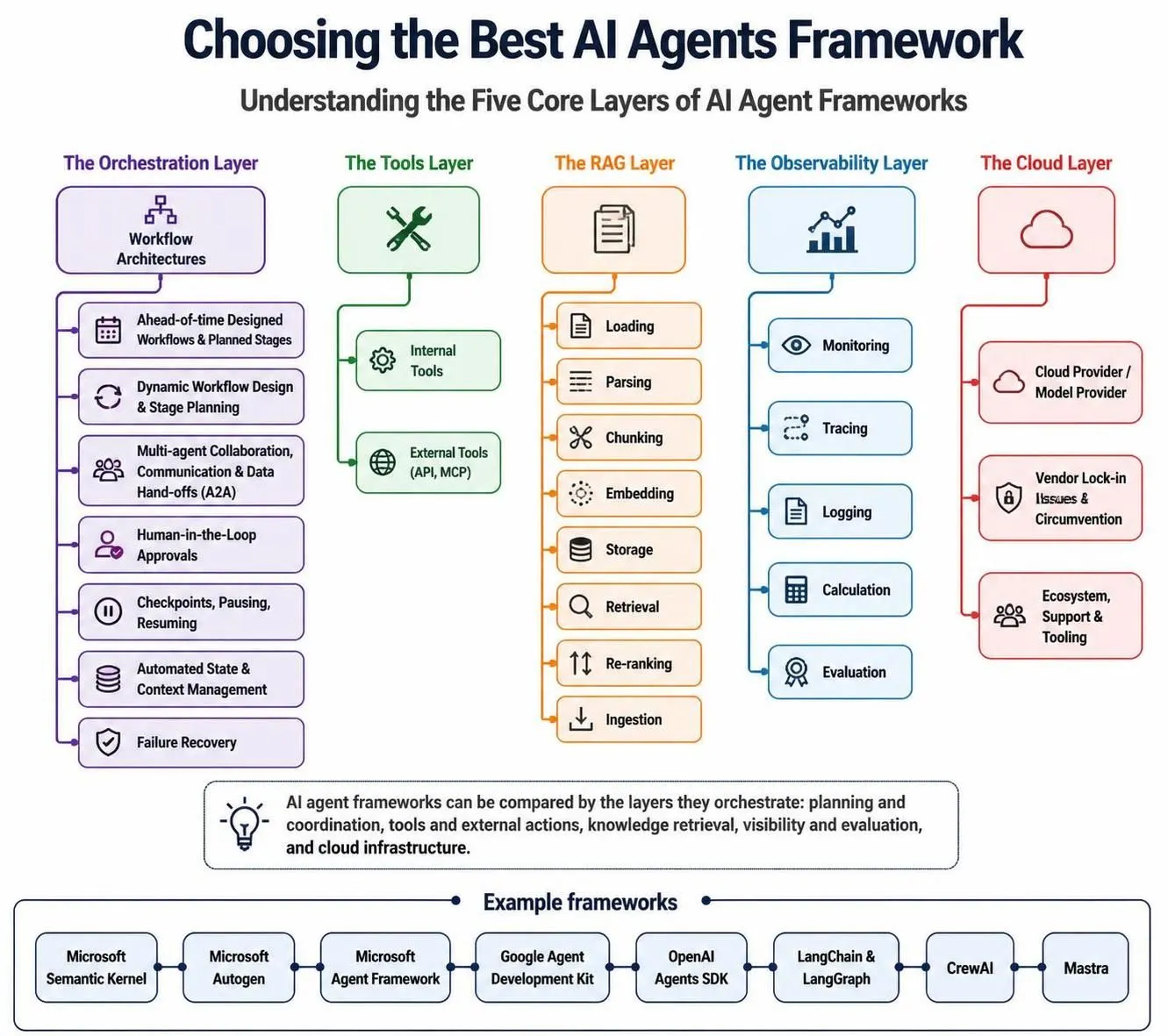
The Anatomy of an AI Agent

Your AI Agent Is Not Just an LLM: Think of It Like a Human Body 🧠⚡
Most people hear “AI Agent” and immediately think:
“It’s just an LLM with a prompt.
That mental model is becoming outdated.
An LLM can understand language, reason, write code, and generate answers. But by itself, it is surprisingly limited.
It is like having a very intelligent brain sitting in a room with no books, no access to the outside world, no learned procedures, and no hands.
The interesting part begins when we give that brain the rest of the body.
The image above provides a surprisingly useful way to understand the modern AI stack:
LLM → RAG → MCP → Skills → Agent
Think of them as:
🧠 Brain
📚 Library
🧬 Nervous system
💪 Muscle memory
🤖 Brain + Hands
Let’s break it down.
🧠 1. LLM = The Brain
At the center is the Large Language Model.
Think of models such as GPT, Claude, Gemini, Llama, Qwen, etc.
The LLM provides the intelligence needed to:
- Understand language
- Reason about problems
- Generate text
- Write code
- Analyze information
- Decide what to do next
But there is an important limitation:
An LLM only knows what is available to it.
Suppose you ask:
“What is the status of our production Kubernetes cluster?”
Your LLM doesn’t magically know.
It needs access to:
- Kubernetes
- Monitoring
- Logs
- Databases
- APIs
- Internal documentation
Without those connections, it can only make an educated response based on its existing knowledge.
That’s where the next layer comes in.
📚 2. RAG = The Brain + Library
RAG = Retrieval-Augmented Generation
Imagine giving the brain access to a massive library.
Instead of asking:
“What do you remember?”
you ask:
“Go find the relevant information first, then answer.”
For example, your company has:
company-docs/
├── HR/
├── DevOps/
├── Security/
├── SOPs/
├── Architecture/
└── Policies/
A user asks:
“What is our production deployment procedure?”
A RAG system can:
Question
   ↓
Search knowledge base
   ↓
Retrieve relevant documents
   ↓
Give context to LLM
   ↓
Generate answer
This changes the LLM from:
“I think this is the answer.”
to:
“Here is the answer based on your organization’s information.”
That’s a huge difference.
RAG gives AI access to knowledge.
But knowledge isn’t action.
And that’s where things get really interesting.
🧬 3. MCP = The Nervous System
This is one of the most interesting parts of the diagram.
MCP = Model Context Protocol
A useful mental model is:
MCP provides a standardized way for AI models to interact with external tools and data.
Think about the human nervous system.
Your brain doesn’t directly become a database, camera, keyboard, or hand.
Instead, the nervous system provides pathways between the brain and the rest of the body.
Similarly, an AI system may need access to:
         AI Agent
            │
           MCP
      ┌─────┼─────┐
      ↓     ↓     ↓
   GitHub  DB   Files
      ↓     ↓     ↓
   APIs   Cloud  Tools
The important idea is standardization.
Instead of building a completely different integration mechanism for every AI application, MCP provides a common protocol for exposing tools and context.
For example, an agent might have tools such as:
get_server_status()
query_database()
search_documents()
create_github_issue()
restart_service()
read_logs()
Now the AI isn’t just talking.
It has pathways into the environment around it.
💪 4. Skills = Muscle Memory
Now imagine you’ve taught the AI how to perform a specific task repeatedly.
For example:
“Deploy a Docker application safely.”
Instead of explaining the entire procedure every time, you can package the procedure as a reusable skill/workflow.
Something like:
Deployment Skill
1. Validate configuration
2. Pull latest image
3. Run health checks
4. Deploy container
5. Verify application
6. Check logs
7. Roll back if unhealthy
The agent doesn’t need to reinvent the procedure every time.
This is similar to muscle memory.
A skilled DevOps engineer doesn’t consciously rethink:
“What is SSH?”
every time they connect to a server.
They simply execute the familiar workflow.
Get Jahangir’s stories in your inbox
Join Medium for free to get updates from this writer.
Skills give AI that kind of reusable procedural knowledge.
RAG answers:
“What do I know?”
Skills answer:
“How do I usually do this?”
That’s an important distinction.
🤖 5. AI Agent = Brain + Hands
Now we arrive at the final layer.
An AI Agent combines reasoning with tools, knowledge and procedures to accomplish a goal.
Instead of:
User → Question → LLM → Answerwe can have:
User
  ↓
AI Agent
  ↓
Reason
  ↓
Retrieve information
  ↓
Choose a tool
  ↓
Execute action
  ↓
Observe result
  ↓
Reason again
  ↓
Complete task
For example, imagine telling an AI DevOps agent:
“Investigate why the production API is slow.”
A basic chatbot might give you a list of possible causes.
An agent could potentially:
1. Check monitoring
        ↓
2. Inspect CPU / memory
        ↓
3. Query application logs
        ↓
4. Check database performance
        ↓
5. Inspect recent deployments
        ↓
6. Identify suspicious change
        ↓
7. Recommend or execute remediation
        ↓
8. Verify recovery
That’s a completely different paradigm.
The AI isn’t merely answering a question.
It’s working toward an outcome.
🔥 The Real Magic Happens When They Work Together
The individual components are useful.
But the combination is where modern AI systems become powerful.
Think about this architecture:
                    ┌──────────────┐
                    │     User     │
                    └──────┬───────┘
                           ↓
                    ┌──────────────┐
                    │  AI Agent    │
                    │              │
                    │ Reason + Plan│
                    └──────┬───────┘
                           │
          ┌────────────────┼────────────────┐
          ↓                ↓                ↓
       🧠 LLM            📚 RAG            💪 Skills
          │                │                │
     Reasoning         Knowledge        Procedures
          │                │                │
          └────────────────┼────────────────┘
                           ↓
                      🧬 MCP
                           │
          ┌────────────────┼─────────────────┐
          ↓                ↓                 ↓
       GitHub           Database           Cloud
          ↓                ↓                 ↓
       Servers           APIs              Files
Now the architecture starts looking less like a chatbot…
and more like a digital worker.
🤯 Here’s the Important Distinction
A lot of AI discussions mix these concepts together.
But they’re solving different problems.
ComponentHuman analogyMain purposeLLM🧠 BrainReason and generateRAG📚 LibraryRetrieve knowledgeMCP🧬 Nervous systemConnect AI to tools/dataSkills💪 Muscle memoryReuse proceduresAgent🤖 Brain + handsPlan and execute
And this gives us a simple formula:
Intelligence + Knowledge + Connectivity + Procedures + Action = Agentic AI
🚀 Why This Matters for Developers
This also changes how we should think about building AI applications.
The old approach was often:
Build chatbot
      ↓
Add bigger model
      ↓
Add better prompt
The newer approach is increasingly:
Choose model
      ↓
Give it relevant knowledge
      ↓
Connect it to real systems
      ↓
Give it reusable skills
      ↓
Let it plan
      ↓
Let it act
      ↓
Observe and verify
And suddenly your application isn’t just an AI chatbot.
It’s an AI system.
⚠️ But There’s a Catch
Giving an AI hands also means giving it responsibility.
If an agent can:
read files
↓
access databases
↓
modify infrastructure
↓
deploy applications
↓
send emails
↓
delete resources
then mistakes can have real consequences.
So production agents need things like:
- Least-privilege access
- Authentication
- Authorization
- Tool restrictions
- Approval gates
- Audit logs
- Sandboxing
- Observability
- Rate limits
- Human oversight
- Rollback mechanisms
A brain with no hands can’t break your server.
A brain with root access potentially can.
That’s why agent engineering is also systems engineering and security engineering.
🧠 The Easiest Way to Remember It
Use this sequence:
Brain → Library → Nerves → Muscles → Hands
LLM → RAG → MCP → Skills → Agent
Or remember:
Think → Know → Connect → Practice → Act
That’s the architecture in five words.
🌐 The Bigger Picture
We’re moving from:
AI that answers
to:
AI that retrieves
to:
AI that uses tools
to:
AI that follows procedures
to:
AI that completes tasks.
And that final transition is the one that could fundamentally change how we build software.
The future isn’t necessarily:
“Everyone gets a chatbot.”
It may be:
“Every organization gets a layer of AI workers connected to its knowledge, tools, systems and workflows.”
And once you see the AI stack as a human body, the architecture suddenly becomes much easier to understand.
The LLM is the brain.
RAG gives it a library.
MCP gives it nerves.
Skills give it muscle memory.
And the agent gives it hands.
The interesting question is no longer:
“How smart is the model?”
It’s:
“What can we connect that intelligence to?”