OLD IS GOLD Episode 3: The Telephone (1876)


On March 10, 1876, in a cramped Boston laboratory, Alexander Graham Bell spilled battery acid on his trousers.
In a moment of panic, he spoke into a strange device sitting on his workbench.
“Mr. Watson, come here. I want to see you.”
Thomas Watson, in the next room, heard every word through a wire.
Bell had not planned history that afternoon. He had planned not to ruin his trousers.
But the voice came through. And nothing about human intimacy, human commerce, or human anxiety was ever the same again.
The year is 1876. Boston, Massachusetts.
Alexander Graham Bell files US Patent №174,465 on March 7, 1876, just hours before his rival Elisha Gray files a competing caveat for a nearly identical device.
The margin of history is sometimes measured in hours.
Bell wins the patent. Bell wins the future. And the world acquires something it had never possessed before: the ability to transmit not just information across a wire, but the human voice itself — with all its warmth, hesitation, urgency, and feeling.
The telegraph could tell you what happened.
The telephone could tell you how someone felt about it.
That distinction would change everything.

What it did to us psychologically:
Before the telephone, written communication dominated long-distance interaction.
Letters. Telegrams. Formal, considered, and edited before sending.
When you wrote to someone, you had time to construct yourself. To choose your words. To present the version of yourself you wish to be seen as.
The telephone took that away entirely.
For the first time, a stranger’s voice came out of a wall. Unedited. Unpolished. Raw.
Psychologist Albert Mehrabian’s foundational research on communication established that vocal tone carries roughly 38 percent of emotional meaning in any human interaction — far more than the words themselves. The telephone didn’t just transmit speech. It transmitted mood, hesitation, warmth, irritation, and love in ways the written word had never been able to replicate across distance.
This created an entirely new form of intimacy.
Historian Claude Fischer, in his definitive social history America Calling, documents how early telephone users were genuinely unsettled by the experience of hearing a familiar voice with no body attached to it. People reported the sensation as uncanny. Some refused to use the telephone at all, insisting that a disembodied voice felt somehow wrong — almost supernatural.
We adapted, of course. We always do.
But in adapting, we also developed something new: telephone anxiety. The dread of an unannounced ring. The pressure of real-time conversation with no time to think, no ability to revise.
This is not a modern phenomenon born of social media.
It is a telephone invention. And it never left.
The telephone also permanently altered how we experience absence. Before it, distance meant silence. After it, distance became a choice. If you had access to a telephone and did not call, the silence became loaded with meaning. Emotional expectation attached itself to a piece of technology for the first time in history.
We would later call this always available. We would learn, much later, that always available and always well are not the same thing.
What it did financially:
Bell formed the Bell Telephone Company in 1877, just one year after his patent.
By 1886, over 150,000 telephones were in use across the United States. By 1900, that number had grown to nearly 600,000. By the time AT&T — the company that grew from Bell’s original patent — was broken up by the U.S. Department of Justice in 1984, it had become the largest private corporation in the history of the world, with assets exceeding $150 billion.
Get Anurag Sharma’s stories in your inbox
Join Medium for free to get updates from this writer.
The telephone did not just create a company. It created an entirely new category of infrastructure.
Tim Wu, in his landmark book The Master Switch, argues that the Bell System was the first great example of what he calls the “Cycle” — the pattern in which a disruptive communications technology begins as an open, democratizing force, gradually consolidates into a monopoly, and ultimately requires government intervention to break apart.
Every major technology company you can name today is living somewhere inside that same cycle.
The telephone also transformed the economics of business negotiation. Deals that once required weeks of written correspondence and in-person travel could now be closed in minutes across hundreds of miles. The velocity of commerce accelerated in ways that compounded across every industry simultaneously.
There is also the story of women.
Emma Nutt became the world’s first female telephone operator in Boston in 1878. Within a decade, telephone operating had become one of the few professional roles openly available to women, considered suitable because of the perceived patience and vocal pleasantness the job required.
It was a patronizing door. But it was a door.
Women entered professional life through the telephone exchange in numbers that had been impossible in almost every other industry. The long arc toward workplace equality bent, slightly but measurably, because someone needed a calm voice on the other end of a wire.
What it did to society:
The telephone did something to social architecture that we have never fully appreciated.
It made the home a place of business.
Before it, professional and domestic life were separated by geography. You went somewhere to work. You came home to stop working. The threshold of your front door was a genuine boundary between two worlds.
The telephone crossed that threshold without asking permission.
For the first time, your employer, your clients, and your business partners could reach you at home. The boundary did not disappear immediately, but it began to erode in 1876, and it has been eroding ever since.
The remote work debate, the right-to-disconnect legislation, and the anxiety of the work notification arriving at 11 PM — all of it traces its origin to the moment Bell’s device began ringing in people’s parlors.
The telephone also transformed courtship. Before it, romantic communication at a distance required letters — formal, slow, and subject to parental interception. The telephone allowed young people to speak privately, in real time, with a degree of emotional directness that letters had never permitted.
Sociologists have argued that the telephone quietly accelerated the shift from arranged and supervised courtship toward individual romantic choice. Love became a faster, more autonomous, more voice-driven affair.
And it became, for the first time, something you could conduct in secret.
Why this matters for where we are now:
Every anxiety we attach to modern communication technology was rehearsed first on the telephone.
The pressure of real-time response. The intrusion of work into personal space. The emotional weight of a call that does not come. The discomfort of a voice without a body. The expectation that being reachable means being available.
None of this started with the smartphone. None of it started with email.
It started with a man in Boston who spilled acid on himself and changed the world by accident.
What the telephone truly invented — more than any technology, more than any market — was the expectation of immediacy.
The expectation that the people in your life should be reachable. That silence is a statement. That distance is no longer an excuse.
We have been living inside that expectation ever since. Every communication platform built after 1876 has simply found new ways to intensify it.
The telephone did not give us a connection.
It gave us the permanent, low-level anxiety of almost-connection.
And we called it progress.
OLD IS GOLD is a series tracing the innovations that quietly built the AI era, and what each one did to us: psychologically, financially, and socially.
Because the most important story about any technology is never the machine.
It is always the person on the other end of the line.
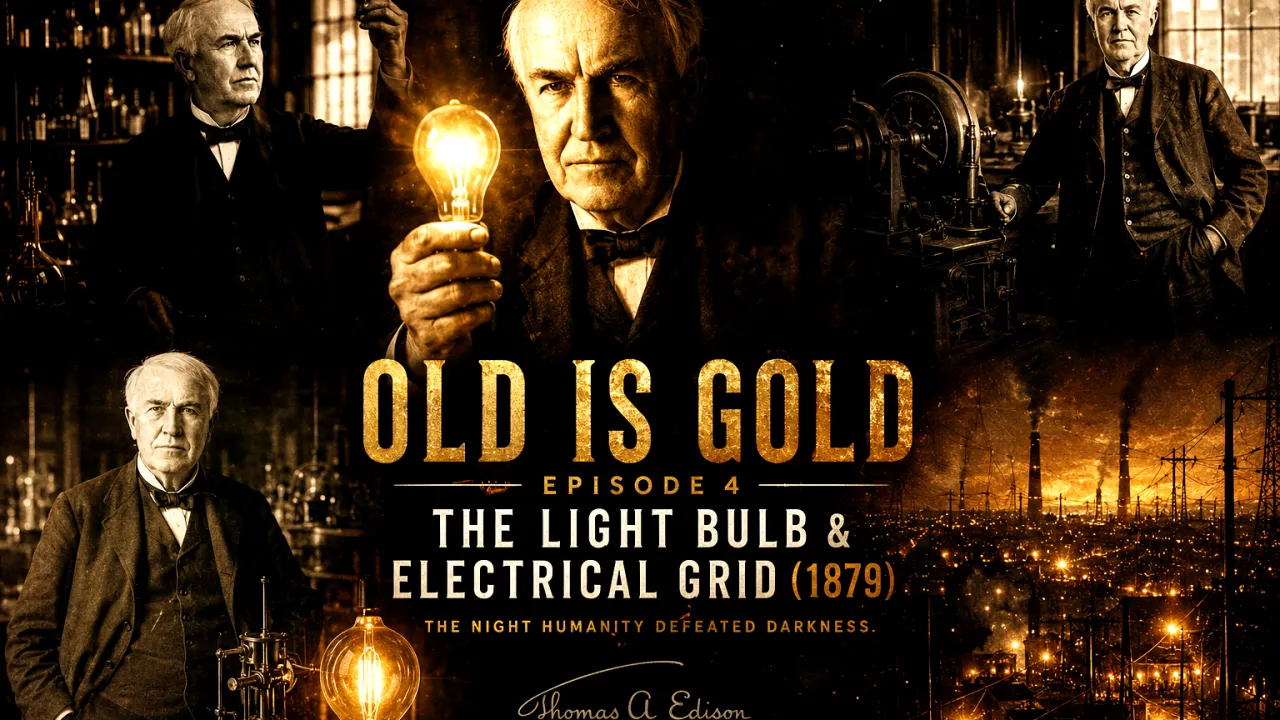
Episode 4: The Light Bulb and the Electrical Grid (1879). The night Edison stole from us. And the 24-hour economy he built in its place.
Follow along if you believe that understanding the past is the only honest way to navigate the future.