Before the Sirens

Richard Fiene, scarce inspection time, and a fictional town learning to account for its readiness.
Dr. Richard Fiene asks a question every community should take seriously: when monitoring resources are limited, where should we look?
His work on regulatory compliance distinguishes rules selected for their risk significance from indicators that help predict wider compliance. In his comparison of sequential and parallel monitoring models, he also calls for comparative evaluation. The useful lesson is to test the arrangement, including what it misses.
That question follows an inspector out of the office. It reaches a receiving dock, a laboratory, a rail crossing and the desk that must decide whether the community has received a warning.
We built a small place to examine those handoffs. Welcome back to Riverton.

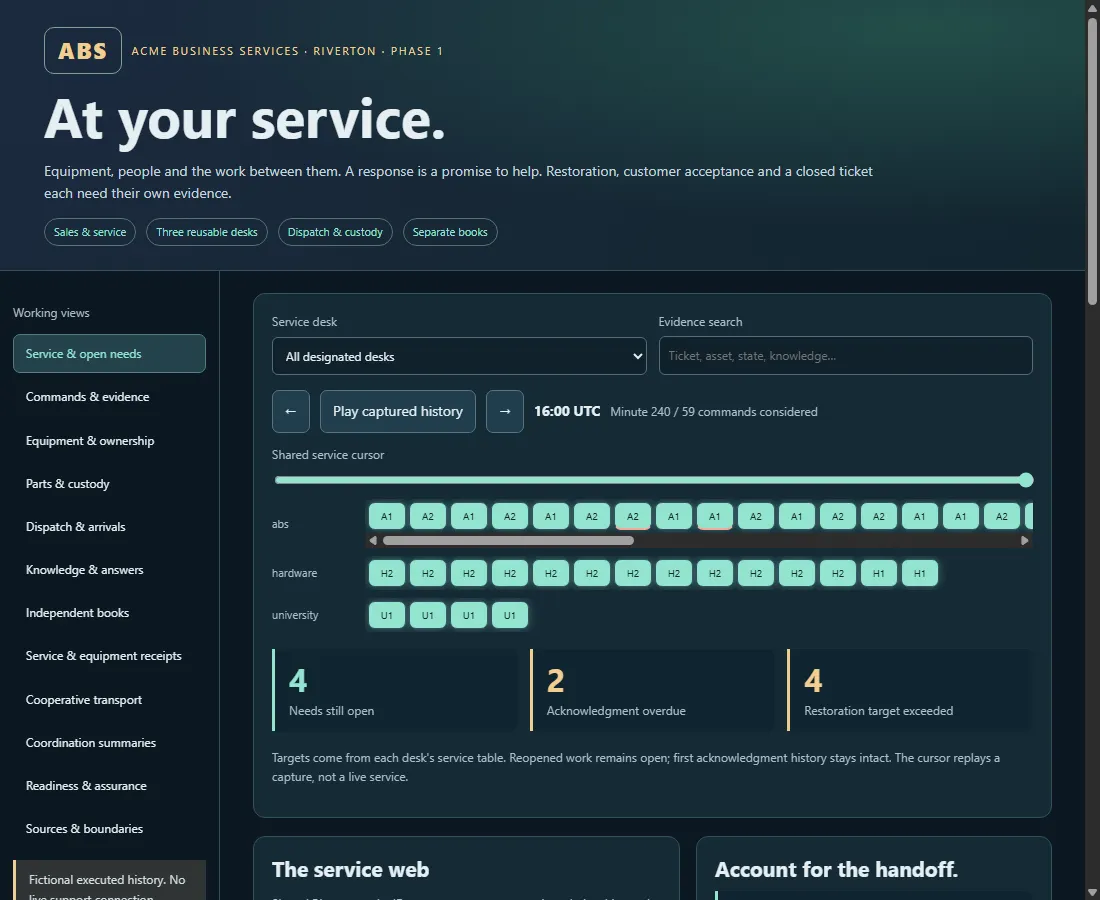
An actual capture of our Phase 1 application. Open the image to try it. Every organization, incident and population count in the demonstration is fictional.
Riverton now has an ACME Environmental Protection Agency, an ACME Compliance Consultant, a laboratory, a planning committee and three industrial neighbors. ACME Beep Beep Rail supplies the cartoon name. The receipts do the serious work.
Our ACME EPA is entirely fictional. There is no government affiliation, real inspection authority or chemical measurement hidden behind the attractive screen. What runs is an accountable tabletop: finite instructions, recorded outcomes and views generated from their capture.
The town can rehearse three situations separately: a rail incident, an industrial fire report and a suspected chemical release. We do not have to run every possible emergency in the same tree at the same instant to learn something useful.
Each rehearsal asks who knows what, which record supports it, who may act, and what still needs a reply.
Attention has a ledger
Our invented inspection policy contains nine checks. Three are mandatory within the exercise and require 50 minutes. The full list requires 110.
Try the budget selector. At 40 minutes, the application reserves 35 minutes and leaves one mandatory 15-minute check unfunded. Five minutes remain available, but ten more are needed to cover the full mandatory workload. That difference stays visible.
Nothing becomes optional because the inspector’s calendar is full.

At 75 minutes, five of nine checks are selected. The comparison exposes two findings the limited plan misses.
The 75-minute plan looks respectable. All mandatory checks fit. The remaining time goes to higher-priority entries in our authored queue.
It also misses both findings in the fictional full-review reference.
That is an important result to display. A polished priority list can be incomplete in exactly the place that matters. We have implemented a deliberately simple selection policy and a counterexample, not demonstrated a safe shortcut or validated Fiene’s methods across the chemical industry.
Selecting all nine checks does not repair every information gap either. Two reference observations remain unknown. Coverage, conformity and safety are separate questions.
My earlier Inspector’s Virtual Array explored the relationship between selected observations and wider predictive reconstruction. This increment builds the accountable records beneath that future analysis. An observed result, a predicted result and their disagreement need distinct identities. Otherwise the prediction can quietly become its own evidence.
The boundaries are where the work collects
A consultant helps the facility prepare. A laboratory handles a sample. A regulator reviews evidence. A planning committee coordinates. An incident commander acts within an assigned authority.
Those relationships belong on a graph. They do not belong in one undifferentiated permission bucket.
Our consultant attempts to file a facility notice. The attempt is refused because that role has no such grant in the exercise. The refusal remains in the journal. Nobody disappears the unsuccessful instruction to make the report cleaner.
This separation has a real counterpart. EPA’s EPCRA planning guidance describes facility responsibilities alongside local and Tribal planning committees and state and Tribal commissions. Those participants have related work and distinct responsibilities.
The demonstration does not encode those legal requirements. In particular, real transportation-release notification has a different route from the fictional shared two-recipient pattern used here. EPA explains that distinction. A future interface must preserve the applicable recipients, timing and fallback; sending an attractive report is insufficient.
A report is moving. Has anybody received it?
The initial report enters our exercise at minute one. Laboratory work begins later. A possible incident does not wait for a specimen to complete its journey before the notification workflow can begin.
The local and state recipients then keep separate acknowledgment records. Their delays are deliberate exercise inputs, not acceptable real reporting delays.

At minute 25, the chemical exercise has accounted for 150 people at reception. Its state receipt is still pending.
Get Don Gunter’s stories in your inbox
Join Medium for free to get updates from this writer.
This is the kind of small distinction that becomes very large when people are tired, radios are busy and another department uses a different word for the same stage of work.
Queued is a condition. Received is another. Acknowledged information does not automatically mean a resource has been dispatched or a hazard controlled.
In our chemical rehearsal the state receipt arrives at minute 42. The accounting closure follows at 43. The dashboard retains the gap instead of awarding itself a successful handoff at the moment it pressed Send.
Keep the person in transit
The three alternative rehearsals account for cohorts of 120, 90 and 150 people. These are independent scenarios, not populations to add together.
For every recorded frame:
People at origin + people in transit + people received = the scenario cohort.
A departure needs the exercise command’s grant, available origin quantity, a reception-capacity reservation and a current, uncontradicted road claim. Reception requires a matching movement quantity.
An early departure fails. Another fails against stale road evidence. A third fails while two current road reports conflict. An attempted receiving record with the wrong quantity fails as well.
Each refusal leaves the scenario state unchanged and leaves an entry explaining why.
The arithmetic is modest. The discipline is the point. People should not vanish between the dispatch screen and the reception desk.
These are anonymous exercise counts over authored availability and capacity. We have not calculated a safe evacuation route, modeled a chemical plume or established which protective action would be appropriate in a real incident. Qualified planning and response remain essential.
A reviewed sample can still be inconclusive
The specimen workflow records collection, receiving, analysis and review. An attempted review before analysis is refused.
The chemical sample eventually reaches the reviewed state. Its result still says inconclusive.

Workflow completion does not manufacture a scientific answer. The expanded row retains the method placeholder, collector and event references.
No concentration has been measured in this fixture. No molecular signature, exposure limit or environmental all-clear is inferred. That distinction protects the usefulness of the record.
OSHA’s HAZWOPER standard addresses emergency-response arrangements and role-specific training. A title in a table cannot substitute for the competence required to do the work. The model gives us a place to retain those references when a properly scoped implementation arrives.
Some sounds stay with you
I remember the sound of the Livingston derailment as a boy. I remember leaves falling. The official NTSB record identifies the event as September 28, 1982, and its abstract records an evacuation that lasted as long as two weeks.
I also remember standing outside with my stepbrother Jim when a distant boom and rising cloud interrupted an ordinary day. A contemporary UPI report dates the Baton Rouge Exxon explosion to Christmas Eve, 1989. My memory supplies the experience; the dated report supplies a historical anchor.
The third Riverton exercise is wholly invented. We have not attached an uncertain chemical-release memory to a real company or represented these programs as reconstructions of those disasters.
What connects the memories to the work is respect for the people who must respond: plant operators, rail crews, dispatchers, firefighters, HAZMAT teams, laboratory staff, medical services, planners and the people opening a reception center while somebody else is still making the next call.
Their coordination deserves rehearsal before the noise begins.
The rehearsal owes us its unfinished work
FEMA’s HSEEP approach links exercise objectives, evaluation and improvement planning. Our small implementation retains an open improvement action for each scenario: recipient fallback, renewal of route evidence, and resolution of conflicting reports and laboratory handoffs.
They remain open after exercise closure. Closing a sequence of transactions does not mean the organization has learned every lesson.
The same source tables generate the browser application, downloadable HTML reports and native Workstation report and graph views. The external generator executes the three programs; native and browser views inspect the captured evidence. We have added no new continuous-mathematics or learning engine to make this increment work.
Twenty-three new unit tests pass, along with the retained service-desk and publication-catalog regressions. Browser checks exercise the real controls at desktop and narrow widths. Existing C++ consumers admit all ten reports, and the native host opens eleven panes. Those are bounded engineering results. They do not certify operational readiness or validate an inspection predictor.
What we can offer for review today is concrete: three reproducible rehearsals, separate responsibilities, visible gaps, conserved counts and reports that let somebody ask the next question.
Open Riverton’s regulatory rehearsal.
Try to close it before the receipt arrives.
The clerk has left that door shut for a reason.